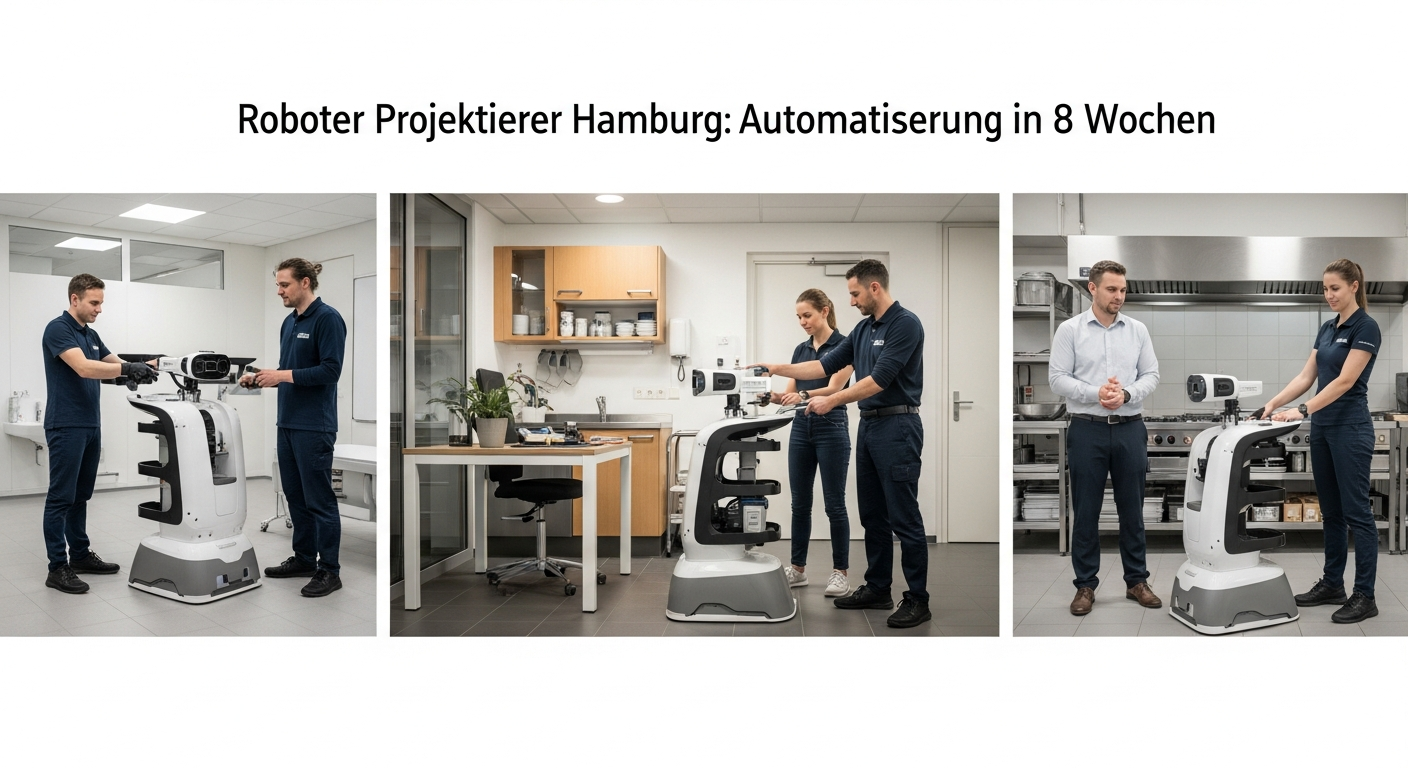
Robot project planner Hamburg: Automation in 8 weeks
It often takes months from the first workflow draft to productive use. werob, as a specialized robot project developer in Hamburg, shortens this path to eight weeks using a hardware-agnostic platform.
Hamburg, Jungfrauenthal. 9:00 a.m. A logistics manager checks the night shift logs. The manual yard patrol was incomplete due to a lack of personnel, and security gaps remained undetected. This is where the work of a modern project designer comes in. It's not about just buying a machine, but about solving a capacity problem through automation. werob translates this operational need into a precise robot specification. While traditional consulting firms are still creating discovery decks, werob is already matching against 280 available robot models. As a robot project developer in Hamburg, werob offers the direct path from the problem to the productive fleet.
Key Takeaways
- 1As a hardware-agnostic project developer, werob delivers a ready-to-use specification in 48 hours and the finished robot in 8 weeks.
- 2Integration takes place via prefabricated connectors in systems such as SAP EWM, Opera PMS or PointClickCare without lengthy IT projects.
- 3The outcome-only model guarantees that costs are only incurred when the robot fleet is running productively and brings measurable relief.
Why a robot project designer in Hamburg makes the difference
Automation in Germany often fails not because of the available hardware, but because of the complexity of the integration. Today, a robot project designer in Hamburg has to do more than just sell a device. werob acts as a hardware-agnostic system integrator that builds the bridge between the manufacturers (OEMs) and the operators. While a manufacturer naturally prioritizes his own hardware, as a project developer he evaluates the actual needs of the location. This independence is particularly crucial in industries such as nursing or the hotel industry, where the environmental variables are highly dynamic.
A significant advantage of working with a specialized project developer is risk minimization. werob is not a robot manufacturer and not a single OEM reseller. This means that the selection of hardware is based solely on the technical suitability for the specific workflow. With over 200 robots in live operation and a presence in 11 European countries, werob has the necessary experience not only to plan projects but also to secure them operationally. Based in Hamburg, werob combines local expertise with a global network of 44+ OEM partners.
The focus is always on the result. A project engineer takes responsibility for the entire chain: from the first Spec Engine analysis through the supplier match to integration into the existing software stack. For companies in Hamburg, this means that they do not risk vendor lock-in. If a hardware component proves to be inadequate, werob's platform architecture allows a quick change without having to rebuild the entire infrastructure. This flexibility forms the core of modern robotics project planning.
The Spec Engine: From workflow to technical requirements
The traditional way of project planning often takes three to six months. During this time, discovery workshops are held and extensive documents are created, which are often out of date by the time they are completed. werob breaks down this process. The Spec Engine takes just 48 hours to generate a usable robot specification from an operator's words. This process has been trained on over 35,000 projects and eliminates the typical sources of error in manual planning.
For example, an operations manager in a Hamburg nursing home describes the medication round or the transport of laundry. The Spec Engine translates this description into technical parameters: load capacity, battery life, navigation type and necessary interfaces. The result is a precise action graph that forms the basis for the subsequent supplier match. This speed is a decisive competitive advantage for companies that suffer from an acute shortage of skilled workers and need immediate relief.
Standardizing the specification phase ensures that all regulatory requirements are taken into account from the start. The planning includes not only technical feasibility, but also compliance with applicable standards such as ISO 13482 for service robots. A robot project engineer in Hamburg who works in this way massively reduces planning costs and at the same time increases the success rate of deployment. The Spec Engine is therefore the heart of the werob platform and the first step towards a productive fleet.
Hardware agnostics as investment protection
The robotics market is extremely volatile. New manufacturers enter the market every month, while established players constantly adapt their portfolios. It is almost impossible for an operator in Hamburg to keep track of the best solutions from Boston Dynamics, Keenon, Pudu or Apptronik. Here werob, as the project developer, takes on the filter function. The ranking of over 44 OEM partners and 280 different robot models ensures that the technologically leading and economically most sensible solution is always chosen.
Hardware agnostics means, above all, investment protection for you as a customer. If you choose a specific cleaning robot or transport robot today, you don't want to be tied to the software of this one manufacturer. werob decouples the hardware from the control level. The werob Cockpit enables the management of a mixed fleet from different manufacturers via a single interface. This approach is particularly relevant for large FM service providers or hotel chains that have different requirements in different locations.
In addition, this approach enables access to specialized hardware that is optimized for niche applications. Whether it's humanoid robots for complex tasks or specialized logistics robots for outdoor use, werob checks suitability against the specification. A robot designer in Hamburg who is not tied to a manufacturer can provide objective advice and guarantee the best performance. This approach has resulted in werob having successfully brought 200 robots into live operation by May 2026.
Software connectors: Integration with SAP, Mews and Toast
A robot operating in isolation offers only a fraction of its potential value. True efficiency comes from integration into the company's existing IT landscape. werob delivers prefabricated connectors for the most common systems in the target industries. In logistics, for example, this is the connection to SAP EWM, in the hotel industry to Opera PMS or Mews, and in the catering industry to systems such as Toast or Lightspeed. These integrations are not individual programming services, but rather standardized components of the werob platform.
For a robot project developer in Hamburg, interface competence is crucial. If a hotel room service robot is automatically summoned via the PMS as soon as an order is received, the manual coordination effort for staff is eliminated. In care, the connection to PointClickCare or MatrixCare enables complete documentation of transport routes and delivery times. The networking not only increases the efficiency, but also the transparency and security of the processes.
Werob's connectors ensure that the data flows without the operator having to tie up its own IT resources for the development of interfaces. Standardization significantly shortens the time to productive use. While conventional integrators often need months to connect to an ERP system, werob uses proven protocols and ready-made modules. This speed is an essential part of the promise of having a robot in productive use within eight weeks.
EU Machinery Regulation 2023/1230: The compliance path
An often underestimated aspect when introducing robotics is regulatory compliance. From January 20, 2027, the new EU Machinery Regulation 2023/1230 will be binding. This places significantly higher demands on the safety and conformity assessment of machines, especially if they are equipped with AI components or work in close proximity to people. As a project developer, werob offers a built-in compliance path that ensures that all systems used meet these strict requirements.
Complying with European standards is often a challenge, especially for Asian OEMs. werob acts as a local partner who carries out the necessary certifications and security assessments. The compliance check also includes specific German requirements such as home supervision in care or the guarding regulations (BewachVO) in the security area. Without this legal protection, operators risk high fines or the decommissioning of their fleets by the regulatory authorities.
As a robot project developer in Hamburg, werob assumes responsibility for regulatory monitoring in live operation. The werob Cockpit has a four-dimensional traffic light system that, in addition to the hardware and infrastructure, also permanently monitors the status of the regulations. This means you will be informed at an early stage if software updates or changes in legislation require your processes to be adjusted. In a time of increasing regulation, this compliance service is an indispensable part of system integration.
Economic efficiency: 92,000 euros relief in care
In the end, every robotics project has to be economically viable. werob focuses on measurable results rather than vague promises. In the nursing care industry, for example, the automation of the medication round leads to significant annual cost reductions per location. This number is based on real data from operations at large nursing home operators. Transporting laundry or meals noticeably reduces the burden on the budget.
The savings are also significant in other industries. In the hotel industry, automated room service brings significant annual relief, while bar and breakfast preparation also provides noticeable savings. In logistics, automated yard patrol saves significant costs per year. These figures make it clear that robotics is no longer an experiment, but a necessary tool for reducing costs and increasing efficiency in times of rising labor costs.
Werob's commercial model is consistently geared towards success. As an outcome-only provider, you only pay when the robot actually runs and takes on the defined tasks. There are no hidden list prices or high upfront investments for consulting services. A robot project developer in Hamburg who is convinced of his solutions takes this risk together with the customer. This transparency creates trust and ensures that only projects that offer real added value are implemented.
The werob cockpit: fleet management in real time
As soon as the robots are in use, the operational management phase begins. A fleet of 5, 10 or 50 robots requires centralized monitoring to minimize downtime and improve performance. The werob cockpit is the central control point for all active systems. It provides a real-time overview of the status of each individual robot, regardless of manufacturer. The four-dimensional traffic light system immediately visualizes where action is needed.
The four dimensions include the hardware (battery level, sensors), the infrastructure (Wi-Fi coverage, charging stations), the regulations (certificates, compliance status) and the spec (does the robot fulfill its tasks according to the action graph). This granular monitoring makes it possible to resolve issues before they disrupt operations. For example, if a robot in a Hamburg hotel cannot perform its task due to a blocked lane, this is immediately reported in the cockpit and can be resolved remotely or on site.
In addition, the cockpit provides valuable data for continuous process improvement. You can see exactly which routes are the most efficient and where there are delays. This transparency is the basis for scaling the fleet. A robot project engineer in Hamburg offers you not only the hardware, but the entire operating system for your automation. With the goal of managing over 2,000 robots by 2028, the cockpit is designed for maximum scalability and reliability.
The process at the robot project developer in Hamburg
At werob, the path to your own robot fleet is divided into a clear, eight-step process. It all starts with the intake, where you describe your requirements in your own words. The Spec Engine delivers the finished specification within 48 hours. After another five days you will receive a concrete offer based on the supplier match. If you decide to implement it, werob guarantees that the robot will be ready for use at your location in Hamburg or any other location in Europe within eight weeks.
This process is designed to maximally reduce complexity for the customer. You don't have to be an expert in robotics to benefit from the technology. werob takes care of selecting the hardware, configuring the software connectors and ensuring regulatory compliance. Training your staff on site is also part of the scope of services. A robot project engineer in Hamburg accompanies you from the initial idea to daily live operation.
The phase of integration into the operator stack is particularly important. This is where the strength of the werob platform becomes apparent. Using prefabricated connectors eliminates the need for lengthy IT projects. The connection to your existing system takes place parallel to the procurement of the hardware. This ensures that everything is ready for the first use on the day of delivery. This structured approach is the reason why werob already operates successfully in 11 European countries.
Outcome-only: Why you only pay when you are successful
The traditional model of asset procurement involves high risks. You buy an expensive machine and hope that it will perform as promised. werob turns this model around. As an outcome-only system integrator, the focus is on the success of the customer. In concrete terms, this means: You pay nothing until the robot is running productively in your company and fulfilling the specified tasks. This model eliminates the investment risk and ensures that werob as a project developer pursues the same goal as you.
This commercial model is only possible because werob has a highly standardized platform. The Spec Engine and Supplier Match reduce the error rate in the planning phase to a minimum. The connectors and the cockpit ensure stable operation. A robot designer in Hamburg who works in this way becomes a real partner for operational excellence. It's not about selling hardware hours, but rather about providing results.
For companies in Hamburg, this means enormous planning security. You can start automation projects without burdening your budget with high upfront costs. Billing is based on the service provided or the relief achieved. This approach is the most modern way to integrate robotics into companies and effectively address the shortage of skilled workers. werob is ready to take this path with you and lead your operational processes into the future.
FAQ
- What exactly does a robot project engineer do in Hamburg?
- A project engineer like werob analyzes your operational processes, creates a technical specification, selects the appropriate hardware from over 44 manufacturers and integrates it into your existing software landscape.
- How quickly can a robot be used in my company?
- At werob, it usually only takes eight weeks from the first specification to live operation. The specification itself is available after just 48 hours.
- Which industries benefit most from project planning?
- We achieve particularly high savings in care (significant six-figure amounts), the hotel industry (high savings) and in logistics through automated patrols and transports.
- Is werob tied to specific robot manufacturers?
- No, werob is hardware agnostic. We objectively rank over 44 OEM partners such as Boston Dynamics, Keenon or Apptronik against your specific requirements.
- How is compliance with the new EU machinery regulation ensured?
- werob offers an integrated compliance path for the EU Machinery Regulation 2023/1230, which is binding from January 2027, and carries out the necessary conformity assessments.
- What does the outcome-only model mean for me?
- It means you bear no financial risk. You only pay for the solution once the robot has been successfully integrated into your business and is running.
Related reading
Robot Integrator Hamburg: System integration in eight weeks
werob is the leading system integrator for robotics in Europe, based in Hamburg. We translate complex workflows into precise specifications in 48 hours and bring robots into live operation within eight weeks.
30 June 2026Robot pilot project gastronomyRobot pilot project for catering: Going live in 8 weeks
A robot pilot project in the catering industry often fails because the planning phase is too long. werob translates workflows into a specification in 48 hours and brings robots into live operation in eight weeks.
1 July 2026automation consulting robotics roofAutomation Consulting Robotics DACH: Efficiency in eight weeks
Forget classic consulting approaches with analysis cycles lasting months. werob translates your operational requirements into a precise specification in 48 hours and brings your robot fleet into live operation within eight weeks.
21 June 2026cfo automation business caseCFO Automation Business Case: Robotics ROI in eight weeks
A CFO-friendly business case for robotics often fails due to unclear integration costs and long pilot phases. werob solves this through a hardware-agnostic platform and a purely results-oriented billing model.
22 June 2026cooking automation fry station qsrRobots at the hot station: what cooking automation in QSR delivers today
How robotic fry stations address turnover and worker safety at the QSR hot line, why they stay narrow and task-specific, and where the honest limits are.
24 July 2026