Robot pilot project for catering: Going live in 8 weeks
A robot pilot project in the catering industry often fails because the planning phase is too long. werob translates workflows into a specification in 48 hours and brings robots into live operation in eight weeks.
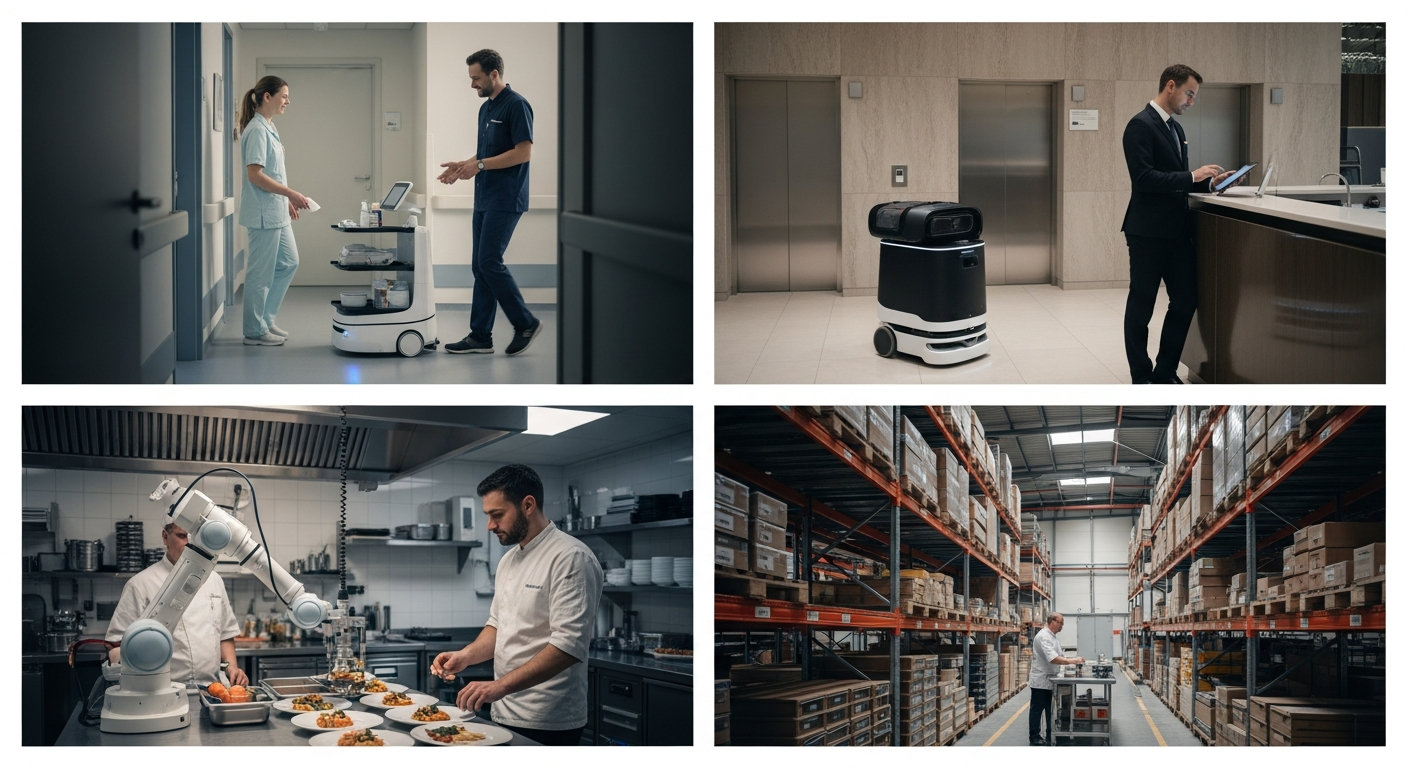
Kitchen. 7:30 p.m. Rush hour is at its peak. While the service staff commutes between the pass and the guest room, the tray bot takes over the routes to the washing chamber. The success of a pilot project is determined in this operational reality. It's not about technology demos, but about relieving the team's workload and measurable cost savings. A robot pilot project in the catering industry today has to deliver results within a few weeks instead of being bogged down in months-long consultation cycles. werob acts as a system integrator, bridging the gap between 44+ manufacturers and everyday operations.
Key Takeaways
- 1From the workflow description to the finished robot specification in 48 hours using the Spec Engine
- 2Hardware-agnostic approach with access to 44+ OEM partners prevents vendor lock-in
- 3Validated cost reduction of up to 76,000 euros per year through tray bots in the washing chamber
The 48-hour specification for the catering industry
The biggest bottleneck in the introduction of robotics in the catering industry is the definition phase. Traditional consulting approaches often require three to six months to analyze workflows and translate them into technical requirements. werob breaks this cycle with the Spec Engine. Within 48 hours, your specific workflow, from shift planning to route analysis, will be converted into a ready-to-use robot specification.
This speed is based on data from over 35,000 projects. The Spec Engine understands the needs of a food service business, be it a QSR chain or a full-service restaurant. Instead of discussing abstract technology concepts, the process focuses on operational reality. The result is a precise graph of robot actions, which immediately serves as a basis for hardware selection. For the operator, this means minimal time expenditure with maximum precision in the objective.
Hardware agnostics: 44 manufacturers in comparison
A pilot project should never be dependent on hardware from a single manufacturer. The market for service robots is fragmented and evolving quickly. werob acts hardware-agnostic and compares over 44 OEM partners, including market leaders such as Keenon, Pudu or Bear Robotics. In total, there are over 280 different robot models available that are tested against your specific requirements.
This supplier match ensures that not the most well-known robot is chosen, but the one that provides the best performance for your floor structure, door systems and team requirements. With this approach, operators avoid vendor lock-in. If a manufacturer does not meet the requirements in long-term operation or a more powerful model comes onto the market, werob's platform enables a seamless change because the operational logic is anchored in the software level and not in the hardware.
Seamless integration with Toast and Lightspeed
A robot that works in isolation from the rest of the IT infrastructure creates additional effort instead of relief. In the catering industry, the connection to the point-of-sale system (POS) is crucial. werob supplies pre-built connectors for leading systems such as Toast and Lightspeed. This integration allows the robot to respond directly to orders or head to tables as soon as an order is completed in the system.
The connectors significantly reduce the complexity of the implementation. Instead of having individual interfaces programmed, operators rely on proven standards. This shortens the time to first productive use to five days for the offering and eight weeks to go live. The robots become part of the restaurant's digital ecosystem, which increases acceptance among staff as there is no need for double entries or manual controls.
Economic efficiency and 76,000 euros in cost relief
The decision for a pilot project in the catering industry must be based on hard numbers. werob provides validated data from the live operation of over 200 robots in eleven European countries. A central area of application is the tray bot for the dishwashing chamber. This takes over the monotonous and physically stressful walking routes between the guest room and the cleaning. The verified cost relief per location and year amounts to 76,000 euros.
Another scenario is automated kitchen floor cleaning. Here the annual relief is 44,000 euros. These sums consist of the reduction of overtime, the reduction of fluctuation by making work easier and the optimization of staff presence at the guest. In an environment with an acute shortage of skilled workers, robotics is not a replacement for humans, but a tool to free existing staff from unproductive tasks and significantly reduce operating costs.
Compliance and the EU Machinery Regulation 2023/1230
An often underestimated aspect of pilot projects is regulatory security. From January 20, 2027, the new EU Machinery Regulation 2023/1230 will be binding. Many Asian manufacturers currently do not have the necessary conformity assessments for the European market. werob acts as a compliance path here and ensures that all systems used meet the strict European security standards.
This includes not only the hardware, but also cybersecurity according to IEC 62443 and data protection according to GDPR, especially for robots with camera sensors. A pilot project with werob offers the security that the investment can be operated in a legally secure manner even beyond 2027. The integrated cockpit continuously monitors the regulatory status of the fleet and proactively warns of deviations, minimizing the liability risk for management.
The path to live operation in eight weeks
Speed is a core promise of werob. The process from the first contact to the robot on the surface is standardized. After the 48-hour specification phase, a binding offer will follow within five days. The entire implementation, including hardware procurement, connector configuration and staff training, will be completed in eight weeks. This timeline is exceptionally short compared to the industry standard of six to twelve months.
This is made possible by prefabrication at the platform level. Since werob does not operate a classic project business with individual programming, but is based on a scalable architecture, lengthy development cycles are eliminated. The pilot project serves to validate the theoretical savings in practice and to create the basis for a rapid rollout to other locations. The goal for 2028 is to operate 2,000 robots, highlighting the scalability of the model.
Fleet management via the live cockpit
As soon as the robots are in use, the werob Cockpit takes over the monitoring. It is a four-dimensional traffic light system that displays the status of hardware, infrastructure, regulatory and specification compliance in real time. For the Director of Operations, this means full transparency across all locations without having to be physically there.
The cockpit provides data on utilization, kilometers traveled and the number of tasks completed. These metrics are critical to objectively assess the success of the pilot. If a robot has a malfunction, it is reported immediately, often before on-site staff notices it. This proactive control ensures the high availability of the systems, which is essential in the catering industry due to the tight timing.
Outcome-only: payment based on success
Werob's commercial model differs fundamentally from classic purchase or leasing models. It is an outcome-only model. This means that operators do not have to make large upfront investments. Payments are only due when the robot is running in live operation as specified and fulfills the defined tasks. This model shifts the risk from operator to integrator.
In the catering industry, where margins are often low, this is a crucial factor for the release of a pilot project. There is no need for complex investment applications with uncertain outcomes. Instead, robotics is viewed as an operational service that is directly refinanced through the cost savings achieved. There are no hidden list prices as each offer is individually tailored to the value proposition determined by the Spec Engine.
Scaling and future of robot gastronomy
A pilot project is just the first step. werob's architecture is designed for scaling. Once efficiency is proven at one location, the model can be rolled out to dozens or hundreds of additional locations via the platform. The integrations into SAP EWM or other ERP systems enable central control of the entire fleet. With 200 robots in live operation, werob has already proven that the model works across different countries and industries.
The future of gastronomy lies in the intelligent division of labor between humans and machines. While the robot takes care of the logistics and cleaning, the staff can concentrate on the quality of service and the guest. A pilot project with werob is the fastest and safest way to transform this future into your own operational reality without getting lost in technical complexity or regulatory pitfalls.
FAQ
- How long does a robot pilot project in the catering industry take?
- At werob it takes 48 hours until the specification, five days until the offer and eight weeks until productive live operation on the site.
- Which POS systems are supported?
- werob offers pre-built connectors for leading systems such as Toast and Lightspeed to ensure seamless data transfer.
- What happens with the new EU Machinery Regulation 2023/1230?
- As a system integrator, werob ensures that all robots used meet the regulations that will be binding from January 20, 2027 and can be operated in a legally compliant manner.
- Do I have to buy the robots?
- No, werob uses an outcome-only model. You only pay when the robot is running and performing as specified.
- How much are the cost savings in the catering industry?
- A tray bot in the washing chamber saves a location by around 76,000 euros per year, and automated floor cleaning by around 44,000 euros.
- Can I mix different brands of robots?
- Yes, werob is hardware agnostic. Various models from over 44 manufacturers can be managed simultaneously via the central cockpit.
Related reading
Request robot pilot project care: Live operation in 8 weeks
A robot pilot project in care must not be an end in itself. Anyone who inquires today is looking for operational relief and legally secure processes. werob translates your requirements into a usable specification in 48 hours.
1 July 2026robot pilot project evaluationWhat a robot pilot proves - and what it does not
Discover why most service robot pilots fail to predict rollout success and learn how operators can design trials that deliver defensible baseline metrics.
27 August 2026robot projector HamburgRobot project planner Hamburg: Automation in 8 weeks
It often takes months from the first workflow draft to productive use. werob, as a specialized robot project developer in Hamburg, shortens this path to eight weeks using a hardware-agnostic platform.
2 July 2026Robot implementation GermanyRobot implementation Germany: Going live in 8 weeks
The implementation of robotics in German companies often fails due to months of planning. werob shortens this process to 48 hours using an automated spec engine and ensures operational readiness in eight weeks.
29 June 2026automation consulting robotics roofAutomation Consulting Robotics DACH: Efficiency in eight weeks
Forget classic consulting approaches with analysis cycles lasting months. werob translates your operational requirements into a precise specification in 48 hours and brings your robot fleet into live operation within eight weeks.
21 June 2026