System integrator robotics: Scaling in eight weeks
A robotics systems integrator bridges the gap between OEM hardware and operational reality. werob translates workflows into usable specifications in 48 hours and integrates fleets into existing IT stacks.
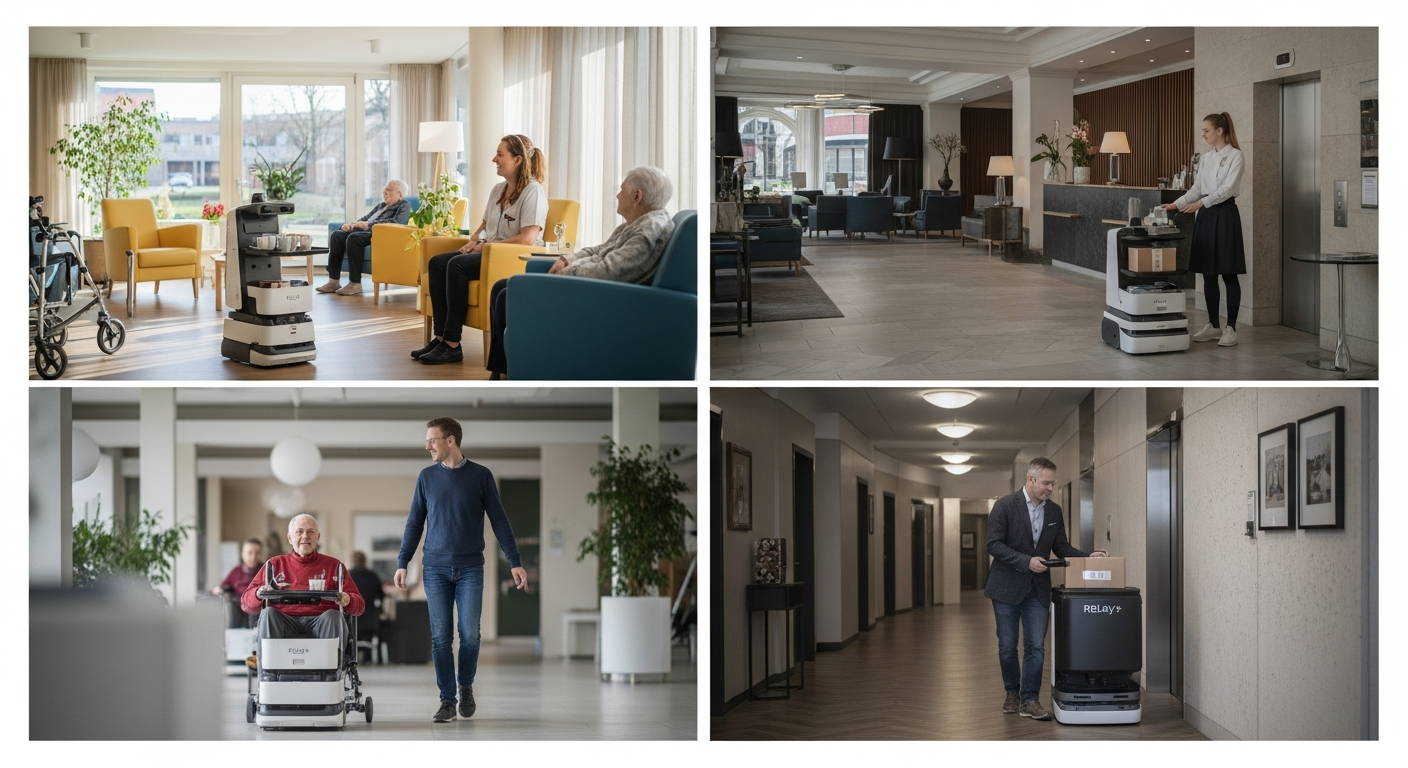
Station 2. 10:00 p.m. The medication cart drives autonomously across the hallway while the night shift focuses on the residents. At this moment the technology is invisible, but the process is stable. A modern system integrator for robotics does not deliver experiments, but operational relief. werob is not a manufacturer, but rather the entity that translates the workflow of a nursing home or hotel into a functioning fleet. With 200 robots in live operation in eleven European countries, it is clear that success lies not in the robot arm, but in the integration into the existing stack.
Key Takeaways
- 1A robotics system integrator like werob delivers a ready-to-use specification in 48 hours and a productive robot in eight weeks.
- 2Hardware agnostics protects against vendor lock-in with access to over 44 OEM partners and 280 different robot models.
- 3Ready-made connectors enable immediate integration into IT systems such as SAP EWM, Opera PMS, MatrixCare or Toast.
The role of the system integrator in modern robotics
A system integrator for robotics is not the creator of the hardware, but the architect of the solution. While manufacturers such as Boston Dynamics, Keenon or Pudu focus on the physical performance of their machines, the integrator solves the problem of applicability in the specific operating context. For an operator in the logistics, care or hotel industry, an isolated robot is worthless if it does not communicate with the merchandise management system or meet the safety requirements of the EU Machinery Regulation. werob takes on the role of strategic translator. In practice, this means that we do not try to sell a specific robot, but rather analyze the customer's workflow and select the most suitable hardware from a catalog of over 44 OEM partners.
This hardware-agnostic approach prevents vendor lock-in and ensures that the chosen solution can still keep up with technological advances in five years. A pure reseller is bound to its contracts with individual manufacturers. A system integrator, on the other hand, ranks over 280 different robot models against the customer's requirements. It's not just about the mechanics, but about the entire operational level: from the specification to matching to integration into the operator's software stack. werob acts as the operational level that ensures that the technology creates measurable economic benefits instead of ending up as an expensive pilot project in the corner.
The Spec Engine: From process description to specification
The biggest bottleneck in the introduction of robotics is traditionally the discovery phase. In many companies it takes three to six months to create a specifications document that precisely describes the technical requirements. werob has shortened this process to 48 hours using the Spec Engine. Trained on over 35,000 projects, this engine converts simple descriptions of shifts, floors and tasks into a ready-to-use robot action graph. If a nursing manager describes that medication needs to be distributed from the central office to three different wards between 8 p.m. and 6 a.m., the Spec Engine generates the necessary parameters for sensors, load capacity, battery life and connectivity.
This speed is crucial for ROI. While competitors are still stuck in consulting cycles, werob delivers a technical specification after just two days that serves as the basis for supplier matching. The Spec Engine not only takes into account the primary task, but also the infrastructural conditions on site, such as elevator controls, door openers and WiFi coverage. The result is a digital twin of the requirement that ensures that the hardware selected later fits exactly into the operational gap. This automated approach eliminates human errors in the planning phase and creates a reliable basis for regulatory acceptance.
Hardware agnostics and the Supplier Match System
The market for robotics is fragmented and confusing. New models of humanoids and service robots appear every month. One operator can hardly explore this market alone. This is where the second level of the werob platform comes into play: the Supplier Match. We rank over 44 OEM partners against the previously created specification. 280 different types of robots are taken into account, including leading names such as Apptronik, Unitree, Figure AI or specialized providers for the service sector. The goal is not to find the best-known robot, but rather the one that meets the specification with the highest efficiency.
This hardware agnostic nature allows the operator to remain flexible. If a manufacturer has delivery problems or a new model with a better price-performance ratio comes onto the market, the system allows a quick change without having to redo the entire integration. werob acts as a protective shield against technological obsolescence. We evaluate OEMs not only on technical data, but also on their reliability, support network and compliance with European standards. What this means for the customer is that they will receive an offer within five days for the optimal hardware combination that has already been validated for their specific workflow.
Connectors: Seamless integration into the operator stack
A robot that does not speak to the existing software creates additional work instead of relief. A system integrator for robotics must therefore delve deeply into the customer's IT landscape. werob offers prefabricated connectors that enable immediate connection to market-leading systems. In care, these are integrations into PointClickCare or MatrixCare. In the hotel industry, we connect fleets to Opera PMS or Mews. Connectors for SAP EWM, Toast or Lightspeed are available for logistics and retail. These integrations ensure that the robot receives its commands directly from the system in which the employees already work.
For example, if a guest in a hotel orders an additional pillow via the PMS, this data set automatically triggers the room service robot. No manual intervention from reception staff is required. This automation of the chain of command is key to scaling. werob avoids expensive individual programming through standardized interfaces. This not only reduces the implementation time to eight weeks, but also increases the stability of the entire system. The data flows bidirectionally: The robot reports the status of the task back to the main system, so that there is full transparency about the operational processes at all times.
Regulatory and the EU Machinery Regulation 2023/1230
The regulatory requirements for robotics in Europe are high and will be further tightened by the new EU Machinery Regulation 2023/1230. From January 20, 2027, this regulation will be binding for all distributors and operators. werob offers an integrated compliance path here. Many innovative robot manufacturers are based in Asia or the USA and do not have the necessary certifications for the European market. As a system integrator, werob takes responsibility for conformity assessment and ensures that the entire solution complies with local laws. This includes not only the hardware, but also the software action graphs and interaction with people in public spaces.
In addition to the machine regulations, we take into account specific standards such as ISO 13482 for personal care robots or the BewachVO for security robots in the DACH region. The EU AI Act also plays an increasing role as robot action graphs can often fall under high-risk AI categories. werob protects the operator against liability risks by monitoring all regulatory requirements in the live cockpit. A four-dimensional traffic light signals the status of hardware, infrastructure, regulations and specifications at all times. If a legal requirement changes, this is proactively reflected in the system so that operations remain legally secure.
Economic efficiency: Verified cost relief per location
The use of robotics must be reflected in hard numbers. A system integrator for robotics is ultimately measured by the cost reduction that it achieves. At werob, these calculations are based on data from 200 robots in live operation. In care, the automation of the medication round leads to an annual relief of €92,000 per location. Simply transporting laundry or meals saves another €71,000. The effects are even clearer in the hotel industry: an autonomous room service relieves the budget by €112,000 per year, while support with bar and breakfast preparations saves €54,000.
The potential is also significant in other industries. In the Food & Beverage sector, a tray bot in the dishwashing chamber saves €76,000, while automated cleaning of the kitchen floor frees up €44,000. In logistics, a yard patrol pays for itself by €68,000 and in the security area, a retail patrol saves €58,000 per year. These figures show that robotics is not a luxury good for innovation departments, but a necessary tool to compensate for the shortage of skilled workers and increase operating margins. werob's commercial model is consistently geared towards this success: it is outcome-only. Operators only pay when the system is running productively and the promised relief occurs.
The Cockpit: Live fleet management and monitoring
After commissioning, the phase of permanent operation begins. For this purpose, werob provides the cockpit, a central management platform for the entire robot fleet. The cockpit provides real-time monitoring of all units, regardless of manufacturer. At its heart is a four-dimensional traffic light system that shows the status of hardware, local infrastructure (such as Wi-Fi and elevators), regulatory compliance and adherence to the original specification. If a robot on station 4 issues an error message, the facility manager sees this immediately in the dashboard and can intervene before the process comes to a standstill.
In addition, the cockpit provides detailed reports on the performance provided. How many kilometers were driven? How many deliveries were successfully completed? Where were there blockages? This data is essential for the continuous optimization of workflows. werob also uses this information to further train the spec engine. With 200 robots in eleven countries (DE, AT, CH, FR, IT, ES, NL, DK, SE, PL, UK), the system generates valuable benchmarks. Operators can compare their own efficiency with the market average and identify potential for further automation. The cockpit is therefore not just a control instrument, but a strategic tool for scaling robotics throughout the company.
Robot in action in eight weeks
The speed of implementation is a core promise of werob. While traditional integration projects often take months or years, we bring robots into live operation in eight weeks. This process begins with an eight-step onboarding intake. First, let's define who you are and what layers you want to automate in your own words. We analyze the form of the task and the location infrastructure. This is followed by selecting the hardware preference and checking the regulatory framework. The finished specification is available within 48 hours, and the binding offer follows after five days.
In the following weeks, the technical integration into your IT stack takes place via the werob connectors. Since we rely on prefabricated modules, the lengthy development of individual software is no longer necessary. At the same time, we prepare the regulatory documentation so that operations are legally secure from day one. In week eight, the first robot rolls across your floor. This tight schedule is only possible because werob has digitized the entire integration value chain. We are not a consulting company that creates PowerPoint decks, but rather a systems integrator that delivers operational results. The goal for 2028 is clearly defined: 2,000 robots in live operation that support European companies in completing their daily tasks.
Outcome-only: The commercial model of the future
A major obstacle for many companies is the high initial investment and the risk of failure with new technologies. werob is removing this obstacle with a radically new commercial model: outcome-only. This means that you as the operator do not pay anything until the robot is actually running and doing its job. We avoid complex list prices or hidden consulting fees. Our success is directly linked to the success of your automation. If the machine does not perform as specified, you will not incur any costs. This model underlines our confidence in our own platform and the selection of our OEM partners.
This model allows companies to treat robotics as an operating expense (OPEX) instead of a capital investment (CAPEX). This protects liquidity and speeds up decision-making processes at the management level. Since werob takes full responsibility for selection, integration and operation, the risk for the customer is minimized. We are your partner for the entire fleet life cycle. From the first spec to daily monitoring in the cockpit, we ensure that the technology delivers what it promises. At a time when efficiency and cost pressure set the agenda, werob offers the safest and fastest path to automated value creation.
FAQ
- What is the difference between a robot manufacturer and a system integrator?
- A manufacturer (OEM) produces the hardware. A system integrator like werob selects the appropriate hardware, integrates it into the customer's existing IT infrastructure, takes care of regulatory compliance and manages the fleet in live operation.
- What role does the EU Machinery Regulation 2023/1230 play?
- This regulation will become binding from January 20, 2027. It imposes strict requirements on the safety and compliance of robots. werob ensures that all solutions used already meet this standard.
- How much is the cost reduction in care?
- In care, werob enables verified cost relief of €92,000 per year for the medication round and €71,000 for general transport tasks per location.
- What does the outcome-only model mean?
- At werob, customers only pay when the robot is actually in operation and provides the specified performance. There are no upfront payments for the planning phase or non-functional hardware list prices.
- Can werob be integrated into existing software such as SAP?
- Yes, werob offers ready-made connectors for SAP EWM as well as for industry software such as PointClickCare, MatrixCare, Opera PMS, Mews, Toast and Lightspeed.
- In which countries does werob operate?
- As of May 2026, werob is active in eleven European countries: Germany, Austria, Switzerland, France, Italy, Spain, Netherlands, Denmark, Sweden, Poland and Great Britain.
Related reading
Robotics Integrator: Scaling without hardware risk
A robotics integrator closes the gap between hardware manufacturers and operational reality. werob translates your processes into a specification in 48 hours and brings robots into live operation in eight weeks.
4 July 2026robot integrator GermanyRobot Integrator Germany: Scaling in eight weeks
A robot integrator in Germany is closing the gap between Asian hardware and European regulations. werob translates workflows into technical specifications in 48 hours and brings systems into live operation in eight weeks.
30 June 2026robot integrator HamburgRobot Integrator Hamburg: System integration in eight weeks
werob is the leading system integrator for robotics in Europe, based in Hamburg. We translate complex workflows into precise specifications in 48 hours and bring robots into live operation within eight weeks.
30 June 2026robotics integrator CopenhagenRobotics Integrator Copenhagen: Automation in 8 weeks
werob is the hardware-agnostic system integrator for robotics in Europe. We translate complex workflows into usable specifications in 48 hours and bring robots into live operation in eight weeks.
4 July 2026Robotics consulting white labelRobotics Consulting White Label: Scalable system integration
White label robotics enables service providers and companies to operate automation solutions under their own flag. werob provides the technological infrastructure from the specification to live fleet management.
3 July 2026