CFO Automation Business Case: Robotics ROI in eight weeks
A CFO-friendly business case for robotics often fails due to unclear integration costs and long pilot phases. werob solves this through a hardware-agnostic platform and a purely results-oriented billing model.
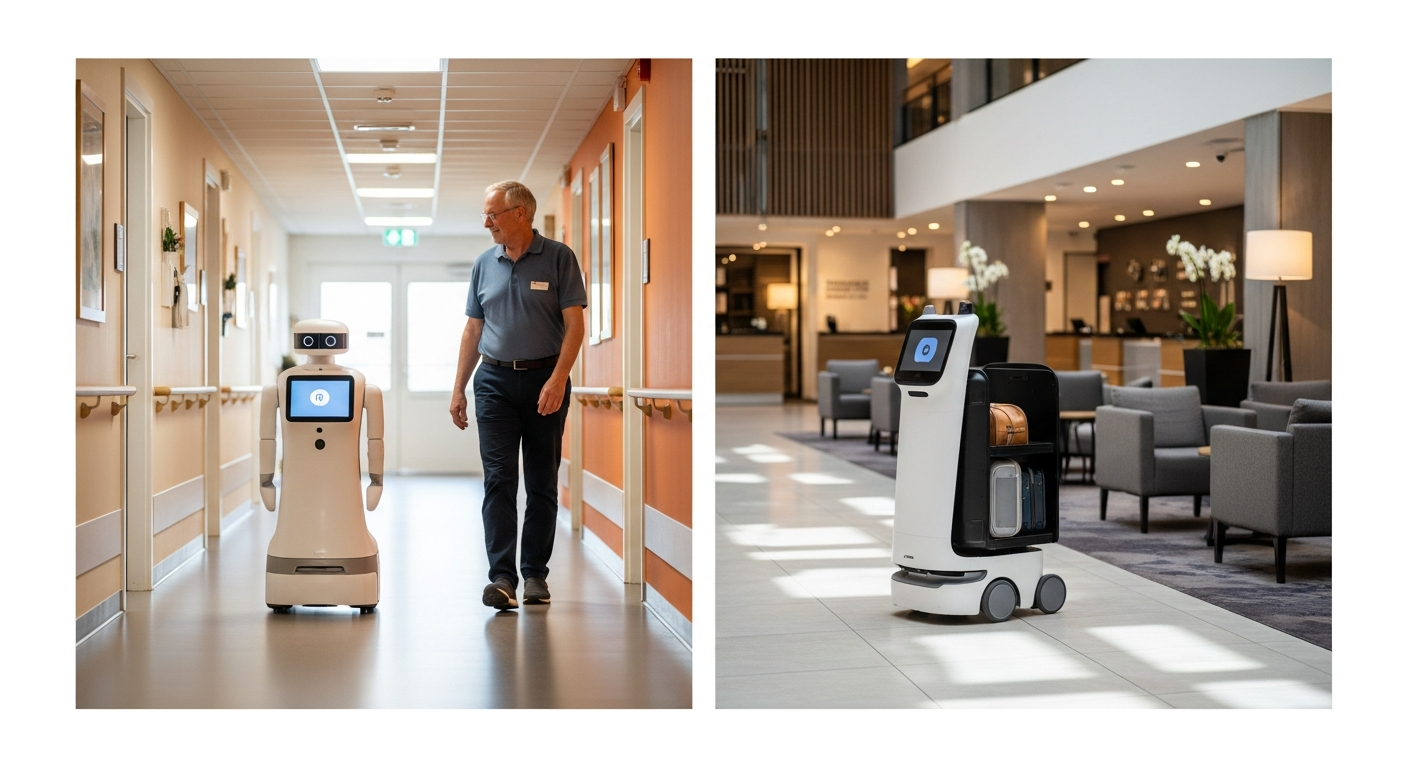
Station 2. 10:00 p.m. The medication cart already runs autonomously across the hallway. While nursing staff focus on direct patient care, robotics takes on the logistical burden. In the CFO's balance sheet, this moment is not reflected as a technical experiment, but as a calculable reduction in operational costs. For companies in the care, hotel or logistics industries, the question is no longer whether robotics works, but rather how quickly it generates positive cash flow. werob translates complex workflows into a usable specification within 48 hours and brings robots into live operation in just eight weeks. This is not a consulting project, but an operational system integration with a clear focus on the result.
Key Takeaways
- 1The werob Spec Engine delivers a ready-to-use robotics specification within 48 hours and drastically shortens the planning phase.
- 2Hardware agnostics through 44+ OEM partners prevents vendor lock-in and ensures long-term operational flexibility.
- 3The outcome-only model eliminates the investment risk as payments are only due upon successful live operation.
The Spec Engine: From workflow to specification in 48 hours
In traditional industrial automation, discovery phases often last three to six months. For a CFO, this means a high financial risk even before the first robot takes over a task. werob breaks this cycle with the Spec Engine. This platform level converts the description of a workflow into a technical specification within 48 hours. Trained on data from over 35,000 projects, the engine immediately recognizes which hardware requirements and regulatory hurdles exist for a specific location.
The speed of the Spec Engine is the decisive factor for investment security. Instead of investing months in consultations, decision-makers receive a precise roadmap within two days. This roadmap not only defines the required hardware, but also the necessary connectors in the company's existing software stack. Whether it's the medication round in a nursing facility or room service in a hotel, the Spec Engine provides the basis for a robust business case. This automated process eliminates the uncertainty often associated with introducing new technologies and enables quick decisions based on hard data.
Hardware agnostics: Why 44+ OEM partners prevent vendor lock-in
A common mistake in automation is tying yourself to a single robot manufacturer. For a CFO, this represents a strategic risk because dependence on the innovation or delivery ability of a single OEM can jeopardize the entire operation. werob acts as a hardware-agnostic system integrator. With a catalog of over 44 OEM partners and 280 maneuverable robots, werob offers the necessary flexibility to select the best hardware for each specific task.
In the Supplier Match process, the requirements of the Spec Engine are checked against the partners' entire portfolio. Not only technical parameters such as load capacity or battery life are taken into account, but also availability and conformity with European standards. Partners include leading names such as Boston Dynamics, Keenon, Pudu and Apptronik. With this approach, werob ensures that the operator always receives the most efficient solution without having to commit to a proprietary hardware platform in the long term. Should a manufacturer no longer meet the requirements, werob's platform structure allows a seamless change of hardware while the software integrations and workflows remain the same. This protects the investments made in process automation in the long term.
The financial leverage: Verified cost reductions per location
A business case is only as strong as the numbers on which it is based. werob provides verified data from the live operation of over 200 robots in eleven European countries. In the care industry, the automation of the medication round leads to an annual cost reduction of 92,000 euros per location. Simply transporting goods within a facility saves a further 71,000 euros per year. These figures are not estimates, but operational reality for customers like Korian Germany, who were able to achieve double-digit cost reductions in the first year.
In the hotel industry, the savings are often even more significant. An autonomous room service reduces the budget by 112,000 euros per location and year. The preparation of the bar and breakfast costs 54,000 euros. There are also significant effects in the Food & Beverage (F&B) sector: a tray bot in the washing chamber saves the company 76,000 euros annually, while automated cleaning of the kitchen floor saves 44,000 euros. In logistics and security, the values for yard patrols are 68,000 euros and for retail patrols 58,000 euros. These concrete dollar amounts allow a CFO to accurately calculate ROI and plan scaling across multiple locations. In a group with several locations, these effects quickly add up to millions, as the example of a senior living group with five robots at four locations shows, which achieves an annual relief of around 1.8 million euros.
The EU Machinery Regulation 2023/1230 as a strategic imperative
An often overlooked risk in the business case for robotics is regulatory compliance. From January 20, 2027, the EU Machinery Regulation 2023/1230 will be binding. This regulation places significantly higher demands on the safety and compliance of robotic systems, especially when they are used in close proximity to people. Many Asian OEMs currently do not have the necessary certifications for the European market. werob acts as the decisive compliance path here.
As a system integrator werob takes responsibility for the conformity assessment and ensures that all systems used meet the strict European standards. This also includes specific requirements such as ISO 13482 for service robots in personal areas or the BewachVO for security robots. For a CFO, working with werob means protection against legal risks and potential shutdowns by regulators. werob integrates the regulatory requirements directly into the live cockpit, so that the compliance status of the entire fleet can be audited at any time. In an environment in which home inspectors or professional associations are increasingly paying attention to compliance with technical standards, this integrated compliance path is an essential part of long-term operational security.
Seamless integration: Connectors for SAP EWM and Opera PMS
The biggest hurdle to scaling robotics is often the lack of connection to the existing IT infrastructure. A robot that works in isolation creates manual effort at the interfaces. werob solves this problem through prefabricated connectors in the operator stack. These integrations allow robots to communicate directly with systems such as SAP EWM, Opera PMS, Mews, Toast or PointClickCare. An order in the hotel management system automatically triggers a room service robot trip without the need for manual intervention from an employee.
This deep integration is the key to operational excellence. In care, the connection to MatrixCare or PointClickCare enables complete documentation of medication dispensing. In logistics, the connection to SAP EWM ensures real-time synchronization of inventory and transport movements. werob offers these connectors as part of the platform, which drastically reduces implementation time. Instead of spending months programming individual interfaces, werob uses proven standards to make the robot fleet productive within just a few days. This not only reduces IT costs, but also ensures that data integrity is maintained across all systems.
The live cockpit: fleet management with the 4-stage traffic light system
Once the robots are in use, the focus shifts to stable operation. The werob Cockpit offers central fleet management that goes far beyond a simple status display. It uses a four-dimensional traffic light system to monitor the status of the fleet in real time: hardware, infrastructure, regulatory and specification. Each dimension is continuously analyzed to identify potential problems before they disrupt operations.
For the CFO and Head of Operations, the cockpit offers full transparency about the performance of the systems. It provides data on utilization, cycles completed and cost reduction achieved. If a robot fails due to a hardware defect or a blocked route, the system reports this immediately and enables quick troubleshooting. Monitoring the infrastructure, such as the accessibility of elevators or automatic doors, is particularly critical. The cockpit ensures that the robots can carry out their tasks at all times. The integration of regulatory monitoring also ensures that all safety checks are carried out on time. This level of control is a prerequisite for operating large, multi-location fleets and significantly minimizes operational failure risks.
Outcome-only: Why the CFO no longer bears investment risk
Werob's commercial model is consistently geared towards the success of the customer. In contrast to traditional providers who require high upfront investments or complex leasing contracts, werob relies on an outcome-only model. This means: The customer only pays when the robot is in productive use and completes the defined tasks. There are no hidden list prices or unpredictable consulting costs. This model shifts the risk of implementation completely to the system integrator.
This is a decisive advantage for a company's financial planning. The costs for automation only arise when the corresponding savings or efficiency gains are realized. This makes the business case for robotics almost risk-free. werob takes over the preliminary work for the specification, the matching of the hardware and the integration into the software stack. Billing only begins when the system delivers the promised service in live operation. This approach reflects werob's confidence in its own platform and the efficiency of the 48-hour spec engine. It enables companies of all sizes to take the path to automation without burdening the budget with high CAPEX expenses.
From theory to practice: The 8-week path to live operations
Speed is a critical factor for competitiveness. While classic automation projects often take years from the initial idea to implementation, werob promises live operation in eight weeks. This tight schedule is made possible by the standardization of processes on the werob platform. After the 48-hour specification phase, a binding offer will follow within five days. As soon as the decision has been made, the eight-week implementation phase begins.
During this time, the hardware is procured, the connectors are configured and the employees on site are trained. Because werob relies on ready-made integrations and a proven network of OEM partners, lengthy development cycles are eliminated. A current example is the use of the first humanoid robot in a Hamburg care facility, which was already fully operational in the twelfth week after the project started. This speed allows companies to react very quickly to staff shortages or increasing cost pressures. werob's structured eight-step onboarding process ensures that all relevant aspects, from infrastructure to compliance, are processed systematically. The result is a smooth transition to automated operations that delivers immediately measurable results.
Comparison: Traditional consulting vs. werob system integration
The difference between a classic management consultancy and the werob approach can best be illustrated using the project results. While consulting firms often produce extensive discovery decks that take months to complete, werob delivers a technical specification within 48 hours that can go straight into implementation. The following table shows the main differences in approach.
| Criteria | Traditional advice | werob system integration |
|---|---|---|
| Time to specification | 3 to 6 months | 48 hours |
| Hardware selection | Often Manufacturer-specific or limited | Hardware-agnostic (44+ OEMs) |
| Integration effort | Individual programming | Prefabricated connectors (SAP, Opera etc.) |
| Compliance path | To be verified externally | Integrated (EU 2023/1230 ready) |
| Cost model | Fee basis (CAPEX risk) | Outcome-only (OPEX focus) |
| Time to go live | 12 to 24 months | 8 weeks |
This The comparison makes it clear that werob is not a pure service provider, but an operational platform that maps the entire life cycle of a robot fleet. For a CFO, this means a drastic reduction in time-to-value and a significant reduction in project risks. werob is the partner for companies that are not looking for concepts, but want to see functioning robots on their floors.
FAQ
- How high are the costs for a robotics integration at werob?
- werob works according to an outcome-only model. There are no classic list prices or upfront investments. You only pay when the robot is running productively in your company and delivers the agreed service.
- How long does it take until the first robot is ready for use?
- It usually only takes eight weeks from the first contact to live operation. The specification is available within 48 hours and the offer follows within five days.
- Which software systems can be connected to werob?
- werob offers pre-built connectors for market-leading systems such as SAP EWM, Opera PMS, Mews, Toast, PointClickCare and MatrixCare.
- Is werob a robot manufacturer?
- No, werob is a hardware-agnostic system integrator. We select the best hardware for your specific requirements from over 44 OEM partners.
- How safe is the operation with regard to new EU regulations?
- werob offers an integrated compliance path for the EU Machinery Regulation 2023/1230, which is binding from January 2027. We ensure that all systems comply with European safety standards.
- In which countries does werob operate?
- werob currently operates over 200 robots in eleven European countries, including Germany, Austria, Switzerland, France, Italy, Spain and the United Kingdom.
Related reading
Business case humanoid robot: ROI and operational strategy
Humanoid robots leave the laboratories and take on operational tasks in nursing, hotels and logistics. This guide analyzes the business case based on real data and shows the path to implementation in eight weeks.
22 June 2026robot integratorRobot Integrator: To an operational fleet in eight weeks
A robot integrator closes the gap between hardware manufacturers and everyday operations. Find out how werob specifies workflows in 48 hours and brings productive units to the floor within eight weeks.
30 June 2026robotics platformRobotics platform for operations: integration instead of hardware
A modern robotics platform is much more than a control unit for individual machines. It acts as an operational layer that combines hardware agnostics, regulatory compliance and deep software integration in one system to realize measurable cost reductions.
5 July 2026robotics integratorRobotics Integrator: Scaling without hardware risk
A robotics integrator closes the gap between hardware manufacturers and operational reality. werob translates your processes into a specification in 48 hours and brings robots into live operation in eight weeks.
4 July 2026use robots in operationUsing robots in business: The guide for system integration
Anyone who wants to use robots in business often fails due to the complexity of integration and regulatory hurdles. werob solves this through a hardware-agnostic platform that translates operational processes into technical specifications in 48 hours.
28 June 2026