Robotics platform for operations: integration instead of hardware
A modern robotics platform is much more than a control unit for individual machines. It acts as an operational layer that combines hardware agnostics, regulatory compliance and deep software integration in one system to realize measurable cost reductions.
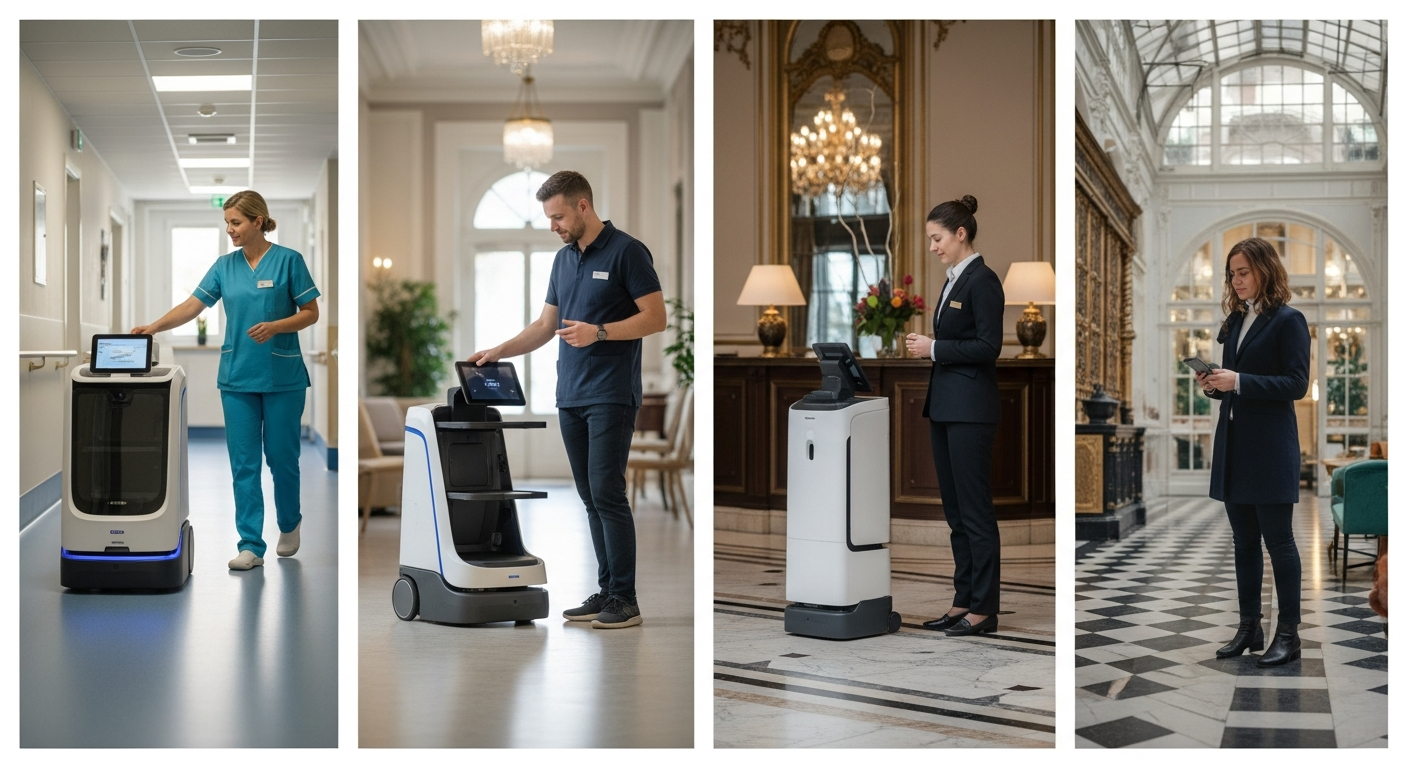
Station 2. 10:00 p.m. The medication cart starts moving silently. While the nursing staff discusses the handover, the robotics platform has already validated the order, checked the route and synchronized the interface to the nursing system. At this moment, it's not about the robot's hardware, but about the operational intelligence behind it. werob does not act as a manufacturer, but rather as a system integrator that translates an operator's workflow into a usable specification. With over 200 robots in live operation in eleven European countries, the platform proves that true automation does not require months of planning, but a precise level of technological translation.
Key Takeaways
- 1Hardware agnostics prevents vendor lock-in with access to 44+ OEM partners and 280 robot models.
- 2The Spec Engine reduces the planning phase from months to 48 hours through AI-powered workflow analysis.
- 3Verified cost reductions per year and location ensure a quick ROI.
The robotics platform as an operational level
Robotics is often incorrectly defined primarily by hardware. A powerful robotics platform like werob breaks this paradigm. It is not a single OEM reseller or a classic consulting firm with lengthy discovery decks. Instead, it acts as the central system integrator for Europe, closing the gap between the operator's requirements and the manufacturers' technical capabilities. werob translates the workflow of a nursing home, a hotel or a logistics hall into a technical specification within 48 hours. This speed is crucial, as traditional approaches often require three to six months for pure needs analysis.
The platform is designed to be hardware-agnostic. This means that it is not tied to a specific manufacturer, but has 44 OEM partners in the catalog. There are currently 280 different robot models that can be maneuvered. This approach prevents vendor lock-in and ensures that the technically and economically optimal hardware is selected for each specific task, be it the medication round in nursing or room service in the hotel. The goal for 2028 is clearly defined: 2,000 robots in active operation, up from 200 robots managed across eleven European countries in May 2026. That fleet is run from a central operating layer, the Cockpit, which brings tasks, states, escalations and evidence together in one place. It is expressly not an intelligence layer: the learned models on board come from the manufacturers. werob is a manufacturer-independent systems integrator, not an OEM, not a manufacturer and not a model developer.
The Spec Engine: From Words to Specification in 48 Hours
The heart of the werob platform is the so-called Spec Engine. This component is trained to transform human descriptions of workflows into precise, machine-readable action graphs. The model has been fine-tuned based on over 35,000 projects and allows a complete project specification to be created in just two days. An operator simply specifies which shift, which floor and which task should be automated. The Spec Engine analyzes this data and creates a requirements profile that takes into account both the physical requirements for the robot and the necessary software interfaces.
This process eliminates uncertainty in the early planning phase. Instead of providing vague estimates, the platform delivers a concrete quote within five days of specification creation. The focus here is on operational specificity. The crucial question is how the robot will transport the dirty laundry from floor 4 to the basement on Monday evening at 8 p.m. This level of detail ensures that the implementation is not only technically completed after eight weeks, but also provides immediate added value in daily operations.
Supplier Match: Hardware agnostics as a strategic advantage
After the specification has been determined, the second level of the platform comes into play: the supplier match. Here the requirements are checked against the extensive catalog of over 44 OEM partners. The partners include well-known manufacturers such as Boston Dynamics, Keenon, Pudu, Apptronik and Figure AI. The platform does not evaluate the robots based on marketing promises, but rather on their actual suitability for the customer's specific workflow. Factors such as load capacity, battery life, navigation ability and connectivity are taken into account.
A key advantage of this model is its flexibility. If a manufacturer has delivery problems or brings a new, more efficient model onto the market, the platform can react quickly. The operator does not have to rely on the technology of a single provider. werob seamlessly integrates humanoids such as the Apptronik Apollo as well as specialized service robots from Keenon or industrial cobots from ABB and KUKA. This breadth of the portfolio makes it possible to find exactly the right solution for every industry, from the hotel industry to heavy logistics, without having to compromise on functionality.
Connectors: Seamless integration into the operator stack
A robot that works in isolation from the rest of the systems often creates more work than it saves. Therefore, the werob robotics platform relies on prefabricated connectors. These enable direct integration into the operator’s existing software stack. Market-leading systems such as PointClickCare and MatrixCare in the care sector, Opera PMS and Mews in the hotel industry, and Toast and Lightspeed in the catering industry are supported. Integrations for SAP EWM and Genetec are available for logistical applications.
These connectors ensure that data flows in real time. When room service is requested in a hotel room via the PMS, the platform automatically receives this order and assigns it to the available robot. In nursing, this means that the medication round is synchronized directly with the digital patient file. This deep integration is the key to the verified cost relief. In nursing, the automation of the medication round leads to an annual reduction of a significant amount per location. Without the direct connection to the care systems, such an increase in efficiency would not be possible, as manual interventions would destroy the time advantage.
The Cockpit: Live fleet management with traffic light system
As soon as the robots are in use, the werob Cockpit takes over the monitoring and control of the fleet. The live fleet management system based on a four-dimensional traffic light system. This system continuously monitors four critical areas: hardware, infrastructure, regulatory and specification. If a traffic light lights up yellow or red, the operational team can intervene immediately, often before operation is disrupted. This is particularly important in environments where downtime has a direct impact on service quality or security.
The cockpit not only provides an overview of the current status, but also provides detailed reports on the performance provided. Operators can see exactly how many kilometers a robot has traveled, how many tasks were successfully completed, and where delays occurred. This data is the basis for werob's outcome-only commercial model. Customers don't pay for the hardware itself, but for the result. If the robot runs and performs its tasks according to the specification, you will be billed. This approach minimizes financial risk for the operator and ensures that the platform interests are aligned with the customer's operational goals.
Regulatory and the EU Machinery Regulation 2023/1230
An often underestimated aspect when using robotics is legal compliance. Werob offers a decisive advantage here: the built-in compliance path for the EU Machinery Regulation 2023/1230. This regulation will become mandatory from January 20, 2027 and places high demands on the safety and compliance of machines, especially when they are used in close proximity to people. Many Asian OEMs do not have the necessary local certifications or conformity assessments for the European market.
werob as a system integrator takes responsibility for compliance with these regulatory requirements. This includes not only the machine regulations, but also specific standards such as ISO 13482 for personal care robots or the BewachVO for security applications. This legal protection is vital, particularly in sensitive areas such as care (home supervision) or food processing (HACCP). The platform ensures that all systems used comply with current standards and can be audited. werob thus offers operators the necessary legal certainty to invest in automation in the long term without having to fear later shutdowns by regulatory authorities.
Economic efficiency and verified cost reductions
The use of a robotics platform must be economically viable. werob provides concrete figures for this that are based on real operations. In the care sector, a robot used to transport laundry or waste relieves a location of high five-figure amounts annually. In the hotel industry, the savings are even more significant: automated room service results in significant cost savings per year, while support with bar and breakfast preparations saves even more costs. These figures are not theoretical projections, but rather operational reality for customers such as a leading European nursing home operator.
| Area | Application | Cost relief per Year/Location |
|---|---|---|
| Care | Medicine round | Significant |
| Care | Transport tasks | 71,000 € |
| Hotel Industry | Room Service | €112,000 |
| F&B | Tray Bot (Sinkroom) | Significant |
| Logistics | Yard patrol | Significant |
| Golf | Ball collection | Significant |
Werob's commercial model is consistently geared towards these results. There are no hidden list prices or high upfront investments for hardware that then sits unused in the corner. The principle is: outcome only. The operator only pays when the robot is in productive use. This allows companies to calculate automation projects with a clear ROI and eliminate the risk of failed pilot projects.
The path to live operation in eight weeks
The provision of a robotics solution via the werob platform follows a tight schedule. After the first onboarding conversation in which the operational requirements are recorded, the Spec Engine creates the technical specification within 48 hours. The customer receives a binding offer within five days. Once the decision has been made, it only takes eight weeks until the first robot is active on the site. This process is highly standardized and minimizes the operator's internal effort.
During these eight weeks, not only are the robots configured, but the necessary infrastructure adjustments are also made and the software connectors are activated. The werob team accompanies the entire process, from the first inspection to the training of the staff on site. A current example is a nursing facility in Hamburg, where the first humanoid robot was running in pilot operation in the twelfth week after first contact. This speed is unique in the market and enables companies to react quickly to staff shortages or increasing cost pressure.
Future security through scalability
A robotics platform is not a standalone solution, but a foundation for future growth. Anyone who starts with two robots in one location today can easily scale to hundreds of units in multiple locations using werob. Central management via the cockpit ensures that operational quality remains consistent across the entire fleet. Since the platform is operational in eleven European countries, internationally operating corporations can also implement their automation strategy across countries with a single partner.
The continuous expansion of the OEM catalog and the constant development of the Spec Engine guarantee that operators always have access to the latest technology. Whether it's advances in AI-controlled navigation or new gripping systems for humanoid robots - werob integrates these innovations into the platform as soon as they are market-ready and regulatory-safe. This means that the investment in the werob platform remains protected in the long term, as it adapts flexibly to technological leaps without the operator having to rebuild its entire infrastructure.
FAQ
- What distinguishes werob from a robot manufacturer?
- werob is a system integrator and not a manufacturer. While a manufacturer only sells its own hardware, werob offers a hardware-agnostic platform that compares over 44 different manufacturers and integrates the best solution for the customer's specific workflow.
- How does the outcome-only payment model work?
- With werob, you only pay when the robot is actually running in your company and fulfilling the defined tasks. There are no high upfront investments in hardware without a guarantee of functionality. The model is purely results-oriented.
- Which IT systems can be connected to the platform?
- werob offers ready-made connectors for systems such as SAP EWM, Microsoft Dynamics, Opera PMS, Mews, PointClickCare, MatrixCare, Toast and Lightspeed. An individual connection of other systems is possible via the API level.
- Is the platform compliant with the new EU Machinery Regulation?
- Yes, werob offers an integrated compliance path for the EU Machinery Regulation 2023/1230, which is mandatory from January 2027. We ensure that all robots used have the necessary certifications for the European market.
- How long does it take from the first contact to live operation?
- The standard process allows for 48 hours for specification, 5 days for quotation and a total of 8 weeks until the robot is deployed productively on site.
- In which countries is the werob platform available?
- werob is currently operational in eleven European countries, including Germany, Austria, Switzerland, France, Italy, Spain, the Netherlands, Denmark, Sweden, Poland and Great Britain.
Related reading
Multi Robot Coordination Platform: Efficiency for Fleets
The management of different robot models often fails due to isolated systems. A central multi-robot coordination platform closes the gap between hardware and operational processes.
25 June 2026hardware markup oem robotHardware markup OEM robots: system integration instead of vendor lock-in
The choice of robot hardware is secondary to process integration. werob explains how hardware markup for OEM robots paves the way from requirement to productive fleet in eight weeks.
23 June 2026rbac robotics platform ssoRBAC Robotics Platform SSO: Security for fleets
Scaling robot fleets requires centralized identity management. Learn how RBAC and SSO increase operational security and reduce administrative hurdles in multi-OEM scenarios.
27 June 2026smooth robotics alternativeSmooth Robotics Alternative: Hardware-Agnostic System Integration
Anyone who commits to a single robot manufacturer today risks being left behind technologically tomorrow. werob offers the hardware-agnostic alternative for scalable automation in logistics, care and the hotel industry.
23 June 2026Authority-ready reports robotsAuthority-ready reports for robots: Compliance in live operation
Automation often fails not because of the technology, but because of the documentation requirement. werob delivers government-ready reports directly from the cockpit to minimize liability risks and ensure compliance with European security standards.
22 June 2026