Counter-Drone Systems Explained: C-UAV Detection & Defense
Discover how C-UAV and C-UAS systems protect airspace through advanced detection, tracking, and mitigation technologies to secure critical infrastructure.
Counter-Unmanned Aerial Vehicle (C-UAV) systems secure sensitive airspace against drone threats. By integrating layered detection, precision tracking, and lawful mitigation strategies, these defenses neutralize unauthorized flights before they reach their targets.
Key Takeaways
- 1Modern defense architectures rely on three functional layers: detect, track, and mitigate.
- 2Precision tracking is fragile; a loss of just 0.1 degrees in accuracy can cause a system to lose custody of a drone.
- 3Costs scale steeply, from single-sensor detection packages to multi-layered integrated defense grids.
Understanding C-UAV and C-UAS terminology
Counter-drone technology has evolved from isolated defense projects into a structured field within aerospace engineering and robotics. Navigating this domain requires a clear understanding of standard nomenclature, specifically the distinction between Counter-Unmanned Aerial Vehicle (C-UAV) and Counter-Unmanned Aircraft System (C-UAS). While both terms are frequently used interchangeably in technical literature, they refer to different technical scopes within airspace defense.
Distinguishing vehicle-centric from system-wide defense
A C-UAV approach focuses primarily on the airborne platform itself, targeting the physical airframe or localized flight controller to interrupt motion. In contrast, a C-UAS framework addresses the complete operational ecosystem. This includes the aerial vehicle, the ground control station, the RF telemetry links, satellite navigation receivers, and the human or algorithmic remote pilot.
- C-UAV (Counter-Unmanned Aerial Vehicle): Neutralization techniques directed strictly at the flying vehicle in flight, such as kinetic nets, laser disruption, or direct localized jamming.
- C-UAS (Counter-Unmanned Aircraft System): Multi-layered architecture targeting the entire command chain, including ground stations, control algorithms, and data uplinks.
- UAS Defense: Broad operational domain encompassing passive detection networks, sensor fusion engines, and regulatory airspace integration.
Securing airspace against unauthorized incursions requires addressing both the kinetic vehicle and its broader communication stack. Understanding these distinctions helps engineers design robust defense networks that match modern operational models, such as drone-as-a-service programs.
The growing need for counter-drone systems
The rapid proliferation of low-cost commercial drones, open-source flight software, and additive manufacturing has lowered the barrier to entering controlled airspace. While these advancements enable beneficial commercial applications, they also expose critical infrastructure, transportation hubs, and military installations to unprecedented security vulnerabilities.
Escalating airspace threats and market dynamics
Modern small unmanned aircraft present unique operational challenges due to their small radar cross-sections, low thermal signatures, and ability to fly at low altitudes beneath traditional air surveillance radar coverage. Autonomous waypoint navigation and swarm protocols further increase threat complexity by enabling multi-vector incursions that can overwhelm single-sensor defenses.
| Sector / Domain | Threat Vector | Impact Profile |
|---|---|---|
| Commercial Aviation | Flight path intrusion and ground collision risk | Flight groundings, severe economic disruption, and severe safety hazards |
| Critical Infrastructure | Unauthorized surveillance and physical payload delivery | Facility damage, power grid disruption, and confidential data breaches |
| Military & Defense | Autonomous reconnaissance and coordinated swarm attacks | Asset loss, sensor saturation, and tactical advantage degradation |
How C-UAV systems detect unauthorized drones
The foundational layer of any counter-drone architecture is detection. A system must rapidly discover the presence of an airborne platform, classify its signature, and distinguish unauthorized target airframes from environmental noise, birds, or friendly cooperative craft.
Multi-modal sensor arrays for passive and active detection
Because every single detection technology possesses physical or operational limitations, modern counter-UAS installations deploy multi-modal sensor networks to ensure complete coverage across all flight regimes.
- Radio Frequency (RF) Sensors: Passively scan the electromagnetic spectrum for control links, telemetry broadcasts, and video downlinks across standard ISM bands (2.4 GHz, 5.8 GHz) and custom frequencies.
- 3D Micro-Doppler Radar: Employs active radio waves to detect physical targets based on their radar cross-section and rotor blade Doppler signatures, making it effective against silent, fully autonomous drones.
- Acoustic Sensor Arrays: Utilize microphone arrays to detect unique acoustic frequency profiles generated by motor rotation and propeller blades in urban or non-line-of-sight environments.
Combining passive RF sensing with active radar prevents target evasion even when aircraft operate in complete radio silence: RF detection depends on the drone actively transmitting, so a platform flying a pre-programmed waypoint mission with no control link is invisible to RF receivers, while radar still returns an echo from the airframe. This detection capability mirrors the technology required for rapid incident verification when deploying a drone as first responder in automated facility management.
Tracking the threat: Continuous positional awareness
Detection merely answers whether an unauthorized drone is present; tracking provides the continuous positional telemetry necessary to predict its flight path and cue mitigation effectors. Maintaining custody of a fast-moving, agile aerial target requires high-precision sensor fusion.
Optical telemetry and trajectory prediction
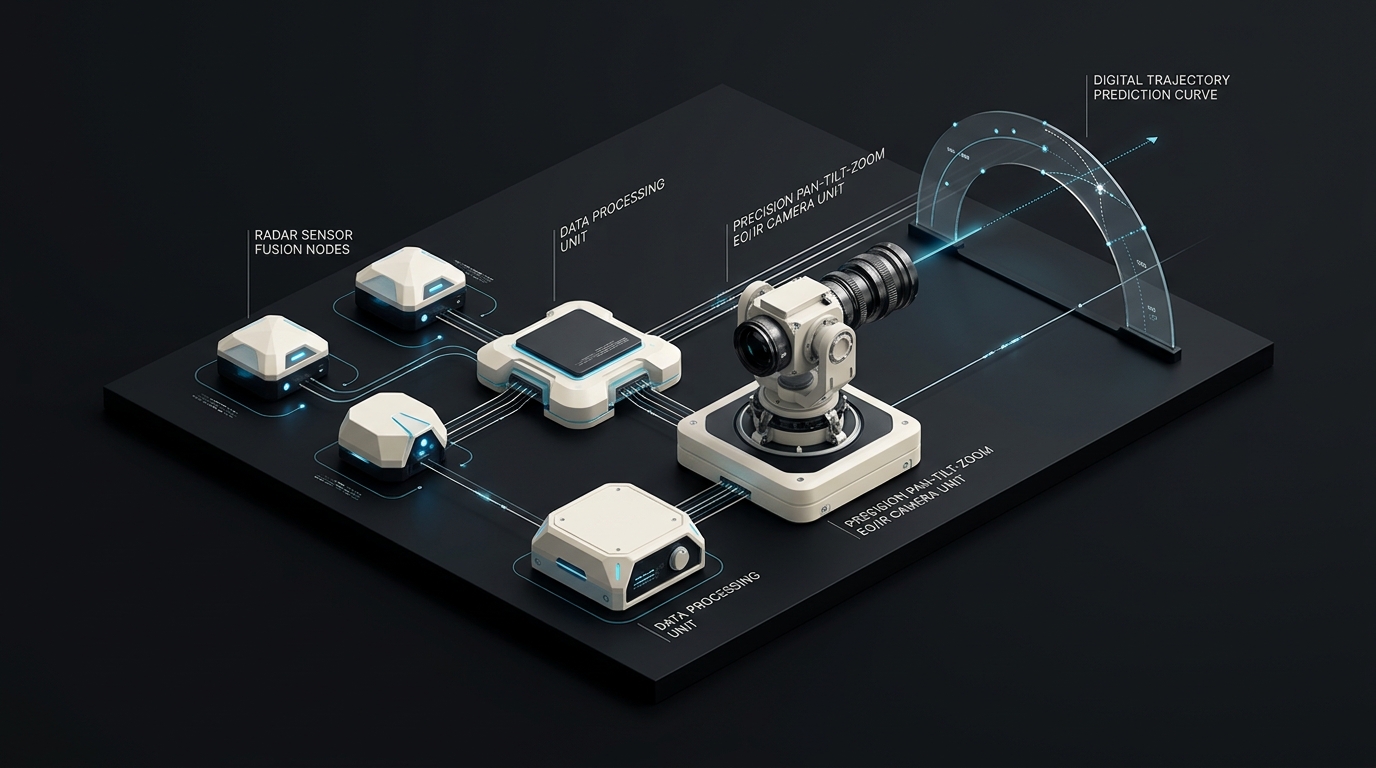
When radar or RF sensors register an initial detection trigger, command-and-control software calculates coordinate estimates and slews high-magnification optical sensors to lock onto the target. Electro-Optical (EO) daylight cameras and Mid-Wave Infrared (MWIR) thermal imagers provide high-resolution visual confirmation.
Mechanical stability and angular precision are critical during target tracking; a loss of just 0.1 degrees in tracking accuracy during a high-speed pan-tilt slew can cause optical sensors to drop target custody entirely. Automated Kalman filtering and neural-network trajectory prediction algorithms continuously compute the flight envelope to maintain sensor lock.
Electronic mitigation: Jamming and cyber-takeovers
Once an unauthorized target is detected and tracked, operators evaluate mitigation options. Electronic countermeasures provide non-kinetic defeat capabilities, interrupting control systems without causing immediate structural destruction or uncontrolled mid-air debris.
Radio frequency disruption and signal injection
Non-kinetic electronic effectors operate by severing the RF link between the ground pilot and the drone, or by manipulating onboard navigation algorithms.
- RF Jamming: Transmits high-power directional noise across control frequencies and satellite navigation bands (GNSS), forcing the drone's flight controller into automated fail-safe modes like hovering or landing.
- Portable Disruptors: Lightweight directional jammers, with some compact handheld configurations weighing as little as 7.5 pounds, provide portable point-defense capabilities for mobile personnel.
- Cyber-Takeover Solutions: Demodulate and decode control communication protocols to inject malicious control packets, allowing the defense system to override the pilot and execute a controlled landing.
The availability of tactical disruptors, such as portable jammers weighing 7.5 pounds, demonstrates the rapid miniaturization of RF energy emission technology for field security teams.
Kinetic interception and directed energy
When autonomous targets fly in RF-silent modes, utilize encrypted frequency-hopping signals, or follow pre-programmed optical paths, electronic countermeasures may prove insufficient. In high-threat scenarios, kinetic and directed energy systems deliver physical hard-kill options.
Hard-kill technologies and energy effectors
Kinetic and energy-based mitigation technologies target the structural integrity or electronic circuitry of the airframe directly to neutralize the flight threat mid-air.
| Effector Type | Mechanism of Action | Primary Operational Advantage |
|---|---|---|
| Physical Nets / Interceptors | Launches physical net payloads or interceptor drones to entangle propellers | Recovers the airframe intact; Fortem reports that only about 15% of target drones evade the first shot, with a second shot usually ready to follow |
| High-Energy Lasers (HEL) | Focuses a continuous thermal beam on the target structure; the US Army's DE M-SHORAD Stryker fields a 50 kW class solid-state laser, and the follow-on E-HEL programme is evaluating systems up to 300 kW | Speed-of-light engagement at a few dollars of electricity per shot, against interceptor missiles costing millions per round |
| High-Power Microwaves (HPM) | Emits intense electromagnetic pulses to destroy internal silicon circuits | Wide-beam area defense that can disable multiple drones in a single engagement; Epirus reports defeating a 49-drone swarm with one pulse in a live-fire demonstration |
Deploying physical interceptors or directed energy effectors requires careful operational perimeter control. Kinetic engagements bring down the target and the projectile, lasers scatter burning fragments, and high-power microwaves act indiscriminately on nearby electronics, so all three carry collateral damage risk that makes them poorly suited to dense urban or otherwise sensitive environments. Managing those spatial boundary conditions is comparable to the exclusion zones used during offshore drone inspection operations.
Legal restrictions and implementation hurdles
Deploying counter-UAS platforms involves strict legal, regulatory, and financial considerations. While passive sensor detection is broadly permissible, active signal mitigation and kinetic interdiction remain strictly controlled by civil aviation and telecommunication statutes.
Regulatory frameworks and modular architecture integration
Federal frameworks balance airspace security against civil aviation safety and radio spectrum integrity. Unapproved jamming can disrupt nearby commercial communications, emergency services, or manned aircraft navigation systems.
- SAFER SKIES Act: Establishes defined legal authorization frameworks for state and local law enforcement agencies to deploy approved counter-UAS technologies under federal oversight.
- FCC Telecommunication Compliance: Strictly prohibits unauthorized RF spectrum emissions and signal jammers that interfere with public communication channels.
- Financial Deployment Tiers: System deployment costs range from single-sensor detection packages to comprehensive, multi-million-dollar integrated defense grids.
Legal standards dictate that passive detection and tracking remain broadly accessible to facility operators, subject to legal counsel and, for radar, FCC and FAA coordination, whereas mitigation authority in the United States has long rested with a small set of federal departments: Defense, Homeland Security, Energy and Justice. Navigating these multi-vendor hardware choices requires modular integration frameworks. Comprehensive platforms like the werob Platform simplify integration by evaluating hardware compatibility through Supplier Match, translating operating logic with Spec Engine, managing communication bridges using Connectors, and providing unified fleet visibility inside Cockpit. Organizations looking to build resilient airspace defenses can consult a hardware-agnostic robotics systems integrator like werob to ensure seamless multi-sensor interoperability.
FAQ
- What is the difference between C-UAV and C-UAS?
- C-UAV refers to neutralizing the unmanned aerial vehicle itself, while C-UAS targets the entire system, including the control station and communication links.
- How do RF sensors detect drones?
- Radio Frequency (RF) sensors passively scan the airspace for the communication signals and telemetry data exchanged between the drone and its operator.
- Can radar detect silent, autonomous drones?
- Yes, because radar bounces signals off physical objects, it can detect autonomous drones that fly without emitting radio frequency control links.
- What is a cyber-takeover in drone defense?
- Cyber-takeovers involve spoofing the drone's control signals to mimic the legitimate operator, allowing security teams to assume command of the aircraft.
- How much does a counter-drone system cost?
- Costs vary widely. A single-sensor detection package sits at the low end, whereas comprehensive, multi-layered enterprise systems with mitigation effectors can cost millions of dollars.
- Are kinetic mitigation techniques legal?
- Using physical force or directed energy to neutralize a drone is heavily regulated. In many regions, authorities are largely limited to federal agencies under strict laws.
Related reading
Drone defense and C-UAS: What it is and how it works
Learn how Counter-Unmanned Aircraft Systems (C-UAS) work. Discover the detection, tracking, and mitigation technologies powering modern drone defense.
6 August 2026drone as a service the operating model thatDrone-as-a-Service: the operating model that turns drone pilots into routine programs
Discover how Drone-as-a-Service converts manual pilots into routine programs. Scale your operations legally under EU regulation 2019/947 with wedrone.
7 July 2026counter drone systems for critical infrastructure and eventsCounter-drone systems for critical infrastructure and events
Evaluate C-UAS hardware, navigate complex airspace regulations, and integrate counter-drone systems to secure critical infrastructure and large events.
6 August 2026drone as first responder how security teams verifyDrone as First Responder: how security teams verify alarms in minutes
See how Drone as First Responder systems verify alarms in under 5 minutes using automated landing pads, compliant BVLOS flight, and unified mission dashboards.
3 July 2026uas defense detection tracking and mitigation methodsUAS defense: detection, tracking, and mitigation methods
Explore how modern Counter-Unmanned Aircraft System (C-UAS) technology integrates radar detection, optical tracking, and non-kinetic mitigation methods.
6 August 2026