Drone as First Responder: how security teams verify alarms in minutes
See how Drone as First Responder systems verify alarms in under 5 minutes using automated landing pads, compliant BVLOS flight, and unified mission dashboards.
Integrating Drone as First Responder (DFR) systems allows corporate security teams to launch autonomous aircraft within 20 seconds of an alarm. This collapses verification times from a typical 30-minute guard dispatch to under 5 minutes, ensuring rapid and safe threat assessment.
Key Takeaways
- 1Traditional physical guard dispatches take 15 to 30 minutes, whereas automated drone response verifies perimeter alarms in under 5 minutes.
- 2Autonomous security drones launch within 20 seconds of an alarm trigger and can arrive at the threat location in under 60 seconds.
- 3The EU drone regulation 2019/947 governs autonomous BVLOS operations, requiring structured risk assessments with specialized partners.
- 4A manufacturer-independent systems integrator like wedrone optimizes hardware choices using Supplier Match and Spec Engine platforms.
The Cost of Delay: Why Traditional Alarm Verification Fails
For corporate facilities and critical infrastructure, manual guard dispatch remains the historical standard for security monitoring. However, once an intrusion alarm is triggered, the clock starts ticking immediately. If a physical guard has to drive to a remote site or navigate a sprawling compound, arrival times typically stretch between 15 and 30 minutes. During this critical delay, perpetrators can easily bypass security perimeters, steal assets, and escape before any responder arrives. This response latency leaves expensive infrastructure exposed and increases the risk of substantial losses. More at the wedrone drone unit.
The Vulnerability of Unverified Alarms
A major driver of traditional dispatch delay is the prevalence of false alarms. Security teams often hesitate to dispatch guards or call local authorities without visual confirmation of an actual threat, as false dispatches incur high fines and drain resources. This hesitation creates a catch-22: security personnel must verify the alarm before reacting, but the verification process itself takes too long. Automated Drone as First Responder (DFR) operations resolve this issue by bypassing physical obstacles and flying straight to the coordinates of the sensor trigger, verifying the situation in real time.
| Response Stage | Traditional Security Guard Dispatch | Automated DFR Drone Response |
|---|---|---|
| Dispatch Activation | Manual notification of on-duty guard or mobile patrol unit. | Instantaneous dispatch triggered automatically by sensor or fence alarm. |
| Transit and Arrival | Vehicle or foot patrol navigating terrain, taking 15 to 30 minutes. | Direct line-of-flight aerial transit, arriving at the scene in under 5 minutes. |
| Data Transmission | Voice updates via radio after arriving and finding the location. | Immediate live video streamed directly to the monitoring dashboard. |
Accelerating Verification with Drone as First Responder (DFR) Technology
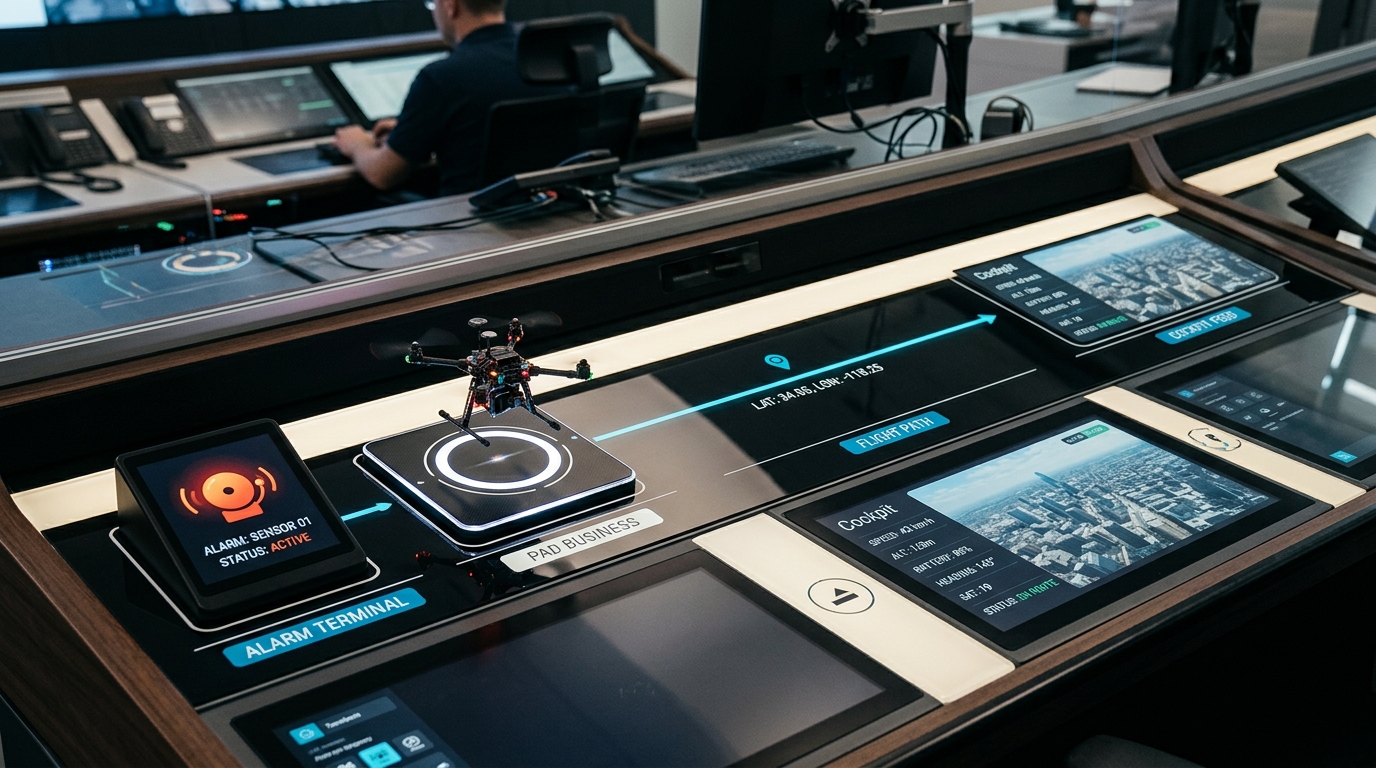
Transitioning from traditional visual line-of-sight patrols to automated, sensor-triggered flights collapses the verification window. When an alarm goes off, a drone launches autonomously from a specialized station, such as the Pad Business engineered for corporate settings. The system streams live overhead footage directly to a centralized operations room. Security teams can monitor the flight and verify threats through a single Cockpit, the unified dashboard designed by werob to display use-case-level data across hardware and regulatory dimensions. This centralized approach allows operators to make immediate decisions based on real-time visual evidence.
As a manufacturer-independent systems integrator, wedrone, the specialized drone unit of werob, takes these automated systems from a promising use case into stable routine operation. Rather than relying on a single drone manufacturer, wedrone designs custom security architectures using a manufacturer-independent partner network. This collaborative model ensures that the entire system, including specialized landing pads like Pad Business or Pad Med for healthcare facilities, integrates seamlessly with existing operator stacks. Furthermore, wedrone structures the entire operational and regulatory framework under EU drone regulation 2019/947 alongside specialized partners, ensuring that companies achieve fully compliant, automated flight operations without administrative bottlenecks.
Drone as First Responder (DFR): Instant Aerial Intelligence
Traditional corporate security operations often suffer from delayed response times. When a localized sensor, thermal camera, or perimeter fence triggers an alarm, security guards must be dispatched to verify the threat. This manual verification process can take up to 30 minutes, during which an intruder may escape or cause significant damage. Furthermore, sending human personnel to investigate an unverified security breach exposes them to unpredictable physical hazards. Managing this operational risk is a major priority for facility operators and security decision makers.
The Drone as First Responder (DFR) workflow addresses these inefficiencies by shifting from visual line-of-sight patrols to automated, sensor-triggered flights. Under this paradigm, a localized alarm automatically triggers an autonomous drone launch within 20 seconds. Guided by pre-programmed flight paths, the drone arrives at the incident scene in under 60 seconds. This rapid deployment collapses the typical alarm verification window from 30 minutes to under five, providing security teams with instant aerial intelligence.
Real-Time Threat Assessment and Infrastructure
During flight and upon arrival, the drone transmits a live visual and high-resolution thermal video stream directly to the security station. This dual-sensor feed allows operators to assess threats in real time from a safe distance, helping them distinguish between false alarms, such as wildlife or blowing debris, and genuine security breaches. By providing immediate situational awareness, the system drastically reduces operator hazard and ensures that physical guards are only deployed when a threat is confirmed.
To support these immediate launch capabilities, a reliable physical charging infrastructure is essential. wedrone, the specialized drone unit of robotics systems integrator werob, builds dedicated landing pads designed for autonomous outdoor operations. These systems include Pad Home for private properties, Pad Business for corporate facilities, and Pad Med for hospital campuses. These weather-resistant landing pads protect the drone between flights, manage automated battery charging, and enable rapid deployment without human intervention.
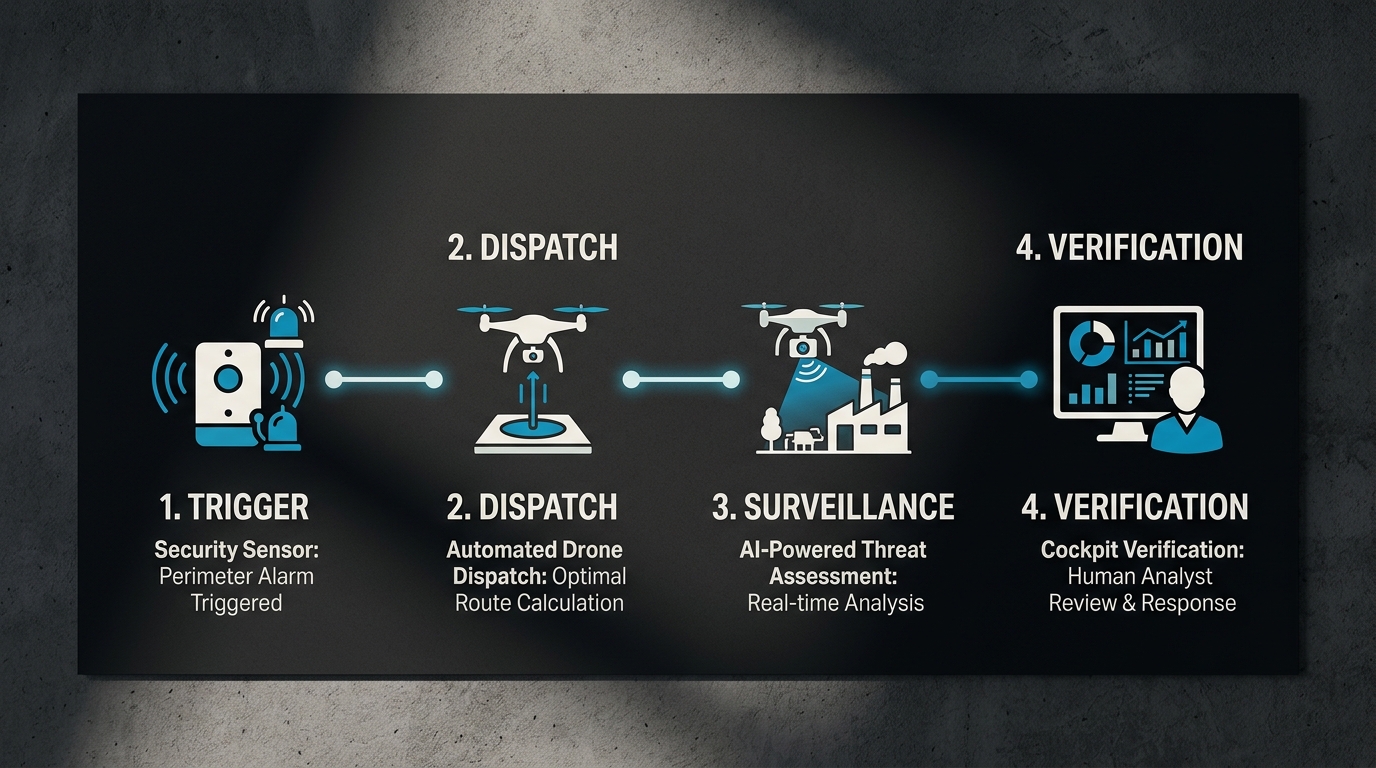
- Sensor Detection: A localized perimeter sensor or camera detects an anomaly and triggers a system-wide alarm.
- Autonomous Dispatch: The drone receives the exact GPS coordinates and launches from its specialized landing pad, such as the Pad Business, within 20 seconds.
- Transit and Flight: The drone flies autonomously to the scene, arriving in under 60 seconds to secure the perimeter.
- Live Intelligence: The security team monitors live thermal and optical video feeds to determine the nature of the alert.
- Return and Recharge: After completing the flight, the drone lands back on its pad to prepare for the next mission.
Sourcing and Operating within the werob Platform
Taking automated drones from an initial use case to a routine, daily security operation requires a comprehensive integration strategy. The werob Platform simplifies this process by handling planning, sourcing, integration, and continuous monitoring. Rather than relying on a single drone manufacturer, wedrone utilizes a manufacturer-independent partner network to select the optimal hardware for each corporate facility. By utilizing software tools like Supplier Match, security teams can select hardware based on regulatory readiness and price, while Spec Engine assists in translating operational requirements into verified, deployable flight plans.
Once deployed, all flights and systems are monitored within a unified monitoring dashboard known as Cockpit. This software provides real-time traffic lights on hardware, infrastructure, and active regulations, ensuring that all security assets operate in harmony. Integration layers, or Connectors, link the drone flights directly with existing facility management and corporate alarm databases, creating a highly coordinated defense system.
In addition to software integration, compliance with civil aviation authorities is a critical operational factor. Under the EU drone regulation 2019/947, operating autonomous drones beyond visual line of sight (BVLOS) is strictly regulated. wedrone structures this transformation by partnering with specialized regulatory and legal experts, helping corporate clients secure the necessary permits and operate fully within the law. Detailed information on regulatory compliance and system integration is available through wedrone at werob.de/en/wedrone.
Navigating EU Drone Regulation 2019/947 for Autonomous Security
Setting up a Drone as First Responder (DFR) system requires shifting from visual line-of-sight patrols to fully automated, Beyond Visual Line of Sight (BVLOS) operations. Under EU Drone Regulation 2019/947, these autonomous missions fall squarely into the specific category of flight operations. This classification represents a major shift from basic consumer drone flights, demanding formal operational authorizations and systematic risk assessments to ensure safety in populated or industrial airspace. While this regulatory framework is strict, it is designed to enable routine operations when handled through a structured, compliant process.
For corporate security teams, the primary legal path involves establishing a comprehensive risk-management workflow. Under Article 11 of Regulation (EU) 2019/947, operators must conduct a Specific Operations Risk Assessment (SORA) or comply with a Predefined Risk Assessment (PDRA) to secure approval from national aviation authorities, such as the Luftfahrt-Bundesamt in Germany. This process evaluates both the ground risk (potential damage on the surface) and the air risk (the likelihood of colliding with other aircraft). By addressing these dimensions systematically, internal compliance officers, including data protection, health and safety, and information security leads, can establish clear boundaries for safe flight.
Core Legal Pathways under the Specific Category
Navigating these complex regulations without a structured operational framework often leads to severe organizational bottlenecks, delaying deployments by several months. To bypass these hurdles, enterprise security departments must align their flight concepts with established standard scenarios or predefined risk models rather than starting from scratch. As a manufacturer-independent integrator, wedrone structures this process by working with a specialized partner network of aviation experts, legal consultants, and technology suppliers. This collaborative approach allows corporate operators to bypass regulatory bottlenecks and match their security needs with compliant hardware and software configurations.
- Standard Scenario (STS-02): Designed for BVLOS operations over controlled ground areas in populated environments, using active visual observers to monitor airspace safety.
- Predefined Risk Assessments (PDRA): Simplified authorization paths, such as PDRA-S01 or PDRA-S02, which offer pre-assessed templates for common flight profiles under specific operating conditions.
- Custom SORA Applications: Required for highly customized corporate sites where standard scenarios do not fit, necessitating a comprehensive analysis of mitigation strategies, technical redundancies, and pilot training.
To support this transition, the European Union Aviation Safety Agency (EASA) provides standardized templates and Acceptable Means of Compliance (AMC) that simplify the administrative burden for operators using approved hardware configurations. By working with specialized legal and technical partners within the wedrone network, corporate operators can implement pre-verified flight concepts that drastically compress the time required to secure operational permits from national authorities. This collaboration turns regulatory hurdles into a structured, manageable workflow.
Establishing Routine Operations with the Cockpit
Once regulatory approval is granted, the challenge shifts to daily management. Security teams need to monitor flights, track remote pilot training, maintain automated audit logs, and coordinate incident responses within a single interface. The Cockpit serves as this central operational hub, providing a real-time monitoring dashboard that tracks critical metrics across hardware, infrastructure, and compliance dimensions. If a sensor trigger alerts the system to a perimeter alarm, the drone can launch autonomously from a protective landing pad, such as the Pad Business designed specifically for corporate environments, and execute a verification mission in under five minutes.
By combining regulatory readiness, specialized partner compliance, and dedicated hardware like the Pad Business, wedrone takes drones from isolated technology use cases to repeatable, routine security operations. Security leaders can coordinate these missions seamlessly without getting bogged down in individual hardware APIs or manual flight planning, ensuring that every deployment remains fully compliant with EU Drone Regulation 2019/947. To explore how to implement these compliant, manufacturer-independent workflows for your security infrastructure, visit the wedrone team at werob.de/en/wedrone.
Manufacturer Independence: Sourcing the Optimal Hardware and Software
Corporate security operations span diverse environments, from sprawling industrial complexes to high-density logistics hubs. Standardizing on a single drone manufacturer often creates operational bottlenecks, as no single original equipment manufacturer (OEM) provides the perfect hardware for every unique site requirement. A manufacturer-independent approach ensures that security teams can select the precise combination of aerial vehicles, specialized sensor payloads, and software integrations. As the drone unit of werob, wedrone takes drones from initial use cases to routine operations through its manufacturer-independent partner network. The werob Platform serves as the central integration layer, allowing organizations to transition from manual patrols to automated, sensor-triggered Drone as First Responder (DFR) flights without being locked into a closed ecosystem.
Finding the Best-Fit OEMs with Supplier Match
To identify the optimal hardware for complex operational environments, the werob Platform utilizes Supplier Match. This matching engine evaluates a network of over 44 drone manufacturers, scoring and ranking hardware candidates based on critical factors such as regional service coverage, integration footprint, and overall regulatory readiness. Rather than forcing a generic drone model onto a specialized facility, Supplier Match helps operators select hardware that aligns with their site layout, weather constraints, and response objectives. The system ensures that the selected hardware integrates with automated landing structures, including specialized landing pads such as Pad Business for corporate sites or Pad Med for hospital facilities, to maintain continuous readiness.
Verifying Flight Plans with Spec Engine
Once the physical hardware is selected, establishing a compliant and automated flight path is the next priority. The werob Platform leverages Spec Engine to translate plain-language shift and security descriptions into formally verified, ROS-compatible action graphs and deployable plans within 48 hours. By utilizing this software, security managers and compliance officers can guarantee that automated response routines remain reliable, predictable, and fully aligned with internal safety guidelines. Spec Engine provides the technical foundation needed to ensure that when an alarm is triggered, the drone executes a precise, pre-verified path to the incident scene, reducing verification times and delivering immediate situational awareness.
- Agnostic hardware integration to prevent vendor lock-in and ensure long-term scalability across different facilities.
- Systematic evaluation of over 44 manufacturers via Supplier Match to secure regional service support and proven hardware reliability.
- Rapid generation of verified, ROS-compatible flight plans through Spec Engine to ensure operational compliance within 48 hours.
- Seamless deployment across automated landing pads, including Pad Home, Pad Business, and Pad Med, depending on site requirements.
- Consolidated real-time monitoring and threat escalation through a single, unified Cockpit dashboard.
Infrastructure for 24/7 Readiness: Automated Drone Landing Pads
To transition drone operations from sporadic manual flights to a reliable, automated security resource, continuous physical readiness is essential. This is where specialized drone landing pads play a central role. As the dedicated drone unit of werob, a brand of CITO GmbH based in Hamburg, wedrone functions as a manufacturer-independent systems integrator. By combining advanced robotic systems with automated charging nests, wedrone helps companies move drones from isolated use cases into seamless routine operations. These landing pads act as autonomous protective stations, housing the aircraft and keeping them fully powered to respond to security events at a moment's notice.
Continuous Power and Environmental Protection
A primary constraint of unmanned aerial systems is limited battery life, which traditionally required human operators to manually swap power packs between flights. Automated landing pads resolve this bottleneck by incorporating precision docking mechanisms and contact-based or wireless charging systems. When a security alarm is triggered, the drone launches instantly from its climate-controlled housing. After completing its automated patrol, the aircraft returns to the dock, where it is guided safely onto the charging surface. This weather-resistant design ensures that the electronic components and payloads are shielded from rain, snow, and extreme temperatures, maintaining continuous operational readiness.
Tailored Charging Stations for Diverse Environments
| Landing Pad Model | Target Application | Key Operational Role |
|---|---|---|
| Pad Home | Private properties | Protects and recharges aircraft on residential estates, enabling rapid automated surveillance when property boundaries are breached. |
| Pad Business | Corporate and industrial sites | Enables commercial facilities to deploy continuous Drone as First Responder patrols and verify perimeter alarms within minutes. |
| Pad Med | Hospitals and healthcare facilities | Provides specialized, secure landing areas for automated medical logistics, ensuring temperature-sensitive transport. |
By deploying these specialized systems, commercial operators can drastically reduce response times. On large corporate properties, for example, deploying a drone via Pad Business allows security teams to collapse their alarm verification window from half an hour to under five minutes. For healthcare campuses, Pad Med serves as a critical node in medical logistics, facilitating the secure, automated transfer of urgent specimens or supplies. Each pad is designed to integrate into the existing infrastructure of the site, ensuring that the technology supports rather than disrupts daily business operations.
Operating such advanced autonomous systems requires strict adherence to legal frameworks, particularly under EU drone regulation 2019/947. To navigate these complex legal environments, wedrone structures its projects alongside a manufacturer-independent partner network of regulatory specialists. This ensures that every deployment, from private estates to hospital grounds, meets the highest safety and compliance standards. Once deployed, the entire operation is monitored in real time through the unified Cockpit dashboard, which provides a single interface for managing alerts, viewing live camera feeds, and tracking hardware status.
With the right landing pad infrastructure in place, organizations can achieve true round-the-clock security automation. To find out more about how wedrone takes robotic systems from pilot projects to standardized routine operations, visit the official website at werob.de/en/wedrone.
Unified Operations: Managing Incidents in One Mission Cockpit
Corporate security operations often struggle with slow response times when perimeter intrusion systems trigger alarms. Relying on physical patrols to inspect distant fences can take up to 30 minutes, creating high risk during active breaches. By transitioning from visual line-of-sight patrols to automated, sensor-triggered Drone as First Responder (DFR) flights, operators can collapse these alarm verification windows to under five minutes. As a manufacturer-independent systems integrator for robotics based in Hamburg, wedrone (the drone unit of werob, a brand of CITO GmbH) structures this operational shift from initial use case to routine, daily security routines.
Unified Fleet Monitoring with Cockpit
To manage automated aerial response effectively, security teams require a single mission center rather than scattered hardware utilities. This is where the Cockpit dashboard serves as the central control plane. Cockpit functions as a unified monitoring dashboard that displays real-time system health and live video feeds directly to operators. Instead of checking multiple separate applications, security personnel can view use-case-level traffic lights across four vital dimensions: hardware, infrastructure, regulatory compliance, and specification. This continuous oversight guarantees that drone-in-a-box units and landing stations are always ready to deploy, with integrated audit logs, tasks, training progress, and escalations handled in one interface.
Integrating Security Stacks via Connectors
Automated deployment is only possible when aerial systems communicate directly with existing ground-based security architecture. Using pre-built, multi-tenant Connectors, the werob Platform bridges the gap between different robotic hardware and corporate security stacks. When a perimeter fence sensor, laser barrier, or motion detector triggers an alarm, these Connectors instantly route the incident data to the drone system. The system automatically launches the drone from its landing pad and directs it to the exact GPS coordinates of the trigger. By using these standard Connectors, companies can establish an automated, software-driven response loop that bypasses manual dispatch delays entirely.
Structured Infrastructure and Regulatory Support
Operating autonomous drones requires both reliable physical infrastructure and strict regulatory compliance. Under the EU drone regulation 2019/947, wedrone assists companies in structuring compliant operations by working with specialized legal and technical partners. This ensures that beyond visual line-of-sight (BVLOS) operations meet all safety and legal standards. Additionally, the physical deployment relies on specialized landing pads developed for different corporate environments. These include Pad Home for private properties, Pad Business for commercial sites, and Pad Med designed specifically for hospital helipads and medical facilities. This complete integration ensures a safe, continuous, and compliant aerial security presence.
| Security Dimension | Traditional Manual Method | Integrated Drone Response |
|---|---|---|
| Verification Time | Up to 30 minutes for guard patrol | Under 5 minutes via automated launch |
| Data and Feeds | Siloed camera views, manual radios | Live video stream integrated into Cockpit |
| System Connection | Separated alarms and guard dispatch | Pre-built Connectors link sensors to drones |
| Operations Base | Physical guard booths and paper logs | Unified dashboard tracking health and audits |
Read more: the wedrone drone unit · drone inventory in warehouses · medical drone delivery.
FAQ
- How fast can a Drone as First Responder (DFR) verify a security alarm?
- In an automated setup, a drone launches within 20 seconds of a triggered sensor or alarm. It flies directly to the coordinates and arrives in under 60 seconds, collapsing the total verification time to under 5 minutes. This is significantly faster than traditional security guard dispatches, which typically require 15 to 30 minutes to reach the scene. The live visual and thermal feeds are streamed instantly to the central cockpit for decision makers.
- What is the regulatory framework for autonomous security drones in Europe?
- Autonomous drone security operations fall under the EU drone regulation 2019/947, specifically in the Specific category for Beyond Visual Line of Sight (BVLOS) flights. Operating in this category requires structured risk assessments, operational authorizations, and compliance with strict safety standards. wedrone works alongside specialized partners to ensure that all flight concepts, equipment, and pilot qualifications strictly adhere to these EASA regulations.
- What is the advantage of a manufacturer-independent systems integrator?
- No single drone manufacturer fits every security requirement. A manufacturer-independent integrator like wedrone selects and combines the best-in-class hardware, landing pads, and software for your specific site. Using tools like Supplier Match, wedrone ranks over 44 robot manufacturers to find optimal hardware based on regional coverage and regulatory readiness, rather than forcing a one-size-fits-all proprietary solution.
- What types of drone landing pads does wedrone offer?
- wedrone builds and integrates automated drone landing pads, also known as drone-in-a-box systems, that secure, weather-protect, and recharge autonomous aircraft between missions. These include Pad Home for private properties, Pad Business for corporate security and campus monitoring, and Pad Med designed specifically for hospital logistics and rapid medical deliveries.
- How do security teams monitor drone missions and analyze incidents?
- Operations run in one unified mission dashboard called Cockpit. It displays live thermal and visual video feeds during automated alarm verification flights. Cockpit monitors system health across hardware, infrastructure, regulatory compliance, and specifications in real time. It also archives audit logs, tracks operator training progress, and manages automated escalations for security personnel.
- Can security drones integrate with existing perimeter alarm systems?
- Yes. Using pre-built software Connectors, the drone system integrates directly with your existing perimeter intrusion detection systems, access control networks, and video management platforms. When an automated sensor or fence alarm is triggered, the Connectors instantly translate that event into a coordinate-based dispatch command for the drone, initiating an immediate autonomous launch.
Related reading
Medical Drone Delivery: How Hospitals and Labs Cut Transport Times from Hours to Minutes
Blood products, lab samples and medication are the fastest-growing drone market. What hospital networks need to start medical drone delivery, and where the value shows up first.
3 July 2026drone defense and c uas what it isDrone defense and C-UAS: What it is and how it works
Learn how Counter-Unmanned Aircraft Systems (C-UAS) work. Discover the detection, tracking, and mitigation technologies powering modern drone defense.
6 August 2026police control center drone networkPolice drone networks: A live picture within minutes
Drone networks for police control centers provide immediate aerial situational pictures. Learn about BOS rights, SORA exemptions, and system integration.
17 August 2026fire control center drone networkFire department drone networks: Automatic launch on alarm
Discover how automated drone networks for fire departments provide real-time aerial intelligence before units arrive, leveraging BOS SORA exemptions.
17 August 2026legal framework for drone defense in germany andLegal framework for drone defense in Germany and the EU
Explore the legal framework for drone defense in Germany and the EU. Learn how the 2026 EU Action Plan and new German laws impact C-UAS deployment.
6 August 2026