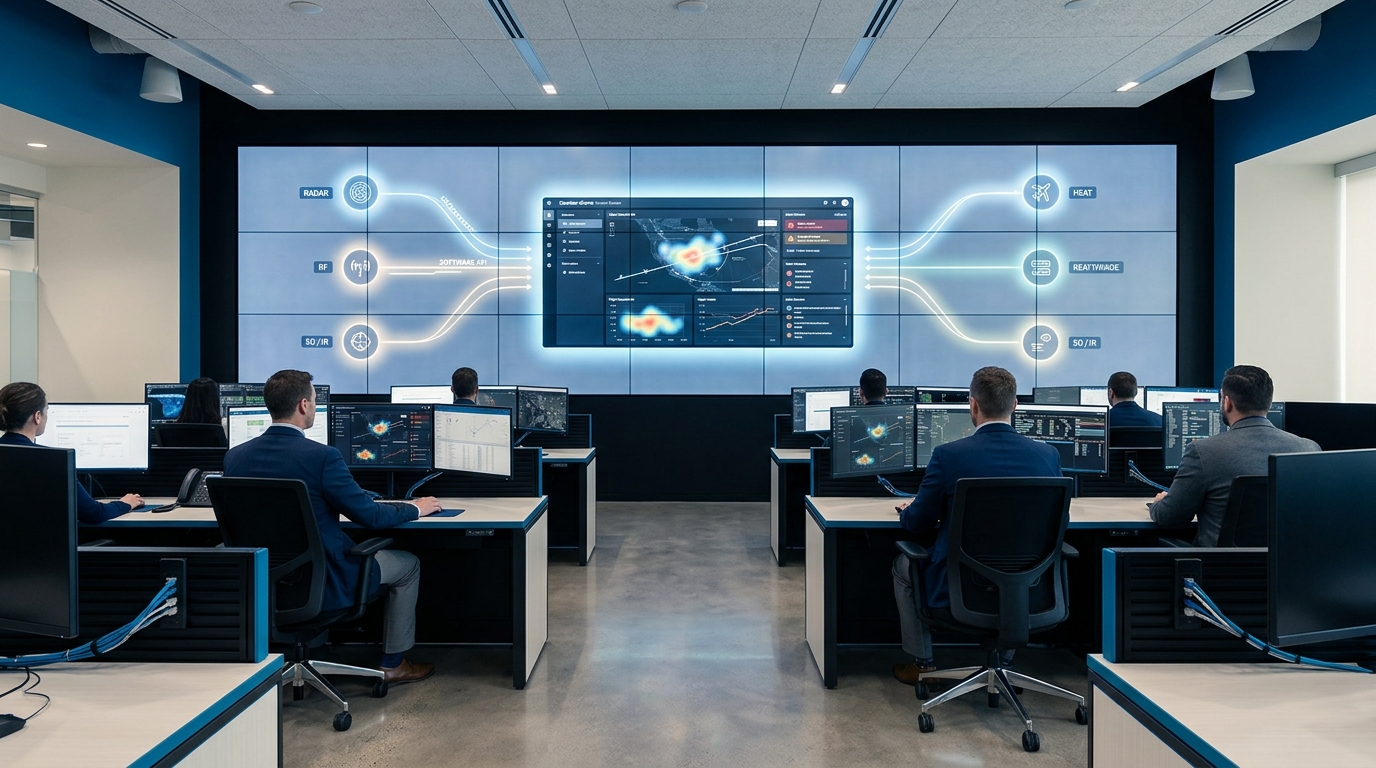
Counter-drone systems for critical infrastructure and events
Evaluate C-UAS hardware, navigate complex airspace regulations, and integrate counter-drone systems to secure critical infrastructure and large events.
Unauthorized drone activity poses severe risks to public gatherings and critical grids. Discover how to evaluate C-UAS hardware, navigate complex airspace regulations, and integrate drone detection into unified security dashboards.
Key Takeaways
- 1Effective detection relies on multi-sensor fusion and AI, offering reliable classification at ranges of 300 to 800 meters.
- 2Mitigation tactics must comply with stringent airspace regulations, such as federal temporary flight restrictions.
- 3Centralized monitoring dashboards simplify the management of hardware, infrastructure health, and incident escalations.
The escalating threat of unauthorized drones
The rapid proliferation of unauthorized uncrewed aerial systems (UAS)-commonly referred to as drones, C-UAVs, or counter-drone threats-presents severe operational, physical, and cyber risks to critical infrastructure facilities, energy grids, and major public events. Commercial off-the-shelf drones have expanded in capability, speed, and payload capacity, enabling unauthorized operators to bypass traditional perimeter security controls and conduct unauthorized surveillance or physical intrusions.
For internal compliance officers, including Chief Information Security Officers (CISOs), Data Protection Officers (DPOs), and Health, Safety, and Environment (HSE) managers, rogue drone incursions create substantial financial liability, intellectual property risks, and operational downtime.
- Physical operational disruption: Forced shutdowns of industrial plants, airports, or power grids caused by airborne collisions or close proximity flights.
- Airborne industrial espionage: Unauthorized high-resolution optical and thermal surveillance of proprietary facility operations or event venues.
- Cyber exploitation: Rogue wireless access points or payload drops designed to intercept sensitive facility communication networks.
- Contraband and safety violations: Unauthorized payload drops across secure perimeters at correctional facilities or high-security logistics hubs.
To counter these evolving risk vectors, corporate compliance and safety teams are adopting structured counter-drone strategies designed to secure low-altitude airspace.
Core technologies driving drone detection
Building an effective counter-drone system requires a multi-sensor fusion approach, as no single sensing modality provides complete airspace coverage across all weather conditions and environmental topographies. CISA recommends a "system of systems" approach that combines two or more sensor types, typically radar, radio frequency (RF) detection, electro-optical/infrared (EO/IR) cameras, acoustic sensors, and Remote ID receivers, linked through sensor fusion software to optimize coverage and reduce detection errors.
Sensor fusion software and machine learning classification process incoming multi-sensor data streams in real time to cut down false positives, which occur when a detection system mistakes another flying object such as a bird for a drone. CISA warns that a high error rate can cause alert fatigue and diminish response effectiveness, and advises buyers to ask manufacturers directly about a system's false positive rate, tested limitations, and detection range. Localized RF and acoustic sensors typically cover a few hundred meters, while radar arrays extend detection out to several kilometers.
| Sensor Modality | Detection Range | Primary Capability | Operational Advantage |
|---|---|---|---|
| Radio Frequency (RF) | 300 to 800 meters | Signal intercept & controller tracking | Passive operation with zero radio emissions |
| Radar (X/Ku Band) | 5 to 30 kilometers | Primary trajectory & velocity tracking | All-weather line-of-sight tracking |
| Acoustic Arrays | 300 to 800 meters | Motor & propeller sound signatures | Detects autonomous drones without active RF link |
| Optical / EO-IR | Visual range | Visual identification & evidence collection | Provides evidence-grade optical verification |
Combining multiple detection layers ensures that security teams receive early warnings while validating target signatures before triggering operational responses.
Evaluating and sourcing counter-drone hardware
Selecting appropriate counter-drone hardware presents a complex technical procurement challenge. Security and compliance leadership must evaluate dozens of original equipment manufacturers (OEMs) to identify hardware configurations that suit local terrain, radio frequency environments, and regulatory requirements.
Procurement frameworks evaluate prospective hardware vendors across four essential operational dimensions: regulatory readiness, regional service coverage, integration footprint, and total price band. Rigorous OEM evaluation prevents costly deployments of mismatched hardware that fails to meet operational standards or regional legal rules.
- Regulatory readiness: Verifying that hardware complies with local spectrum non-interference laws and regional aviation standards.
- Regional service coverage: Guaranteeing local service level agreements (SLAs), spare parts availability, and rapid technical support.
- Integration footprint: Standardized API compatibility with existing facility video management systems and security access controls.
- Price band alignment: Transparent cost structures balancing capital expenditures with ongoing software licensing fees.
To streamline sourcing, compliance teams must translate plain-language shift requirements and site specifications into verified deployment plans, ensuring hardware matches site requirements before capital expenditure.
Navigating airspace regulations and mitigation laws
Compliance officers must strictly distinguish between drone detection and active mitigation. The joint DOJ, FAA, DHS and FCC advisory notes that legal prohibitions are not based on broad classifications such as active versus passive, but on the specific functionality of each system: radar, EO/IR and acoustic sensors that simply reflect waves off an aircraft are less likely to raise concerns under federal criminal surveillance statutes, while RF systems that monitor communications between a drone and its ground control station may implicate the Pen/Trap Statute and the Wiretap Act.
In most jurisdictions, active countermeasures like active RF jamming, GPS spoofing, or kinetic interception are restricted to federal authorities or designated state security agencies due to potential interference with commercial aviation, public telecommunications, and emergency response infrastructure.
| Operation Category | Legal Classification | Regulatory Framework | Authorized Personnel |
|---|---|---|---|
| Passive Sensing (RF/Acoustic) | Monitoring & Detection | CISA risk assessment guidelines | Private security, HSE & facility compliance officers |
| Active RF Jamming | Frequency Interruption | Strict telecommunications non-interference laws | Federal law enforcement & military agencies |
| GPS Spoofing | Signal Falsification | Aviation safety prohibitions | Designated national defense authorities |
| Kinetic Neutralization | Physical Interception | Airspace & property safety regulations | Authorized state defense entities |
CISA advises critical infrastructure operators to integrate drone detection technology into existing security plans rather than running it as a standalone capability, and to coordinate with the FAA where a site sits on or near an airport and with the FCC where a sensor transmits, such as radar. Both CISA and the interagency advisory strongly encourage entities to seek legal counsel experienced in federal and state criminal, surveillance, and communications law before acquiring or operating any detection or mitigation system.
Integrating drone defense into physical security stacks
Siloed monitoring systems create operational friction during critical security incidents. A standalone counter-drone terminal requiring separate manual oversight increases operator cognitive load and delays escalation times during fast-moving airspace incursions.
To maximize operational efficiency, C-UAS alerts must integrate directly into existing enterprise security management systems, video management software (VMS), and building management stacks. Pre-built integration middleware connects airspace alerts with ground-level physical security workflows, allowing operators to trigger automated pan-tilt-zoom camera tracking, access control adjustments, or security dispatches through a qualified systems integrator.
Linking aerial security data with existing physical infrastructure systems gives compliance and security teams comprehensive situational awareness across physical and digital perimeters infrastructure robotics.
Real-time monitoring for multi-site deployments
Managing airspace security across multi-site enterprises or geographically dispersed event venues requires centralized real-time monitoring. Compliance officers and operations managers need high-level visibility over sensor uptime, system health, and incident logs across every active site.
Utilizing a unified operational dashboard featuring use-case traffic light indicators simplifies multi-dimensional risk monitoring traffic light system. Evaluating site readiness across hardware health, infrastructure connectivity, regulatory compliance, and specification adherence ensures immediate clarity without requiring manual technical reviews.
- Status monitoring: Continuous operational verification of sensor health, power supply, and network connectivity across all sites.
- Threat classification: Real-time threat categorizations driven by multi-sensor fusion and AI algorithms.
- Protocol escalation: Automated routing of verified aerial incursions to on-site security personnel and local law enforcement authorities.
- Audit logging: Automated event archiving for post-incident reporting, legal compliance, and forensic analysis.
Standardized audit logging provides verifiable documentation for legal inquiries, ensuring full audit compliance for internal HSE and risk management reviews.
Future-proofing against autonomous swarms
As uncrewed aerial technology advances, counter-drone systems must evolve to address coordinated autonomous swarms targeting decentralized infrastructure. Swarm architectures leverage distributed mesh networks and edge computing, making conventional single-target tracking and basic signal jamming ineffective.
Future-proofing facility airspace security requires transitioning from reactive detection to predictive, cloud-connected airspace management architectures. Adaptive systems continuously update threat detection models, analyze flight trajectory anomalies, and coordinate multi-sensor arrays to maintain airspace sovereignty drone inspection.
- Continuous cloud-connected updates: Automated AI detection model updates to combat emerging flight control protocols.
- Multi-agent tracking capabilities: Advanced algorithms capable of detecting and tracking multiple simultaneous targets.
- Standardized integration architecture: Flexible middleware connecting aerial sensors with enterprise risk management stacks.
- Formally verified specification standards: Modular frameworks enabling rapid hardware and software upgrades without operational downtime.
Achieving long-term operational resilience requires an integrated systems integration approach. The werob Platform provides a hardware-agnostic architecture that handles planning, OEM evaluation via Supplier Match, pre-built Connectors, and continuous fleet monitoring through Cockpit, ensuring complete airspace security for critical infrastructure and major events.
FAQ
- What does C-UAS stand for?
- C-UAS stands for Counter-Unmanned Aircraft System, commonly referred to as counter-drone technology, designed to detect, track, and mitigate unauthorized drone activity.
- Why do critical infrastructure sites need drone defense?
- Facilities such as power plants and stadiums face risks from unauthorized surveillance, data theft, and operational disruption caused by malicious or careless drone operators.
- What sensors are used in drone detection?
- Systems typically use multi-sensor fusion, combining radio frequency (RF) scanners, radar, acoustic sensors, and electro-optical/infrared cameras to accurately classify threats.
- Can security teams legally shoot down or jam drones?
- Active mitigation, such as jamming or kinetic interception, is heavily restricted by federal laws. Organizations must consult legal counsel and adhere strictly to airspace regulations.
- How does AI improve counter-drone systems?
- Artificial intelligence enhances predictive analytics and machine learning classification, which significantly reduces false positive alerts and automates threat prioritization.
Related reading
The Role of a Robotics Systems Integrator in Modern Operations
A robotics systems integrator bridges the gap between raw hardware and operational ROI by managing the entire deployment lifecycle. This guide explores how werob uses a four-layer platform to deliver live robots in eight weeks.
7 July 2026counter drone systems explained c uav detection defenseCounter-Drone Systems Explained: C-UAV Detection & Defense
Discover how C-UAV and C-UAS systems protect airspace through advanced detection, tracking, and mitigation technologies to secure critical infrastructure.
6 August 20264 dim traffic light robot use case4-dim traffic light system for robots: operational safety in live operation
A robot that stands up costs money. A robot that drives unsafely endangers operations. The 4-dimensional traffic light system in the werob cockpit offers the necessary transparency for scaled use.
21 June 2026drone landing pad businessDrone Landing Pads for Business and Home: The Last Metre of Drone Delivery
Drone delivery rarely fails because of the drone. It fails at the landing point. What a drone landing pad is, which variants exist and how wedrone plans, builds and operates pads.
3 July 2026gemini robotics er 2 safety criticalThe Gemini Robotics ER 2 model card prohibits safety-critical use
While the coverage celebrates robots collaborating, the model card for the same model tells you not to deploy it where a malfunction could injure someone. Both statements are true, and the gap between them is where operators live.
30 July 2026