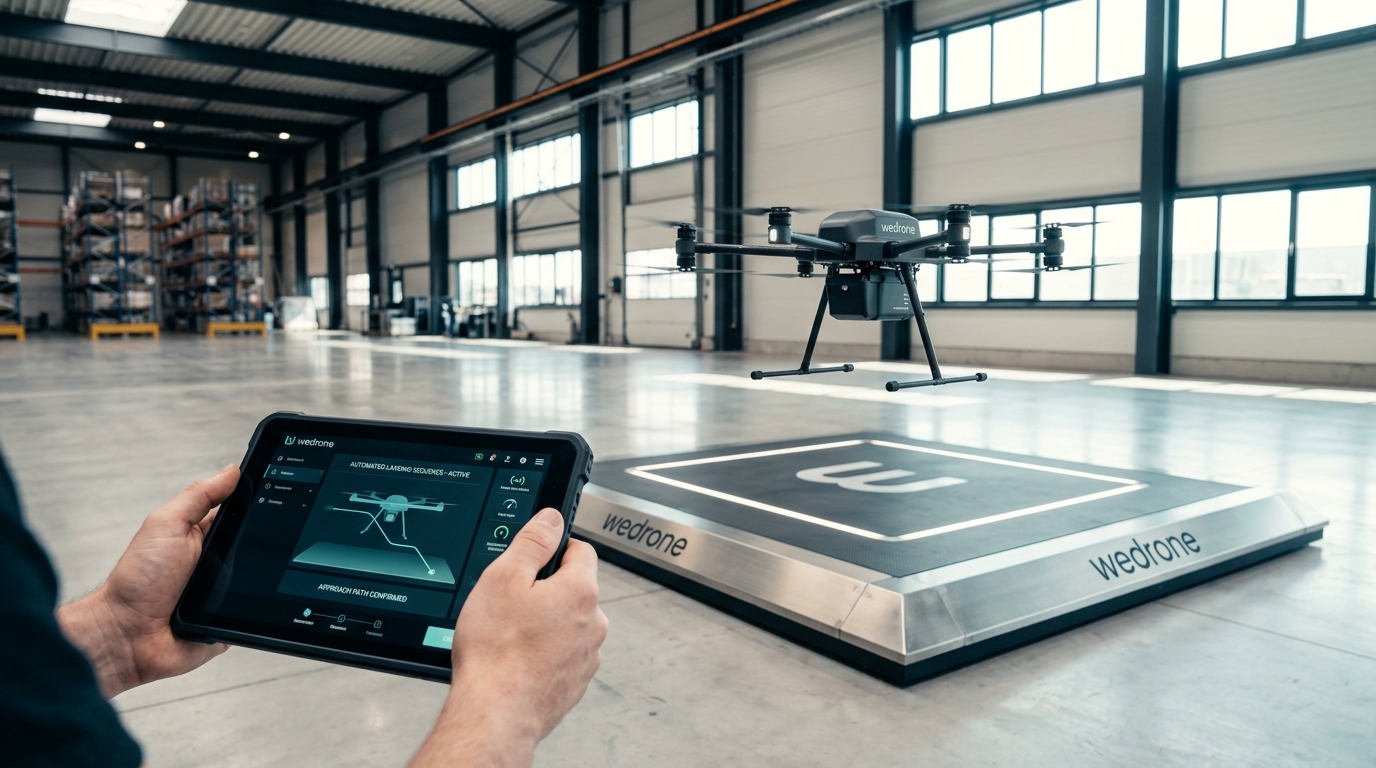
Drone-as-a-Service: the operating model that turns drone pilots into routine programs
Discover how Drone-as-a-Service converts manual pilots into routine programs. Scale your operations legally under EU regulation 2019/947 with wedrone.
Transitioning from isolated drone flights to automated enterprise programs requires a structured operating model. Learn how a manufacturer-independent framework, specialized landing pads, and a single mission cockpit make drone operations routine under EU regulation 2019/947.
Key Takeaways
- 1Enterprise drone services are scaling rapidly, with the global market valued at 17.0 billion USD in 2023.
- 2The Drone-as-a-Service model shifts focus from complex hardware ownership to routine, automated data consumption.
- 3EU drone regulation 2019/947 defines three categories of risk to keep aerial operations legally compliant.
- 4Automated landing infrastructures like Pad Business and Pad Med provide the physical foundation for routine flights.
The shift from experimental pilot projects to routine programs
For years, enterprise drone adoption was characterized by isolated test flights and localized proof-of-concept trials. These initial pilot projects successfully demonstrated the theoretical value of aerial data but frequently failed to scale. Today, the global landscape is changing rapidly as organizations transition from these ad-hoc experiments toward systematic, repeatable drone programs. Reflecting this maturity, the global drone services market was valued at USD 17.0 billion in 2023 and is projected to expand significantly as businesses integrate aerial operations into their daily workflows. This commercial growth indicates a broader industrial demand for standardized, reliable operational frameworks rather than customized, one-off missions.
Managing drone operations as isolated events creates substantial operational bottlenecks. When missions rely entirely on the manual scheduling of pilots, scaling becomes cost-prohibitive and operationally restrictive. Furthermore, the manual transfer of flight logs and captured sensor data into corporate databases introduces unnecessary delay and risk of error. For enterprise decision makers and operators, scaling requires shifting the focus from the individual aircraft to the broader operating model. Moving past these bottlenecks means establishing systematic workflows where aerial missions run on predetermined routines, supported by automated infrastructure and standardized integration layers.
Comparing experimental flights and systematic programs
| Operational Dimension | Experimental Pilot Projects | Routine Drone Programs |
|---|---|---|
| Flight Execution | Dependent on manual piloting and individual operator availability | Automated mission execution based on standardized action graphs |
| Infrastructure | Temporary takeoff areas and manual battery changes between flights | Permanent landing pads like Pad Business or Pad Med for autonomous housing and charging |
| Data Workflow | Manual download of flight data from memory cards to local storage | Direct integration into corporate databases using middleware like Connectors |
| Regulatory Compliance | Ad-hoc, manual flight approvals per individual mission | Continuous, structured operations compliant with EU regulation 2019/947 |
To establish this routine operating model, wedrone, the drone unit of Hamburg-based robotics systems integrator werob (a brand of CITO GmbH), coordinates the entire system architecture. By utilizing a manufacturer-independent partner network, operators avoid hardware lock-in and select the optimal airframes for their specific applications. This architecture is managed through a single mission cockpit, such as Cockpit, which aggregates telemetry, infrastructure status, and flight plans into a unified interface. Working with specialized partners also ensures that all operations remain fully compliant with EU drone regulation 2019/947, turning complex regulatory hurdles into routine, automated compliance checks.
Defining the Drone-as-a-Service (DaaS) operating model
For many enterprises, the initial excitement of introducing drone technology often stalls during the transition from pilot projects to routine operations. What begins as a successful test flight frequently becomes an operational burden, as companies struggle to manage pilot licensing, hardware maintenance, and changing regulatory frameworks. The Drone-as-a-Service (DaaS) operating model addresses this challenge by shifting the corporate focus from drone hardware ownership to standardized data delivery pipelines and automated mission execution.
This operational shift transforms how organizations budget for and execute aerial missions. Instead of dedicating significant capital expenditures (CapEx) to purchase rapidly aging drone fleets, companies utilize DaaS to transition these costs into predictable operating expenses (OpEx). According to market data from Meticulous Research, the global drone services market was valued at USD 21.5 billion in 2025 and is projected to reach USD 218 billion by 2036, growing at a compound annual growth rate (CAGR) of 24 percent between 2026 and 2036. This rapid growth reflects a widespread industry realization: the true value of a drone program lies in the insights collected, not the aircraft itself.
The Transition from CapEx to OpEx
By shifting from drone procurement to a subscription or pay-per-mission structure, operators minimize upfront capital requirements. This budget model is particularly valuable for organizations scaling operations across multiple locations, where owning and maintaining specialized hardware in every region is cost-prohibitive. Instead of managing depreciation and technological obsolescence, enterprises purchase verified aerial data as a utility.
- Hardware Independence: Organizations avoid hardware lock-in, enabling them to deploy the exact drone model required for a specific mission, whether a multi-rotor drone for precise infrastructure inspection or a fixed-wing model for large-scale agricultural mapping.
- Continuous Regulatory Compliance: Specialized partners handle the complexities of EU drone regulation 2019/947, ensuring that every flight operates under valid operational authorizations without requiring internal regulatory expertise.
- Infrastructure Integration: Physical landing zones like Pad Home, Pad Business, or Pad Med are integrated directly into the operational environment to facilitate automated charging, protection, and deployment.
- Automated Data Pipelines: Mission results are ingested automatically, removing the need for manual file transfers or pilot-dependent data processing.
Managing Operations in a Unified Mission Cockpit
To scale aerial operations without growing organizational complexity, enterprises require a single control interface. Through the werob Platform, which is developed by the systems integrator, companies can orchestrate their entire drone ecosystem. This is supported by wedrone, the dedicated drone unit of the company, which delivers manufacturer-independent drone solutions. Rather than managing separate tools for scheduling, maintenance, and flight logs, operators utilize the Cockpit. This dashboard provides real-time traffic lights across hardware, infrastructure, regulatory, and specification dimensions, allowing managers to monitor flight status, track pilot training progress, and review automated audit logs from a single screen.
Compliance under EU drone regulation 2019/947
Scaling drone operations from isolated proof-of-concept flights to enterprise-wide routine programs requires a rigorous approach to safety and regulatory standards. In Europe, the legal foundation for these operations is governed by the EU drone regulation 2019/947, which establishes unified aviation rules across all member states. For decision makers and operators, navigating this framework is the most critical step to avoid regulatory bottlenecks and build a legal path to scale. Rather than managing complex national approvals in isolation, the operating model shifts the focus toward standardized compliance, allowing businesses to integrate unmanned aerial systems into daily operations as routine programs rather than highly specialized experiments.
Navigating the Operational Categories
The European framework classifies drone operations into three distinct categories based on the operational risk of the mission. Understanding where a specific use case falls is essential for determining the required remote pilot certifications, operational authorizations, and hardware standards. While low-risk operations can easily proceed under simplified rules, moving to more complex industrial or urban missions requires transitioning into categories that demand structured risk assessments and formal operating declarations.
| Operating Category | Risk Level | Regulatory Requirements | Typical Enterprise Use Case |
|---|---|---|---|
| Open | Low risk | No prior operational authorization required, flight must remain within visual line of sight (VLOS). | Simple facility inspections or basic mapping within line of sight. |
| Specific | Medium risk | Requires operational authorization from the National Aviation Authority or operating under a Standard Scenario (STS). | Beyond Visual Line of Sight (BVLOS) operations, urban transport, or flight over populated areas. |
| Certified | High risk | Certified aircraft, licensed remote pilots, and certified operator approval required, comparable to manned aviation. | High-risk transport of dangerous goods or passenger-carrying operations. |
Partner-Led Compliance and the Cockpit
Managing this regulatory matrix requires deep operational expertise. As the drone unit of werob, a manufacturer-independent systems integrator for robotics, wedrone addresses this challenge by utilizing a partner-driven approach. By collaborating with a manufacturer-independent partner network and specialized regulatory experts, wedrone helps companies secure the necessary operational approvals, compile Specific Operations Risk Assessments (SORA), and streamline remote pilot training. This operational model also standardizes physical safety on-site. The installation of dedicated landing pads, such as Pad Home for residential setups, Pad Business for industrial environments, or Pad Med for healthcare facilities, ensures that every takeoff and landing occurs in a controlled, compliant zone.
Once operations are active, continuous oversight is vital to maintain regulatory compliance. This is managed via the Cockpit, a unified monitoring dashboard that provides real-time visibility across the entire fleet. The dashboard features use-case-level traffic lights across four dimensions: hardware, infrastructure, regulatory, and spec. Should a pilot qualification expire or a specific airspace restriction change, the system flags the issue instantly. This integration of compliance data with active flight monitoring ensures that safety audits are fully transparent. By standardizing physical landing infrastructure and consolidating compliance workflows into a single dashboard, enterprises can safely transform automated flights into routine, repeatable operational programs.
Managing operations within a single mission cockpit
To scale corporate aerial operations beyond isolated, manually flown pilot tests, organizations must shift from a pilot-centric model to highly standardized, repeatable workflows. Scaling these operations effectively requires that all flights and fleet assets are monitored through a single, centralized interface. Under the unified EU drone regulation 2019/947, commercial drone flights are subject to strict operating rules, particularly when operating under specific category authorizations or complex scenarios. To streamline these strict requirements, wedrone, the drone unit of werob, organizes flight management, safety oversight, and operator compliance into a single operational interface: Cockpit.
The four dimensions of operational tracking
Rather than relying on disjointed software tools for flight paths, maintenance logs, and aviation registry checks, the Cockpit, which is built on the broader werob Platform, aggregates data in real time. The system employs use-case-level traffic lights to monitor operational health across four critical dimensions:
- Hardware: Tracking telemetry, battery life, and physical drone maintenance schedules to ensure pre-flight airworthiness.
- Infrastructure: Verifying communication links, sensor diagnostics, and the status of local landing infrastructures.
- Regulatory: Checking active flight permissions, pilot certifications, and airspace restrictions in accordance with EU drone regulation 2019/947.
- Spec: Confirming that the flight plan matches the programmatic specification translated by the Spec Engine.
This standardized oversight is completed by physical infrastructure designed for autonomous processes. wedrone builds robust drone landing stations, including Pad Home, Pad Business, and Pad Med, which provide secure, weather-protected docking and automated battery recharging between scheduled flights. Because werob operates as a manufacturer-independent systems integrator, companies can deploy these hardware components alongside drones from multiple OEMs without facing vendor lock-in. Centralizing these infrastructure components and digital logs inside Cockpit ensures that the complete flight history remains audit-ready and fully standardized for corporate compliance.
Automating physical operations with Pad Home, Pad Business, and Pad Med
Transitioning from isolated drone flight testing to a scalable, routine corporate program requires more than intelligent software. It demands standardized physical infrastructure on the ground to manage landing, protection, and charging without manual human intervention. For organizations seeking to run continuous aerial operations, relying on a pilot to manually swap batteries or retrieve aircraft defeats the purpose of autonomy. Standardized drone landing stations act as the physical anchor of the entire drone-as-a-service model, providing a secure, autonomous hub where drones can operate in repeating cycles.
These automated landing stations resolve two critical challenges of physical drone automation: weather-proof housing and reliable battery charging. When a drone completes an assigned mission, it lands autonomously on the pad using precision guidance. Once landed, the weatherproof housing seals the aircraft from wind, rain, and debris, ensuring the drone remains operational in harsh outdoor environments. Simultaneously, an integrated charging system starts, preparing the drone for its next scheduled flight. This continuous cycle operates under the strict guidelines of EU drone regulation 2019/947, ensuring safety and compliance across all routine missions.
Tailored physical ground infrastructure for diverse use cases
To support different operational scales and environments, wedrone provides specialized configurations of its landing stations: Pad Home, Pad Business, and Pad Med. Each version is optimized for distinct operational profiles and environmental requirements, allowing organizations to select the landing infrastructure that aligns with their specific business goals. This flexibility prevents hardware lock-in and allows enterprises to scale their infrastructure alongside their software capabilities. Whether managing light residential monitoring or intensive medical transport networks, having the correct physical station ensures the long-term reliability of the flight program.
| Landing Pad Model | Operational Focus | Key Structural Features |
|---|---|---|
| Pad Home | Residential and light commercial environments | Compact physical footprint, quiet sealing mechanism, and standard AC power integration for localized property monitoring. |
| Pad Business | Industrial sites, logistics hubs, and facility security | Heavy-duty rugged construction, rapid thermal-managed charging, and integrated environmental sensors for continuous high-frequency operations. |
| Pad Med | Healthcare facilities and clinical delivery networks | Temperature-controlled storage chambers, secure access control mechanisms, and sterile landing surfaces to protect medical payloads during transport. |
The integration of these physical stations with the broader robotics ecosystem is managed through the central Cockpit from werob. The Cockpit allows operators to monitor the status of the landing pads in real-time, tracking charging progress, weather seal integrity, and local environmental conditions. For instance, in clinical transport networks, healthcare operators can track the status of Pad Med units to ensure that temperature-sensitive payloads are secured. This seamless link between ground hardware and cloud monitoring ensures that senior living facility managers and other operational leaders can run reliable programs without complex manual checks.
The power of a manufacturer-independent systems integrator
When establishing a drone program, many organizations naturally begin by purchasing hardware from a single supplier. While this approach appears straightforward initially, it frequently leads to severe proprietary bottlenecks. Relying on a single drone manufacturer limits operational flexibility, restricts sensor selection, and significantly increases supply chain risks. If a manufacturer alters its product roadmap, discontinues a key model, or faces regulatory restrictions, the entire corporate drone program can grind to a halt.
A manufacturer-independent systems integrator solves this structural vulnerability by decoupling hardware selection from operational execution. As the drone unit of werob, wedrone provides a manufacturer-independent partner network that ensures long-term stability. Instead of bending operational requirements to fit the constraints of a single brand, operators can select the optimal drone, payload, and sensor suite for each specific use case. This modularity ensures that the aerial program remains highly adaptable to changing technical and business needs.
| Operational Dimension | Single-Manufacturer Approach | Manufacturer-Independent Integration |
|---|---|---|
| Hardware Flexibility | Limited to vendor-specific models and proprietary payload options. | Access to diverse hardware optimized for specific operational use cases. |
| Supply Chain Resilience | High vulnerability to manufacturer shortages, parts delays, or discontinuations. | Mitigated by sourcing alternatives across an active partner network. |
| Software Integration | Proprietary software silos that hinder integration with existing enterprise stacks. | Unified data flows and centralized monitoring across the entire fleet. |
Scaling operations through the werob Platform
Achieving hardware independence does not mean operators must manage a chaotic patchwork of software interfaces. High-performing programs require open, hardware-agnostic systems that unify diverse fleets under a single operational standard. This is where the werob Platform becomes essential. The platform handles the underlying complexity of planning, sourcing, integration, and continuous monitoring, allowing operators to manage different drone brands within a standardized workflow.
By shifting the focus from specific drone hardware to the broader operational system, organizations can transition isolated pilot activities into routine, scalable business programs. Hardware changes become minor details rather than program-disrupting events, giving enterprise decision makers the confidence to scale aerial automation safely and predictably.
Read more: wedrone drone services · drone inventory in warehouses · power line inspection with drones.
FAQ
- What is the Drone-as-a-Service (DaaS) operating model?
- Drone-as-a-Service is an operational framework where enterprises consume aerial data and automated flight execution without managing hardware, maintenance, or internal pilot teams. This model shifts high capital expenditures into predictable operating costs and ensures that flight plans are executed as standardized, repeatable programs.
- How does EU regulation 2019/947 affect commercial drone operations?
- EU regulation 2019/947 harmonizes drone operations across Europe by classifying them into three categories based on risk: Open, Specific, and Certified. For routine commercial applications, operating in the Specific category with specialized partners ensures all flight approvals, pilot licenses, and safety assessments comply with European Union Aviation Safety Agency standards.
- What is the role of a manufacturer-independent systems integrator in DaaS?
- A manufacturer-independent systems integrator like werob ensures that enterprises are not locked into a single hardware brand. Instead, they can match the absolute best drone hardware, landing pads, and sensors to their specific use case, leveraging a diversified supplier network for greater operational resilience.
- What are Pad Home, Pad Business, and Pad Med?
- These are specialized drone landing pads developed by wedrone to automate the physical side of drone programs. They provide automatic weather-proof housing, precision landing guides, and autonomous battery charging. Pad Home is designed for residential use, Pad Business for industrial environments, and Pad Med for healthcare and emergency logistics.
- How does the werob Cockpit help manage daily drone flights?
- The werob Cockpit is a unified dashboard that tracks drone operations across four core dimensions: hardware, infrastructure, regulatory status, and mission specifications. It eliminates operational fragmentation by providing status traffic lights, continuous flight task schedules, training progress logs, and standardized audit reports in one single system.
- How fast is the global drone services market growing?
- According to industry data, the drone services market is experiencing significant growth, having been valued at 17.0 billion USD in 2023. Backed by the rise of automated models like DaaS, the market is projected to expand at a compound annual growth rate of 24 percent, reaching substantial valuation by 2036.
Related reading
Power Line and Infrastructure Inspection with Drones: Thermography, BVLOS Corridors and Data Products
Learn how drone thermography and BVLOS corridors optimize power line inspections under EU regulation 2019/947, from planning to routine operations.
8 July 2026drone dike inspection programmeDrone dike inspection: from the single flight to a programme
Coverage, repeatability and an evidence trail — not sharper eyes. What operators must set up to turn drone flights over flood defences into a running inspection programme.
28 August 2026onboard drone autonomyOnboard Drone Autonomy: What Changes for Operators
The question is not whether the aircraft can fly itself. It is what you have to be able to show once it does — indoors, on containment, on link loss, and in procurement.
31 August 2026counter drone systems explained c uav detection defenseCounter-Drone Systems Explained: C-UAV Detection & Defense
Discover how C-UAV and C-UAS systems protect airspace through advanced detection, tracking, and mitigation technologies to secure critical infrastructure.
6 August 2026missing person search drone thermalAerial Search for Missing Persons: What Thermal and Search Patterns Deliver
The drone finds nobody. It produces a lead that somebody on the ground has to check. What thermal imaging physically delivers, where it fails, and who holds the operating authorisation when volunteers fly.
1 September 2026