UAS defense: detection, tracking, and mitigation methods
Explore how modern Counter-Unmanned Aircraft System (C-UAS) technology integrates radar detection, optical tracking, and non-kinetic mitigation methods.
As unauthorized drone activity increases, organizations are turning to structured Counter-Unmanned Aircraft System (C-UAS) architectures to protect airspace. Discover how integrated platforms combine radio frequency detection, optical tracking, and electronic mitigation.
Key Takeaways
- 1Radio frequency and radar systems remain the most widely deployed technologies for initial drone detection.
- 2Non-kinetic mitigation methods like signal jamming are highly effective but risk disrupting localized communications.
- 3Modern C-UAS platforms fuse optical, thermal, and acoustic data to minimize false positives from wildlife or electronics.
The growing need for Counter-UAS capabilities
The rapid expansion of autonomous uncrewed aerial systems (UAS) across commercial, industrial, and recreational domains has fundamentally reshaped low-altitude airspace dynamics. Modern counter-drone technologies, formalised in engineering and defense literature as Counter-Unmanned Aircraft Systems (C-UAS) or C-UAV, encompass the specialized hardware and software frameworks required to detect, track, identify, and mitigate unauthorized aerial platforms. As small unmanned aircraft become more accessible, autonomous, and payload-capable, academic researchers and security architects face an unprecedented requirement to protect critical infrastructure, university campuses, and public venues from negligent or malicious drone operations.
Projections from aviation authorities highlight the scale of this airspace transformation. Federal reports indicate that the commercial drone fleet has expanded beyond one million registered units, with forecasts expecting further growth to 1.18 million aircraft by 2029. This structural shift moves operators away from reactive, manual dispatches toward automated, multi-layered airspace defense architectures capable of continuous monitoring.
Earlier counter-drone deployments relied heavily on isolated visual spotters or hand-held radio frequency detectors. Modern operational security mandates a transition to structured, programmatic defense systems. For university robotics departments and systems research labs, evaluating C-UAS design requires understanding the integration of heterogeneous sensing modalities and active mitigation tools within tight regulatory and technical constraints.
- Proliferation of low-cost, high-payload consumer and industrial quadcopters
- Increasing prevalence of autonomous GPS-waypoint navigation bypassing basic RF links
- Regulatory pressure to maintain continuous situational awareness around sensitive airspace
- Requirement for automated response mechanisms to reduce human operator latency
Radio frequency and radar detection systems
Radio frequency (RF) monitoring and radar systems form the primary detection layer for modern C-UAS architectures. RF detection systems operate passively by continuously scanning the electromagnetic spectrum for wireless communication channels established between the unmanned aircraft and its ground control station (GCS). These systems intercept command and control (C2) uplinks as well as downlinked video telemetry, typically operating within open ISM radio bands such as 2.4 GHz, 5.8 GHz, and emerging industrial telemetry frequencies. By matching intercepted packet structures and frequency-hopping signatures against pre-compiled signal libraries, RF sensors can identify the specific drone protocol and estimate the direction of both the aircraft and the pilot.
Active radar systems complement RF monitoring by detecting the physical structure of aircraft regardless of whether they transmit radio signals. Traditional air traffic control radar often filters out small, low-velocity targets to prevent clutter. Modern C-UAS radars employ high-frequency Doppler processing, specifically X-band and Ku-band active electronically scanned arrays (AESA), to isolate small radar cross-section (RCS) targets. By analyzing micro-Doppler signatures caused by high-speed rotating propeller blades, these radar platforms reliably differentiate micro-UAVs from birds, cloud clutter, and ground movement. Citing a survey of fielded systems, the US Government Accountability Office reports that radio frequency and radar systems are the most common drone detection technologies, which is why they anchor the outer detection layer of most deployments.
| Technology Parameter | RF Spectrum Monitoring | Micro-Doppler Radar |
|---|---|---|
| Primary Mechanism | Passive RF signal extraction & protocol decoding | Active electromagnetic wave reflection & Doppler shift |
| Operational Range | 1.5 km to 5.0 km (environment dependent) | 1.0 km to 3.5 km for small RCS (<0.01 m²) |
| Line of Sight Requirement | Non-line-of-sight capable via signal diffraction | Strict line-of-sight required |
| Primary Detection Target | Transmitting radio links and telemetry feeds | Physical airframe and rotating propeller blades |
Optical, infrared, and acoustic tracking methods
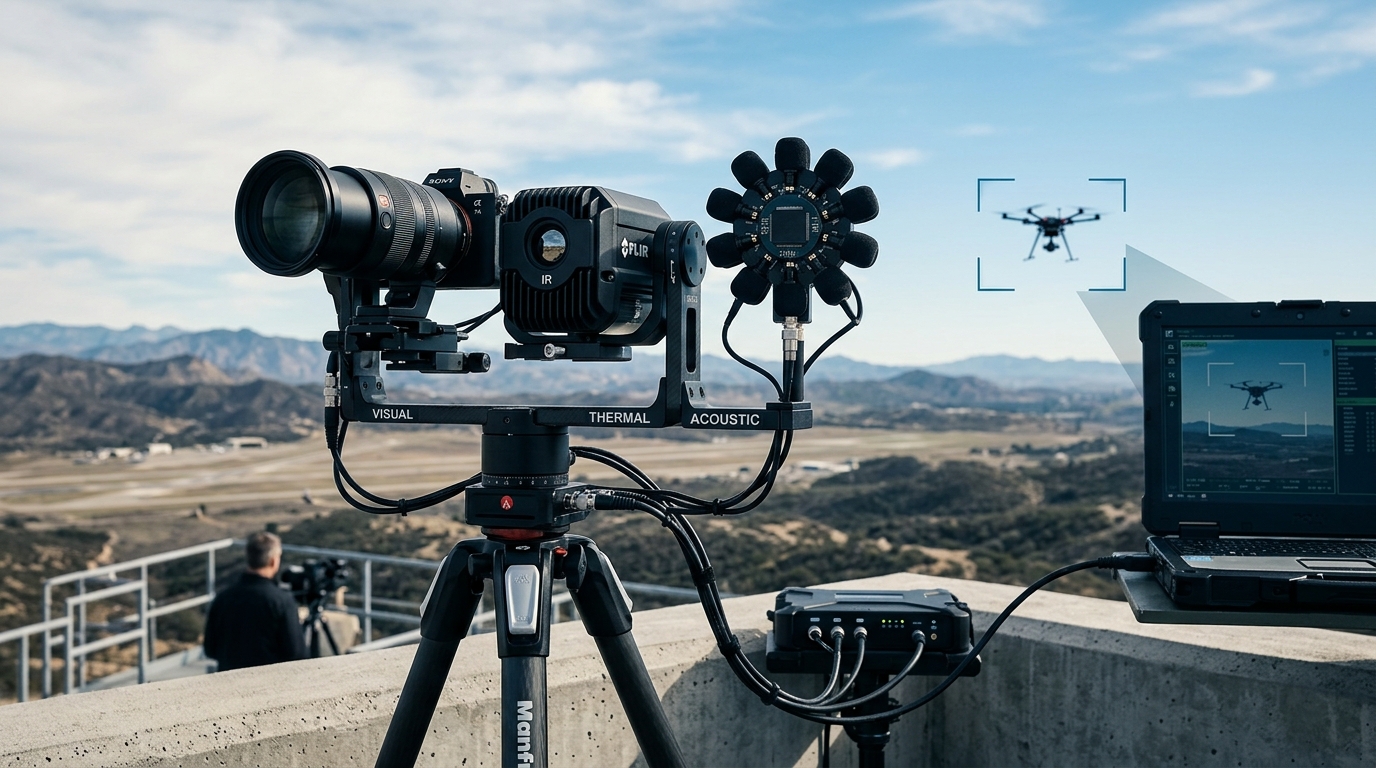
While RF and radar systems provide broad perimeter detection, supplementary tracking modalities are essential for target verification and continuous kinematic tracking. Electro-optical (EO) daylight cameras and long-wave infrared (LWIR) thermal sensors are mounted on stabilized pan-tilt-zoom (PTZ) gimbals to deliver real-time visual confirmation. Infrared tracking isolates heat signatures emitted by brushless electric motor hubs, speed controllers, and onboard microprocessor boards, maintaining target locks even under low-contrast sky conditions or nighttime operations.
Acoustic sensor arrays offer an essential alternative when detecting radio-silent or fully autonomous drones. An aircraft flying a pre-programmed GPS waypoint mission maintains no active control link for RF sensors to intercept, and small airframes can present radar cross-sections similar to birds, so each sensing modality carries its own blind spots. Acoustic arrays utilize calibrated microphone grids and cross-correlation beamforming algorithms to detect the unique fundamental frequencies and motor harmonic profiles produced by drone propellers, offering localized detection in dense urban environments.
Non-kinetic mitigation: jamming and spoofing
Once an unauthorized drone is detected and verified, mitigation subsystems are triggered to neutralize the airborne threat. Jamming is the most common mitigation technology in use, and non-kinetic electronic countermeasures dominate civilian and dual-use environments for that reason. RF jamming systems flood target frequency bands with high-power directional noise, severing the wireless link between the ground operator and the aircraft. Deprived of C2 signals, standard commercial drones trigger automated safety routines, resulting in a controlled hover, vertical landing, or automated return-to-home (RTH) procedure.
More sophisticated non-kinetic tactics include Global Navigation Satellite System (GNSS) spoofing and RF protocol takeover. GNSS spoofing transmits synthetic satellite signals (such as GPS L1/L5 or Galileo E1) to override the drone's onboard navigation matrix, forcing the flight controller to calculate a false spatial coordinate and steering the craft away from protected zones. Protocol takeover systems decode specific proprietary communication layers to inject command packets, granting security operators control to safely land the target vehicle.
Despite their effectiveness, non-kinetic countermeasures present significant operational trade-offs. Directional jamming can inadvertently disrupt local Wi-Fi networks, emergency responder communications, and surrounding industrial telemetry. Consequently, active jamming requires narrow beamforming arrays and precise power calibration to minimize collateral spectrum pollution.
- RF Channel Jamming: Broad spectrum noise injection forcing fail-safe hover or landing routines
- GNSS Spoofing: False satellite signal broadcasting to divert autonomous navigation flight paths
- Protocol Takeover: Cyber-mitigation decoding telemetry to command unauthorized airframes directly
- Spectrum Collateral Risk: Potential disruption to surrounding municipal or industrial wireless infrastructure
Kinetic mitigation: physical interception techniques
In high-security contexts where non-kinetic interventions fail, such as against hardened military drones or autonomous swarms immune to electronic jamming, kinetic mitigation techniques physically disable or capture the target airframe. Kinetic methods range from soft-kill capture systems to hard-kill directed energy weapons. Ground-launched or drone-mounted net cannons deploy weighted nets to entangle rotor blades, causing immediate loss of lift while allowing the airframe to descend via ballistic parachute to preserve forensic evidence.
For rapid engagement at extended ranges, defense architectures deploy high-power lasers and high-power microwave (HPM) directed energy weapons. High-power lasers focus concentrated thermal energy onto critical structural joints, battery housings, or optical sensors, causing rapid physical destruction. High-power microwave systems emit intense electromagnetic pulses that destroy unshielded internal electronics and microcontrollers instantly, providing effective point-defense against multi-drone swarm attacks.
The application of kinetic mitigation in civilian or urban airspace is strictly constrained by secondary risks. As the GAO notes, kinetic methods are problematic because a falling or exploding aircraft may cause unintended damage on the ground. For operators managing industrial sites or infrastructure inspection missions, kinetic deployment decisions must balance immediate airspace defense against potential collateral damage.
| Interception Method | Target Mechanism | Engagement Range | Primary Operational Constraint |
|---|---|---|---|
| Net Projectiles | Physical rotor entanglement | 50 m to 200 m | Limited range and single-shot reloading latency |
| Directed Energy Laser | Thermal structural destruction | 500 m to 2.0 km | Atmospheric attenuation from fog, dust, and smoke |
| High-Power Microwave | Electronic circuit burnout | 100 m to 1.0 km | Potential disruption to non-target electronics in target cone |
Integrated command and control (C2) platforms
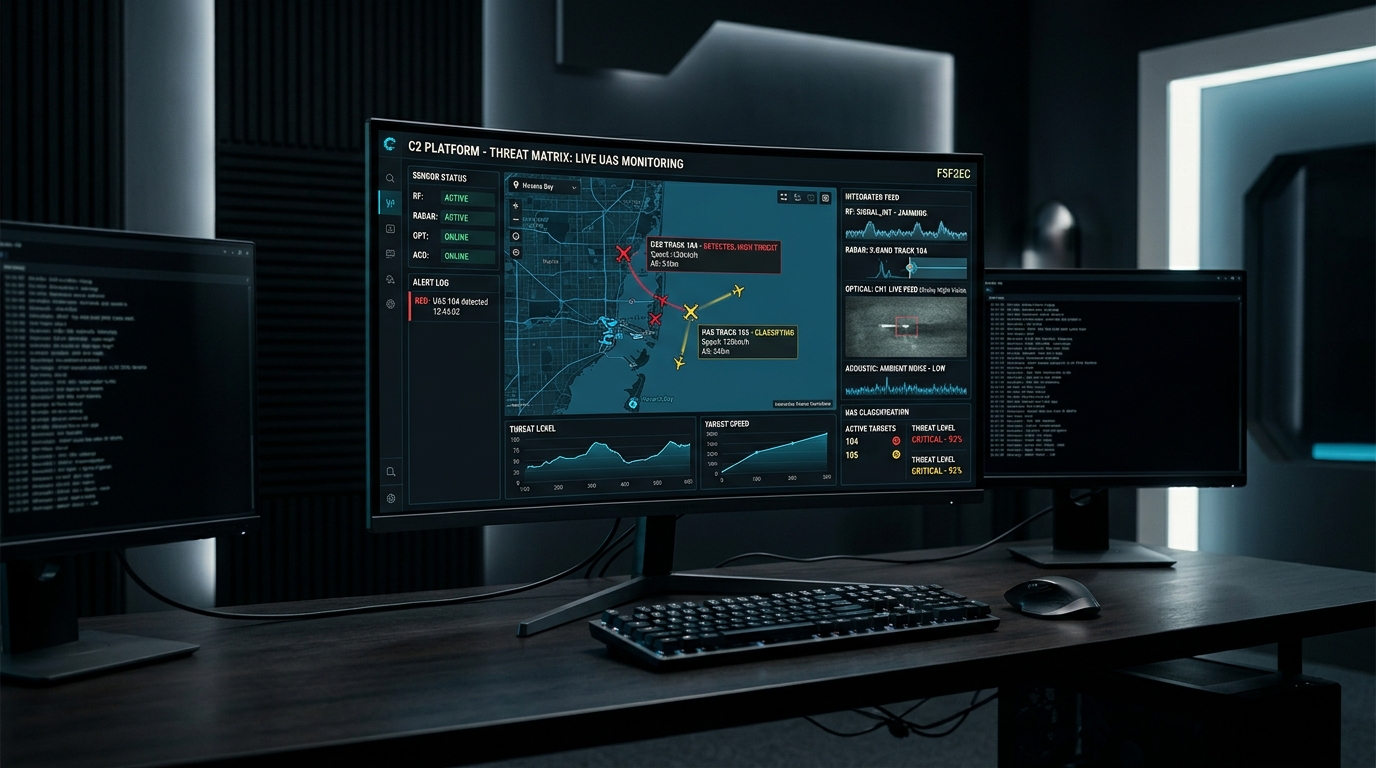
The effectiveness of a counter-UAS deployment depends on the seamless integration of individual sensing and mitigation layers into a unified Command and Control (C2) platform. Raw data streams from RF receivers, micro-Doppler radar tracks, EO/IR video feeds, and acoustic arrays must be ingested, aligned, and correlated in real time. This matters because electromagnetic interference from sources such as power lines and LEDs, along with small airborne objects such as birds, can reduce detection capability or generate false detections. Sensor data fusion is what turns the separate feeds into a single track picture and suppresses those false positives, with fusion engines applying techniques such as Kalman filtering and probabilistic track correlation to associate detections with one target.
Unified C2 dashboards translate complex sensor matrices into actionable situational awareness for security personnel. Automated threat scoring engines evaluate target altitude, vector, velocity, and payload profile to determine threat levels and recommend appropriate response protocols. Modern unified dispatch frameworks mirror broader physical work coordination concepts, where software platforms orchestrate tasks across mixed robotic fleets and human operators physical work operating system.
For operational management of deployed robotic assets, operators rely on centralized dashboards to maintain situational monitoring. Within modern fleet management architectures, platforms such as Cockpit provide comprehensive traffic-light indicators across hardware, infrastructure, and spec dimensions, maintaining real-time audit logs and escalation workflows during incident management.
Legal frameworks and deployment policies
Deploying C-UAS technologies involves navigating complex legal, regulatory, and policy frameworks. In the United States, only four federal departments, Defense, Energy, Justice, and Homeland Security, have express statutory authority to deploy counter-drone technologies under defined circumstances, while other counter-UAS activity may be restricted or prohibited by existing federal laws such as the Aircraft Sabotage Act or the Computer Fraud and Abuse Act. Active mitigation techniques such as frequency jamming or cyber-takeover therefore often collide with telecommunications rules on intentional radio interference, wiretapping statutes, and computer access regulations.
Regulatory bodies worldwide, including the Federal Aviation Administration (FAA) and European Union Aviation Safety Agency (EASA), are developing standardized frameworks to govern counter-drone deployments around civil airports and critical energy infrastructure. These standards emphasize strict operational safety tests, requiring C-UAS hardware to demonstrate low disruption to air traffic management systems before authorization.
To successfully implement counter-drone measures without breaching regulatory boundaries, research institutions and facility managers work with experienced integration partners. Engaging a specialized robotics systems integrator enables organizations to evaluate hardware compatibility, verify regulatory readiness, and select compliant sensor suites. Using automated evaluation tools within the werob Platform, such as Supplier Match for scoring OEM regulatory compliance and Spec Engine for generating verified operational action plans, allows security architects to deploy effective C-UAS capabilities within established legal limits.
- Telecommunications Compliance: Ensuring RF mitigation does not breach public spectrum regulations
- Airspace Coordination: Establishing protocol links with local air traffic control prior to system activation
- Audit Logging: Maintaining detailed forensic track records for legal verification of incident responses
- Hardware Verification: Scoring OEM equipment against local regulatory and operational requirements
FAQ
- What is C-UAS?
- C-UAS stands for Counter-Unmanned Aircraft System. It encompasses the hardware and software technologies designed to detect, track, identify, and mitigate unauthorized or malicious drones in protected airspace.
- How do radio frequency systems detect drones?
- Radio frequency detection systems scan the local airspace for the specific control signals transmitted between a drone and its operator. This allows security personnel to identify the presence of a drone and often locate the operator.
- What is the difference between kinetic and non-kinetic mitigation?
- Non-kinetic mitigation uses electronic means, such as signal jamming or GPS spoofing, to safely disable a drone or force it to land. Kinetic mitigation involves physical force, such as nets, projectiles, or lasers, to physically destroy or capture the aircraft.
- Why is jamming a common mitigation technology?
- Signal jamming is highly effective at severing the communication link between a drone and its operator, which typically triggers the drone's automated safety protocols to land or return home without causing falling debris.
- Can any organization deploy C-UAS technology?
- In many jurisdictions, the deployment of active mitigation systems is strictly regulated. For example, in the United States, only specific federal agencies have the explicit authority to utilize jamming or kinetic interception, while civilian sites focus primarily on detection.
- What challenges do C-UAS systems face in urban environments?
- Urban environments produce significant electromagnetic interference and physical obstacles, making radar and RF detection difficult. Furthermore, using kinetic mitigation or widespread jamming in cities poses high risks of collateral damage to citizens and legitimate communications.
Related reading
Counter-Drone Systems Explained: C-UAV Detection & Defense
Discover how C-UAV and C-UAS systems protect airspace through advanced detection, tracking, and mitigation technologies to secure critical infrastructure.
6 August 2026drone defense and c uas what it isDrone defense and C-UAS: What it is and how it works
Learn how Counter-Unmanned Aircraft Systems (C-UAS) work. Discover the detection, tracking, and mitigation technologies powering modern drone defense.
6 August 2026operating system for physical workThe operating system for physical work: routing one job across agent, robot and person
Field software models one kind of worker: a person with a van and a time slot. Three now share the same job list. What changes in dispatch, safety and measurement when the cheapest qualified resource is a machine.
29 July 2026robotics systems integratorThe Role of a Robotics Systems Integrator in Modern Operations
A robotics systems integrator bridges the gap between raw hardware and operational ROI by managing the entire deployment lifecycle. This guide explores how werob uses a four-layer platform to deliver live robots in eight weeks.
7 July 2026pedestrian detection excavator wheel loader AI camera retrofitPedestrian detection on excavators and wheel loaders: what the camera is documented to do, and what no datasheet says
Two routes lead today to a camera on the back of a construction machine that tells a person from a pallet: a brand-independent retrofit kit that has been in series production for years, and a factory option that brakes a wheel loader to a standstill on its own. Both manufacturers document what their system detects and where it runs. Neither documents at what distance, in how many milliseconds, or to what safety level. That is exactly where the site walk begins.
16 September 2026