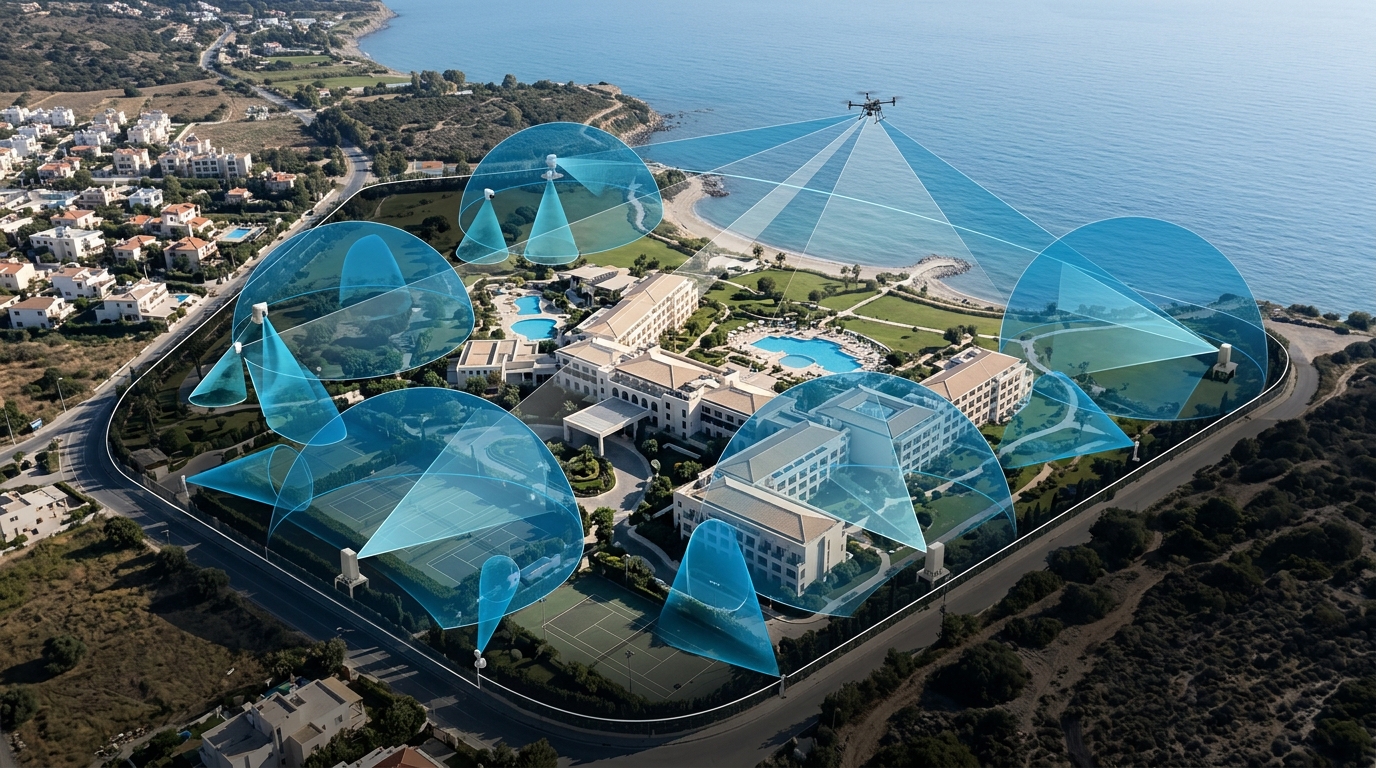
Drone defense and C-UAS: What it is and how it works
Learn how Counter-Unmanned Aircraft Systems (C-UAS) work. Discover the detection, tracking, and mitigation technologies powering modern drone defense.
Counter-Unmanned Aircraft Systems (C-UAS) detect and mitigate unauthorized drone threats. This guide explores how radar, RF sensors, and integrated software secure sensitive airspace against rogue drones.
Key Takeaways
- 1Rogue drones are a severe operational risk, with the U.S. Government Accountability Office reporting more than 2,000 drone sightings near U.S. airports since 2021.
- 2Effective C-UAS requires layered detection, combining radar, optical sensors, and RF finders to minimize false positives.
- 3U.S. federal law heavily restricts drone mitigation, requiring commercial sites to focus on detection and law enforcement coordination.
The growing threat of rogue drones
High-end hospitality venues, resort properties, and critical corporate campuses face an escalating security challenge overhead. Commercial and consumer unmanned aircraft systems (UAS) have proliferated rapidly, giving unauthorized operators low-cost tools to bypass traditional ground security perimeters. In hospitality environments, rogue drones compromise guest privacy, record confidential events, and present direct safety hazards to outdoor amenities.
The sheer frequency of airspace incursions illustrates the magnitude of the challenge across critical locations. According to a landmark report by the U.S. Government Accountability Office, federal authorities recorded more than 2,000 drone sightings near U.S. airports since 2021. This surge in low-altitude traffic demonstrates how accessible off-the-shelf camera drones have become, creating immediate operational risks for hotel managers charged with protecting high-profile guests, executive retreats, and sensitive property boundaries.
- Privacy violations: High-resolution camera payloads capture footage of private guest villas, balconies, and VIP events.
- Physical safety hazards: Equipment failures or careless piloting over crowded outdoor pools and terraces risk personal injury.
- Contraband delivery: Unmonitored drones can drop illicit items into restricted hotel grounds, inner courtyards, or open balconies.
- Industrial espionage: Unauthorized aerial surveillance can compromise unannounced corporate conferences or executive meetings.
Ground-based security guards and physical fencing cannot secure three-dimensional airspace. For operational teams, closing this vulnerability requires extending situational awareness skyward through dedicated drone defense strategies.
What is a Counter-Unmanned Aircraft System?
A Counter-Unmanned Aircraft System, commonly abbreviated as C-UAS or counter-drone system, is not a single countermeasure or takedown device. Instead, C-UAS represents a multi-layered security ecosystem designed to detect, track, identify, and mitigate unauthorized unmanned aerial vehicles within protected airspace. Modern counter-drone architecture coordinates multiple hardware sensors and software analytics to ensure continuous airspace surveillance.
| Operational Phase | Primary Objective | Key Technologies |
|---|---|---|
| 1. Detection | Discover the presence of an airborne object in monitored airspace | Long-range radar, Radio Frequency (RF) scanners, acoustic arrays |
| 2. Tracking | Maintain continuous positional data, altitude, and trajectory | Pan-Tilt-Zoom EO/IR cameras, directional RF direction finders |
| 3. Identification | Classify object type, verify serial ID, and assess threat level | AI optical classification, Remote ID decoding, signal matching |
| 4. Mitigation | Neutralize or redirect threat in accordance with local regulations | RF jamming, protocol manipulation, security escalation protocols |
Achieving high reliability across these four phases requires seamless multi-sensor fusion. No single sensor performs well on its own, and environmental clutter such as bird flights can confuse sensors and generate false positive detections. By combining complementary sensor feeds, an integrated C-UAS filters out environmental noise, verifies legitimate targets, and alerts operational staff only when a genuine drone threat enters the perimeter.
Detection: Radars and visual sensors
Primary detection relies on complementary primary sensors to scan the surrounding sky. Radar serves as the long-range foundation of airspace monitoring. Unlike radio receivers, radar does not depend on emitted control signals, allowing it to spot fully autonomous, pre-programmed, or radio-silent drones that fly without active remote control links.
Specialized drone-detection radars are tuned for low-altitude, low radar cross-section targets. However, radar alone must contend with heavy ground clutter, and birds remain one of the hardest false-target classes: a GAO technology assessment notes that electromagnetic interference and small airborne objects such as birds can reduce detection capability or generate false detections, and that small, highly manoeuvrable drones are harder to detect and track. To eliminate ambiguity, security deployments pair primary radar with Electro-Optical and Infrared (EO/IR) camera systems.
High-definition EO/IR optical cameras pan toward targets cued by primary radar or RF sensors, capturing thermal signatures and high-magnification visual images. Visual confirmation provides the definitive evidentiary proof needed before resort security managers initiate emergency guest protocols or call local law enforcement.
Tracking: RF and acoustic technologies
While radar detects physical objects, Radio Frequency (RF) directional finders monitor the electromagnetic spectrum for active communications between drones and their controllers. Most commercial drones communicate over standard 2.4 GHz and 5.8 GHz frequency bands. Advanced RF sensors passively listen for command-and-control links and compare them against a signature library that determines which drone models the scanner can identify by name; a signal with no matching library entry is flagged as an unknown RF source rather than classified. They also read Remote ID, the FAA-mandated broadcast that carries a drone's identification and location plus the position of its control station.
- Pilot location pinpointing: Triangulates the exact GPS coordinates of the ground station controller to help security teams intercept rogue pilots.
- Telemetry decoding: Reads real-time altitude, airspeed, heading, and home-point coordinates transmitted by the drone.
- Non-line-of-sight tracking: Tracks RF-emitting drones behind buildings, foliage, or surrounding terrain before visual contact occurs.
- Passive operations: Operates continuously without emitting radio signals, preserving corporate communications and radio spectrum compliance.
Acoustic sensor arrays provide an additional short-range detection layer by matching motor and propeller acoustic signatures against database profiles. Acoustic sensors excel in dense architectural spaces where RF noise is high and line of sight is obstructed. When combined with RF directional finders, acoustic arrays allow security teams to maintain active target custody across complex resort layouts.
Mitigation: Taking down rogue drones
When an unauthorized drone enters protected airspace, security teams must respond effectively while complying strictly with federal and regional laws. Countermeasure technologies fall into two broad categories: soft-kill (electronic countermeasures such as RF jamming, GPS spoofing, and cyber protocol takeover) and hard-kill (physical interception using nets, projectiles, or directed energy).
| Mitigation Method | Mechanism | Regulatory & Practical Considerations |
|---|---|---|
| RF Jamming (Soft-Kill) | Disrupts command and control radio frequencies, triggering return-to-home or forced landing | Strictly prohibited for commercial entities without federal authorization due to spectrum interference |
| Cyber Takeover (Soft-Kill) | Emulates ground station commands to take control and land the aircraft safely | Requires explicit protocol support; minimizes physical fallout and collateral risk |
| Net Capture (Hard-Kill) | Deploys tethered or flying nets to capture the drone physically | Limited operational range; high risk of falling debris over populated resort grounds |
| Kinetic Interception (Hard-Kill) | Uses physical projectiles or defensive drones to neutralize the target | Extremely restricted; creates collateral risk for guests, buildings, and ground personnel |
Commercial site operators must navigate significant legal restrictions regarding active mitigation. Announcing the joint advisory issued by DOJ, FAA, DHS, and FCC in August 2020, the Justice Department stated that "Congress has given limited authority to only four federal Departments, Defense, Energy, Justice, and Homeland Security, to engage in UAS detection and mitigation activities," and that the issuing departments and agencies do not have the authority to approve non-federal public and private use of those capabilities. The advisory guidance document itself is published by DHS. Commercial security teams and facility managers must therefore rely on passive detection to identify threat vectors, immediately dispatching ground staff to locate the pilot while coordinating active mitigation with authorized law enforcement agencies.
Integrating C-UAS into existing security
Standalone security systems create operational silos that slow down response times during active incidents. For hotel operations managers, counter-drone data must feed directly into established property management, video management, and physical security platforms.
- Multi-tenant middleware: Pre-built enterprise software layers, such as Connectors, link sensor feeds to property PMS and building safety management systems.
- Centralized monitoring dashboard: A unified operational interface, like Cockpit, displays multi-dimensional traffic lights and real-time threat maps.
- Automated dispatch: Triggers automated alerts to security staff on foot or dispatches autonomous aerial surveillance units to verify intruder coordinates.
- Audit logging: Records time-stamped RF spectra, optical video feeds, and flight telemetry for legal documentation and incident reporting.
Working with an experienced systems integrator ensures hardware neutrality and streamlined software integration. Rather than managing fragmented vendor contracts, enterprise operations can coordinate physical security and physical work workflows through a single unified architecture.
The future of the counter-drone market
The counter-drone industry is evolving rapidly to keep pace with advancing UAS capabilities, including autonomous GPS-denied navigation and AI-driven drone swarms.
- AI sensor fusion: Machine learning models combine radar, RF, and optical data to automatically classify threats and eliminate false positives.
- Swarm defense algorithms: Automated command systems prioritize and track multiple simultaneous targets during coordinated swarm incursions.
- Software-defined architecture: Cloud-connected detection nodes receive continuous firmware updates to detect new drone protocols without hardware replacement.
- Integrated autonomous response: Security fleets coordinate automated ground and aerial assets to maintain total perimeter awareness.
As low-altitude airspace grows more crowded, commercial venue operators must transition from reactive incident response to proactive airspace management. Scalable, software-defined integration platforms allow commercial sites to maintain sovereign control over their airspace, protecting guest privacy, operational continuity, and physical safety.
FAQ
- What does C-UAS stand for?
- C-UAS stands for Counter-Unmanned Aircraft System. It refers to the integrated technologies and procedures used to detect, track, identify, and mitigate unauthorized or rogue drones in restricted airspace.
- How does radar work for drone detection?
- Radar emits radio waves to detect objects and is effective for long-range airspace monitoring. However, it can struggle to differentiate small drones from birds, which can lead to false positives in highly populated urban environments.
- What is RF drone detection?
- Radio Frequency (RF) detection monitors the specific frequency bands drones use to communicate with their controllers. This passive system can often pinpoint both the drone and the pilot's exact location without emitting interference.
- Are commercial businesses allowed to shoot down drones?
- In most jurisdictions, including the U.S., commercial businesses are prohibited from shooting down or jamming drones. Federal law protects aircraft, meaning mitigation must usually be handled by authorized law enforcement or military personnel.
- Why are acoustic sensors used in C-UAS?
- Acoustic sensors listen for the unique motor and propeller sounds of drones. While easy to deploy, they are often less effective in noisy areas like stadiums or airports where ambient sound masks the drone's noise.
Related reading
Counter-Drone Systems Explained: C-UAV Detection & Defense
Discover how C-UAV and C-UAS systems protect airspace through advanced detection, tracking, and mitigation technologies to secure critical infrastructure.
6 August 2026legal framework for drone defense in germany andLegal framework for drone defense in Germany and the EU
Explore the legal framework for drone defense in Germany and the EU. Learn how the 2026 EU Action Plan and new German laws impact C-UAS deployment.
6 August 2026drone as first responder how security teams verifyDrone as First Responder: how security teams verify alarms in minutes
See how Drone as First Responder systems verify alarms in under 5 minutes using automated landing pads, compliant BVLOS flight, and unified mission dashboards.
3 July 2026drone landing pad businessDrone Landing Pads for Business and Home: The Last Metre of Drone Delivery
Drone delivery rarely fails because of the drone. It fails at the landing point. What a drone landing pad is, which variants exist and how wedrone plans, builds and operates pads.
3 July 2026operating system for physical workThe operating system for physical work: routing one job across agent, robot and person
Field software models one kind of worker: a person with a van and a time slot. Three now share the same job list. What changes in dispatch, safety and measurement when the cheapest qualified resource is a machine.
29 July 2026