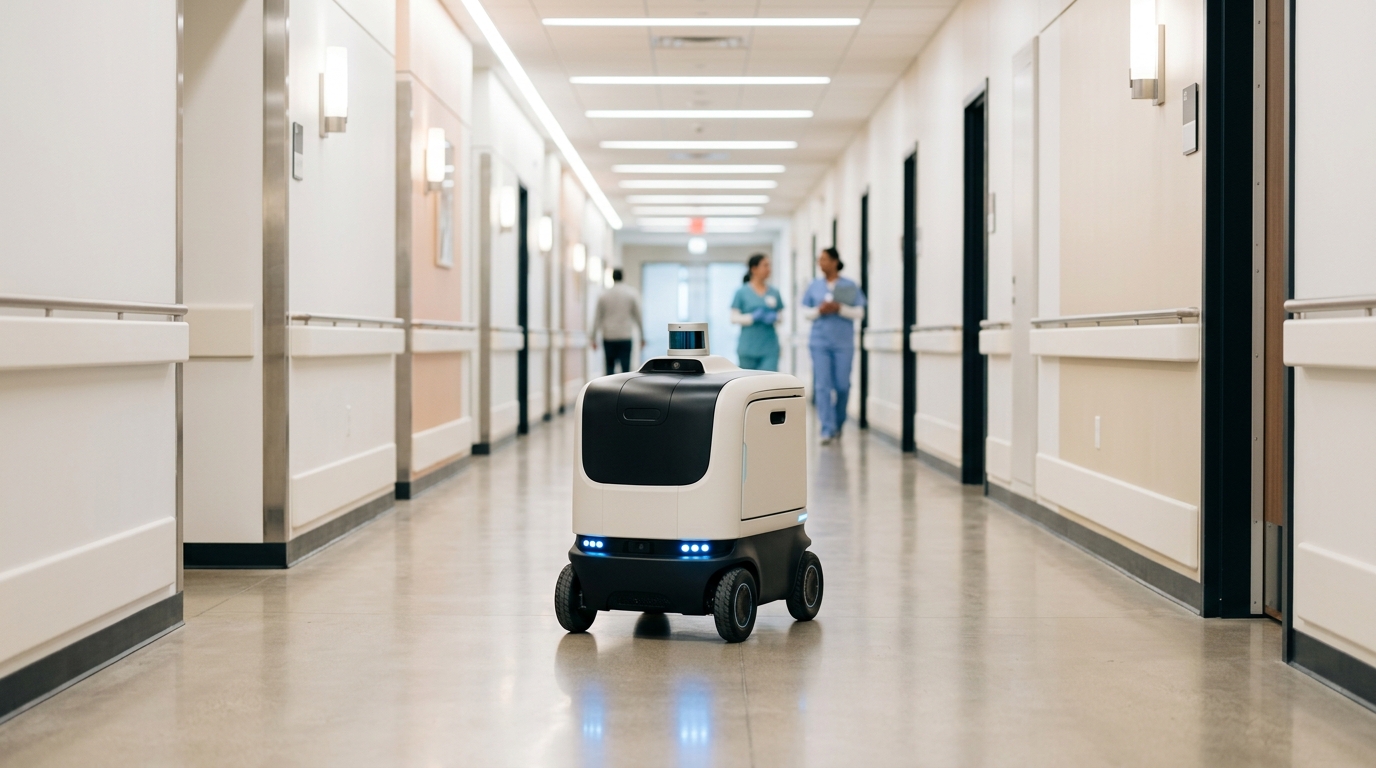
Service Robot Deployment: Why Wheeled Models Win
While humanoids capture funding headlines, discover why wheeled, task-specific service robots are the practical choice for hospitals and care homes today.
While humanoids dominate funding headlines, the robots running shifts in European care homes, hotels, and hospitals are wheeled and task-specific. For operators budgeting today, wheeled service robots offer calculable payback without requiring facility retrofits.
Key Takeaways
- 1AI funding favors humanoids, but deployed service robots are overwhelmingly wheeled.
- 2Task-specific service robots are bought against a payback an operator can calculate from the labour one defined task offsets.
- 3Even leading humanoid developers build wheeled bases for their first enterprise deployments.
- 4Measured hospital deployments show shorter delivery cycle times and reclaimed staff hours.
- 5Successful robotic deployment depends entirely on integration with lifts and fire doors.
Funding headlines versus operational reality
While venture capital markets and technology headlines focus heavily on humanoid robots, the machines physically completing daily shifts across European healthcare, hospitality, and care facilities are wheeled and task-specific. There is a sharp divergence between the speculative platforms attracting private equity and the practical automation systems that facility operators purchase and deploy today.
European robotics startups raised more equity funding in the first half of 2026 than in the previous two years combined[1]. A significant portion of this capital flowed into large rounds for humanoid platforms and foundation AI models. Neura Robotics in Metzingen secured a Series C round of up to 1.2 billion euros, while London-based Humanoid completed a 133 million euro Series A round at a 1.1 billion euro valuation. Outside Europe, Unitree filed to list on the Shanghai Stock Exchange, seeking roughly 610 million dollars.
Despite these staggering capital inflows, roughly 73 percent of European artificial intelligence funding was concentrated into just 38 companies raising 100 million dollars or more. For operations managers in senior living facilities, hospital networks, and hotels, these headline investments represent future research rather than immediately available labor solutions. On the operational floor, the actual work is carried out by autonomous mobile robots (AMRs) designed for dedicated, repetitive tasks.
- Capital allocation priorities: Venture funding concentrates on general-purpose bipedal locomotion, multimodal physical AI models, and long-term research roadmaps.
- Operational procurement priorities: Facility managers invest in single-purpose automated scrubber-dryers, enclosed linen transporters, meal delivery carts, and pharmacy courier units.
- Deployment timelines: Humanoid platforms target multi-year evaluation trials, whereas task-specific wheeled machines deliver immediate operational labor offloading on day one.
Operators live on the deployed side of this equation. Signing an equipment lease or capital expenditure contract requires verifiable reliability, predictable maintenance schedules, and guaranteed shift coverage, none of which can be replaced by investor enthusiasm for general-purpose prototypes.
The business case for task-specific machines
Task-specific wheeled service robots succeed on the service floor because they resolve a single operational bottleneck with a calculable return on investment. Rather than attempting to replicate human dexterity across varied tasks, these machines automate isolated, high-frequency logistics and sanitation workflows.
Dedicated transport robots in healthcare facilities relieve clinical staff of repetitive hauling, and the effect has been measured. In a systematic review of robot use in critical care, an automated delivery robot handling medication carts cut mean pharmacy cycle time from order receipt to order exit by 29.6 percent and freed 7.2 hours of technician time[2]. Automated mobile transport units and automated floor scrubbers take over repetitive physical transit, allowing nurses and caregivers to redirect their hours toward direct patient support. Because the scope of work is narrow and clearly defined, facility managers can accurately project cost savings and labor offset metrics.
The operational advantage of task-specific robotics rests on four practical parameters:
| Operational Dimension | Task-Specific Wheeled AMR | General-Purpose Humanoid |
|---|---|---|
| Target Payback Period | Calculable from the direct labour one defined task offsets | Uncertain due to higher initial capital cost |
| Staff Onboarding Time | Within a single shift | Requires specialized training and monitoring |
| Facility Modifications | None on standard level flooring | Requires extensive safety zoning and clearance |
| Workflow Scope | Single defined task (e.g. linen transport) | Multiple theoretical tasks in development |
Deploying a dedicated floor scrubber or meal transport trolley requires no structural alteration to corridors or doorway thresholds. Cleaning personnel or nursing aides can master dispatching and basic maintenance within a single work shift. By contrast, a general-purpose humanoid platform introduces complex task-planning requirements and safety boundaries that complicate straightforward return calculations in nursing home operational relief projects.
Why wheeled mobility is the correct engineering answer
On flat indoor surfaces served by standard passenger and service elevators, wheeled locomotion is the mechanically superior engineering choice. Corridors in modern hospitals, hotels, and care homes are designed for wheeled trolleys, hospital beds, and cleaning carts, making bipedal walking mechanically redundant.
Even commercial developers developing advanced physical AI platforms are converging on wheeled bases for real-world enterprise deployments. Humanoid's HMND 01 platform, scheduled for production under a Bosch contract manufacturing agreement at its Bühl facility starting August 2027, utilizes a wheeled chassis specifically configured for industrial logistics rather than legs. Industry engineering efforts are increasingly directed toward wheeled form factors that eliminate the mechanical overhead of dynamic balancing.
- Energy efficiency: Wheeled drivetrains consume a fraction of the power required by dynamic bipedal balancing actuators, allowing continuous 8 to 12 hour operational shifts on a single battery charge.
- Payload capacity: Differential and omnidirectional wheeled bases easily carry payloads between 50 kg and 300 kg, matching the physical volume of heavy linen hampers and bulk meal trays.
- Acoustic footprint: Rolling wheel assemblies operate virtually silently, satisfying strict acoustic limits in hospital inpatient wards and hotel guest corridors at night.
- Mechanical stability: Wheeled robots possess an inherently low center of gravity, preventing tip-overs and accidental collisions in busy communal corridors.
Wheels are not an engineering compromise. In built environments characterized by polished vinyl, smooth concrete, or low-pile commercial carpet, wheeled drivetrains provide the reliability, stability, and runtime that 24/7 service operations demand.
Honest timing for general-purpose humanoids
General-purpose humanoid robots are not industry hype, but their practical readiness for unassisted service operations is still years away. The long-term engineering vision remains compelling: a machine built in human proportions with articulated arms can theoretically climb stairs, operate manual door latches, and handle standard cleaning utensils without requiring facility modifications.
For operations managers budgeting across a 24 to 36 month window, however, current technical limitations prevent autonomous humanoid deployment. Dynamic bipedal walking and complex dexterous manipulation draw significant power, limiting operational runtimes to roughly one to two hours under continuous mechanical load. Furthermore, safety certification under ISO 13482 for heavy, multi-jointed robots operating in close contact with elderly residents or hospital patients remains a complex regulatory hurdle.
- Manipulation reliability: Grasping varied, deformable objects like laundry sacks or loose medical packaging remains difficult to execute with high autonomy rates.
- Failure recovery: When a legged robot loses footing or encounters an unexpected floor obstruction, automatic self-recovery without human intervention remains unreliable.
- Unit economics: High manufacturing costs for multi-axis harmonic drives and high-torque actuators place humanoid capital expenditures far above task-specific mobile platforms.
- Regulatory zoning: Strict liability and workplace safety frameworks currently require physical separation or constant supervision in populated public facilities.
Operators facing immediate staffing shortages cannot afford to wait for multi-year software updates to resolve fundamental hardware and manipulation bottlenecks. Deploying proven wheeled technology today provides immediate productivity gains while general-purpose systems mature in controlled test environments.
Specifying against the task list
Operators achieve successful automation outcomes by specifying robots strictly against immediate task requirements, floor layouts, and payback horizons. Sourcing robotics hardware should follow the same disciplined procurement principles used for commercial dishwashers, industrial laundry systems, or HVAC equipment.
Procurement teams in hotel service robots and healthcare intralogistics projects should structure their operational requirements through a systematic evaluation framework:
- Define task parameters: Quantify the daily transport volume, peak dispatch hours, payload weights, and required cycle times for each specific workflow.
- Audit physical infrastructure: Measure corridor clearances, door thresholds, ramp gradients, elevator dimensions, and floor material transitions across all planned routes.
- Evaluate facility network connectivity: Verify uninterrupted Wi-Fi signal coverage and local network security protocols along the entire operational path.
- Calculate direct labor offset: Compare total cost of ownership against the contractor hours, overtime pay, and staff walking time reclaimed by automation.
- Establish vendor service level agreements: Secure binding uptime guarantees, replacement part turnaround times, and local maintenance response windows.
Taking a bet on speculative general-purpose software roadmaps is the domain of venture investors and hardware manufacturers. Facility operators must ensure that every euro committed to automation solves an existing, measurable operational problem with predictable financial returns.
Integration decides the project
Regardless of whether a robot moves on wheels or legs, the operational success of the deployment depends almost entirely on building systems integration. A high-specification autonomous machine is useless if it cannot pass through fire doors, call elevators, or maintain stable network connectivity.
A feasibility study of an autonomous medication delivery robot in a high-traffic tertiary hospital found that elevator congestion, not the machine, decided mission success: overall delivery success was 87 percent, rising to about 96 percent when the elevator operating rate stayed below roughly 59 percent[3]. Most failures came from passengers or carts physically blocking the car, and two missions aborted because weak wireless coverage delayed the elevator-call handshake. That is why lifts, fire doors and WLAN decide the project rather than the chassis, and why hospital transport robots need automated lift dispatch and stable network coverage before they can hold a schedule.
| Building Subsystem | Integration Requirement | Operational Risk If Incomplete |
|---|---|---|
| Elevator Dispatch | IoT/cloud communication module for automated car calling | Robot stalls at landing, blocking corridor traffic |
| Fire & Security Doors | Relay triggers to hold doors open during transit | Mechanical door closures damage robot or halt missions |
| Facility Access Control | RFID/BLE integration with electronic badge readers | Robot trapped between secure access wards |
| Local Network (WLAN/5G) | Seamless roaming without dead zones across floor handovers | Navigation drift, communication timeout, and dropped tasks |
Facility integration is the primary determinant of robotics return on investment. Operations managers should evaluate prospective robotics vendors primarily on their middleware maturity and building control integrations rather than purely on chassis aesthetics.
Taking robots from concept to live operation
Transitioning from initial operational planning to live robotic execution requires a structured integration framework that unifies hardware selection, building connectivity, and workflow management. Managing multiple hardware vendors, custom IoT interfaces, and staff training independently often creates substantial operational friction for facility teams.
The werob Platform resolves this complexity by serving as an end-to-end systems integration environment that takes autonomous robots from concept to live operation in eight weeks. Rather than locking operators into proprietary hardware, the platform combines four specialized modules to deliver reliable, vendor-neutral automation across healthcare, hospitality, and care facilities:
- Spec Engine: Translates plain-language shift descriptions and facility requirements into verified, ROS-compatible action graphs and executable deployment plans within 48 hours.
- Supplier Match: Automatically evaluates and ranks over 44 robot manufacturers based on regional service coverage, regulatory readiness, price band, and integration footprint.
- Connectors: Pre-built integration middleware that interfaces robotic fleets directly with property management systems, electronic health records, and building infrastructure.
- Cockpit: A unified operational dashboard providing real-time fleet health tracking, task scheduling, compliance audit logs, and infrastructure connectivity monitoring.
By handling the technical overhead of building integration, supplier vetting, and fleet coordination, the werob Platform ensures that wheeled service robots deliver measurable operational relief and predictable payback without burdening facility management teams.
FAQ
- How do operators calculate the payback on a service robot?
- Payback on a task-specific service robot is calculated against the labour one defined task offsets: the shift hours reclaimed, the contractor or overtime cost avoided, and the staff walking time removed. That calculation can be made against a defined task list before purchase, rather than against a speculative future capability.
- Are humanoid robots ready for hospital and care home deployment?
- General-purpose bipedal humanoids are still a research bet and lack the robustness required for daily duty cycles. Current service robots in these environments rely on wheeled mobility for stability, safety, and speed.
- Why do service robots use wheels instead of legs?
- Wheeled service robots navigate flat indoor surfaces faster and more efficiently than bipedal models. They consume less energy and eliminate the complex balance control associated with walking, which is why most enterprise deployments, including those from humanoid developers, run on wheeled bases.
- Do I need to modify my building to deploy a service robot?
- Task-specific wheeled robots are designed to work within existing infrastructure. They use standard corridors and can integrate directly with existing lifts and automatic fire doors via standard networking protocols, avoiding expensive structural retrofits.
- How reliable are autonomous hospital delivery robots?
- In a feasibility study at a high-traffic tertiary hospital, an autonomous medication delivery robot completed 87 percent of missions without human intervention, and about 96 percent when the shared lift was not congested. Reliability therefore depends less on the robot than on lift traffic and network coverage along the route.
Related reading
Service robots in hotels: operational excellence through integration
The implementation of service robots in the hotel industry often fails due to isolated isolated solutions. As a system integrator, werob offers the direct path to an automated fleet through seamless PMS connection and manufacturer-independent specifications.
19 June 2026service robot retirement home costsService robots in nursing homes: costs and operational relief
The costs for service robots in care primarily depend on the integration and the selected operating model. Learn how werob eliminates financial risk through hardware-agnostic system integration and an outcomes-only model.
18 June 2026humanoid robots hotelHotel Robots: What the PLAZA Humanoid Test Actually Means
Explore what the PLAZA Hotelgroup's humanoid robot deployment means for hospitality operators and how it compares to proven wheeled service robots.
27 August 2026robot as a service pricing germanyRobot as a Service Pricing Germany: ROI and Models
Robot as a Service (RaaS) transforms high investment costs into predictable operating expenses. Learn how werob realizes measurable cost relief in care, hospitality, and logistics through hardware agnosticism and outcome-only models.
16 June 2026robot lift integrationLifts, Fire Doors and WiFi: What Decides Hospital and Hotel Robot Projects
Discover how to integrate service robots in hospitals and hotels by mastering elevator APIs, fire door hold-open systems, and seamless WiFi roaming.
25 August 2026