Service robots in nursing homes: costs and operational relief
The costs for service robots in care primarily depend on the integration and the selected operating model. Learn how werob eliminates financial risk through hardware-agnostic system integration and an outcomes-only model.
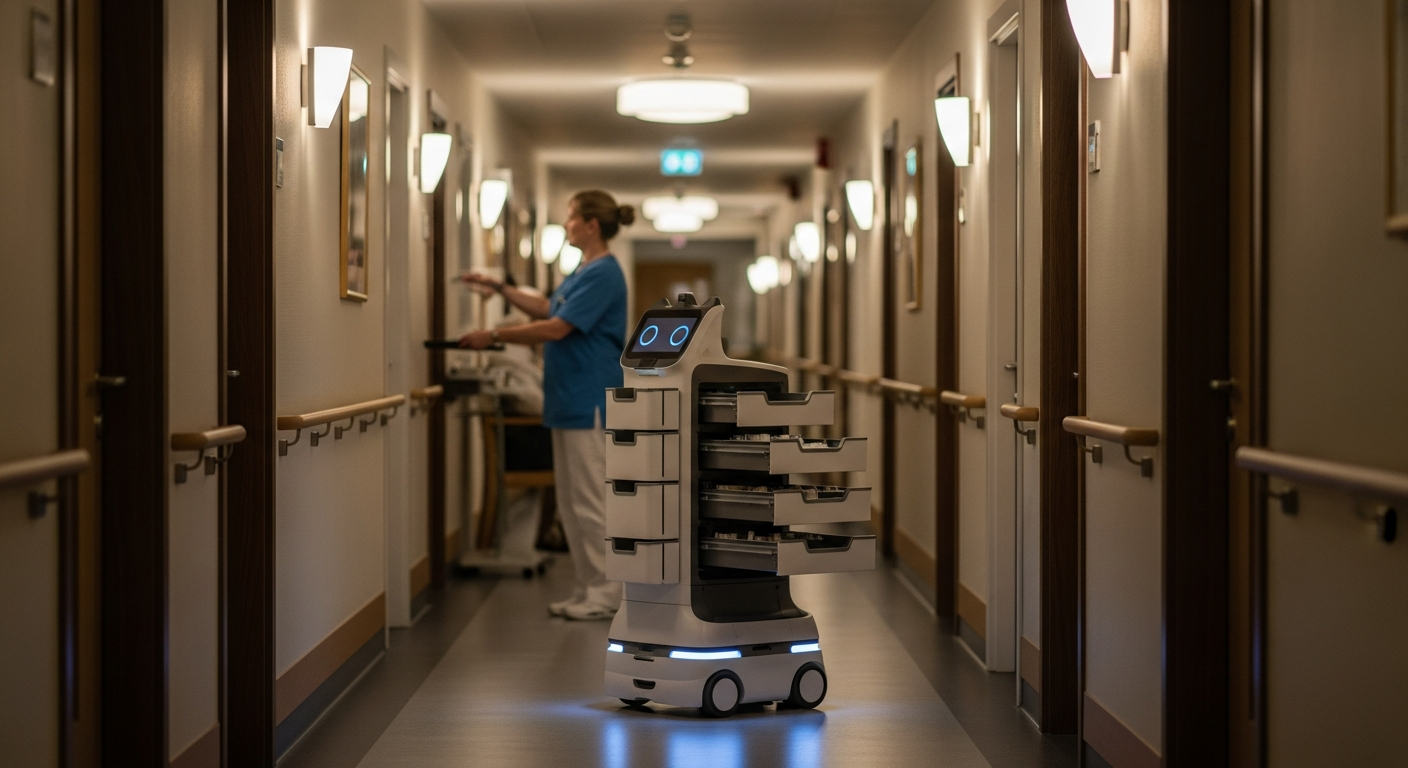
Station 2. 10:00 p.m. The medication round is already taking place autonomously, while the only nurse on duty concentrates on a critical patient discussion. The robot safely transports the prepared medication from room to room. What is already a reality in the Hamburg care facility in week 12 of live operation marks the standard for modern operators. At Korian Germany, a double-digit cost reduction was achieved in the first year. It is no longer a question of whether robots will come, but rather how quickly they can reduce the operational load.
Key Takeaways
- 1Outcome-only model: You only pay when the robot is running productively in your facility.
- 2High cost relief: Savings of up to €92,000 per year through automation of the medication round.
- 3Future security: Full compliance with the EU Machinery Regulation 2023/1230 (binding from 2027).
The economic calculation: cost relief instead of purchase price
In inpatient care, the economic viability of robotics is often incorrectly defined by the list price of the hardware. For an operator, however, the net relief per shift is the key figure. werob has identified validated data for cost reduction by analyzing over 35,000 projects. An automated medication round leads to an annual relief of €92,000 per location. Transport tasks, such as transporting laundry or food, reduce operational costs by a further €71,000 per year.
These figures are based on the release of specialist hours that were previously spent on logistical support activities. For a care group with, for example, four locations and five robots each, the annual relief adds up to around 1.8 million euros. werob's commercial model is consistently focused on results. As a system integrator, werob offers an outcome-only model. This means for you as the operator: There are no costs until the robot is productively integrated into your workflow and running. This model eliminates the investment risk associated with traditional purchase or leasing models from individual OEM resellers.
Hardware agnostics: Why the robot manufacturer is secondary
A common mistake when introducing robotics in nursing homes is the premature focus on a specific robot model. werob is not a manufacturer, but a system integrator that evaluates the entire market neutrally. There are over 44 OEM partners in the werob catalog, including well-known manufacturers such as Keenon, Pudu, Bear Robotics or humanoid developers such as Apptronik and 1X. A total of 280 different robot models are qualified for the ranking.
The crucial process is the supplier match. Instead of being tied to a single manufacturer (vendor lock-in), werob uses the Spec Engine. Within 48 hours, this engine translates your individual shift, floor and task requirements into a technical specification. Only then will the 44+ OEMs be ranked against this specification. This ensures that the selected hardware fits exactly to the structural conditions and nursing requirements of your facility. The objective data from the Spec Engine decides whether a Keenon T9 is used for transport or a humanoid robot for more complex interactions.
Integration into the operator stack: PointClickCare and MatrixCare
A robot that acts as an isolated standalone solution will, in case of doubt, cause more work than it removes. The real added value comes from the seamless integration into the existing IT infrastructure of the care facility. werob supplies prefabricated connectors into the operator stack for this purpose. This includes direct interfaces to systems such as PointClickCare and MatrixCare. This integration allows the robot to receive information about ward occupancy or specific delivery requirements directly from nursing documentation.
Without these connectors, nurses would have to program the robot manually or enter data twice. The werob platform acts as an operating layer that stands between the hardware and your software. You maintain control of the entire fleet at all times via the live cockpit. A four-dimensional traffic light system not only monitors the status of the hardware and infrastructure, but also compliance with regulatory requirements and the defined application specifications. This guarantees availability, which is absolutely necessary for 24/7 operation in care.
Regulatory and compliance: The EU Machinery Regulation 2023/1230
An often underestimated cost factor when introducing service robots is legal protection. From January 20, 2027, the new EU Machinery Regulation 2023/1230 will be binding. Many robots that are currently entering the market from Asian manufacturers do not yet have the necessary conformity assessments for the European market. werob acts as your compliance path here. We ensure that all systems used meet the strict requirements of the regulation and ISO 13482 for personal care robots.
In addition, in Germany the requirements of home supervision and the GDPR must be met, especially if camera systems are used for navigation. werob takes over the regulatory review and documentation as part of the onboarding process. This protects you as the operator from liability risks and unforeseen costs due to retrofitting or operating bans. Compliance with these standards is firmly anchored in the werob cockpit, so that you can provide complete proof of the conformity of your robot fleet at any time during audits.
For productive use in eight weeks
While traditional consulting firms often require three to six months for discovery phases, werob follows an accelerated implementation path. The promise is: 48 hours until the finished specification, five days until the binding offer and eight weeks until the first robot in live use. This process begins with a structured intake, in which the shift processes and the infrastructure of the facility are recorded.
After the supplier match and the selection of the hardware, the connectors are configured. Since werob uses ready-made integrations, time-consuming individual programming is no longer necessary. The rollout is controlled centrally via the cockpit, which enables rapid scaling across multiple locations. Since the model is outcome-only, the focus is on operational excellence throughout the eight weeks. The goal is not to deliver a machine, but rather to successfully take on a defined task in everyday care.
FAQ
- How much does a service robot for a retirement home cost per month?
- There are no classic list prices at werob. The model is designed to be outcome-only. The costs depend on the service provided and the operational relief, with payments only becoming due once the live operation is successful.
- What tasks can robots take on in care?
- The main areas of application are in logistics: medication rounds, transport of food, laundry and waste as well as support with room cleaning. This relieves the staff of unproductive walking distances.
- Is integration with PointClickCare possible?
- Yes, werob offers pre-built connectors for PointClickCare and MatrixCare to ensure seamless data transfer between care documentation and the robot fleet.
- How does home supervision react to the use of robots?
- By complying with ISO 13482 and the EU Machinery Regulation 2023/1230, werob offers a legally secure framework. The documentation is carried out automatically via the werob cockpit, which makes coordination with the home supervisor easier.
- How long does it take to introduce a robot?
- At werob, it usually takes eight weeks from the first intake to productive use. An initial specification is available after just 48 hours.
- Do I have to choose a manufacturer?
- No, werob is hardware agnostic. We rank over 44 OEM partners neutrally against your requirements in order to find the technically and economically best solution for your location.
Related reading
Service Robot Deployment: Why Wheeled Models Win
While humanoids capture funding headlines, discover why wheeled, task-specific service robots are the practical choice for hospitals and care homes today.
26 August 2026service robot gastronomy costsService robot catering costs: ROI and system integration
The calculation of service robots in the catering industry goes far beyond the pure purchase price. werob shows how integration into existing POS systems such as Toast or Lightspeed increases operational efficiency and creates measurable cost savings.
18 June 2026rent care robotsRenting Care Robots: Costs, Benefits, and System Integration
The decision to rent care robots is often the first step toward relieving specialist staff. But without the right software connection and regulatory protection, the hardware remains ineffective.
14 June 2026robot as a service pricing germanyRobot as a Service Pricing Germany: ROI and Models
Robot as a Service (RaaS) transforms high investment costs into predictable operating expenses. Learn how werob realizes measurable cost relief in care, hospitality, and logistics through hardware agnosticism and outcome-only models.
16 June 2026robot as a serviceRobot as a Service: Operational excellence without investment risk
Robot as a Service (RaaS) transforms rigid investment models into flexible, results-oriented operating solutions. As a hardware-agnostic system integrator, werob offers direct access to over 44 OEM partners and ensures integration into existing IT stacks.
27 June 2026