Robot as a Service Pricing Germany: ROI and Models
Robot as a Service (RaaS) transforms high investment costs into predictable operating expenses. Learn how werob realizes measurable cost relief in care, hospitality, and logistics through hardware agnosticism and outcome-only models.
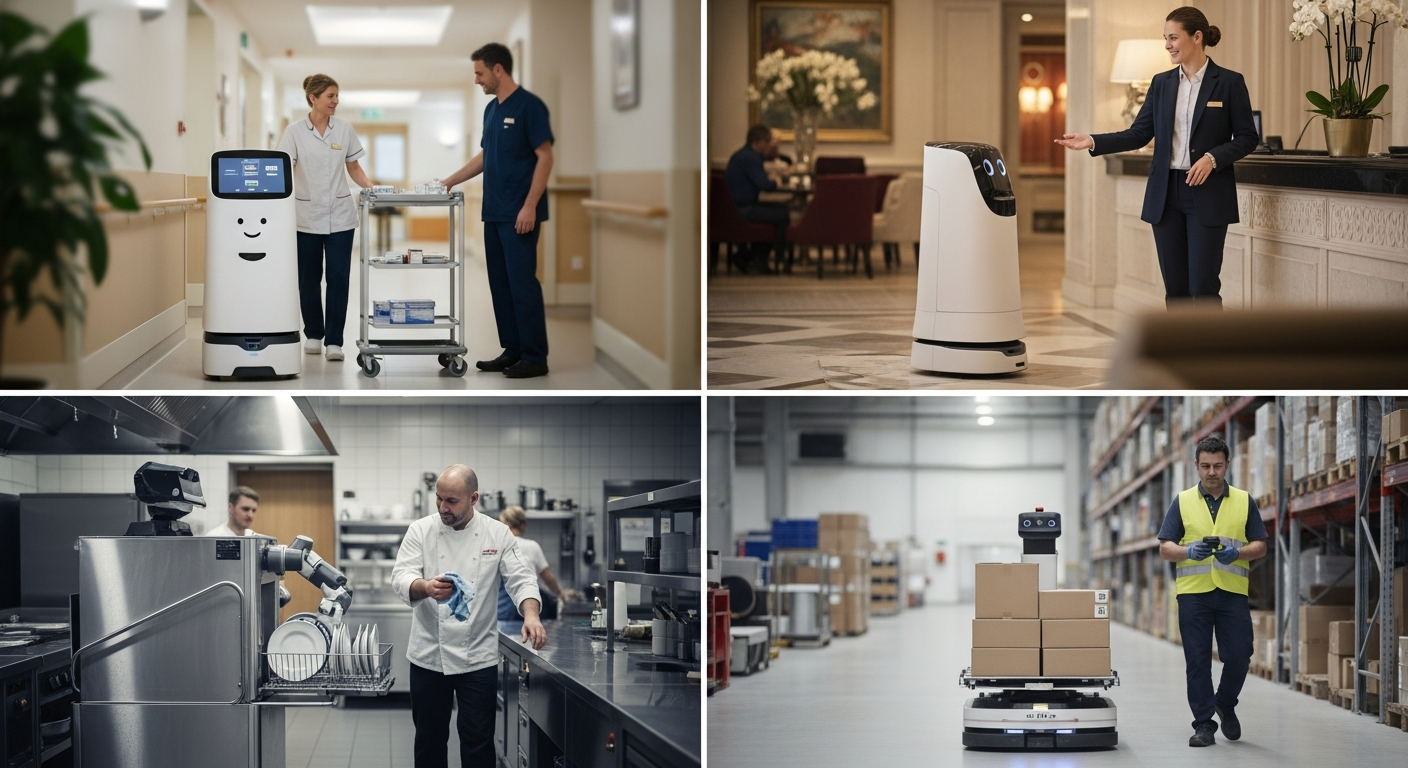
Ward 2. 10:00 PM. The medication cart moves autonomously through the corridor while the nursing specialist finds time for documentation. In modern business management, technology is no longer purchased as a capital asset, but rented as a result. While classic robotics projects often remain in the planning phase for three to six months, werob translates workflows into deployable specifications within 48 hours. The goal is not the ownership of a machine, but the relief of the staff and the lowering of operating costs. In Germany, this model is gaining importance as the skilled labor shortage increases the pressure on operational efficiency.
Key Takeaways
- 1RaaS enables the switch from CAPEX to OPEX with immediate cost relief without high investment risk.
- 2The werob Spec Engine delivers a deployable specification within 48 hours based on 35,000 projects.
- 3The EU Machinery Regulation 2023/1230 makes a certified integration pathway mandatory for all operators from January 2027.
The RaaS Model in German Industry
The Robot as a Service (RaaS) model marks a paradigm shift for German companies. Instead of high initial investment costs (CAPEX) that often tie up budgets for years, monthly operating expenses (OPEX) take their place. This enables operators to use state-of-the-art technology without bearing the financial risk of a wrong purchase. werob acts here as a systems integrator that is not tied to a single manufacturer. With over 44 OEM partners and 280 deployable robots, werob offers a selection that goes far beyond the portfolio of individual resellers.
A decisive advantage of the RaaS model at werob is the outcome-only approach. You pay nothing before the robot is actually running in live operation. This eliminates the risk of pilot projects that never reach production readiness. Pricing is based on the performance delivered and the operational relief. In sectors such as care or hospitality, where margins are tightly calculated, this flexibility offers the necessary scope for innovation. Integration takes place seamlessly into existing systems such as SAP EWM or Opera PMS, which massively increases process speed.
The werob Spec Engine: From Task to Price
Determining the costs for robotics has been a lengthy process until now. Classic consulting firms often need months for a discovery phase. werob shortens this path to 48 hours with the Spec Engine. This engine was trained based on over 35,000 projects and translates your workflows directly into a technical specification. Whether it concerns the medication round in a nursing home or room service in a hotel, the Spec Engine precisely identifies the requirements for hardware, infrastructure, and regulation.
After the specification follows the Supplier Match. Here, 44+ OEMs are tested against your requirements. Since werob works in a hardware-agnostic manner, you receive the best device for your specific task, not the device that a seller happens to have in stock. This process leads to a binding offer within five days. Speed is an essential factor for economic viability. While competitors are still writing concepts, werob is already preparing the integration into your software stack. Within eight weeks, the robot is in operation, which drastically shortens the time until the first euro of cost relief.
Cost Relief in Care: Concrete Numbers
In the care sector, the economic pressure is particularly high. Here, the value of RaaS shows most clearly. At Korian Germany, double-digit cost relief was already realized in the first year. Specifically, this means an annual relief of 92,000 euros per site for a medication round. When robots take over the transport of laundry or meals, the savings amount to about 71,000 euros per year. These numbers are not estimates, but are based on real data from the live operation of over 200 robots in 11 European countries.
Another example is a Hamburg care facility, where the first humanoid pilot project is already successfully operating in the twelfth week. Here, it is not only about pure cost savings, but also about relieving specialist staff from repetitive, physically strenuous tasks. Through the connection to systems such as PointClickCare or MatrixCare, data flows are automated, which lowers the error rate and reduces documentation time. The RaaS price thus becomes an investment in the quality of care and the satisfaction of employees, while the economic stability of the site is secured.
ROI in Hospitality and Gastronomy
The hospitality industry benefits massively from autonomous systems integrated directly into guest management via interfaces such as Opera PMS or Mews. A robot in room service generates annual cost relief of 112,000 euros. In the preparation of bar and breakfast, savings amount to 54,000 euros per year. These values result from the reduction of empty paths and the optimization of personnel deployment planning, particularly during off-peak times or during high occupancy.
In gastronomy (F&B), the deployment options are equally diverse. A tray bot in the dishwashing area relieves the team by 76,000 euros annually, while automated kitchen floor cleaning saves 44,000 euros in costs. Through integration into POS systems such as Toast or Lightspeed, the robots act as part of the team. The RaaS model allows hotel and restaurant chains to roll out this technology across multiple sites without high capital risk. werob takes over the fleet management via the live cockpit, so that the operator has full transparency on performance and costs at all times.
Regulation as a Price Factor: EU Machinery Regulation 2023/1230
An often underestimated cost factor in the introduction of robotics is compliance with legal standards. From January 20, 2027, the EU Machinery Regulation 2023/1230 becomes mandatory. This has far-reaching consequences for the operation of robots in Europe, particularly for devices from Asian manufacturers, which often cannot provide sufficient conformity assessments for the European market. werob offers an integrated compliance pathway here. As a systems integrator, werob ensures that all deployed systems comply with current and upcoming regulatory requirements.
This includes not only the Machinery Regulation but also specific standards such as ISO 13482 for service robots in the personal area or the German Guard Regulation for security robots. Without a partner such as werob, operators would have to spend high sums on external expert opinions and adjustments. In the werob RaaS model, this regulatory security is already included. The cockpit continuously monitors the status of the fleet with regard to hardware, infrastructure, and regulation. This protects you from legal risks and unforeseen costs through shutdowns or fines, which secures the long-term ROI of your automation strategy.
Integration into the Operator Stack: SAP EWM and Opera PMS
A robot that operates in isolation loses a large part of its value. The true efficiency arises through the connection to the existing software landscape. werob delivers pre-built connectors for the most important systems in the target industries. In logistics, the connection to SAP EWM enables an automated yard patrol that saves 68,000 euros per year. In retail, integration into security systems such as Genetec leads to relief of 58,000 euros for the retail patrol.
These connectors significantly reduce implementation costs and the time until commissioning. Instead of expensive custom programming, you use proven interfaces that are already in use in eleven European countries. This is a core component of the werob promise: eight weeks from the initial contact to productive deployment. The seamless communication between the robot and the operating system ensures that tasks are assigned and acknowledged in real time. This creates a data foundation that is indispensable for the continuous optimization of workflows and precise billing in the RaaS model.
Hardware Agnosticism: 44+ OEMs in Comparison
The market for robotics is highly dynamic. New manufacturers such as Figure AI, Apptronik, or Unitree are pushing into the market with powerful humanoid systems, while established players such as Keenon or Pudu dominate the area of service robots. For an operator, it is almost impossible to keep track and make the right choice. werob solves this problem through hardware agnosticism. We are not a manufacturer and not an exclusive reseller. Our catalog includes over 44 OEM partners.
This independence guarantees that the selection of the robot takes place exclusively based on your specification. When a new, more efficient robot comes onto the market, it can be easily integrated into the existing fleet via the werob platform. This prevents vendor lock-in and ensures that your RaaS costs are always in optimal proportion to performance. Whether Boston Dynamics for demanding terrain or specialized cleaners from Ecovacs Robotics, werob ranks the systems by performance, reliability, and conformity. You benefit from the innovative power of the entire market, bundled through a single integration partner.
The Cockpit: Transparency on Operating Costs
Successful operation of a robot fleet requires permanent monitoring. The werob cockpit offers a four-dimensional traffic light system that depicts hardware, infrastructure, regulation, and adherence to the specification in real time. This is particularly important in the RaaS model, since the costs are directly coupled to the availability and performance of the systems. The cockpit enables management to centrally control the status of 200 robots across 11 countries.
Malfunctions are detected before they lead to outages. This secures the calculated cost relief, such as the 38,000 euros for ball collection on the golf course or the 31,000 euros for mowing the greens. Through the detailed analysis of deployment data, workflows can be continuously refined. The cockpit thus serves not only for control but is a tool for value enhancement. It delivers the necessary evidence for compliance with the EU Machinery Regulation and other regulatory requirements, which increases revision security. With werob, you have the assurance that your investment in Robot as a Service delivers the promised results permanently.
FAQ
- What does Robot as a Service cost monthly in Germany?
- The costs vary depending on the use case and robot type. werob uses an outcome-only model, in which you only pay when the system is productively running. The monthly fees cover hardware, software, maintenance, and support, with the costs being compensated by annual savings of up to 112,000 euros per site.
- How quickly is a RaaS system ready for deployment?
- werob guarantees a specification within 48 hours and an offer within five days. The complete implementation and commissioning of the robot usually takes place within eight weeks.
- Which industries benefit most from RaaS?
- Particularly high ROI values are shown in care (92,000 € relief for medication rounds), hospitality (112,000 € for room service), and logistics (68,000 € for yard patrol).
- Is werob a robot manufacturer?
- The werob cockpit monitors the fleet in real time. Through the 4-dimensional traffic light system, problems with hardware or infrastructure are immediately detected and resolved, often before they disrupt operations.
- What happens in case of technical malfunctions?
- How safe is compliance with the EU Machinery Regulation?
- werob offers a built-in compliance pathway for the EU Machinery Regulation 2023/1230, which becomes mandatory from January 20, 2027. We take over the necessary conformity assessments for the entire fleet.
Related reading
Rent service robotics: operational efficiency without tying up capital
Renting service robot systems allows companies to scale quickly without high investment risk. As a hardware-agnostic system integrator, werob offers the direct path from workflow analysis to a productive fleet in eight weeks.
19 June 2026robot as a serviceRobot as a Service: Operational excellence without investment risk
Robot as a Service (RaaS) transforms rigid investment models into flexible, results-oriented operating solutions. As a hardware-agnostic system integrator, werob offers direct access to over 44 OEM partners and ensures integration into existing IT stacks.
27 June 2026robot as a service GermanyRobot as a Service Germany: Efficiency without investment risk
Robot as a Service (RaaS) is transforming the way German companies scale automation. As a hardware-agnostic system integrator, werob offers the direct path from workflow analysis to a productive fleet in eight weeks.
27 June 2026service robot deploymentService Robot Deployment: Why Wheeled Models Win
While humanoids capture funding headlines, discover why wheeled, task-specific service robots are the practical choice for hospitals and care homes today.
26 August 2026service robot funding Germany 2026€12,000 once, €30,000 in Bavaria, 30 percent in year one: what actually pays towards a service robot in Germany in 2026
Germany has no funding programme for service robots. It has three instruments a robot fits into, and each has an amount, an end date and one condition most applications fail on. Plus a loan that is not a grant.
14 September 2026