Hotel Robots: What the PLAZA Humanoid Test Actually Means
Explore what the PLAZA Hotelgroup's humanoid robot deployment means for hospitality operators and how it compares to proven wheeled service robots.
PLAZA Hotelgroup and NEURA Robotics have announced Germany's first deployment of a humanoid robot in hospitality. While the 4NE1 system promises staff support, operators must weigh the complex payback maths and integration risks against proven wheeled robotics.
Key Takeaways
- 1PLAZA Hotelgroup and NEURA Robotics announced the 4NE1 humanoid for hotel operations at ITB Berlin 2026.
- 2Official Bundesagentur für Arbeit data show 18,785 registered hospitality vacancies in May 2026, well below the shortage estimate quoted in trade coverage.
- 3Humanoids at a reception desk face more complex payback calculations than single-task wheeled robots.
- 4Operators need proven data on uptime, GDPR compliance, and hours returned to staff before scaling.
What PLAZA and NEURA Robotics Actually Announced
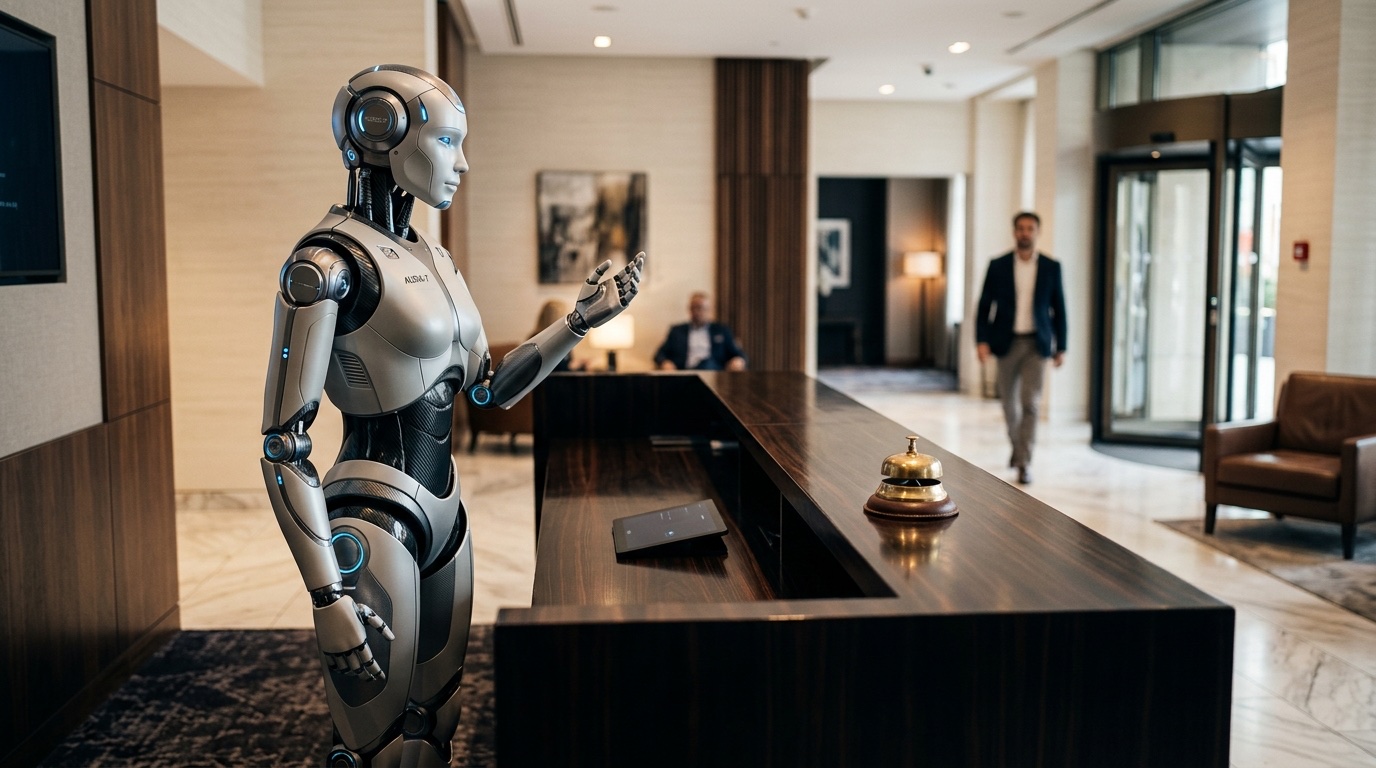
At the ITB Berlin 2026 trade fair in early March 2026, Heilbronn-based PLAZA Hotelgroup and Metzingen-based NEURA Robotics announced a partnership to introduce the humanoid robot 4NE1 into hotel operations, reported as the first of its kind on the German market. The hotel group is family-run and was founded in 2002; NEURA Robotics is a robotics specialist based in Baden-Württemberg.
Intended roles and announced scope
According to the manufacturer's description, the 4NE1 robot is designed to move with human-like motor skills, perceive its physical surroundings, hold natural conversations in multiple languages, and act largely autonomously[1]. In hotel environments, the system is planned for deployment across reception, guest service, and housekeeping workflows, and both partners explicitly position the machine as operational support for existing staff rather than a replacement for human workers[2]. Yonca Yalaz, CEO of PLAZA Hotelgroup, is quoted as saying: "Unsere Branche befindet sich im Wandel. Mit NEURA Robotics haben wir einen Partner gefunden, der technologische Exzellenz mit echter Innovationskraft verbindet"[2].
What remains unannounced
While the trade fair demonstration generated significant industry attention, the partnership remains a declared practical test rather than a verified commercial rollout. PLAZA Hotelgroup operates 65 hotels in Germany, Austria and the Netherlands[1]. As of late August 2026, however, no specific deployment dates, designated pilot properties, or operational performance data have been published by either organisation. For operators evaluating NEURA 4NE1 deployment models, distinguishing between an announced pilot and proven field capability is essential.
- Stated operational scope: Testing humanoid assistance across front-desk reception, guest service, and floor housekeeping routines.
- Staffing positioning: Collaborative support designed to relieve employees of repetitive tasks rather than eliminate headcount.
- Current verification status: Early practical test with no published operational metrics, deployment timetable, or designated property list as of late August 2026.
The Vendor Landscape and NEURA's Series C
The corporate backing behind the hotel partnership reflects substantial capital investment. On 10 June 2026, NEURA Robotics announced a Series C financing round with a total round size of up to 1.4 billion US dollars, described by the company as the largest ever raised by a full-stack robotics company[3]. The named investors include Tether, Qualcomm Technologies, Amazon, NVIDIA, imec.xpand, Bosch, Schaeffler, the European Investment Bank, Lingotto Horizon and InterAlpen Partners[3], and NEURA states that its existing orderbook and strategic deployment pipeline exceed 1 billion US dollars.
Training in dedicated simulation environments
NEURA states that this growth capital is allocated to scaling series manufacturing and to the global rollout of its dedicated real-world training environments, which the company calls "NEURA Gyms". According to the partners, the systems are prepared for hotel tasks in these training centres, where specialists from the hospitality sector help train specific application scenarios[2].
Understanding this funding landscape is crucial for hospitality executives. While record venture capital flows into general-purpose humanoid research, the broader structure of European robotics funding demonstrates that large balance sheets and simulation facilities do not automatically eliminate the complex integration requirements of live hotel operations.
| Vendor Parameter | Reported Metric / Stated Detail |
|---|---|
| Financing Volume | Series C with a total round size of up to 1.4 billion USD, announced 10 June 2026 |
| Orderbook | Existing orderbook and strategic deployment pipeline stated to exceed 1 billion USD |
| Named Investors | Tether, Qualcomm Technologies, Amazon, NVIDIA, imec.xpand, Bosch, Schaeffler, European Investment Bank, Lingotto Horizon, InterAlpen Partners |
| Stated Capital Allocation | Scaling series production and global rollout of NEURA Gyms training environments |
The True Scale of the Hospitality Labour Shortage
The standard commercial justification for hotel automation is the persistent shortage of operational staff. Trade coverage surrounding the PLAZA announcement referred to a large gap of unfilled positions in German hospitality in 2026, attributing that estimate to the announcing partners rather than to official statistics[2]. An examination of official labour records shows a different baseline.
Official Bundesagentur für Arbeit vacancy data
Official statistics from the Bundesagentur für Arbeit compiled by DEHOGA indicate a different baseline. Registered hospitality vacancies in Germany stood at 18,785 in May 2026, compared to 39,696 in May 2019[4]. Earlier in the year the figure was lower still, with 17,667 registered vacancies in January 2026 and 19,063 in March 2026[4]. In terms of active payroll, March 2026 saw 1,088,600 employees subject to social insurance contributions, 1.9 percent more than the comparison value in the statistics, alongside 1,044,400 in marginal employment[4].
Registered vacancy figures inevitably undercount total industry demand because employers do not report every vacant role to the employment agency. Nevertheless, maintaining a strict distinction between verified public records and speculative estimates is essential when underwriting automation investments. The same trade coverage puts personnel costs at commonly between 35 and 40 percent of revenue[2], which is precisely why operators need precise, measurable shift requirements rather than general industry figures to justify equipment acquisition.
| Labour Market Metric | Official Statistical Value | Source Baseline |
|---|---|---|
| Registered Vacancies (May 2026) | 18,785 positions | Bundesagentur für Arbeit / DEHOGA |
| Registered Vacancies (May 2019) | 39,696 positions | Pre-pandemic comparison point |
| Registered Vacancies (Jan 2026) | 17,667 positions | Bundesagentur für Arbeit / DEHOGA |
| Social Insurance Employment (Mar 2026) | 1,088,600 employees, 1.9 percent (20,201 people) above the comparison value shown in the statistics | Bundesagentur für Arbeit |
| Marginal Employment (Mar 2026) | 1,044,400 employees | Bundesagentur für Arbeit |
Payback Maths: Humanoid Desks vs. Wheeled Corridors
Stationing a humanoid robot at a reception desk involves fundamentally different financial calculations than placing a wheeled transport robot in a service corridor. Calculating payback depends entirely on whether a robotic system isolates a discrete, measurable unit of work or attempts to handle an unstructured bundle of responsibilities.
Calculating isolated tasks versus complex bundles
Dedicated wheeled service robots automate single, highly repetitive tasks such as transporting linen trolleys, delivering room service orders, or moving luggage between fixed service points. Because these tasks consist of measurable transit hours and predictable routes, an operations manager can directly calculate the labour offset against hourly wage baselines. If a wheeled delivery unit completes four hours of corridor transit per day, the monthly labour saving is direct, calculable, and auditable.
In contrast, a humanoid positioned at a front desk addresses an interconnected bundle of administrative, social, and physical tasks. A reception agent checks guests in, resolves billing disputes, answers localized questions, handles emotional complaints, and coordinates with housekeeping. If a humanoid completes only 25 percent of these interactions while requiring human staff to supervise the remaining 75 percent, the staffing roster remains unchanged. The robot adds capital cost without removing a full shift or returning measurable labor savings.
| Operational Dimension | Wheeled Transport Robot | Humanoid Front-Desk Robot |
|---|---|---|
| Task Structure | Single, isolated physical transit routine | Broad, unstructured bundle of administrative and social tasks |
| Labour Offset | Direct substitution of measurable transit hours | Partial assistance without eliminating shift staffing requirements |
| Payback Calculation | Linear calculation based on recovered porter/logistics hours | Complex, indirect calculation dependent on unproven multi-tasking |
| Integration Scope | Standard lift relays, automated doors, flat corridors | Complex multi-sensor fusion, bipedal navigation, real-time voice UI |
Different Failure Modes in Guest-Facing Environments
The operational viability of any robotic system is determined by how it behaves during technical failures. A malfunction in a back-of-house service corridor creates an internal logistical delay, whereas an interruption at a front desk immediately impacts the guest experience.
Service corridor stoppage versus front-desk disruption
When an autonomous wheeled transport robot suffers a sensor lock or navigation stall in a basement corridor, the failure mode is contained. Hotel staff can wheel the unit aside, complete the delivery manually, and file a maintenance ticket without guest visibility. The disruption remains entirely internal and operational.
Conversely, a humanoid robot operating at reception functions in direct view of arriving guests. If the natural language processing stack falters in a noisy lobby, or if an actuator locks during check-in, the failure becomes an immediate customer service incident. A stalled robot during peak check-in hours delays guests and forces front-desk staff to de-escalate tension, increasing rather than reducing operational workload.
- Back-of-house failure mode: Internal transit delay, zero guest exposure, and straightforward manual bypass within minutes.
- Front-of-house failure mode: Direct guest interruption, visible technical freeze, and immediate demand on staff to intervene.
- Environmental tolerance: Service corridors offer controlled lighting and predictable layouts, whereas hotel lobbies present acoustic reverberation, erratic foot traffic, children, and unpredictable physical obstacles.
What Operators Must See Before Drawing Conclusions
For hotel general managers, senior living operators, and facility directors, trade show demonstrations cannot substitute for verified operational proof. Before committing capital or signing long-term equipment leases, decision-makers must evaluate concrete performance across several operational criteria.
Essential operational criteria for commercial viability
A thorough evaluation requires transparent reporting on real field metrics rather than controlled vendor tests. Operators require empirical evidence regarding baseline labour recovery, sustained hardware uptime, and dependable service coverage when technical issues arise outside standard vendor support hours.
- Baseline labour recovery: Audited data demonstrating measurable shift hours returned to hospitality staff compared against a documented pre-robot operational baseline.
- Unassisted uptime and fault resolution: Documented mean time between failures (MTBF) and clear service-level agreements (SLAs) defining who resolves hardware stalls once vendor engineers leave the site.
- Front-desk exception handling: Quantitative success rates for unassisted check-ins, language comprehension accuracy in reverberant lobby environments, and clear automated fallback protocols.
- Data governance and privacy compliance: Clear contractual confirmation of who owns conversational audio, video streams, and guest personal data, ensuring processing remains within EU data protection frameworks.
- Night and weekend autonomy: Demonstrated capability to operate reliably during night shifts and peak weekends without requiring dedicated on-site robotics personnel.
- Supplier continuity and parts availability: Long-term service commitments, spare-parts guarantees, and maintenance structures that protect operational investments over multi-year lifecycles.
The Verdict on the Wheels-Versus-Humanoid Question
The announced partnership between PLAZA Hotelgroup and NEURA Robotics marks a notable step as the first named humanoid partnership in German hospitality. However, commercial operators should view it as an exploratory live trial rather than proof that humanoid platforms are ready to displace specialized wheeled automation.
Systems integration over hardware fascination
Specialized wheeled robots remain the proven solution for operational relief across hospitality, senior living, and healthcare facilities today. They deliver transparent payback on repetitive transport tasks without the mechanical complexity, high acquisition costs, and delicate failure modes associated with bipedal humanoid platforms.
Moving robotics from experimental pilots into reliable daily operations requires thorough workflow mapping, property management system connectivity, and vendor-neutral monitoring. As an independent systems integrator, werob supports facility operators through the werob Platform and pre-built Connectors to assess site readiness, integrate robotic workflows into existing infrastructure, and deliver measurable operational performance.
- Current commercial reality: Wheeled robots deliver proven, calculable payback for transport and logistics workflows today.
- Humanoid development status: Humanoid deployments in guest-facing roles remain active research pilots that require rigorous independent verification before broad commercial underwriting.
- The systems integration role: Long-term operational reliability depends on property management system integration, strict regulatory compliance, and hardware-agnostic operational support.
FAQ
- What is the 4NE1 humanoid robot?
- The 4NE1 is a humanoid robot developed by NEURA Robotics, designed with human-like motor skills. The manufacturer states it can perceive its environment, hold multilingual conversations, and act autonomously, though independent operational results in hotels are not yet published.
- Which hotel group is testing the NEURA humanoid robot?
- PLAZA Hotelgroup, a family-run business based in Heilbronn with 65 hotels in Germany, Austria and the Netherlands, announced a partnership with NEURA Robotics at ITB Berlin 2026 to bring the 4NE1 robot into hotel operations.
- What tasks will the humanoid robot perform in hotels?
- The 4NE1 robot is planned to support staff in reception, service, and housekeeping roles. Both PLAZA Hotelgroup and NEURA Robotics frame the deployment as a practical test to assist employees rather than replace them.
- How many unfilled jobs are there in German hospitality?
- Trade coverage of the announcement quotes a shortage estimate from the announcing partners themselves. The official figure from the Bundesagentur für Arbeit is 18,785 registered hospitality vacancies in May 2026. Registered numbers undercount the total shortage, but accurate baselines remain essential for operators.
- How does a humanoid robot compare to a wheeled service robot?
- A wheeled transport robot typically offsets one repetitive task in a corridor, making its payback simple to calculate. A humanoid robot addresses a bundle of guest-facing tasks, making its return on investment harder to underwrite and increasing the risk of service incidents.
- When will the PLAZA humanoid robots be deployed?
- As of late August 2026, no specific operating results, deployment dates, or named hotel sites have been published for the PLAZA Hotelgroup and NEURA Robotics partnership.
Related reading
NEURA 4NE1 Germany: Humanoid Robotics in Operational Deployment
The NEURA 4NE1 marks the transition from research to real value creation. As a systems integrator, werob translates this technology into measurable cost relief for care, hospitality and logistics.
12 June 2026humanoid robot hype reality hotel pilotHumanoid hype, read from the outside: what a physical-AI primer adds to the PLAZA question
In August this site read the PLAZA Hotelgroup and NEURA Robotics announcement against the official vacancy statistics and against wheeled service robots. A March 2026 primer on physical AI, written for executives by an author with no stake in hotels, supplies the piece that announcement could not: what experts in the field say about the humanoid narrative when they are not selling one, and why the limiting factor in a humanoid is heat before it is intelligence.
16 September 2026robot lift integrationLifts, Fire Doors and WiFi: What Decides Hospital and Hotel Robot Projects
Discover how to integrate service robots in hospitals and hotels by mastering elevator APIs, fire door hold-open systems, and seamless WiFi roaming.
25 August 2026rent humanoid robotsRenting Humanoid Robots: Strategies for B2B Deployment
Humanoid robots are leaving the labs and reaching operational practice. For companies, the question is no longer whether but how to integrate without capital risk through Robotics-as-a-Service.
8 June 2026robotics funding 2026Buying a Service Robot: 2026 European Robotics Funding
European robotics funding hit record highs in 2026, but for operators buying a service robot, this capital changes contracts rather than shortlists.
26 August 2026