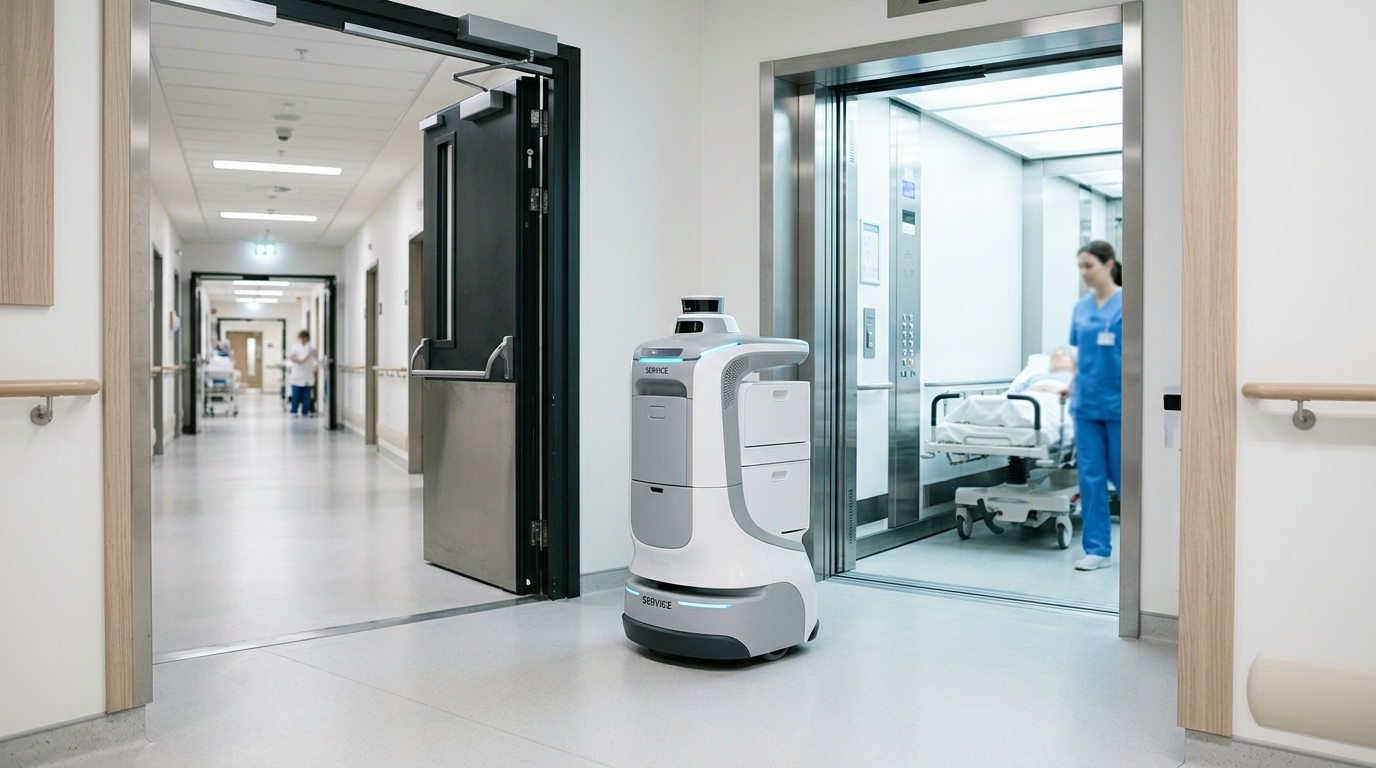
Lifts, Fire Doors and WiFi: What Decides Hospital and Hotel Robot Projects
Discover how to integrate service robots in hospitals and hotels by mastering elevator APIs, fire door hold-open systems, and seamless WiFi roaming.
Service robot projects in hospitals and hotels succeed or fail at three critical building interfaces: elevator integration, fire door hold-open systems, and WiFi roaming. This guide explains the technical mechanics and responsibilities required to make autonomous fleets work.
Key Takeaways
- 1Hospital robotics projects typically fail at building interfaces like elevators and fire doors, not due to the robot's navigation hardware.
- 2Elevator integration requires clearance from the maintenance provider and relies on either cloud APIs or relay-based retrofits.
- 3Fire doors must close automatically in emergencies; robots require approved hold-open systems that are function-tested at intervals of no more than one month.
- 4Seamless WiFi roaming requires fast roaming support (IEEE 802.11k and 802.11r) and consistent SSID settings across all building access points.
- 5Unclear project responsibilities are the biggest cause of delays, requiring a strict division of tasks between IT, facility management, and integrators.
The reality of building integration for service robots
Autonomous service robots rarely fail due to onboard navigation or sensor limitations; they fail because of unresolved physical and digital interfaces within existing building infrastructure. While modern mobile robot hardware is technically mature, commercial facilities like hospitals and hotels were historically designed exclusively for human occupants.
When transitioning from isolated single-room proofs of concept to autonomous multi-floor operations, robotic fleets encounter severe friction at three primary architectural choke points: elevators, fire doors, and wireless network boundaries. Solving these physical bottlenecks requires deep system-level coordination across mechanical, electrical, and digital domains rather than simply adding more sensors to the robot.
- Elevator interfaces: Real-time coordination of cabin dispatch, floor selection, door hold times, and spatial availability.
- Fire door compliance: Managing automated passage without breaching statutory fire compartmentation and self-closing mandates.
- Network infrastructure: Ensuring persistent data links and low-latency access point handovers across shielded shafts and transit corridors.
Addressing these three interfaces requires moving beyond hardware procurement toward holistic system integration. The following sections break down the specific mechanics, protocols, safety clearances, and operational responsibilities required to integrate autonomous mobile robots into enterprise facility workflows.
Elevator integration mechanics and requirements
Autonomous multi-floor navigation requires continuous, bidirectional communication between the mobile robot and the vertical transport dispatch system. A service robot cannot simply wait in front of an elevator shaft like a human passenger; it must programmatically request a car, monitor arrival status, verify available floor space, and command extended door dwell times to ensure safe transit.
The operational sequence follows a strict transactional handshake to prevent deadlocks or safety incidents:
- Call placement: The robot approaches the elevator lobby, triggers a call for its current floor, and requests a target destination via API or relay control.
- Car assignment and monitoring: The dispatch controller allocates a specific car, transmitting real-time telemetry including car identifier, current position, travel direction, and arrival state.
- Payload and space verification: Before boarding, the robot evaluates cabin load status and internal obstacle sensors to confirm sufficient capacity.
- Door dwell extension and boarding: The robot commands the doors to remain open during entry, navigates into the car, turns to clear the threshold, and releases the door hold.
- Transit and disembarkation: The elevator travels to the assigned floor, signals arrival, holds the doors open, and confirms complete exit before returning to standard passenger service.
Standard elevator door timers are calibrated for human walking speeds and for a passenger's ability to react to a closing door. Autonomous robots move at controlled, lower velocities across door thresholds to ensure safety, requiring dynamic door-hold overrides. Furthermore, if a cabin arrives with high passenger occupancy, the robot must register the full load condition, reject the car, and wait for a subsequent dispatch without blocking the lobby.
Elevator interfaces: Cloud APIs versus relays
Elevator integration is achieved either through modern cloud-based APIs provided by elevator manufacturers or via hardwired relay retrofits using potential-free contacts. Selecting the correct technical approach depends on the age of the elevator installation, controller architecture, and the manufacturer maintenance contract.
Modern smart elevators increasingly support native digital interfaces for robots. KONE's Service Robot API, for example, uses the WebSocket protocol and lets a robot place automated elevator calls, read real-time status such as car position, direction and door state, and monitor the call as it is allocated, arriving or served[1]. The concrete protocol and feature set is manufacturer-dependent and must be clarified with the elevator manufacturer or maintenance provider. In contrast, legacy elevators built without digital connectivity require discrete I/O hardware modules installed directly inside the controller cabinet, physically bridging call buttons and door sensor circuits.
| Interface Characteristic | Cloud-Based Elevator API | Relay / Hardwired Retrofit |
|---|---|---|
| Deployment Complexity | Software-driven integration via standard protocols | Physical hardware installation in machine room |
| Functional Depth | Full bidirectional telemetry (cabin load, direction, floor) | Basic binary states (door open/close, floor arrived) |
| Dynamic Dispatching | Group-level dispatch integration supporting multiple robots per elevator group[3][2] | Dedicated single-car assignment only |
| Hardware Alterations | No physical cabinet modification required | Physical wiring onto elevator controller boards |
| Manufacturer Approval | Standardized commercial licensing model | Mandatory case-by-case engineering sign-off |
Cloud APIs shift the work from heavy hardware installation toward digitally managed connections, and their two-way communication lets robots receive real-time status such as emergency or service modes and adapt their behaviour accordingly[3][2]. However, legacy relays remain necessary in older building stock. Regardless of the technical route, any interface intervention requires formal clearance from the certified elevator maintenance provider to prevent voiding operational warranties or statutory safety certifications.
Fire doors and the self-closing mandate
Fire doors represent the most stringent regulatory boundary for autonomous robots because their legal purpose is to prevent the spread of smoke and fire through mandatory self-closing mechanisms. Robots cannot physically push open heavy, latching fire doors without compromising structural integrity or breaching building safety codes.
Under German fire safety practice, fire and smoke protection doors must be self-closing, and if they are to be held open, only a hold-open system (Feststellanlage) with building-law approval may be used, granted on the basis of a suitability assessment against the requirements of the Deutsches Institut für Bautechnik (DIBt)[5][4]. Such a system combines a hold-open device (a magnet with an armature plate or a door closer with hold-open function, optionally with a powered door drive), at least one fire detector such as an optical smoke detector, and a manual release button, so that the door is released and closed at the earliest possible moment in the event of smoke, fire, a fault or a power failure[4][5].
- Approved hold-open hardware: Hold-open magnets or door closers with hold-open function, fire detectors, and a manual release button must form one approved system regulated under DIN 14677, DIN EN 14637, and the DIBt guidelines[4][5].
- Fail-safe release: In the event of an alarm or electrical interruption, hold-open mechanisms must release immediately without software delay.
- Monthly functional testing: The operator must keep the hold-open system permanently operable and check its correct function at intervals of no more than one month, plus an annual inspection and maintenance by a qualified specialist[5][4].
- Expert sign-off: Any modification or automation retrofit on a fire barrier requires formal review and approval by an authorized fire safety expert or building authority.
Robots navigating across fire compartments rely on hold-open systems or synchronized automatic swing door drives that open on approach via secure wireless interlocks. Wedging fire doors open or altering closing tensions manually is illegal and creates severe liability. For hospital cleaning robots and transport units, passage must be designed entirely within certified building automation guidelines.
Network infrastructure and seamless WiFi roaming
A continuous, low-latency wireless connection is vital for fleet coordination, real-time elevator handshakes, and door interlocks across complex floor plans. In hotel and hospital environments, physical barriers like reinforced concrete cores, elevator shafts, and fire compartment walls cause severe radio frequency attenuation, resulting in connection dead zones.
Unlike consumer devices that can buffer data or tolerate brief dropouts, autonomous mobile robots require deterministic communication. Without fast roaming support, a client disconnects from its current access point before associating with the next one, leaving a window with no network access that shows up as packet loss or dropped sessions[6]. Implementing fast roaming standards such as IEEE 802.11k (neighbour information so the client knows where to roam next) and IEEE 802.11r (Fast BSS Transition, so encryption keys are already held by the target access point) reduces the time a handover takes and therefore its impact on operations[6].
- Dedicated SSID and VLAN: Robot fleet traffic must be isolated from guest and general staff networks to guarantee bandwidth, eliminate broadcast overhead, and protect operational integrity.
- Elevator shaft coverage: In-shaft connectivity or specialized lobby access points are required so robots do not lose connection while inside vertical transit cabins.
- Fail-safe offline behaviors: Robots must execute predefined safe-stop or hold-position routines if a wireless connection drops mid-journey, preventing unauthorized threshold blocking.
Deploying hotel service robots alongside guest networks without network segmentation risks unexpected communication timeouts. A dedicated, professionally surveyed wireless local area network forms the backbone of reliable autonomous operations across multi-zone facilities.
Project responsibilities and dependencies
Deployment delays in service robotics projects rarely stem from robot programming; they occur because organizational responsibilities across facility management, external contractors, and IT departments are undefined. Establishing an explicit responsibility assignment matrix at project kickoff prevents scope gaps and ensures compliance milestones are met on schedule.
| Project Workstream | Building Operator / Facility Management | Elevator Maintenance Provider | In-House IT Department | Robotics Systems Integrator |
|---|---|---|---|---|
| Elevator API & Hardware Interface | Commissions service contract and funds upgrade | Provides interface hardware, API keys, and safety sign-off | Configures machine room network connectivity | Integrates dispatch protocols and conducts transit tests |
| Fire Door Automation & Hold-Open | Secures fire safety expert sign-off and logbooks | Not applicable | Not applicable | Maps trigger zones and verifies sensor safety timings |
| WLAN Infrastructure & Roaming | Approves access point placement and cable runs | Not applicable | Provisions dedicated VLAN, SSIDs, and fast roaming | Validates signal coverage and handover latency across routes |
| Fleet Workflow & Application Logic | Defines operational schedules and service routes | Not applicable | Manages host ERP/PMS network firewall permissions | Maps site layout, configures middleware, and trains staff |
When evaluating vertical integration across facility services, the robotics systems integrator acts as the central technical coordinator. The integrator aligns the elevator contractor, fire safety inspector, and IT network engineers to ensure each interface complies with statutory requirements before live commissioning begins.
System orchestration and continuous monitoring
Maintaining dependable fleet availability across elevators, fire barriers, and networks requires centralized operational oversight that tracks building interfaces alongside robotic hardware. When a robot stops in a hallway, operations teams must immediately determine whether the root cause is a dropped wireless signal, a locked fire barrier, an occupied elevator, or an onboard hardware alert.
To manage multi-system environments without manual troubleshooting, modern deployments utilize standardized integration middleware. Pre-built software layers like Connectors translate commands between proprietary robot operating systems and external building controllers, hospital information systems, or hotel property management software. This removes the need to develop custom point-to-point drivers for every door or elevator.
Real-time fleet health is monitored through operational dashboards like Cockpit, which tracks system performance across hardware health, infrastructure availability, and regulatory compliance. The werob Platform coordinates this end-to-end integration architecture, turning isolated robotic units into a reliable, integrated building utility.
FAQ
- Why is elevator integration difficult for service robots?
- Elevator integration requires real-time data exchange for the robot to call a cabin and hold doors open. Depending on the elevator's age, this involves either native cloud APIs or relay-based retrofits, which always require approval from the elevator's maintenance provider.
- Can a service robot open a closed fire door?
- No, robots cannot physically open closed fire doors or override their safety mechanisms. Instead, fire doors on robot routes must be equipped with officially approved hold-open systems that are connected to fire detectors and automatically close in the event of a fire.
- How often must hold-open systems for fire doors be inspected?
- The functional test of a hold-open system should be carried out at intervals of no more than one month; after twelve tests without defects, the interval may be extended to every three months. In addition, an annual inspection and maintenance must be performed by a qualified specialist or specialist company.
- Why do robots lose WiFi connection in hospitals?
- Robots often drop their WiFi connection in elevators, stairwells, and fire compartments due to weak signals or slow handovers between access points. To prevent this, networks require dedicated VLAN configurations plus fast roaming support such as IEEE 802.11k and 802.11r, which shorten the handover between access points.
- Who is responsible for integrating robots into a hospital building?
- Integration requires a joint effort: facility management handles fire safety approvals and elevator clearance, in-house IT configures dedicated WiFi VLANs, and the robotics integrator orchestrates the technical connections between the robot fleet and the building infrastructure.
Related reading
Service robots in hotels: operational excellence through integration
The implementation of service robots in the hotel industry often fails due to isolated isolated solutions. As a system integrator, werob offers the direct path to an automated fleet through seamless PMS connection and manufacturer-independent specifications.
19 June 2026humanoid robots hotelHotel Robots: What the PLAZA Humanoid Test Actually Means
Explore what the PLAZA Hotelgroup's humanoid robot deployment means for hospitality operators and how it compares to proven wheeled service robots.
27 August 2026cleaning robot clinic providerCleaning Robot Clinic Provider: System Integration for Daily Clinical Operations
The selection of the right cleaning robot for clinics often fails due to hardware fixation. werob solves this problem as a systems integrator through a 48-hour specification and manufacturer-independent ranking of over 44 OEM partners.
16 June 2026robot commissioning on siteHow a robot learns your building: off-site vs on-site
Understand how robots learn to navigate your building, what vendors can train off-site, and why on-site integration dictates the commissioning schedule.
27 August 2026robot fiducial marker site configurationThe 146 millimetre square your inspection round depends on
Boston Dynamics specifies the printed marker Spot localises against down to the millimetre, and documents what happens when one moves. It is building infrastructure with a tolerance, and it is on nobody's maintenance schedule.
9 September 2026