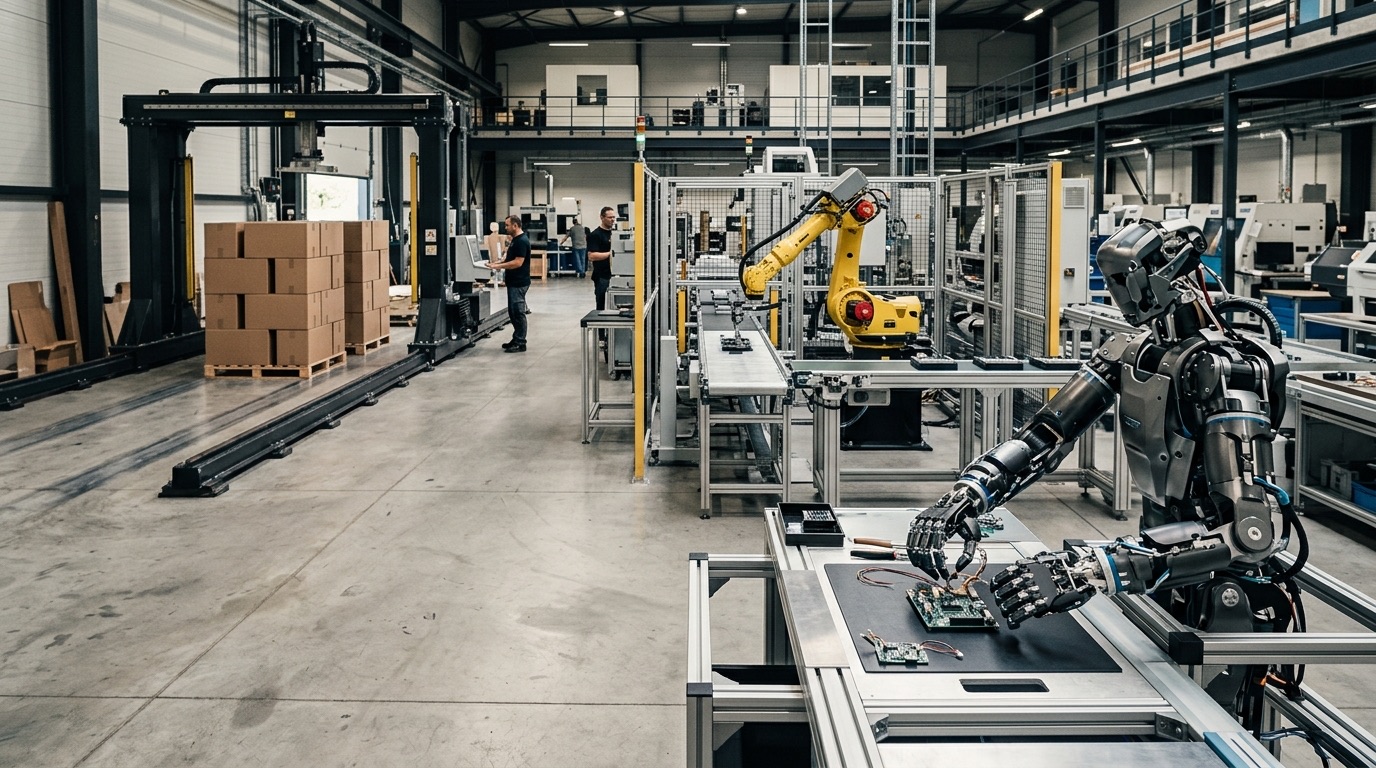
Bosch Plans to Build Humanoid Robots in the Black Forest
Bosch will begin manufacturing humanoid robots at its Bühl plant in August 2027. Discover what this timeline means for European logistics managers.
Bosch has announced plans to contract-manufacture humanoid robots for the London startup Humanoid in Germany's Black Forest starting in August 2027. For European logistics managers, the deal signals maturing supply chains, but immediate shop-floor readiness remains years away.
Key Takeaways
- 1Bosch will begin contract manufacturing of humanoid robots in August 2027 for a London startup.
- 2The initiative pivots a traditional motor plant facing job cuts into an early industrialization hub.
- 3Target applications are logistics and factories, but full-scale mass production remains slated for 2028.
- 4The signal for European buyers is maturing industrialization capacity, not near-term shop-floor availability.
The Bosch and Humanoid Contract Manufacturing Deal
German technology and automotive supplier Robert Bosch has entered a strategic partnership to contract-manufacture humanoid robots at its production plant in Bühl, located in the Nordschwarzwald region of Germany[1]. Production is scheduled to begin in August 2027, marking one of the first high-volume contract-manufacturing agreements for general-purpose robotic platforms in continental Europe.
The manufacturing partner is Humanoid, a London-based robotics company founded in 2024 by Artem Sokolov. In July 2026, the startup completed a 152 million US dollar Series A funding round at a post-money valuation of 1.35 billion US dollars, securing institutional backing to transition its hardware designs from laboratory prototypes into industrial-scale output.
- Partner entity: Humanoid (London, UK), founded in 2024 by Artem Sokolov
- Manufacturing location: Bosch manufacturing facility in Bühl (Nordschwarzwald, Germany)
- Target timeline: Contract manufacturing start in August 2027
- Capitalization: 152 million US dollar Series A round closed in July 2026 at a 1.35 billion US dollar valuation
For industrial and logistics operators across Europe, this partnership represents an important supply-chain milestone. However, understanding the exact scope of the agreement requires distinguishing between production capabilities and near-term commercial availability.
The Pivot at the Bühl Plant: Legacy to Robotics
The selection of the Bühl site reflects a broader structural transformation within the European automotive supplier base. The Bühl facility currently employs approximately 2,700 people and focuses on the production of small legacy components, including micro-motors and window-lifter drives[2].
Facing ongoing pressure in traditional automotive manufacturing, the site had already instituted cost-cutting measures, with approximately 1,100 additional job reductions planned by 2030[2]. The agreement with Humanoid represents an attempt to repurpose existing precision-engineering capacity and skilled manufacturing labour toward emerging automation technologies rather than establishing a greenfield facility.
Contract Manufacturing vs. Proprietary Development
Bosch's operational role in this agreement is strictly defined. Bosch will serve as Humanoid's contract manufacturing partner, providing strategic oversight and technical expertise rather than a robot platform of its own[3]. Entering the field this way lets Bosch apply its existing industrialisation capability to a new product category without owning the platform development itself. While Bosch is currently examining whether to supply components such as drives, motors and sensors for future robot generations, this component-supply arrangement remains under review and is unconfirmed[1].
| Aspect | Current Status | Operational Scope |
|---|---|---|
| Manufacturing Model | Contract assembly only | Bosch builds units designed by Humanoid |
| Platform Intellectual Property | External (Humanoid) | Bosch is not developing a proprietary robot platform |
| Site Workforce Context | Restructuring facility | Plant currently employs ~2,700 staff with 1,100 job cuts planned by 2030 |
| Component Integration | Under evaluation | Actuators, drives, and sensors under technical review |
The Roadmap: From Beta to Mass Production
Humanoid's founder and chief executive, Artem Sokolov, has described a phased rollout leading up to volume output, starting with Beta in late 2026, then Gamma in 2027, and the mass-production version beginning in 2028[3]. The roadmap establishes a deliberate multi-year engineering validation cycle prior to broad deployment.
The company plans to release a beta version for testing and validation at the end of 2026. Following pilot evaluations, the "Gamma" generation is scheduled to enter series production at the Bühl plant in August 2027[1]. Volumes for Bühl are initially modest: a few hundred units are planned for 2027, staffed at first by a double-digit number of employees[1].
- Late 2026: Rollout of initial beta units for controlled pilot operations
- August 2027: Initiation of Gamma model assembly in Bühl (initial run: several hundred units)
- 2028 and beyond: Projected transition to mass production and broader commercial availability
Operations managers should note that the August 2027 date marks the commencement of production lines, not the availability of ready-to-deploy units at scale. Plant managers looking to automate workflows must separate factory commissioning dates from off-the-shelf commercial delivery.
Target Applications: Logistics and Factories First
The commercial deployment strategy for the robots produced in Bühl prioritises structured industrial environments. The hardware and software frameworks are designed primarily for factory shop floors and intralogistics workflows, where material transport and repetitive movement can be mapped systematically. Longer-term concepts such as domestic assistance or complex caregiving tasks remain speculative future applications rather than near-term targets.
Automotive supplier Schaeffler is confirmed as the first customer and, like Bosch, is an investor in the London-based startup[1]. Humanoid does not plan to sell the machines outright but to rent them under a robotics-as-a-service model[1]. Early pilot operations focus on material-handling tasks: in the joint proof of concept at Bosch's Bühl intralogistics facility, the robots autonomously transferred boxes from a conveyor to a trolley[3].
Pragmatic Form Factors and Task Complexity
This industrial focus aligns with how the platform's own developers describe near-term deployment. Humanoid's chief executive has argued that wheeled humanoids can move between workstations and operate within facilities already designed around human workers, with box handling as the entry use case and dexterous work such as assembly and packaging following later[3]. Focusing on structured box handling and cart transfer mitigates the reliability risks associated with fine-motor manipulation.
The Integrator Perspective: Maturing Supply Chains
From the viewpoint of an independent systems integrator, the Bosch-Humanoid agreement is significant not because it delivers immediate machines, but because it establishes European industrialization capacity. Historically, European robotics startups have struggled with the transition from functional prototypes to repeatable, automotive-grade serial production.
Contract manufacturing agreements with established Tier-1 suppliers provide the supply-chain rigor, quality management, and design-for-manufacturing discipline required for industrial adoption. In this case Bosch will provide strategic oversight and technical expertise through a structured design-for-excellence (DfX) framework spanning hardware design, production, supply chain, and cost optimization[3], which is the part of the value chain European robotics startups have historically lacked.
- Supply-chain verification: Tier-1 suppliers bring mature sourcing, component validation, and traceability
- Production scalability: Transitioning assembly from lab-based craft methods to standardized line assembly
- Regulatory compliance: Ensuring mechanical and electrical assemblies comply with EU machinery and safety directives
- Support infrastructure: Establishing long-term spare-parts manufacturing and service pipelines
While the industrial ecosystem is preparing for future humanoid robotics deployments, industrial operators must still evaluate machines based on current reliability metrics and total cost of ownership.
Shop Floor Reality in 2026: An Anti-Hype Assessment
Despite substantial venture capital and high-profile manufacturing announcements, plant managers must maintain an objective view of what is deployable on shop floors today. General-purpose humanoid platforms remain in early pilot validation stages, with production volumes measured in hundreds rather than tens of thousands.
Long-term industry forecasts illustrate the scale of future expectations. An analysis published by The Robot Report cited projections that the global market for general-purpose robotics could reach 370 billion dollars by 2040[4]. However, closing the gap between current trial runs and a mature 2040 market requires years of safety validation, mean-time-between-failure testing, and software hardening.
| Dimension | 2026 Operational Reality | Post-2027 Production Trajectory |
|---|---|---|
| Availability | Controlled pilot projects and research trials | Initial serial assembly (hundreds of units in Bühl) |
| Task Scope | Fixed-path transport, basic container moving | Structured material handling across factory cells |
| Integration Path | Custom engineering, specialized middleware | Standardized fleet interfaces and connectors |
| Deployment Lead Time | Multi-month exploratory pilots | Integrated fleet rollout via validated frameworks |
European plant managers should not pause automation roadmaps waiting for general-purpose humanoids. Effective automation strategies focus on deploying mature, specialized autonomous platforms that deliver immediate operational return.
Deploying Today with the werob Platform
While contract manufacturing deals in the Black Forest lay the groundwork for tomorrow's humanoid supply chains, European operations, logistics, and plant managers need reliable, deployable automation today. The challenge on current shop floors is not waiting for future prototypes, but selecting, validating, and integrating proven autonomous systems into live production.
The werob Platform addresses this operational requirement by acting as an end-to-end integration architecture. Instead of managing complex vendor negotiations and custom software builds, operators can move from concept to live operation in eight weeks through a structured, hardware-agnostic framework.
End-to-End Tools for Operational Scale
The platform coordinates procurement, software integration, and site monitoring across every stage of robotics deployment:
- Spec Engine: Translates plain-language operational workflow descriptions into formally verified, ROS-compatible action graphs within 48 hours
- Supplier Match: Evaluates and scores over 44 robot manufacturers based on regional service coverage, price bands, and regulatory compliance
- Connectors: Delivers pre-built integration layers connecting robotic fleets to existing enterprise systems like SAP EWM
- Cockpit: Provides centralized operational dashboards monitoring hardware status, regulatory compliance, and fleet task progress
By relying on a dedicated systems integration layer, European enterprises can capture immediate productivity gains with validated autonomous mobile robots and collaborative systems, while remaining fully prepared to incorporate future humanoid platforms as production matures.
FAQ
- What is the Bosch humanoid robot production plan?
- Bosch will start contract manufacturing humanoid robots for the London-based startup Humanoid in August 2027 at its Bühl plant in the Black Forest.
- Is Bosch developing its own humanoid robot?
- No, Bosch is acting strictly as Humanoid's contract manufacturing partner and is not bringing a robot platform of its own, though it is evaluating supplying components.
- When will the humanoid robots be available for mass deployment?
- While a beta is expected at the end of 2026 and initial production in August 2027, mass production is not scheduled until 2028.
- What are the primary applications for these humanoids?
- The robots are intended primarily for factories and logistics. Healthcare and household applications are considered longer-term potentials.
- How mature is the European humanoid robot market?
- The European humanoid robot market is widely described as fast-growing but still in the early stages of industrialisation, with volumes measured in hundreds of units rather than mass-market quantities.
- Who is an early customer for Humanoid's robots?
- Schaeffler, an industrial supplier, is set to be one of the first customers and is also an investor in the London-based startup Humanoid.
Related reading
Humanoid Integrator Europe Comparison: Scaling General Purpose Robots
Humanoid robotics in Europe is shifting from laboratory demos to floor-ready operations. This guide compares the integration pathways for general-purpose robots across senior living, hospitality, and logistics.
2 July 2026robotics funding 2026Buying a Service Robot: 2026 European Robotics Funding
European robotics funding hit record highs in 2026, but for operators buying a service robot, this capital changes contracts rather than shortlists.
26 August 2026robotics made in germanyRobotics Made in Germany: Does Vendor Origin Matter?
Germany leads Europe's robotics funding, but does vendor origin matter for operators? Discover the real impact of domestic service networks and CE compliance.
26 August 2026plain language robot deployment aiPlain Language Robot Deployment AI for Operational Scale
Traditional robotics procurement is stalled by months of discovery and vendor lock-in. werob uses plain language AI to convert operational workflows into deployable specifications within 48 hours.
4 July 2026humanoid robot hype reality hotel pilotHumanoid hype, read from the outside: what a physical-AI primer adds to the PLAZA question
In August this site read the PLAZA Hotelgroup and NEURA Robotics announcement against the official vacancy statistics and against wheeled service robots. A March 2026 primer on physical AI, written for executives by an author with no stake in hotels, supplies the piece that announcement could not: what experts in the field say about the humanoid narrative when they are not selling one, and why the limiting factor in a humanoid is heat before it is intelligence.
16 September 2026