Service robots in hotels: operational excellence through integration
The implementation of service robots in the hotel industry often fails due to isolated isolated solutions. As a system integrator, werob offers the direct path to an automated fleet through seamless PMS connection and manufacturer-independent specifications.
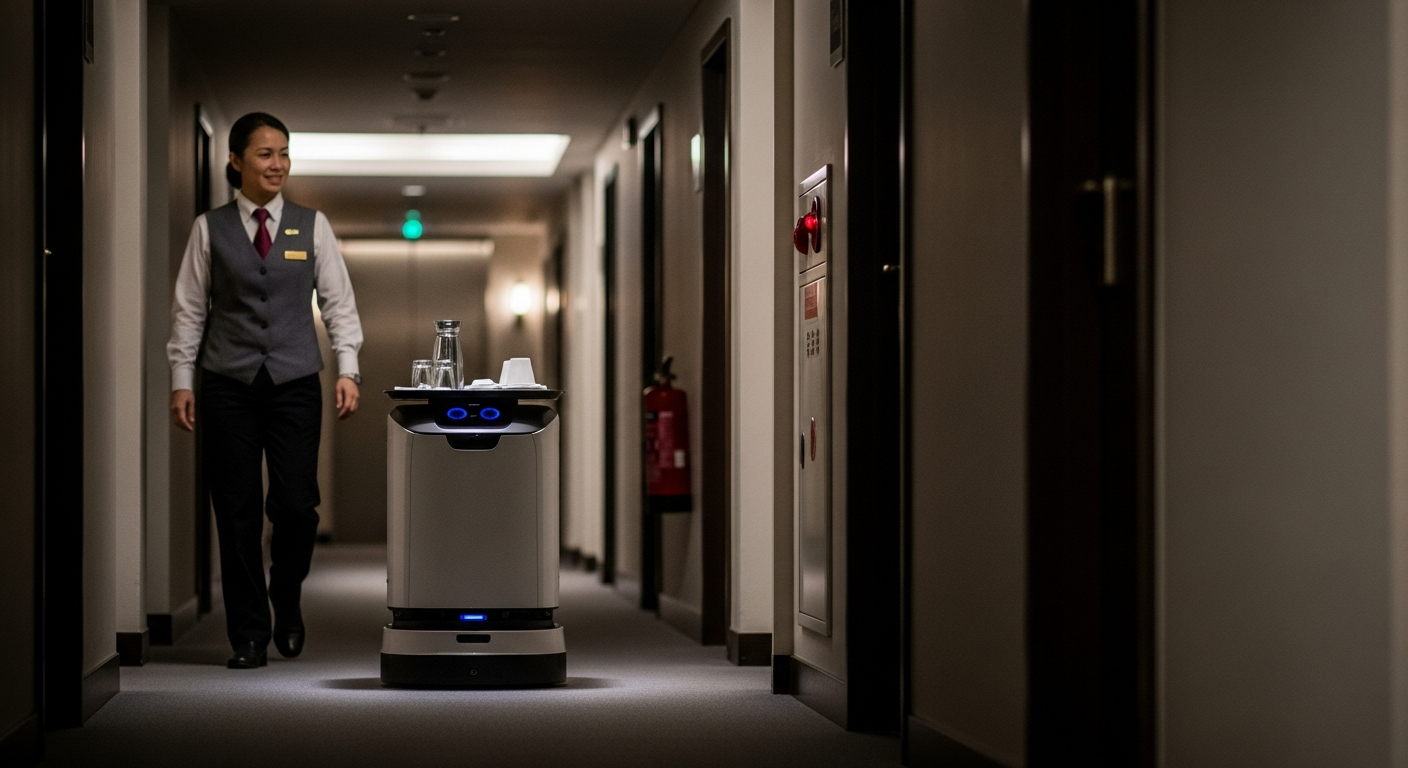
Friday evening, 11:30 p.m. On the fourth floor of a city hotel, a guest orders a late dinner. Instead of an employee making the time-consuming journey from the kitchen via the freight elevator to the guest room, an autonomous unit takes over the transport. Meanwhile, the staff stays with the guest or concentrates on complex tasks at the bar. This scene is not a future scenario, but rather everyday operational life for werob customers. In an industry characterized by 600,000 hotels in Europe and a chronic shortage of skilled workers, the focus is shifting from pure hardware to intelligent system integration. werob acts as an operational level that translates the hotel's workflow into a functional robotics specification.
Key Takeaways
- 1System integration beats hardware: The success of service robots in hotels depends on the connection to PMS systems such as Opera or Mews, not on the robot model alone.
- 2Massive cost reduction: Verified data shows savings of €112,000 in room service and €54,000 in breakfast preparation per location per year.
- 3Regulatory security: werob offers the compliance path for the EU Machinery Regulation 2023/1230, which will be binding from 2027.
The operational bottleneck: Why hardware alone is not a solution
In the European hotel industry, operators are faced with the challenge of meeting increasing guest expectations while at the same time decreasing staff availability. Many companies experiment with individual robots, but quickly realize that an isolated device without a connection to the existing IT infrastructure offers little added value. A service robot in the hotel has to do more than just drive autonomously; it must be part of the digital ecosystem. Without integration into the property management system (PMS), the manual effort for staff remains high, as orders have to be recorded twice or robots have to be loaded and started manually.
werob starts at exactly this point. As a system integrator, we do not consider the robot as a product, but rather the automated workflow. The goal is to completely relieve staff of unproductive walking distances. In a typical hotel, up to 30 percent of the working time in room service is spent purely on transport. By automating these paths, valuable capacity is freed up for direct guest contact. Hardware agnostics is crucial: Depending on the floor condition, elevator type and aisle width, different models from manufacturers such as Keenon, Pudu or Bear Robotics are possible. werob selects the most technically suitable solution from over 44 OEM partners instead of tying the customer to a single manufacturer.
The werob Spec Engine: A precise specification in 48 hours
The traditional path to introducing robotics often takes three to six months and is characterized by lengthy discovery phases and consultations. werob has radically shortened this process with the Spec Engine. Within just 48 hours, our platform translates a hotel operator's operational requirements into a ready-to-use robot specification. The system uses data from over 35,000 projects to take factors such as door widths, carpet resistance and elevator interfaces into account in the planning phase.
This speed is crucial for hotel groups that need to scale quickly. Instead of reinventing the wheel for each location, the Spec Engine provides a standardized profile that is checked against werob's catalog of over 280 maneuverable robots. The result is an objective ranking of the most suitable OEMs. This data-driven approach eliminates the risk of bad purchases where the hardware fails in everyday operations due to physical barriers or a lack of software compatibility. The operator receives a clear basis for decision-making that combines technical feasibility and economic efficiency.
Direct connectivity: integration with Opera PMS and Mews
The real lever for efficiency lies in software integration. werob supplies prefabricated connectors for the hotel industry's market-leading systems, in particular Opera PMS and Mews. This integration enables a room service order booked in the PMS to be automatically transmitted to the werob cockpit and thus to the available robot. No manual intervention is required from front desk or kitchen staff to instruct the robot.
This connectivity also extends to the physical infrastructure. The robots must be able to communicate with elevators and automatic doors. werob acts as a translator between the various protocols of the hardware manufacturers and the building technology. The standardized interfaces shorten the implementation time to just eight weeks. For the operator, this means that automation does not run on the side as an isolated project, but is deeply embedded in the existing digital processes. This reduces the error rate and increases acceptance among employees, as the system is perceived as a supporting tool and not as an additional burden.
Economic efficiency: Verified cost reduction in hotel operations
The decision for service robots in the hotel is primarily an economic one. werob works with concrete, verified numbers to show the return on investment (ROI). For the room service area, the annual cost reduction per location is, on average, significant amounts. This sum results from the saving in personnel capacities, which were previously tied up for simple transport tasks, as well as the reduction in errors during delivery.
Another significant area is the preparation of bar and breakfast. Here our customers achieve relief of around significant amounts per year. In the early hours of the morning, robots take over the transport of dishes, cutlery and food between basement storage and the guest rooms. The following table summarizes the typical savings potential:
| Area of application | Annual cost reduction per location |
|---|---|
| Hotel room service | 112,000 € |
| Bar/breakfast preparation | 54,000 € |
| Kitchen floor cleaning (F&B) | significant amounts |
| Tray transport (washing chamber) | significant amounts |
werob's commercial model is consistently geared towards success: results-oriented. This means that operators only pay when the robot is in productive use. There are no hidden list prices or upfront investments in hardware that ultimately don't deliver the desired benefits.
Compliance and safety: The EU Machinery Regulation 2023/1230
An often underestimated aspect when introducing robotics is the regulatory framework. From January 20, 2027, the new EU Machinery Regulation 2023/1230 will be binding. Many Asian OEMs currently do not have the necessary conformity assessments for the European market. werob offers the crucial compliance path here. We ensure that all systems used meet strict security and data protection requirements.
Especially in the hotel environment, where robots operate in close proximity to guests and children, compliance with standards such as ISO 13482 is essential for personal assistance robots. werob assumes responsibility for regulatory acceptance and risk management. This also includes data protection (GDPR), as modern robots are equipped with cameras and sensors. Our cockpit monitors the fleet in real time and ensures that all regulatory traffic lights are green. For hotel operators, this means legal security and protection against liability risks that could arise from self-importation or purchase from non-specialized resellers.
The werob cockpit: transparency across the entire fleet
As soon as the robots are in use, the werob cockpit takes over central control and monitoring. It is a 4-dimensional traffic light system that visualizes the status of the hardware, infrastructure (e.g. WiFi coverage), regulations and the original specification. Hotel managers can see at a glance whether the fleet is achieving the defined performance goals.
Should a robot stop due to a blocked lane or a technical defect, the cockpit provides immediate notifications and diagnostic data. This minimizes downtime and ensures that operations are not disrupted. In addition, the cockpit enables continuous improvement of routes and operating times based on real usage data. This transparency is the prerequisite for successful fleet management across multiple locations. werob not only offers the integration but also the long-term operation of the robotics infrastructure as a managed service.
Going live in eight weeks: The introduction process
Time is a critical factor in the hotel industry. While classic integration projects often take months, werob promises to have the robot in use within eight weeks of the start of the project. This tight schedule is made possible by standardizing the four platform levels: Spec Engine, Supplier Match, Connectors and Cockpit. The process begins with an 8-stage onboarding intake, in which all relevant data about the location and the desired workflow are requested.
After the Spec Engine has validated the requirements, matching with the best OEM partners takes place. A binding offer will be made within five days. The remaining weeks will be used to configure the connectors and physically prepare the site. Since werob uses ready-made integrations for Opera PMS and Mews, time-consuming individual programming is no longer necessary. The result is a quick amortization of the investment and an immediate, noticeable relief for the hotel team.
The future of the hotel industry is system-integrated
Service robots are no longer toys for technology enthusiasts, but a necessary answer to the economic realities of the industry. However, success does not depend on the choice of a specific robot model, but on the quality of system integration. werob offers hotel operators the security of receiving a hardware-agnostic, legally compliant and deeply integrated solution that delivers measurable results.
With cost savings of up to €112,000 per year in room service and an implementation time of just eight weeks, werob sets the standard for automation in the hotel industry. By taking on regulatory responsibility and providing a live cockpit, robotics becomes scalable and manageable for hotel groups. The path to operational excellence leads through the intelligent linking of workflow, software and hardware.
FAQ
- Which hotel systems does werob directly support?
- werob offers pre-built connectors for market-leading property management systems such as Opera PMS and Mews to ensure direct automation of workflows.
- How long does it take until a service robot is ready for use in a hotel?
- At werob, it usually only takes eight weeks from the first intake to productive use on the floor.
- Is werob a manufacturer of robots?
- No, werob is a hardware-agnostic system integrator. We rank over 44 OEM partners (like Keenon or Pudu) against your specific requirements.
- How much does it cost to implement a service robot?
- werob works according to a results-oriented model. This means you only pay when the system is running. There are no classic prices for the hardware.
- Do I have to worry about the EU Machinery Regulation?
- No, werob takes over the compliance path for the EU Machinery Regulation 2023/1230, which will be binding for all operators from January 2027.
- Can the robots use elevators independently?
- Yes, the integration of the elevator control is a core component of the werob solution, so that the robots can navigate autonomously between floors.
Related reading
Service Robot Deployment: Why Wheeled Models Win
While humanoids capture funding headlines, discover why wheeled, task-specific service robots are the practical choice for hospitals and care homes today.
26 August 2026robot lift integrationLifts, Fire Doors and WiFi: What Decides Hospital and Hotel Robot Projects
Discover how to integrate service robots in hospitals and hotels by mastering elevator APIs, fire door hold-open systems, and seamless WiFi roaming.
25 August 2026robot as a serviceRobot as a Service: Operational excellence without investment risk
Robot as a Service (RaaS) transforms rigid investment models into flexible, results-oriented operating solutions. As a hardware-agnostic system integrator, werob offers direct access to over 44 OEM partners and ensures integration into existing IT stacks.
27 June 2026robot integration pms hotelRobot Integration PMS Hotel: Efficiency through automation
The manual coordination of room service and cleaning ties up valuable human resources in the hotel industry. werob integrates robots directly into your property management system for automated processes without media breaks.
29 June 2026abb robot integrator service providerABB robot integrator service provider for operational excellence
Choosing an ABB robot integrator service provider determines the speed of payback. As a hardware-agnostic system integrator, werob offers the direct path from process analysis to the finished robot specification within 48 hours.
5 July 2026