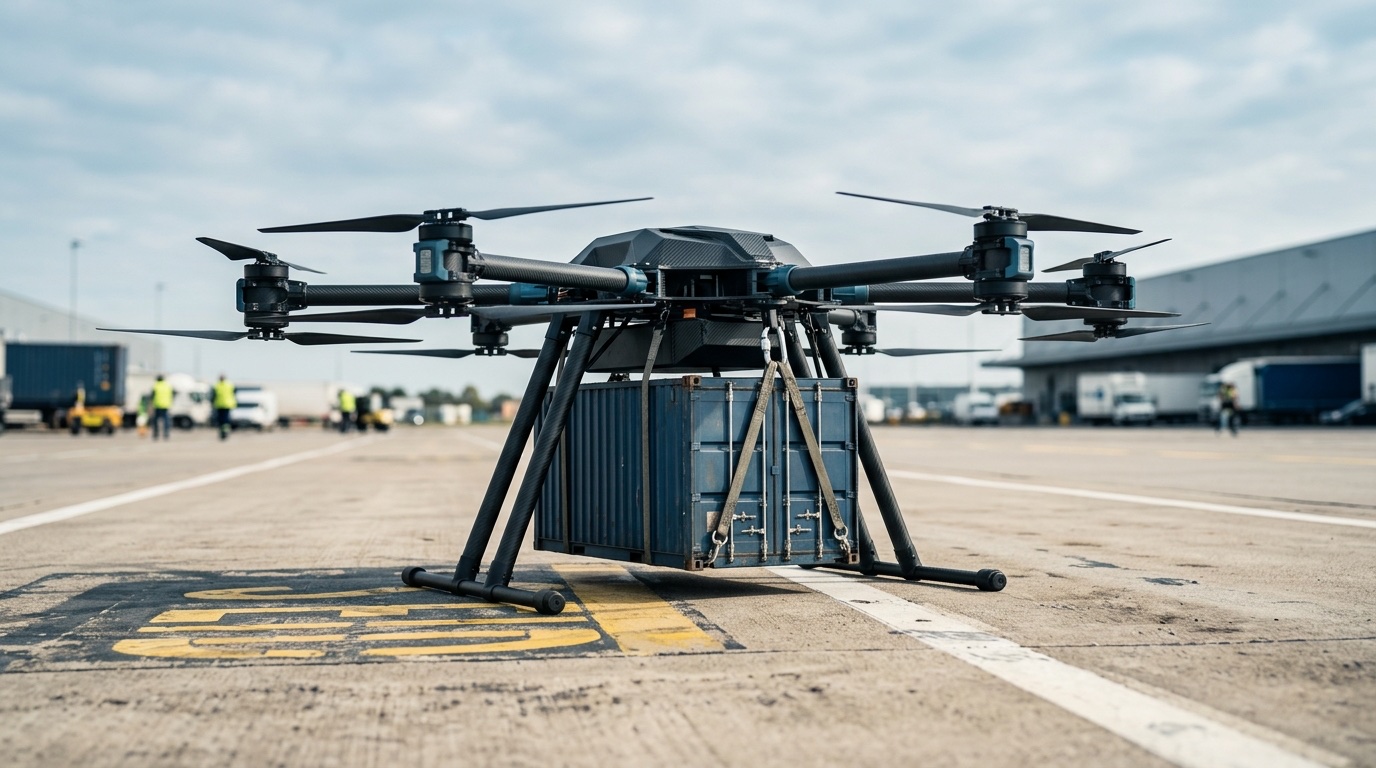
Cargo drones: which payload class is actually approvable in Europe today
The cargo drone conversation is about aircraft. It is settled by a number that sits in the regulation rather than the spec sheet: 25 kilograms of take-off mass. That is exactly where the whole class-mark system ends, and both standard scenarios end with it.
Anyone shopping for a cargo drone is shopping for an aircraft. That is the wrong order. The number that decides your project is not the lifting capacity in the brochure but the maximum take-off mass, because at a single threshold — 25 kilograms — the entire European class-mark system ends, and with it the only simplified route into operation. What flies below it carries single-digit kilograms. What flies above it exists as an aircraft, but not as routine operation.
Key Takeaways
- 1The class-mark system ends at 25 kilograms: C0 through C6 are all capped at a maximum take-off mass below 25 kg (dipul, the German digital platform for unmanned aviation).
- 2The simplified route ends there too. The two standard scenarios STS-01 and STS-02 require class C5 and C6 respectively, and both sit below the 25 kg line.
- 3Payload is a fraction of take-off mass: the Wingcopter 198 is listed at 25 kg take-off mass with a 4.7 kg payload. Roughly a fifth of the mass is cargo; the rest is airframe, energy and redundancy.
- 4The second threshold has nothing to do with mass. Article 6 of Implementing Regulation (EU) 2019/947 puts operations into the certified category where, among others, the aircraft has a characteristic dimension of 3 m or more and is designed to be operated over assemblies of people, or is designed to transport dangerous goods requiring high robustness.
- 5The honest answer to "how much can a cargo drone deliver today" is, in Europe: single-digit kilograms, on a fixed route, with a named operator.
The lifting capacity in the brochure is not the deciding number
Every spec sheet quotes a payload. Almost none of them puts it next to the maximum take-off mass, and it is that ratio which actually tells you what an aircraft is. A drone has to carry itself: airframe, motors, energy storage, redundancy for a motor failure, sensors, parachute. What is left over is your cargo.
Two figures from the market make the ratio concrete. The manufacturer lists the Wingcopter 198 at a maximum take-off mass of 25 kilograms with a payload of 4.7 kilograms; older material from the same manufacturer says 5 kilograms. The Matternet M2 carries up to 2 kilograms over up to 20 kilometres according to its manufacturer. In both cases the cargo is a bare fifth or less of the mass that actually leaves the ground.
For planning that means something specific. Anyone describing a route as "about ten kilos" is not describing an aircraft in the class available today, but one in the next class up. And the next class up is not one size larger. It is, in regulatory terms, a different continent.
Why 25 kilograms is the real boundary
The number 25 appears in several places in European drone law, and it always means maximum take-off mass, never payload. In the open category, subcategory A3 is limited to aircraft below 25 kilograms. What matters more is what happens to the class marks: according to the overview published by dipul, the German digital platform for unmanned aviation, classes C0 through C6 are all capped at a maximum take-off mass below 25 kilograms — C0 below 250 grams, C1 below 900 grams, C2 below 4 kilograms, and C3, C4, C5 and C6 each below 25 kilograms.
So the class-mark system simply stops at 25 kilograms. There is no class C7 for heavier aircraft, and none is planned. What that means for a purchase decision we took apart in Class marks C5 and C6; here only the consequence for the cargo matters.
Because the two standard scenarios hang off that marking. STS-01, visual line of sight over a controlled ground area in a populated environment, requires a class C5 aircraft. STS-02, beyond visual line of sight with observers over a controlled ground area in a sparsely populated environment, requires C6. Both classes sit below 25 kilograms. A heavier cargo drone therefore cannot use either standard scenario — not because it is too dangerous, but because there is no class mark for it that the scenario could refer to.
What falls away above the threshold
Above 25 kilograms what remains is the full individual assessment in the specific category. That is neither an exclusion nor a dead end. It is a substantially longer, more expensive and more bespoke compliance path whose effort rises with the risk classification. What that path looks like, which means of compliance has been binding since 29 September 2025, and why there is no shortcut for beyond-visual-line-of-sight flight over populated areas, is set out on our drone delivery page. We deliberately do not repeat it here.
What matters is the order in which the costs appear. An aircraft below 25 kilograms with a matching class mark can invoke a standard scenario and gets by with a declaration rather than an authorisation procedure. The same route flown with an aircraft above 25 kilograms needs the individual assessment, an operations manual, the process with the authority, and time. Going from five to fifteen kilograms of payload is therefore not a factor of three in price. It is a change of procedure.
This is why the routes that emerge in Europe look small. They are not small because nobody wanted to move more. They are small because below the threshold a path exists, and above it every case has to be built from scratch.
The second threshold, which has nothing to do with mass
Alongside take-off mass there is a second boundary that applies independently and is regularly overlooked. Article 6 of Implementing Regulation (EU) 2019/947 assigns operations to the certified category where, among other cases, the unmanned aircraft has a characteristic dimension of 3 metres or more and is designed to be operated over assemblies of people, and where the system is designed for transporting dangerous goods and requires a high level of robustness to mitigate the risks to third parties in the event of an accident.
Both criteria hit cargo drones squarely. An aircraft that lifts a meaningful load has span, and three metres is not an exotic figure for a fixed-wing platform with five kilograms of payload. And dangerous goods are in play for precisely the cargo where flight pays off soonest — medical samples, batteries, chemicals, compressed gases.
The certified category means certification of the system, certification of the operator and, where applicable, licensing of the remote pilot. That is the framework of manned aviation, and for a logistics project it is generally not a realistic option inside a two-year planning horizon.
What actually fits into single-digit kilograms
The interesting question is therefore no longer how to move more, but which cargo makes a real difference at single-digit kilograms. The answer is surprisingly concrete, and it has little to do with weight and a great deal to do with time.
It is cargo whose value sits in its arrival time rather than its mass. A spare part that stops a production line rarely weighs more than two kilograms — the same observation the use cases on our delivery page are built on. A laboratory sample weighs grams, and its entire value lies in turnaround time. A tool, a document, a component awaiting release.
That is exactly why the solid European routes are medical and industrial point-to-point connections rather than parcel networks. The German reference case is documented on our delivery page, as is how to read manufacturer claims about type certification. Both belong in the assessment of any offer, and both are set out there at more length than would be useful here.
Why the term "cargo drone" promises something else in the market
There are aircraft that carry two- and three-digit kilogram figures. They exist, they fly, they get demonstrated. What most of them do not have in Europe is routine operation: a route served daily to a schedule, under an operational authorisation that is not tied to a demonstration purpose.
That gap between demonstration, pilot and routine operation is not a footnote. It is the actual subject of any assessment. We broke it down case by case for medical transport in Blood, samples and organs by drone. The same grid applies to freight: ask about the operational authorisation, about its geographic scope, about the number of flights per week, and about who holds it.
Anyone offering you a cargo drone with 200 kilograms of payload is not selling you an approved mode of transport but a development programme. That can be a sensible investment. It is simply not a logistics decision.
What the operator decides
All of this reduces to a short list that comes before any aircraft selection, and that you have to answer yourself, because no supplier can answer it for you.
First: the actual cargo in kilograms, not as a range but as an upper figure including packaging, cooling and mounting. Second: whether any of it is dangerous goods, and under which UN number. Third: origin and destination, and who owns the ground at both ends. Fourth: the required frequency, because a route with two flights a week carries an approval effort very differently from one with forty.
And then the questions to the supplier, in writing. What is the maximum take-off mass of the aircraft you are offering? Does it carry a class mark, and which one? Which standard scenario or approval path are you invoking for our specific route? Who holds the operational authorisation, and for which geographic area? A supplier who will not answer those four in writing has not assessed the route.
FAQ
- How much can a cargo drone actually carry in Europe today?
- In routine operation, single-digit kilograms. The reason is regulatory rather than technical: class marks C0 through C6 are all capped at a maximum take-off mass below 25 kilograms, and only a fraction of that take-off mass is payload. The Wingcopter 198 is listed at 25 kilograms take-off mass with a 4.7 kilogram payload; the Matternet M2 carries up to 2 kilograms.
- Why does the 25 kilogram line matter so much?
- Because that is where the class-mark system ends, and the simplified route ends with it. The two standard scenarios STS-01 and STS-02 require class C5 and C6 respectively, and both sit below 25 kilograms. A heavier aircraft cannot invoke either scenario and needs the full individual assessment in the specific category.
- Is there a class above C6?
- No. The system ends at C6, and every class from C0 to C6 is capped at a maximum take-off mass below 25 kilograms. No marking class is provided for heavier aircraft; they take the individual assessment route or, where the criteria in Article 6 of Implementing Regulation (EU) 2019/947 apply, the certified category.
- When does a transport flight become certified-category regardless of weight?
- Article 6 of Implementing Regulation (EU) 2019/947 names, among others, two cases that bear directly on freight projects: where the aircraft has a characteristic dimension of 3 metres or more and is designed to be operated over assemblies of people, and where the system is designed for transporting dangerous goods and requires a high level of robustness to mitigate the risks to third parties in the event of an accident.
- What should we require from a supplier in writing before selecting?
- Four things: the maximum take-off mass of the aircraft, its class mark if it has one, the specific approval path or standard scenario for your route, and who holds the operational authorisation and for which geographic area. Without those four, an offer is a price, not a feasibility statement.
Related reading
Blood, samples and organs by drone: what actually flies in Europe today
A sober status report on medical drone logistics in Europe: which routes are in routine operation, which projects have ended, and what hospitals need to check before they plan a route of their own.
23 July 2026uas class mark c5 c6Class marks C5 and C6: the purchase decision that sets your approval path
C5 and C6 are properties of the aircraft, bought with it. They decide whether an operation runs on a declaration to the authority or needs an individual authorisation. What the two classes require, what the declaration route saves, and where it stops.
1 September 2026autonomous field robot approval routeTractor or machinery: the 6 km/h that decides a field robot's approval route
Two autonomous machines can work side by side in the same field and sit under two different European legal acts. Which one applies is settled by a definition in the tractor regulation — and the number inside it is rarely in the brochure.
8 September 2026drone inventory in warehousesInventory drones in the warehouse: does the hall have a door to outside?
The market sells them as drones, and with the word comes the drone regulation. For operation inside buildings its core requirements expressly do not apply — and switching them off is what pulls a different body of law in. One question decides which.
9 September 2026drone no-fly zone airport section 21h LuftVODrone No-Fly Zones at German Airports: What Section 21h LuftVO Means
An airport is not an ordinary fenced site. Section 21h LuftVO sets its own, considerably larger exclusion zones — regardless of who owns the ground underneath.
18 September 2026