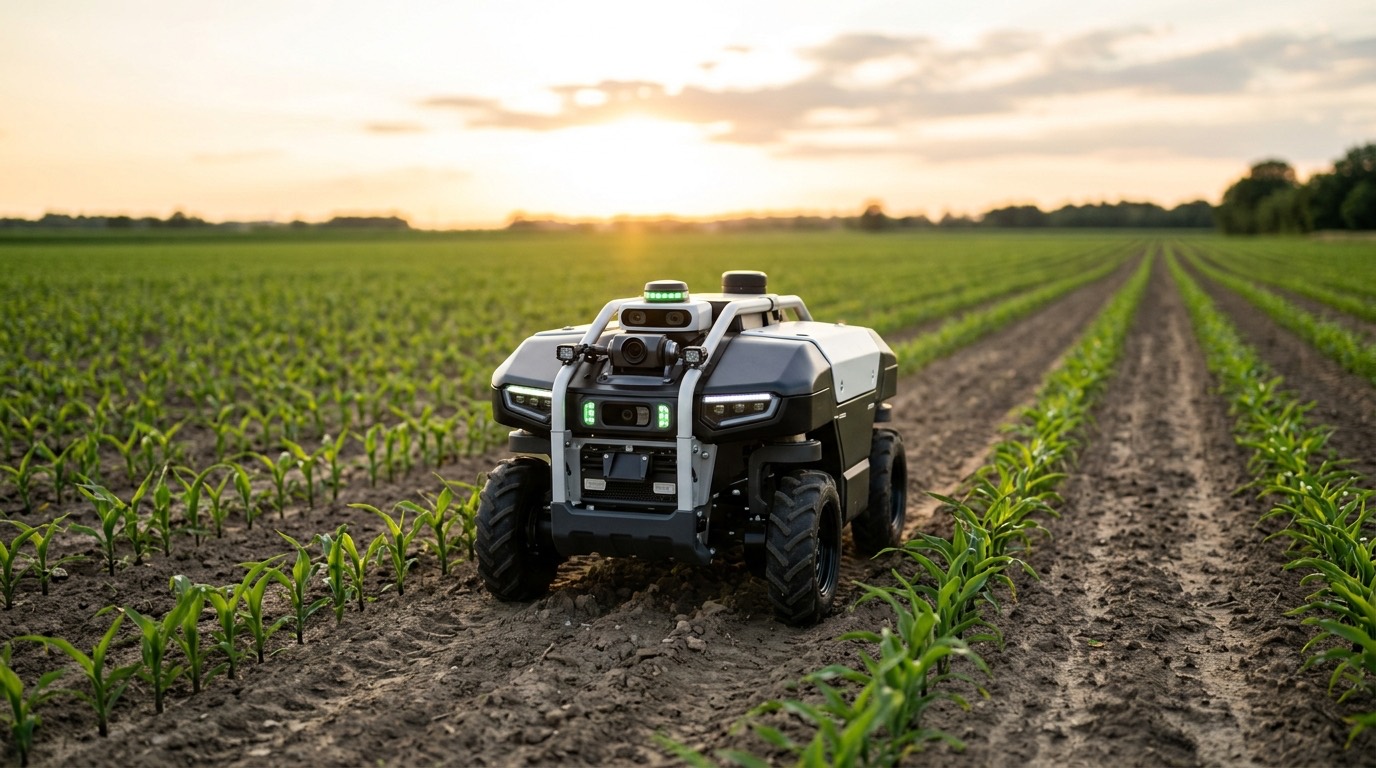
Tractor or machinery: the 6 km/h that decides a field robot's approval route
Two autonomous machines can work side by side in the same field and sit under two different European legal acts. Which one applies is settled by a definition in the tractor regulation — and the number inside it is rarely in the brochure.
Two autonomous machines can work side by side in the same field and sit under two different European legal acts. One is machinery under the Machinery Regulation, the other a vehicle under tractor law, and the dividing line does not run where the brochures suggest it does. It comes out of a definition in Regulation (EU) No 167/2013 and a single exclusion in Article 2 of the Machinery Regulation. Anyone facing a purchase settles that classification first, because it decides the conformity route, the documents and which authority is competent at all.
Key Takeaways
- 1Article 3 of Regulation (EU) No 167/2013 defines a tractor through three criteria that must all hold at once: at least two axles, a maximum design speed of not less than 6 km/h, and tractive power as the main function.
- 2Article 2(2)(i) of Machinery Regulation (EU) 2023/1230 excludes exactly those tractors — "except for machinery mounted on those tractors". The implement stays in scope even when the carrier is out.
- 3The main-function criterion is the one most often skipped. A self-propelled seeding and hoeing robot pulls nothing, so it stays outside tractor law even above 6 km/h.
- 4The published working speed is not the maximum design speed. Only the second one appears in the definition, and it is rarely on the datasheet.
- 5On the machinery route, ISO 18497 has since 2024 set out in four parts what an autonomous field machine has to deliver: design principles, obstacle protection systems, autonomous operating zones and verification methods.
- 6No harmonised standard has yet been cited in the Official Journal under the Machinery Regulation. The presumption of conformity that exists today still rests on Directive 2006/42/EC.
Two machines in the same field, two legal acts
The purchase looks like one decision: which machine runs the pass? Legally it is two. An autonomous field machine can be machinery under Regulation (EU) 2023/1230, or a vehicle under Regulation (EU) No 167/2013 on the approval and market surveillance of agricultural and forestry vehicles. The two routes have different assessment procedures, different technical documentation and different competent bodies.
Operators know this shape from other purchases: a number in the text of a regulation settles the approval route before any technical comparison starts. For cargo drones it is 25 kilograms of take-off mass. In the field it is 6 km/h and half a sentence about the vehicle's main function.
The difference is not academic. It decides which declaration the manufacturer has to supply, which documents you produce if you are asked, and whether an approval authority is competent at all.
The definition everything hangs on
Article 3 of Regulation (EU) No 167/2013 defines a tractor as "any motorised, wheeled or tracked agricultural or forestry vehicle having at least two axles and a maximum design speed of not less than 6 km/h, the main function of which lies in its tractive power".
That sentence carries three criteria, and they have to hold simultaneously: at least two axles, at least 6 km/h maximum design speed, tractive power as the main function. Drop one and the machine is not a tractor within the meaning of that regulation.
The third criterion is the one most often skipped. A self-propelled seeding and hoeing robot pulls nothing. Its main function is the field work itself, not the provision of tractive power for an implement. Such a machine therefore stays outside tractor law even if it exceeds 6 km/h. Conversely, an autonomous tool carrier with a three-point linkage and a PTO, whose entire purpose is to pull and drive implements, meets the criterion without difficulty.
One warning about the number itself: 6 km/h also appears in section 1 of the German Fahrzeug-Zulassungsverordnung, there as the boundary of vehicle registration law for delivery robots on the pavement. That is a coincidence of the figure, not of the legal consequence. The two provisions have nothing to do with each other, and mixing them means arguing in the wrong instrument.
What the Machinery Regulation excludes, and what it deliberately keeps
Article 2(2) of Regulation (EU) 2023/1230 lists what falls outside its scope. Point (i) covers "agricultural and forestry tractors, as well as systems, components, separate technical units, parts and equipment designed and constructed for such tractors, that fall within the scope of Regulation (EU) No 167/2013, except for machinery mounted on those tractors".
The closing clause is the actual news. The exclusion catches the carrier, not the implement. A seed drill, a hoeing unit or a spray boom mounted on a tractor under 167/2013 remains machinery under 2023/1230 and needs its own declaration of conformity. Buying an autonomous outfit means buying two conformity files, not one.
Note also the wording "that fall within the scope of Regulation (EU) No 167/2013". The exclusion is tied to the scope of the other regulation, not to a manufacturer's own assessment. If the machine does not fall within that scope, the exclusion does not apply and the Machinery Regulation governs — whatever the datasheet calls the machine.
Where the actually available machines sit
The machines you can genuinely buy in Germany today fall on both sides of the line.
FarmDroid FD20. Solar-powered seeding and hoeing robot, around 950 metres per hour in work by the manufacturer's own figure, roughly 1,250 kg, sowing and mechanical hoeing from the same reference. The manufacturer states more than 500 units across 26 countries. Available in Germany through the AGRAVIS Technik-Gruppe and, for the south, through EDER Landtechnik. Neither tractive power as its main function nor the speed threshold: clearly on the machinery side.
AgXeed AgBot 5.115T2. Tracked undercarriage with variable track width, four-cylinder Deutz at 115 kW, electric drive train with a speed range of 0 to 13.5 km/h, category 3 rear linkage with an 8-tonne lift. A machine whose purpose is to pull and drive implements and which passes the speed threshold comfortably. Here the tractor question has to be asked seriously, and before the order.
Lely Discovery and Juno. Manure collection and feed pushing in the barn. Indoors, no towing vehicle, no boundary question.
Naïo Oz and Orio. A warning is due here that has nothing to do with the approval route. Naïo Technologies was placed under redressement judiciaire on 6 June 2025 and subsequently taken over by a new company. The Orio product page now carries a notice that Orio and Jo are not manufactured or sold by Naïo SAS and are not supported by Naïo SAS as of 15 June 2026, while the dealer section of the same site still lists four robots. Anyone putting that platform into a specification should get the support status in writing before ordering. What an operator secures contractually in cases like this is set out in supplier insolvency and operator risk.
The number missing from the brochure
Datasheets give the working speed. The regulation gives the maximum design speed. They are not the same figure, and the gap between them can flip the classification.
A machine that runs at 1 km/h in work may have a maximum design speed of 8 km/h for headland turns and transport. Working speed is an operating figure; maximum design speed is a design property. Only the second one appears in the definition.
For procurement that produces one simple requirement: get the maximum design speed in writing, separately from any working speed or hectares-per-day figure, together with a statement of which legal act the manufacturer places the machine on the market under. A supplier who answers both without hesitation has settled the question already. One who points at area output instead has not.
What the machinery route actually asks for: ISO 18497 in four parts
If the machine lands on the machinery side, the relevant standard family is ISO 18497. It was restructured in 2024, and the title changed with it. The former ISO 18497:2018 was "Safety of highly automated agricultural machines — Principles for design". The current edition runs to four parts under the title "Safety of partially automated, semi-autonomous and autonomous machinery":
ISO 18497-1:2024 — machine design principles and vocabulary.
ISO 18497-2:2024 — design principles for obstacle protection systems.
ISO 18497-3:2024 — autonomous operating zones.
ISO 18497-4:2024 — verification methods and validation principles.
For an operator, parts 2 and 3 are the two on which an offer stands or falls. Part 2 addresses the system that detects an obstacle and stops the machine. Part 3 addresses the boundary of the autonomous operating zone — what prevents the machine from unintentionally leaving the field. Those two points decide whether a machine can work unsupervised on a block that adjoins a farm track, a cycle path or a neighbour's land.
Part 4 is the one to write into a tender, because it describes how any of this is demonstrated. A manufacturer's statement that the system detects people is not a checkable claim. A statement of which verification method under part 4 was applied, and with what result, is.
The sentence that cannot appear in any 2026 offer
Machinery Regulation (EU) 2023/1230 applies from 20 January 2027 and replaces Machinery Directive 2006/42/EC. What suppliers regularly do too early with that is claim their machine is built to a standard harmonised under the Regulation.
That is not currently possible, because no such citations exist yet. The standards that trigger a presumption of conformity today are still carried through Implementing Decision (EU) 2023/1586, which by its own title lists harmonised standards "drafted in support of Directive 2006/42/EC". The most recent amendment, Implementing Decision (EU) 2026/2015 of 4 September 2026, does not change that.
Implementing Decision (EU) 2024/1329 of 13 May 2024, published in the Official Journal on 15 May 2024, shows the mechanism. It adds EN ISO 3691-4:2023 for driverless industrial trucks at entry 189a, and recital 1 grounds the effect expressly in Article 7 of Directive 2006/42/EC: machinery manufactured in conformity with harmonised standards whose references have been published in the Official Journal is presumed to comply with the essential health and safety requirements set out in Annex I to that Directive.
The Commission expects the majority of the standards currently cited under the Directive to be cited under the Regulation as well in the fourth quarter of 2026. Until then, a claim about harmonised standards under 2023/1230 is not a checkable claim — and that applies to ISO 18497 exactly as it does to any other standard. Ask instead which standard in which edition was applied, and under which legal act the manufacturer places the machine on the market.
What the operator settles before ordering
Six points, all before machine selection, all in writing.
First, the maximum design speed, separate from any working speed. Second, the vehicle's main function within the meaning of Article 3 of Regulation (EU) No 167/2013: does it pull, or does it do the work itself? Third, the manufacturer's statement of which legal act it places the machine on the market under, with the corresponding declaration. Fourth, for an outfit, that same statement separately for carrier and implement, because Article 2(2)(i) divides them at exactly that seam. Fifth, the evidence against ISO 18497-2 and -3, obstacle protection and operating-zone boundary, with the verification method under part 4. Sixth, the support status of the platform, with a date.
None of these requires a prior commitment to a manufacturer, and all six can be answered before a machine arrives on the yard. They are considerably cheaper to settle there than afterwards.
werob integrates field robotics manufacturer-independently and answers this classification as part of the specification. The overview of the solution is on the agriculture page.
FAQ
- Is an autonomous field robot a tractor?
- Only if it meets all three criteria in Article 3 of Regulation (EU) No 167/2013 at once: at least two axles, a maximum design speed of not less than 6 km/h, and tractive power as its main function. A self-propelled seeding or hoeing robot fails the third, and is therefore machinery under Regulation (EU) 2023/1230 regardless of how fast it can travel.
- What does the clause "except for machinery mounted on those tractors" mean?
- That the exclusion in Article 2(2)(i) of the Machinery Regulation catches only the carrier. The implement — seed drill, hoeing unit, spray boom — remains machinery under Regulation (EU) 2023/1230 and needs its own declaration of conformity. For an autonomous outfit that is two separate files.
- Is the working speed on the datasheet enough to classify the machine?
- No. What counts is the maximum design speed, which is a design property rather than the working speed quoted in a brochure. A machine running at 1 km/h in work can be built to travel considerably faster. Ask for the figure separately and in writing.
- Which parts of ISO 18497 belong in a tender?
- Part 2 on obstacle protection systems and part 3 on autonomous operating zones describe the two functions that unsupervised operation depends on. Part 4 describes the verification and validation methods and is the part that makes a manufacturer's claim checkable. Part 1 supplies the vocabulary the other three rest on.
- Can a supplier name a standard harmonised under the Machinery Regulation today?
- No. The references that currently trigger a presumption of conformity are carried through Implementing Decision (EU) 2023/1586, which lists harmonised standards in support of Directive 2006/42/EC; that is still true of its most recent amendment of 4 September 2026. The Commission expects the majority of those standards to be cited under the Regulation in the fourth quarter of 2026. Until then such a claim cannot be checked.
Related reading
Legged delivery robots: what actually delivers in 2026
Seven years of announcements and not one commercial route. What Boston Dynamics, RIVR, Ford and Continental actually achieved in delivery, and what it means for your planning.
6 August 2026cargo drone payloadCargo drones: which payload class is actually approvable in Europe today
The cargo drone conversation is about aircraft. It is settled by a number that sits in the regulation rather than the spec sheet: 25 kilograms of take-off mass. That is exactly where the whole class-mark system ends, and both standard scenarios end with it.
2 September 2026robot manufacturer insolvencyWhen Your Robot Supplier Goes Under: What an Operator Actually Loses
Discover the operational risks of a service robot manufacturer going bankrupt. Learn how to protect fleets using escrow clauses and multi-OEM strategies.
25 August 2026hoeing robot sugar beet mechanical weed control20 hectares per robot per season: what changes when the machine hoes instead of sprays
On the Kirschgartshausen trial farm the hoeing robot left 26,000 weeds per hectare standing; broadcast spraying controlled 97 to 99 percent. The arithmetic is still not as simple as those two numbers sound — and the Bavarian state institute measured the part the brochure leaves out.
11 September 2026works council robot approvalWorks Council Robot Approval: Guidelines for the rollout
The introduction of robotics often fails not because of the technology, but because of the lack of involvement of employee representatives. Find out how you can secure the works council’s approval through transparency and clear specifications.
22 June 2026