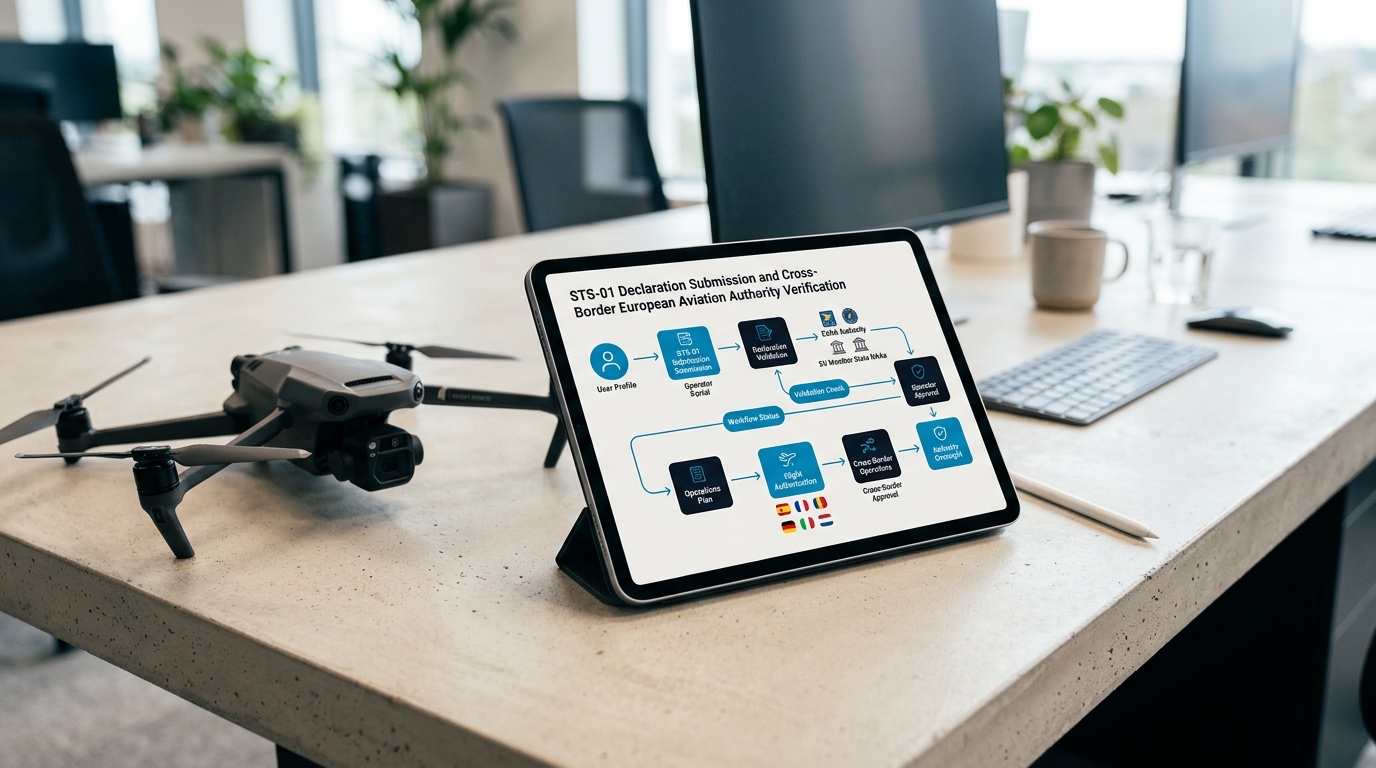
Class marks C5 and C6: the purchase decision that sets your approval path
C5 and C6 are properties of the aircraft, bought with it. They decide whether an operation runs on a declaration to the authority or needs an individual authorisation. What the two classes require, what the declaration route saves, and where it stops.
A class mark is not a label you attach later. It is a property of the aircraft, bought with the aircraft — and it decides whether your operation will run on a declaration to the competent authority or need an individual authorisation. Notice it only after procurement and you have already fixed the approval path without choosing it. The money is spent, and the path left to you is the heavier one.
Key Takeaways
- 1Classes C5 and C6 are not in the original Delegated Regulation (EU) 2019/945. They were introduced by Delegated Regulation (EU) 2020/1058 of 27 April 2020, as Parts 16 and 17 of the Annex.
- 2The mark is the ticket to the declaration route: under Article 5(5) of Regulation (EU) 2019/947, an operator who submits a declaration under UAS.SPEC.020 for an operation complying with a standard scenario in Appendix 1 is not required to obtain an operational authorisation.
- 3STS-01 requires a class C5 aircraft, STS-02 a class C6 aircraft. Both scenarios require a controlled ground area — under Article 2(21), the area within which the operator can ensure that only involved persons are present.
- 4A class C5 UAS may consist of a class C3 UAS fitted with an accessories kit (Part 16). It is the one place where a purchase decision already taken can still be corrected.
- 5Since 1 January 2026, declarations based on national standard scenarios are no longer valid (Article 23(4)). Without C5 or C6, the declaration route no longer exists.
A product property, not an operational decision
The class mark belongs to the aircraft, not to the operation. It is assigned by the manufacturer through the conformity procedure, it is physically affixed to the aircraft, and it cannot be produced later by a better operations manual, a tighter organisation or a more experienced remote pilot. That is exactly why it is a procurement question rather than an approval question — even though it decides the approval path.
The technical requirements for the classes sit in Delegated Regulation (EU) 2019/945. The two classes this article is about were not there at first: C5 and C6 were introduced by Delegated Regulation (EU) 2020/1058 of 27 April 2020, as Parts 16 and 17 of the Annex. They close the gap between the open-category classes and operations in the specific category.
For an operator that means something uncomfortable: the compliance path is fixed on the day of procurement, not on the day of the application. In real projects there are often months between those two days — and by then the decision was long since made, without anyone treating it as a decision.
What C5 and C6 actually require
Both classes build on Part 4 of the Annex, the requirements for class C3, and carve individual points out of it. That is more than a formality: an operator with C3 aircraft in the fleet stands closer to C5 than the separate class names suggest.
Class C5 (Part 16)
A C5 aircraft complies with Part 4 except paragraphs (2) and (10). Added to that: it must not be a fixed-wing aircraft unless tethered. Unless tethered, it must offer a low-speed mode limiting the ground speed to not more than 5 m/s. It must provide a means to terminate the flight that is reliable, predictable and independent from the automatic flight control, forces a descent and includes means to reduce the effect of the impact dynamics. It must alert the remote pilot to imminent or actual loss of the command and control link, and give clear information on height above the surface or take-off point.
And then Part 16 contains one sentence that matters more for procurement than any of the rest: a class C5 UAS may consist of a class C3 UAS fitted with an accessories kit that ensures the conversion — provided the kit does not modify the C3 system's software.
Class C6 (Part 17)
A C6 aircraft complies with Part 4 except paragraphs (2), (7) and (10). It has a maximum ground speed in level flight of not more than 50 m/s. It provides means to prevent the aircraft from breaching the horizontal and vertical limits of the operational volume. Its flight termination means is independent from the automatic flight control and guidance system, forces a descent and prevents powered horizontal movement. It allows the trajectory to be programmed, and it reports position, speed and height. The alerting duty on link degradation or loss applies here too.
The difference is not a detail. C5 is cut for operations within visual line of sight at low speed; C6 for operations beyond visual line of sight with a programmed trajectory and a built-in limit on the operational volume. Buy the wrong one of the two and you have not bought a weaker aircraft — you have bought an aircraft for a different scenario.
How the mark maps onto the standard scenarios
The standard scenarios sit in Appendix 1 to the Annex of Regulation (EU) 2019/947. There are two, and the mapping is unambiguous:
STS-01 is operation within visual line of sight over a controlled ground area in a populated environment. It requires an aircraft bearing the C5 class mark.
STS-02 is operation beyond visual line of sight with airspace observers over a controlled ground area in a sparsely populated environment. It requires an aircraft bearing the C6 class mark.
What both scenarios share is the condition most often overlooked in practice: the controlled ground area. Article 2(21) of the regulation defines it as "the ground area where the UAS is operated and within which the UAS operator can ensure that only involved persons are present". That is an operational undertaking, not a fence. A fenced works site is a good starting position for it, but it is not automatically a controlled ground area — the undertaking has to be organisationally assured and documented. We have written that point up at more length for site security, on the aerial site security page.
So the mark does not open the scenario. It satisfies one of several conditions of the scenario — but the only one you cannot produce after the purchase.
What the declaration route actually saves
The difference between the two paths is set out in Article 5(5) of Regulation (EU) 2019/947. Where the operator submits a declaration to the competent authority of the Member State of registration in accordance with UAS.SPEC.020 in Part B of the Annex, for an operation complying with a standard scenario in Appendix 1, the operator shall not be required to obtain an operational authorisation.
That is the whole saving, and it is a substantial one. The declaration route is a notification with confirmation of receipt and completeness, not an application that is assessed and decided. The individual assessment falls away, the negotiation over mitigations falls away, and so does the uncertainty over processing time — which for an individual authorisation depends on the case, on the maturity of the submission and on the mitigations claimed, and for which no meaningful blanket figure can be given.
The alternative path is an operational authorisation in the specific category with a risk assessment under SORA 2.5, made binding on 29 September 2025 by EASA ED Decision 2025/018/R. How that procedure runs in detail, from the risk classes through the SAIL to the safety objectives, we have described separately — see BVLOS approval in Germany: SORA, LUC and the path to routine operation. Here only the outcome matters: it is a project, not a form.
What the declaration route is not: a free pass. The declaration is a binding undertaking to comply with the conditions of the scenario. An operator who declares and then does not comply is operating without authorisation — not merely deviating.
1 January 2026, and why the question is sharper now
Two dates explain why this decision carries more weight at the moment than it did two years ago.
The first: the standard scenarios in Appendix 1 have applied since 1 January 2024. They were moved to that date by Implementing Regulation (EU) 2022/425 of 14 March 2022, on the express grounds that the harmonised standards for classes C0 to C6 and for direct remote identification would not be available before mid-2023. The declaration route therefore existed on paper before the aircraft existed that would make it usable.
The second, and the decisive one for procurement: under Article 23(4), Member States could accept declarations based on national standard scenarios until 31 December 2023. Those declarations ceased to be valid on 1 January 2026.
The transition is therefore over. An operator who wants to fly today without an individual authorisation needs a European standard scenario, and for that needs an aircraft carrying a C5 or C6 mark. Operators who worked for years under a national scenario sometimes discover this only once the fleet is already standing — and the fleet then carries aircraft bought for a route that no longer exists.
Where the mark stops helping
The mark is necessary but not sufficient, and the line is clean: the aircraft satisfies the product requirement, the operation satisfies the operational requirement. Appendix 1 sets operational conditions for each scenario — among them height limits, distances and the role of the airspace observers in STS-02. Those conditions are not properties of the class. They sit in Appendix 1, they differ between the two scenarios, and they belong read there before a route is planned.
Three cases where the declaration route does not carry, despite a correct mark:
- The ground area cannot be controlled. If the track runs over a public road, someone else's car park or any area whose access you do not govern, the basic condition of both scenarios is missing — and no mark on an aircraft substitutes for it.
- The operation does not fit the conditions. Height, distance, environment and type of operation are described exhaustively in Appendix 1. An operator who has to go beyond them leaves the scenario entirely; there is no partial application.
- It is not only about the aircraft. Operator registration, remote pilot competency, the operations manual and the procedures remain the operator's obligations. The mark discharges none of them.
In all three cases what remains is the operational authorisation with an individual assessment. That is not a failure but the regular path for everything beyond the standard scenarios — it simply costs more time and more work, and both should be known before the purchase rather than after it.
What to ask before signing, and what to get in writing
wedrone is a manufacturer-independent systems integrator, not a manufacturer. We do not assign class marks, we hold no operational authorisation and we do not fly ourselves — operations run through certified partner operators. What we do is establish the order: the area and the scenario first, the aircraft second. That order produces a short list which should be answered before anyone signs.
- Which class mark does the aircraft carry, and is it affixed to the aircraft? Not: is it applied for, announced, or planned for a coming production run. An undertaking about a future mark is not a mark.
- Which scenario is the purchase aimed at? STS-01 and STS-02 are different types of operation. An operator who needs both does not buy one aircraft with two marks; they make a decision.
- With C3 in the fleet: is there an accessories kit for conversion to C5? Part 16 expressly permits that path, provided the kit does not modify the C3 system's software. Have that condition confirmed.
- Which documents come with the aircraft? The declaration of conformity, the manufacturer's documentation and the operating instructions are part of what you are buying — not something supplied afterwards.
- Who carries what? Settle contractually who is registered as the operator, who provides the remote pilots, who submits the declaration, and who maintains it when the operation changes.
The class mark is one of the few properties in this field that cannot be renegotiated after the purchase. Everything else about a drone programme — procedures, training, integration, the operator — can be corrected later. This one cannot.
FAQ
- Is the class mark alone enough to fly without an authorisation?
- No. It is one of several conditions of the standard scenario, though the only one you cannot produce after the purchase. Alongside it come the controlled ground area under Article 2(21), the operational conditions in Appendix 1 to the Annex of Regulation (EU) 2019/947, operator registration, remote pilot competency, and the declaration itself under UAS.SPEC.020. Only when all of that comes together does Article 5(5) apply and the operational authorisation fall away.
- We have C3 aircraft in the fleet. Is that money lost?
- Not necessarily. Part 16 of the Annex to Delegated Regulation (EU) 2019/945 expressly allows a class C5 UAS to consist of a class C3 UAS fitted with an accessories kit that ensures the conversion — on condition that the kit does not modify the C3 system's software. Whether such a kit exists for your specific aircraft is a question for the manufacturer, and the answer belongs in the procurement file in writing. There is no equivalent path for C6.
- What about our old national declaration?
- It no longer carries. Under Article 23(4) of Regulation (EU) 2019/947, Member States could accept declarations based on national standard scenarios until 31 December 2023, and those declarations ceased to be valid on 1 January 2026. An operator who wants to keep using the declaration route needs a European standard scenario, and therefore an aircraft of class C5 or C6.
- Why did the marked aircraft reach the market so late?
- Because the standards were missing. The standard scenarios were postponed to 1 January 2024 by Implementing Regulation (EU) 2022/425 of 14 March 2022, expressly on the grounds that the harmonised standards for classes C0 to C6 and for direct remote identification would not be available before mid-2023. The route existed before the aircraft did. That explains why many fleets date from a period in which the question could not yet be asked — and why it has to be asked now.
- What if our route does not fit a standard scenario anyway?
- Then the class mark is secondary for the approval path, and the decision becomes a different one: you are procuring for an operational authorisation in the specific category with an individual assessment under SORA 2.5, introduced by EASA ED Decision 2025/018/R of 29 September 2025. That is a regular path and not a fallback; it simply costs more time and more work. What matters is that you know it before the purchase rather than after it.
- Can wedrone obtain the mark or the authorisation for us?
- No, and the two are not the same thing either. The class mark is assigned by the manufacturer in the conformity procedure; we are a manufacturer-independent systems integrator, not a manufacturer. The operational authorisation, or the declaration, is carried by the operator; wedrone holds no operational authorisation and does not fly itself. What we do is structure the area, the scenario and the compliance path before anything is procured, and bring in the certified operator who carries the authorisation.
Related reading
Cargo drones: which payload class is actually approvable in Europe today
The cargo drone conversation is about aircraft. It is settled by a number that sits in the regulation rather than the spec sheet: 25 kilograms of take-off mass. That is exactly where the whole class-mark system ends, and both standard scenarios end with it.
2 September 2026bvlos approval germany medical droneBVLOS approval for medical drones in Germany: SORA, LUC and the path to routine operation
What it actually takes to get a clinic drone route approved in Germany: the specific category under Regulation (EU) 2019/947, the binding SORA 2.5 methodology, SAIL levels, the LUC pathway and the two bottlenecks operators underestimate.
23 July 2026works council robot approvalWorks Council Robot Approval: Guidelines for the rollout
The introduction of robotics often fails not because of the technology, but because of the lack of involvement of employee representatives. Find out how you can secure the works council’s approval through transparency and clear specifications.
22 June 2026