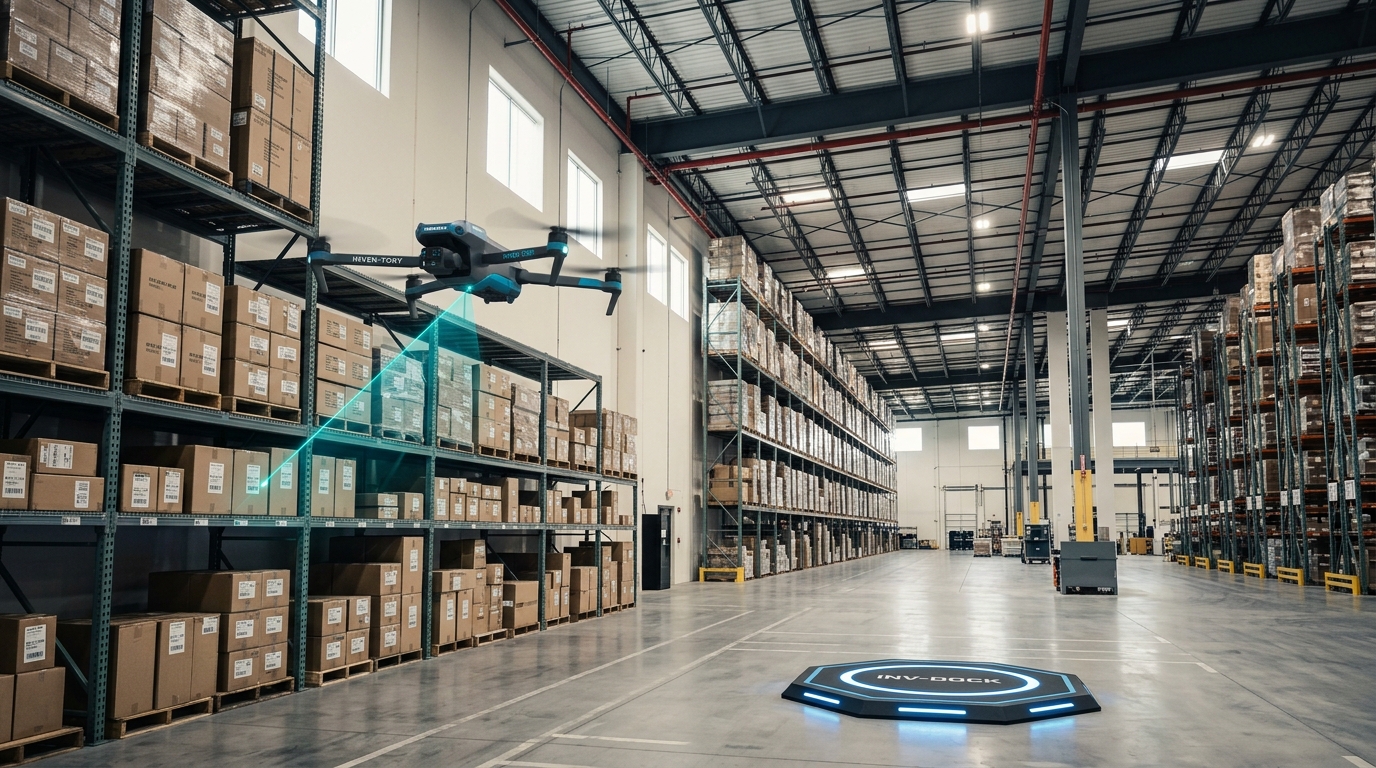
Inventory drones in the warehouse: does the hall have a door to outside?
The market sells them as drones, and with the word comes the drone regulation. For operation inside buildings its core requirements expressly do not apply — and switching them off is what pulls a different body of law in. One question decides which.
Buy an inventory drone and you buy it as a drone, and the word brings an apparatus with it: operator registration, an operating category, a remote pilot, and for anything beyond that a risk assessment and an operating authorisation. For a machine that flies a rack aisle and never leaves the hall, most of that apparatus has nothing to attach to. That is not a reading; it is what the competent German authority writes. What follows is the interesting part. Switching the aviation requirements off does not leave the machine unregulated. It is a hinge, and it pulls in the product law for machinery — which steps back precisely where aviation law applies.
Key Takeaways
- 1The Luftfahrt-Bundesamt lists three requirements for flying — operator registration, classification into an operating category, remote-pilot competence — and then states: „Diese Anforderungen gelten nicht für den Betrieb von UAS in Gebäuden.“ (These requirements do not apply to the operation of UAS in buildings.)
- 2With no classification into an operating category there is no category-bound authorisation route. A SORA assessment presupposes the specific category, and pure indoor operation does not produce one.
- 3Machinery Regulation (EU) 2023/1230 excludes, in Article 2(2)(e), “means of transport by air”. Recital 17 grounds that exclusion in risks arising “from the transport of goods, persons or animals” — a drone that carries a camera and transports nothing is not obviously caught by it.
- 4Article 2(2)(f) excludes aeronautical products only “insofar as Regulation (EU) 2018/1139 covers the relevant essential health and safety requirements of this Regulation”. Where aviation law covers nothing indoors, the exclusion does not bite.
- 5The Machinery Regulation applies from 20 January 2027; until then Directive 2006/42/EC is the measure. Either way it is product law an operator can demand on paper — CE marking, EU declaration of conformity, instructions, the manufacturer's risk assessment.
The market sells a drone. Indoors that is the wrong category
Autonomous stocktaking in the hall is no longer a promise. There are systems that fly the rack aisles at night, read barcodes at pallet positions and produce a discrepancy list by morning, and there are systems that do the same thing from the floor. The difference from manual counting is not only accuracy; it is that nobody has to go up into the high-bay area.
It gets procured as a drone. The assessment therefore lands reflexively with whoever handles aviation, and there a familiar chain begins: registration, operating category, remote pilot, risk assessment, operating authorisation. That chain costs months.
For pure indoor operation its core requirements do not apply. This is not a trick and not a grey area. It is written down by the authority responsible for it in Germany.
The sentence from the Luftfahrt-Bundesamt
In its questions and answers on unmanned aircraft systems, the Luftfahrt-Bundesamt answers „Was benötige ich zum Fliegen?“ — what do I need in order to fly — with three points: registration as a UAS operator, where the aircraft has a take-off mass of 250 g or more or carries a sensor capable of capturing personal data; classification of the operation into an operating category; and a remote-pilot competence certificate from 250 g maximum take-off mass.
Immediately after them comes a sentence that is almost never quoted in procurement:
„Diese Anforderungen gelten nicht für den Betrieb von UAS in Gebäuden.“
These requirements do not apply to the operation of UAS in buildings. The sentence attaches to the three requirements named above it, and it should be held to exactly that. It does not say that no law at all applies inside a hall. It says that the three entry conditions on which every outdoor application hangs do not apply to operation inside buildings.
In practice that reaches further than the three points themselves. Authorisation is bound to the classification into an operating category. If no classification arises, no category-bound authorisation route arises either — none to be walked, and none that has to be.
What is not switched off
Two things stand in any case, and neither hangs on aviation law.
The first is the employer side. Anyone putting work equipment into service owes a risk assessment, and an aircraft operating over traffic routes and workstations is work equipment with a hazard profile of its own: fall, collision with racking or people, behaviour on loss of control, how the area is closed off during the flight and released afterwards. That duty exists regardless of which product law built the machine.
The second is data protection. An inventory system works with cameras, and a hall is a workplace even when the flight runs at night. Where staff can be captured, that is processing which has to be justified, bounded and codetermined. It is the same examination as for any other camera-led system in the building.
The Machinery Regulation: two exclusions, both conditional
That leaves the question of which product law applies. The obvious answer would be none, because Machinery Regulation (EU) 2023/1230 excludes aviation. It is not that simple, because both relevant exclusions carry conditions.
Article 2(2)(e) excludes “means of transport by air, on water and on rail networks, with the exception of machinery mounted on those means of transport”. The purpose of that exclusion is set out in recital 17: the Regulation is meant to address risks arising “from the machinery function and not from the transport of goods, persons or animals”. That is precisely why it steps back for means of transport.
An inventory drone transports nothing. It carries a camera and a scanner and applies them at the rack. Its risk arises from the machinery function, not from a transport operation. Read against the stated purpose of the exclusion, it is not a means of transport.
Article 2(2)(f) excludes “aeronautical products, parts and equipment falling within the scope of Regulation (EU) 2018/1139 […] insofar as Regulation (EU) 2018/1139 covers the relevant essential health and safety requirements of this Regulation”.
The hinge is the word “insofar”
That “insofar” is the actual finding. The exclusion for aeronautical products is not absolute. It is conditional: it holds only to the extent that aviation law actually covers the health and safety requirements the Machinery Regulation would otherwise impose.
The two regimes therefore hang on a hinge. Where aviation law applies, machinery law steps back. Where aviation law does not apply — and inside buildings, on the Luftfahrt-Bundesamt's own answer, its core requirements do not — it covers nothing, and the condition attached to the exclusion is not met.
So switching the drone rules off does not lead into a legal vacuum. It leads into the product law for machinery. For an operator that is the better outcome, because machinery law produces paper he already knows how to demand: CE marking, an EU declaration of conformity, instructions in the language of the site, a manufacturer's risk assessment.
One note on honesty. This reading follows the wording of the exclusions and the purpose given in the recital. It is not an authority decision and not a judgment. No binding classification of pure indoor inventory-drone operation exists to date. The operator closes that gap where he can close it — in the contract, by demanding the documents rather than relying on a category.
The one question: does the flight path pass through a door to outside?
Everything on this page hangs on a single property of the deployment, and it can be settled on site in a minute.
If the flight path at no point passes through an open door, out over a ramp, across a yard between two halls or under a canopy, it is operation inside buildings. The three requirements fall away, and the procurement is a machinery procurement.
If it goes outside on even one segment, the whole apparatus is back: registration, operating category, remote pilot, and for anything beyond the open category a risk assessment with an operating authorisation. Twenty metres of yard between hall A and hall B is not a detail of the route. It is a change of legal regime.
That is why the question belongs at the start of the specification and not in commissioning. It decides which documents the supplier has to produce, which timelines are realistic, and whether an operator holding aviation approvals is needed in the project at all.
What the operator settles before selection
Five points to settle in writing before selection.
One, the path description. Not “in the warehouse” but the actual flight path with every transition, every door and every area that stands open at times. A door that is open through the summer is a different legal frame through the summer.
Two, the machinery documents. CE marking, EU declaration of conformity, instructions in the local language, risk assessment. A supplier who answers that request by saying the product is an aircraft has not read the condition in point (f).
Three, the risk assessment. Who enters the area during flight, what happens on loss of control or loss of the radio link, how the area is closed and released, and who in the operation is accountable.
Four, the camera. What is recorded, for how long, who sees it, and how codetermination is settled. This is not a formality: a system that runs the aisles every night produces a continuous record of the workplace.
Five, the connection. A discrepancy list only becomes a stocktake when it reaches the inventory system and is reconciled against book stock. How the count flows back into the leading system, and who posts the discrepancy, decides more about the value than the recognition rate does.
Moving the goods is a different problem from counting them — what goes wrong when the load comes on and off is in Load transfer. How vehicles from different manufacturers share one floor is in VDA 5050 and the mixed fleet.
FAQ
- Does an inventory drone in a hall need an operating authorisation?
- For pure operation inside buildings, the Luftfahrt-Bundesamt states that operator registration, classification into an operating category and the remote-pilot competence certificate do not apply. With no classification into an operating category there is no category-bound authorisation route either. As soon as the flight path leaves the building, that no longer holds.
- So no law applies inside the hall?
- No. What shifts is which law. The employer's duties are untouched: a risk assessment for the work equipment, control of who enters the area during operation, defined behaviour on failure. Data protection is untouched as well, because an inventory system works with cameras. And on the product side the wording of the exclusions suggests the Machinery Regulation applies.
- Why would the Machinery Regulation apply to an aircraft?
- Because both relevant exclusions carry conditions. Point (e) excludes means of transport, and recital 17 grounds that in risks from the transport of goods, persons or animals — a drone carrying a camera and transporting nothing is not obviously caught. Point (f) excludes aeronautical products only insofar as Regulation (EU) 2018/1139 covers the relevant requirements. Where aviation law covers nothing indoors, the exclusion does not bite. No authority has ruled on this to date.
- From when does the Machinery Regulation apply?
- Regulation (EU) 2023/1230 applies from 20 January 2027, and Directive 2006/42/EC is repealed with effect from that day. Until then the Directive is the measure. For procurement that means an installation intended to run past that date is read against both.
- What about a yard between two halls?
- That is the case where the assessment tips. As soon as one segment of the flight path is in the open, it is no longer operation inside buildings, and the full apparatus of registration, operating category and remote pilot is back — with a risk assessment and an operating authorisation for anything beyond the open category. Twenty metres of yard is not a routing detail; it is a change of legal regime.
- Which systems are on the market?
- As publicly documented market examples: Verity of Zurich states it runs inventory drones at more than one hundred warehouse sites; doks. solution of Kassel offers doks.inventairy, a drone-based system for high-bay storage; Ubica Robotics of Bremen scans retail shelving with a ground robot and is in use at dm. These are market examples, not confirmed werob partners. werob is a manufacturer-independent systems integrator and is neither an OEM nor a manufacturer.
Related reading
Drone-as-a-Service: the operating model that turns drone pilots into routine programs
Discover how Drone-as-a-Service converts manual pilots into routine programs. Scale your operations legally under EU regulation 2019/947 with wedrone.
7 July 2026drone as first responder how security teams verifyDrone as First Responder: how security teams verify alarms in minutes
See how Drone as First Responder systems verify alarms in under 5 minutes using automated landing pads, compliant BVLOS flight, and unified mission dashboards.
3 July 2026power line and infrastructure inspection with dronesPower Line and Infrastructure Inspection with Drones: Thermography, BVLOS Corridors and Data Products
Learn how drone thermography and BVLOS corridors optimize power line inspections under EU regulation 2019/947, from planning to routine operations.
8 July 2026VDA 5050 mixed fleetVDA 5050 and the mixed fleet: what the standard covers and what it does not
Running two OEMs in one building does not make their robots cooperate. What VDA 5050 actually standardises, what its own Scope section excludes, and the list you have to agree in writing.
28 August 2026automated stocktaking robot costThe real cost of a stock count
A manual stock count shuts operations down, ties up staff for days, and still comes with an error rate. The real cost centre isn't the counting itself — it's the standstill around it.
11 September 2026