Blood, samples and organs by drone: what actually flies in Europe today
A sober status report on medical drone logistics in Europe: which routes are in routine operation, which projects have ended, and what hospitals need to check before they plan a route of their own.
Press releases about medical drone delivery age badly. Several of the projects still quoted as proof that drones fly blood and samples were shut down years ago, while a small number of unspectacular routes have quietly moved into daily service. This status report separates three states that are routinely confused: a single demonstration flight, a repeated pilot, and genuine routine operation. It also names what is realistic as payload today, and what is not.
Key Takeaways
- 1Only a handful of European routes are in genuine routine operation. Most of what is cited as evidence was a time-limited research project or has been discontinued.
- 2The strongest German reference is Zollernalb Klinikum with the operator DiAvEn, around 20 kilometres between Albstadt and Balingen, roughly seven flights per day since 2025 under an LBA approval at SAIL III.
- 3Swiss Post ended its drone programme on 31 December 2022, Medifly Hamburg was a research project whose last activity dates from June 2022, and Swoop Aero was liquidated in November 2024. None of them is a live operation.
- 4No hospital operator flies itself. Every documented route in Europe runs through an approved external operator, with the clinic as the customer.
- 5Organ transport is the hardest case, not the entry point. Realistic drone logistics starts with diagnostic samples and accompanying material under UN 3373.
- 6The ground side decides whether a route becomes routine: laboratory system integration, chain of custody, and validated sample integrity.
Demonstration, pilot, routine operation: three different things
Almost every claim about medical drone logistics collapses into one of three categories, and the difference matters more than the flight technology. A demonstration is a single flight, usually with press coverage, often flown under a narrow one-off permission. A pilot is a repeated but time-limited operation, typically publicly funded, with a defined end date and no obligation to be economically self-supporting. Routine operation means a standing operational approval, a defined daily schedule, a paying customer and a service level that clinical staff can plan around.
The second distinction that matters is who holds the risk. In every documented European medical route, the hospital is the customer and an approved operator holds the operational authorisation. No hospital operator in Europe flies its own aircraft on a medical route. That is not a detail of governance, it is the central design decision: aviation liability, crew qualification, maintenance and airworthiness stay with a specialised organisation, and the clinic buys a transport service with an agreed availability.
- Demonstration: one flight or a short flight series, no operational continuity, no service commitment.
- Pilot: repeated flights over weeks or months, defined project end, funding rather than revenue, results published as feasibility.
- Routine operation: standing approval, fixed schedule, contractual availability, cost carried by the operating budget rather than by a grant.
Applied honestly, this filter removes most of what circulates as evidence. It also makes the remaining cases far more useful, because a route that survives its own funding is a route that can be copied. wedrone, the drone unit of werob, works as a manufacturer-independent systems integrator and does not operate flights or hold aviation certificates of its own. Its role is the sourcing and integration layer around approved partner operators.
What actually flies in Germany today
Germany has moved further than its reputation suggests, but the evidence sits in a small number of concrete routes rather than in a broad market.
Zollernalb Klinikum with the operator DiAvEn is the strongest German case. The route connects the sites in Albstadt and Balingen over roughly 20 kilometres and carries laboratory samples and blood products. The Luftfahrt-Bundesamt granted the operational approval in August 2024 at SAIL III, with dangerous goods clearance for UN 3373. Test operation started in October 2024, routine operation followed in 2025, and the route now runs at around seven flights per day, seven days a week. The reported cost is 75,000 euros per year against 180,000 to 220,000 euros for the previous ground courier arrangement. The Labfly 1000 platform used on the route has a range of 30 kilometres and a payload of 0.5 to 1 kilogram, and the remote pilot operates from Berlin.
Asklepios and its laboratory subsidiary MEDILYS with the operator Jedsy run a scheduled route in Schleswig-Holstein between Blomenburg near Selent and Bad Oldesloe, roughly 60 kilometres in about 30 minutes, carrying laboratory samples of up to 4 kilograms at least daily. Scheduled operation started on 24 March 2025, also at SAIL III.
German Copters in Saxony received its approval on 7 April 2025 and flew its first medical route on 12 May 2025, with blood samples for Collm Klinik Oschatz from 29 August 2025. Morpheus Logistik in North Rhine-Westphalia is running a pilot with St. Elisabeth Iserlohn and Eurofins GeLaMed. That one is explicitly a pilot, and announced flight volumes for it are planning figures, not performance.
What these routes have in common is unglamorous: short to medium distances, small payloads, diagnostic material rather than organs, a single defined pair of sites, and an operator who already holds the approval. That is the realistic shape of an entry project, and it is the pattern described in more detail in our analysis of laboratory transport times.
Europe beyond Germany: the operating models that hold
Outside Germany, several European routes have passed the same test, and two of them point at operating models worth copying.
Helicus in Belgium has flown clinical samples between Diksmuide and Ypres since 2024. In May 2026 the company signed a multi-year commercial contract with CHU de Liège worth 1.5 million euros. That is currently the only documented multi-year commercial hospital contract for drone logistics in Europe, and it is significant precisely because it is a procurement fact rather than a flight statistic.
Apian in the United Kingdom operates as a health logistics layer inside the NHS and has been in routine operation since 2024. Apian does not fly itself. It works with Wing and Matternet as flight operators and supplies the clinical, regulatory and data layer around them. On the route serving South West London Pathology and St George's since February 2026, more than 2,000 patients have been covered, with transport times of three minutes instead of about twenty. That separation of roles, clinical integrator plus approved operator, is the closest existing analogy to the model werob applies in healthcare logistics.
Everdrone in Sweden solves a different problem: it delivers AED defibrillators to the scene of a suspected cardiac arrest as part of the emergency call chain in Region Västra Götaland. A study published on 25 May 2026 reported that AED application on the patient rose from 27 percent to 50 percent. This is an emergency response use case, not a logistics one, and it should not be quoted as evidence for sample transport.
In France, RigiTech with Biogroup flies laboratory samples on a 26 kilometre BVLOS route at Bourgoin-Jallieu on a daily basis, and Delivrone has carried biological samples at Valenciennes three times a day from Monday to Friday since November 2025. France also has the most interesting procurement instrument in Europe: the Resah framework agreement 2024-R023, running from 15 July 2024 to 14 July 2028, covers drone transport of health products and lets hospitals call it off without running an individual tender.
Projects that ended, and what they teach
A large share of the material circulating as proof of medical drone delivery describes operations that no longer exist. Quoting them as live is the single most common factual error in this field, and it is worth naming the cases precisely.
Swiss Post and Matternet in Switzerland are the most cited example. The programme started in 2017 and carried laboratory samples between Swiss hospital sites. It was preceded by two crashes in 2019, in January and in May. University Hospital Zurich ended its participation on 30 June 2022, and Swiss Post discontinued the drone programme entirely on 31 December 2022. The instructive point is that the technology worked and the economics did not. Swiss hospitals have since wound down their drone projects, with the laboratory Dr. Risch and the operator Jedsy the remaining active case. Anyone building a business case should assume that unit economics, not airworthiness, will be the deciding constraint.
Medifly Hamburg was a research project, a Reallabor, that tested medical flights across urban airspace with test flights in 2021 and 2022 and no recorded activity after June 2022. It demonstrated urban feasibility under close supervision. It never was, and was never intended to be, a permanent transport service.
Swoop Aero should not appear on any list of active operators. The company entered administration on 14 October 2024 and was placed into liquidation on 19 November 2024, with its assets acquired by Kite Aerospace. Flight-hour and mission totals attributed to it are inherited history from a liquidated company, not the performance record of its successor.
Manna in Ireland announced a strategic pause on 19 June 2026 after municipal planning permissions for its hubs were refused. Manna is a food and retail delivery operator and never ran clinical transport, so it is not evidence about medical logistics at all. It is, however, a precise warning about the second bottleneck: the aviation authority had approved the operation, and local planning law stopped it. Roof loads, hub planning permission, noise limits and land use sit outside aviation law entirely and have to be cleared separately.
Outside Europe, Zipline remains genuinely active, reporting 125.7 million miles flown and 1.97 million deliveries on its own site as of 21 July 2026. The qualification belongs with the number: in Ghana only three of the six distribution centres are still active following payment arrears on the state side. Scaled operation is not the same as durable financing, even where the flights themselves are routine.
Blood, samples, organs: what payload is realistic
The headline of every drone article promises organs. The operational reality starts several steps earlier, and the difference is driven by mass, time limits and liability rather than by ambition.
Diagnostic samples are the natural entry point. They are light, they travel as biological substance category B under UN 3373 with packing instruction P650, and their clinical value degrades on a timescale where a saved hour is measurable. The technical caveat is haemolysis: mechanical stress from vibration, acceleration and landing can damage red cells and invalidate results. Every new route needs a validation series agreed with the receiving laboratory before it carries diagnostic material in routine service. That validation is not optional and it is not transferable from another route.
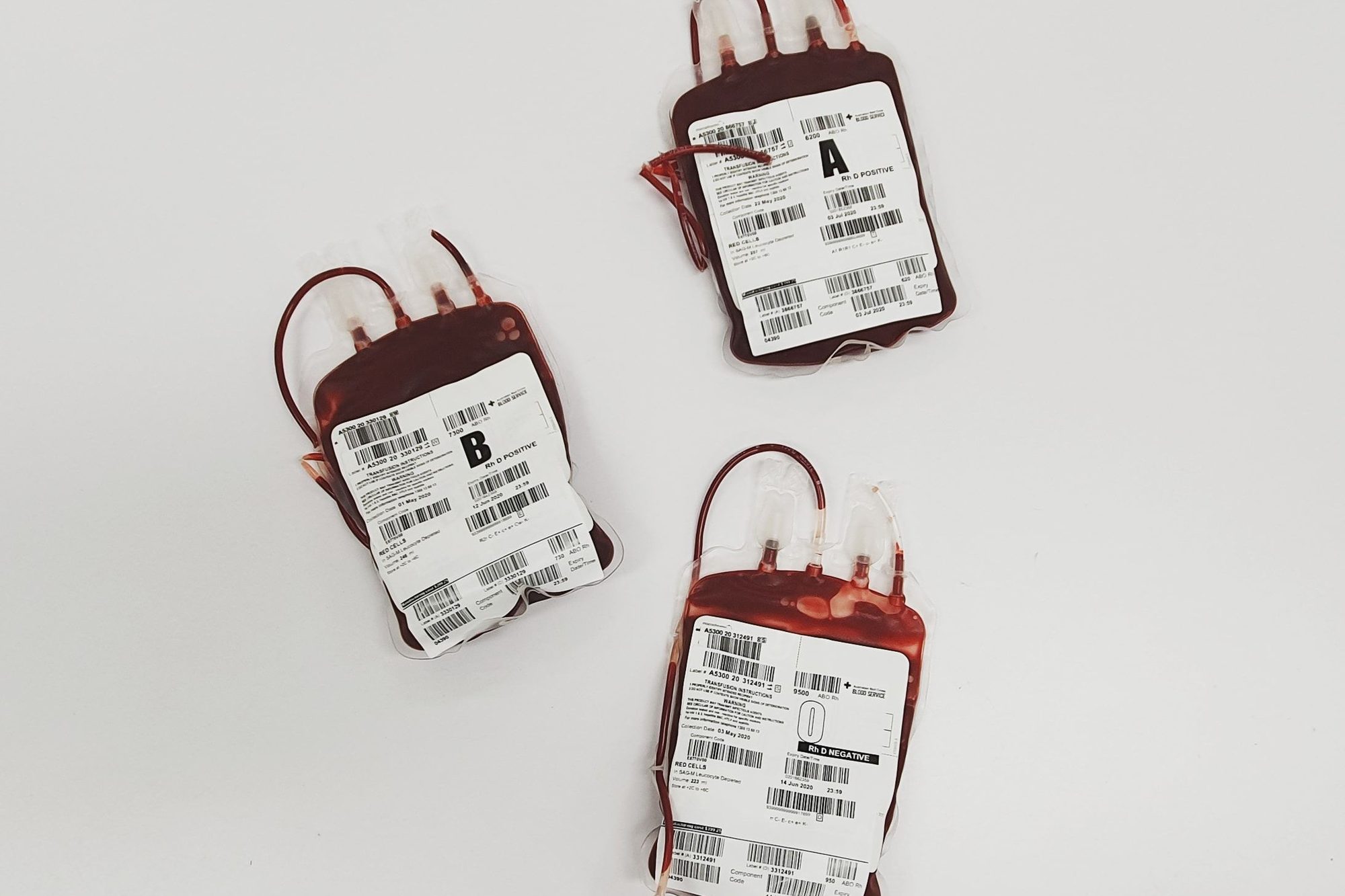
Blood products are the case with the clearest economic argument. According to the Paul-Ehrlich-Institut report under section 21 of the German Transfusion Act for 2024, 3,175,723 red cell concentrates were transfused in Germany, with a discard rate of 4.43 percent at the point of use. Shelf life is 28 to 49 days at 4 degrees Celsius. Loss at that scale is partly a distribution problem: units expire in the wrong place because moving them between sites at short notice is slow and expensive. Faster point-to-point transfer of individual units is a plausible lever, provided the cold chain is documented across the whole journey rather than at the endpoints.
Organs are the hardest case, not the showcase. In 2025 the DSO recorded 3,256 organs transplanted at 43 transplant centres in Germany, from 985 post-mortem donors, against a waiting list of 8,199 patients. The obstacles are structural: a packed organ with its transport container is far heavier than current medical drone payloads of roughly 0.5 to 4 kilograms, cold ischaemia time turns any diversion or weather hold into a clinical event, and the liability position for a lost organ has no precedent that any operator or insurer currently wants to test. The realistic near-term contribution of drone logistics to transplantation is on the periphery: crossmatch samples, tissue typing material and accompanying documentation, where speed changes the timeline and a failed flight does not destroy the transplant.
A related structural argument sits behind all three payload types. Only 331 of 1,893 German hospitals had their own laboratory medicine department, and 91 had a transfusion medicine department, according to the Destatis hospital base data for 2022. The large majority of hospitals therefore depend on transport to an external or central laboratory. That dependency, not the aircraft, is what creates the demand.
The regulatory frame for European medical routes
Medical point-to-point flights beyond visual line of sight fall into the specific category under Implementing Regulation (EU) 2019/947, with the aircraft covered by Delegated Regulation (EU) 2019/945. The available compliance routes are a full SORA risk assessment, a standard scenario (STS-01 or STS-02), a predefined risk assessment (PDRA), or a Light UAS Operator Certificate (LUC).
Two points decide how much work a clinical route actually is. First, SORA 2.5 has been the binding acceptable means of compliance since 29 September 2025 under ED Decision 2025/018/R, with a quantitative intrinsic ground risk model, ten steps, and the former CONOPS replaced by Detailed Operational Information. Second, and more consequential, there is still no PDRA for BVLOS operations over populated areas. The existing PDRA set is unchanged and PDRA-05 to 08 remain under development. A hospital route across a built-up area therefore requires a full individual SORA assessment, which in practice lands at SAIL III to IV, exactly where the two German scheduled routes sit. In Germany the operational authorisation is issued by the Luftfahrt-Bundesamt, and any promised processing time should be treated with suspicion.
The airspace integration layer is further behind than the rulebook suggests. The U-space framework under Regulations (EU) 2021/664, 2021/665 and 2021/666 has applied since 26 January 2023, but implementation is slow: San Salvo in Abruzzo is the first and so far only fully certified operational U-space airspace in the EU, covering 307 square kilometres since 1 January 2026, with only three CISP and three USP across the Union. EASA has been consulting on a lighter U-space category since 15 July 2026 under NPA 2026-103, which is not law.
One figure summarises the gap between approval and viability better than any forecast: of 496 active BVLOS approvals across 11 member states, only 89 are considered economically viable. Getting permission is difficult. Getting a route that pays for itself is harder, and it is the part that hospital procurement should scrutinise. The approval path itself is set out in detail in our guide to BVLOS approval in Germany.
From route to routine: the ground side decides
Once the aircraft is approved and the corridor is agreed, the remaining work is almost entirely on the ground. A flight that lands with a sample and no data attached does not save time, it moves the manual effort from the courier desk to the ward. Routine operation requires that the transport event exists in the clinical systems, not only in the operator's flight log.
- Chain of custody: a continuous, auditable record for every sample or unit from the ward to the landing point to the analyser, with the handover documented rather than assumed.
- Payload telemetry: temperature, and where relevant vibration and humidity, logged across the flight and stored with the sample record, so that cold chain and sample integrity can be demonstrated afterwards.
- Order and result integration: arrival at the landing point should trigger the laboratory workflow through the existing LIS or hospital information system interfaces rather than a phone call.
- Fallback: a defined ground route for weather holds and technical stoppages, with the switch-over decided by rule rather than improvised, since availability, not peak speed, is what clinical planning depends on.
This is where a systems integrator is useful and where the honest limits sit. wedrone does not fly, does not manufacture aircraft and holds no aviation certificates. What it does is specify the clinical requirement, evaluate approved partner operators and suitable platforms against it, and connect the resulting service to the existing hospital software stack, so that the drone route behaves like any other logistics process rather than like a project.
For a hospital evaluating its first route, the practical sequence is narrow and boring, which is the point: pick a single pair of sites with a known daily transport volume, confirm the payload category and the validation requirement with the receiving laboratory, verify the ground-level permissions for both landing points including planning and noise, select an operator who already holds an approval of the required SAIL level, and only then compare platforms. Comparable equipment questions for ground transport are covered in the robot catalogue.
FAQ
- Are medical drones in routine operation in Germany today?
- Yes, but on a small number of specific routes. Zollernalb Klinikum has flown laboratory samples and blood products between Albstadt and Balingen with the operator DiAvEn since 2025, at around seven flights per day under an LBA approval at SAIL III with UN 3373 clearance. Asklepios and MEDILYS have run a scheduled route of about 60 kilometres in Schleswig-Holstein with the operator Jedsy since March 2025. German Copters flies in Saxony, and Morpheus Logistik is running a pilot in North Rhine-Westphalia. Beyond these, most German activity remains at pilot or demonstration level.
- Is the Swiss Post drone network still flying?
- No. Swiss Post discontinued its drone programme on 31 December 2022, and University Hospital Zurich had already ended its participation on 30 June 2022. The programme was preceded by two crashes in January and May 2019. The relevant lesson is economic rather than technical: the flights worked, the unit economics did not carry the service. Among Swiss medical users, the laboratory Dr. Risch with the operator Jedsy is the remaining active case.
- What was Medifly Hamburg, and is it still running?
- Medifly Hamburg was a publicly funded research project, a Reallabor, that tested medical drone flights across urban airspace with test flights in 2021 and 2022. Its last recorded activity dates from June 2022. It demonstrated that urban medical flights are technically feasible under close supervision, but it was never a permanent commercial transport service and should not be cited as one.
- Can drones transport donor organs?
- Not realistically in the near term. In 2025 the DSO recorded 3,256 organs transplanted at 43 German transplant centres. A packed organ with its transport container exceeds the payload of the medical drones currently in service, which carry roughly 0.5 to 4 kilograms, cold ischaemia time makes any weather hold or diversion a clinical problem, and the liability position is untested. Drone logistics realistically starts with crossmatch samples, tissue typing material and accompanying documentation rather than with the organ itself.
- What does drone transport change for blood supply?
- The argument is distribution rather than speed alone. In 2024, 3,175,723 red cell concentrates were transfused in Germany with a discard rate of 4.43 percent at the point of use, at a shelf life of 28 to 49 days at 4 degrees Celsius. Part of that loss occurs because units expire at one site while another site needs them and short-notice transfer is slow. Faster point-to-point transfer of individual units is a plausible lever, provided the cold chain is documented across the entire journey.
- Does a hospital need its own aviation approval?
- No, and no hospital operator in Europe currently flies on its own certificate. In every documented medical route the clinic is the customer and an approved external operator holds the operational authorisation, carries the aviation liability and provides the crew. Apian in the NHS shows the same split on the integrator side: it has been in routine operation since 2024 without flying itself, working with Wing and Matternet as operators.
- Does wedrone operate its own flights?
- No. wedrone is the drone unit of werob, a manufacturer-independent systems integrator for service robotics. wedrone does not operate flights, does not manufacture aircraft and holds no aviation certificates. It specifies the clinical requirement, evaluates approved partner operators and suitable platforms, and connects the resulting transport service to the hospital software stack.
Related reading
Medical drone logistics: cutting laboratory transport from hours to minutes
How medical drone logistics replaces batched courier loops on short clinic-to-laboratory routes, what German operations already prove, and where the regulatory and pre-analytical limits sit.
22 July 2026bvlos approval germany medical droneBVLOS approval for medical drones in Germany: SORA, LUC and the path to routine operation
What it actually takes to get a clinic drone route approved in Germany: the specific category under Regulation (EU) 2019/947, the binding SORA 2.5 methodology, SAIL levels, the LUC pathway and the two bottlenecks operators underestimate.
23 July 2026cargo drone payloadCargo drones: which payload class is actually approvable in Europe today
The cargo drone conversation is about aircraft. It is settled by a number that sits in the regulation rather than the spec sheet: 25 kilograms of take-off mass. That is exactly where the whole class-mark system ends, and both standard scenarios end with it.
2 September 2026medical drone delivery hospitalMedical Drone Delivery: How Hospitals and Labs Cut Transport Times from Hours to Minutes
Blood products, lab samples and medication are the fastest-growing drone market. What hospital networks need to start medical drone delivery, and where the value shows up first.
3 July 2026drone in a boxDrone-in-a-box: what one dock actually covers in a day
The box launches in 45 seconds. That number is real and it is also the least useful one in the brochure, because a dock flies one aircraft at a time and then has to charge it. What decides whether the installation earns its place is the cycle, not the launch.
2 September 2026