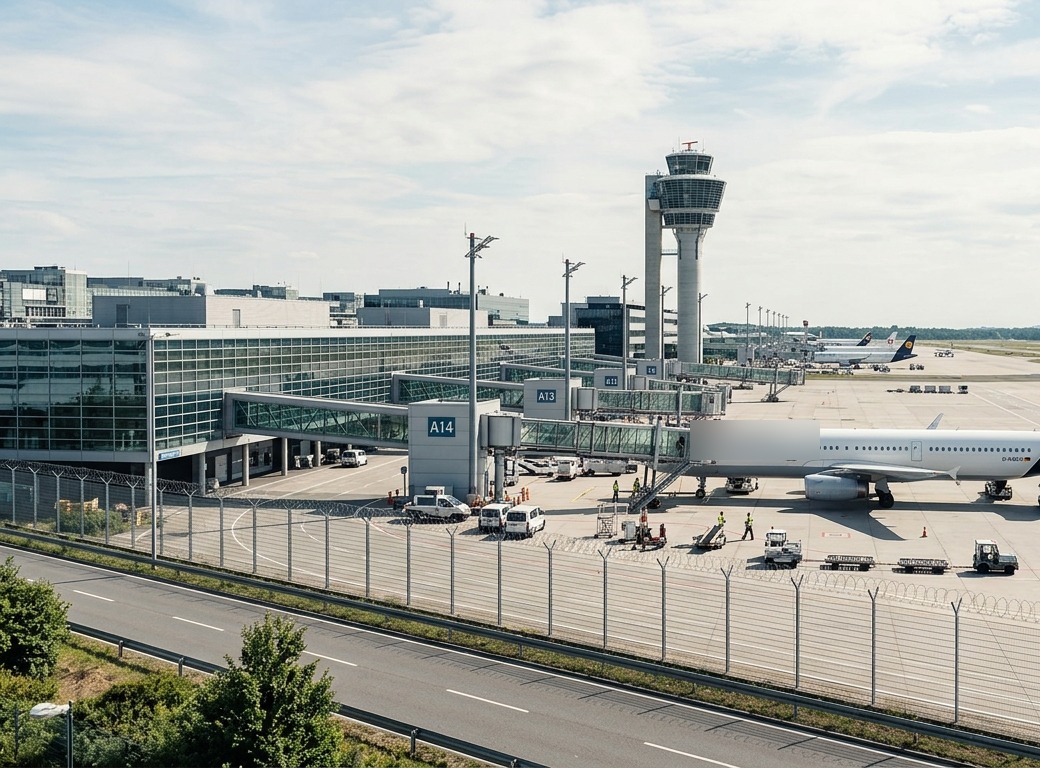
Drone No-Fly Zones at German Airports: What Section 21h LuftVO Means
An airport is not an ordinary fenced site. Section 21h LuftVO sets its own, considerably larger exclusion zones — regardless of who owns the ground underneath.
Anyone wanting to fly a drone near a German airport runs into a considerably stricter rule than on an ordinary works site. Section 21h LuftVO sets a 1 km lateral buffer from an airport's boundary, plus a no-fly exclusion off each runway's extended centreline running 5 km long and 2 km wide in both directions. At airfields that are not airports, a flat 1.5 km buffer from the perimeter still applies. werob and wedrone have no deployments in this space; this article only maps the legal position.
Key Takeaways
- 1Section 21h LuftVO sets a 1 km lateral buffer at airports plus a 5 km x 2 km exclusion zone off each runway's extended centreline; other airfields keep the flat 1.5 km buffer.
- 2An exemption for airports is granted by the competent state aviation authority; for airfields and heliports, clearance from the flight operations office or operator is enough.
- 3The ADV airport association lists 30 members per its current membership map (as of January 2026), 23 international and 7 regional airports; Bundespolizei is responsible for air security at 13 major German airports (§4 BPolG).
The rule in detail
Who grants the exemption
The context: who runs these sites
What this is not
FAQ
- Does werob offer a drone solution for airports?
- No. This article maps the legal position under Section 21h LuftVO; werob and wedrone have no deployments in this space.
- Does the 1.5 km buffer still apply?
- Only at airfields that are not airports. At airports, a 1 km lateral buffer applies plus the 5 km x 2 km exclusion off each runway direction.
- Is a SORA 2.5 authorisation enough for the airport zone?
- No. The exemption for the Section 21h LuftVO zone is additionally granted by the competent state aviation authority, independent of the SORA compliance path under EU 2019/947.
Related reading
Drone Landing Pads for Business and Home: The Last Metre of Drone Delivery
Drone delivery rarely fails because of the drone. It fails at the landing point. What a drone landing pad is, which variants exist and how wedrone plans, builds and operates pads.
3 July 2026legal framework for drone defense in germany andLegal framework for drone defense in Germany and the EU
Explore the legal framework for drone defense in Germany and the EU. Learn how the 2026 EU Action Plan and new German laws impact C-UAS deployment.
6 August 2026medical drone delivery laboratoryMedical drone logistics: cutting laboratory transport from hours to minutes
How medical drone logistics replaces batched courier loops on short clinic-to-laboratory routes, what German operations already prove, and where the regulatory and pre-analytical limits sit.
22 July 2026fire control center drone networkFire department drone networks: Automatic launch on alarm
Discover how automated drone networks for fire departments provide real-time aerial intelligence before units arrive, leveraging BOS SORA exemptions.
17 August 2026vehicle-launched drone operationsLaunching drones from a vehicle: line of sight, the operating site, and the containment that travels
The fixed box on the fence is well understood. The other case is the crew that arrives in a van, stays two hours and drives on. For them there is no hangar, no fixed operating site, and no containment that stays put.
2 September 2026