Rent a robot: operational scaling without investment risk
Renting robots is evolving from a trend to an operational standard for European companies. Find out how werob, as a system integrator, combines hardware agnostics and regulatory security in an outcome-only model.
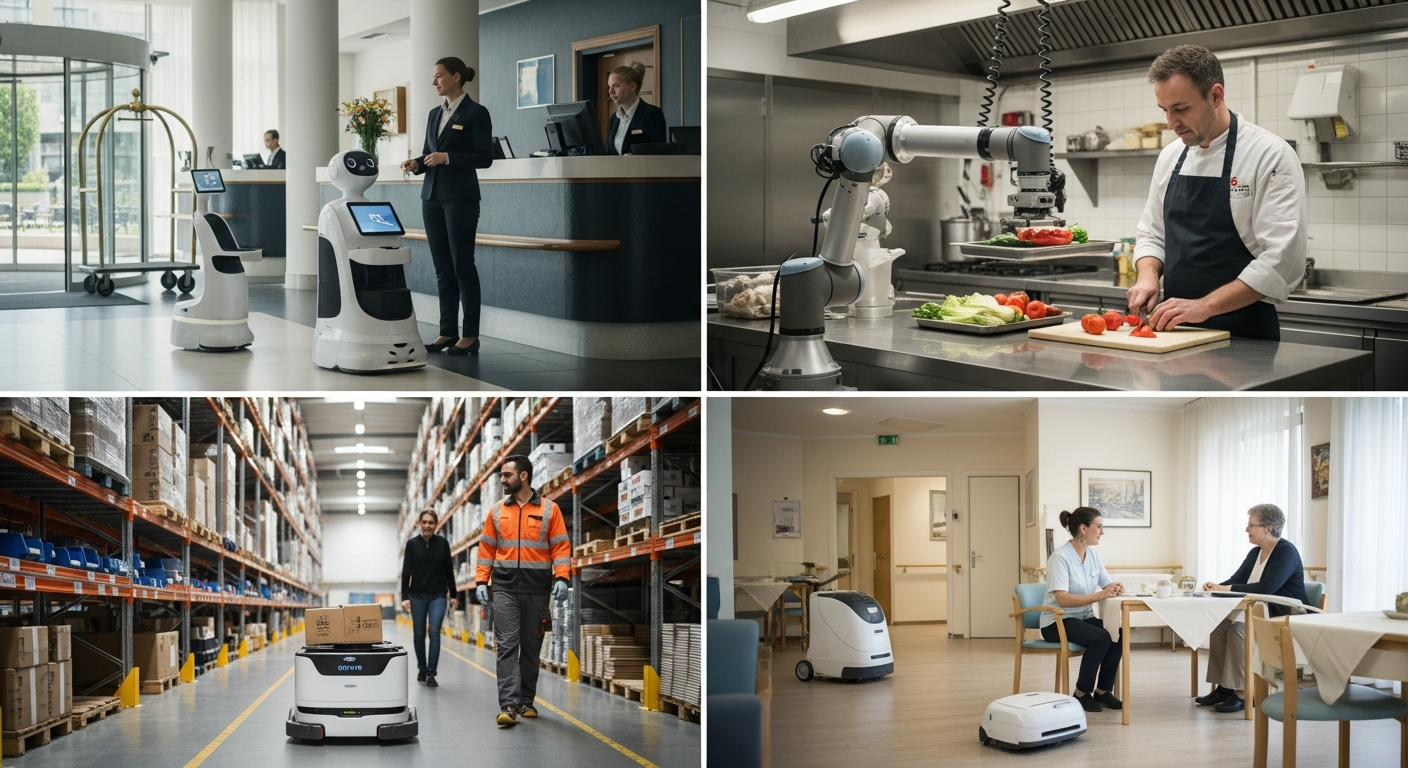
Station 2. 10:00 p.m. The medication trolley already runs autonomously across the hallway, while the nursing staff gains time for direct resident care. In the hotel industry, a service robot simultaneously takes over the room service rounds on floors three to five. These scenarios are already an operational reality for werob customers like Korian Germany. The decisive factor for success is not the physical ownership of the machine, but rather the seamless integration of the function into the existing workflow. werob translates these requirements into operational solutions in record time, with a focus on measurable results and regulatory compliance.
Key Takeaways
- 1Hardware agnostics prevents vendor lock-in and enables access to 44+ specialized OEM partners.
- 2The werob Spec Engine shortens the planning phase from months to 48 hours through AI-supported workflow analysis.
- 3The outcome-only model eliminates upfront financial risks and makes automation cash flow positive from the first month.
Why operators rent robots instead of buying them
In modern business management, the focus is increasingly shifting from CAPEX (capital expenditure) to OPEX (operating expenditure). When companies rent robots, they eliminate the risk of technological obsolescence and high initial capital commitment. A robot that is state of the art today may have been replaced by more efficient models in three years. werob does not act as a simple landlord, but as a system integrator who ensures that the rented hardware fits the workflow exactly.
A key advantage of werob's rental model is the outcome-only principle. Operators only pay when the robot is in productive use. This differs fundamentally from classic leasing models, where the payment obligation often begins with delivery, regardless of the actual integration. For a Director of Operations, this represents a significant reduction in project risk. The flexibility to scale the fleet if necessary or carry out technological upgrades is a decisive competitive advantage in a dynamic market environment.
Werob also assumes responsibility for continuous operational readiness. While maintenance and repair often remain an additional burden on the operator when purchasing, in the werob model this is an integral part of the system performance. The goal is maximum uptime, which is monitored by the central live cockpit. In this way, robotics becomes a calculable service that is reflected directly in the profit and loss statement without burdening the balance sheet with heavy assets.
The werob Spec Engine: To the specification in 48 hours
The biggest bottleneck when introducing robotics is traditionally the planning phase. Industry-standard discovery processes often take three to six months. werob breaks this pattern with the Spec Engine. Based on data from over 35,000 projects, this AI-powered tool translates an operator's verbal requirements into a technical specification in just 48 hours. Whether it's the medication round in nursing or the yard patrol in logistics, the Spec Engine identifies the necessary parameters for success.
This process takes into account not only the task itself, but also the infrastructural conditions on site. Do elevators need to be controlled? What floor coverings are available? What does the WiFi coverage look like? By quickly creating this specification, werob shortens the route to the offer to five days. For decision-makers, this means enormous time savings and the certainty that the chosen hardware solution is based on valid data instead of manufacturer promises.
The Spec Engine is the heart of the werob platform. It ensures that the right questions are asked from the start to avoid later integration problems. Users often ask: How secure is planning at werob. The answer lies in the volume of project data processed, which enables precise prediction of performance. This closes the gap between the operational vision and the technical implementation even before the first robot reaches the site.
Hardware agnostics: 44+ OEM partners compared
A common mistake when introducing robotics is the so-called vendor lock-in. Anyone who commits to a single manufacturer at an early stage depends on its innovation cycle and pricing. werob follows a strictly hardware-agnostic approach. The system currently ranks across 44 OEM partners and more than 280 different robot models against the customer's individual specifications. These include well-known partners such as Boston Dynamics, Keenon, Pudu, Apptronik and Unitree.
| Criteria | Individual OEM reseller | who is a system integrator |
|---|---|---|
| Hardware selection | Limited to one brand | 44+ OEMs, 280+ Models |
| Interoperability | Proprietary | Pre-built connectors (SAP, Mews etc.) |
| Planning duration | Weeks to months | 48 hours (Spec Engine) |
| Compliance | Manufacturer responsibility | EU Machinery Regulation 2023/1230 path |
| Price model | List price / leasing | Outcome-only |
Through this comparison, werob ensures that the most technologically and economically sensible solution is always selected will. A robot that does an excellent job in a nursing facility in Hamburg is not necessarily the best choice for a resort in Spain. The platform objectively evaluates factors such as load capacity, battery life, sensors and price-performance ratio. Users also ask: Which robot manufacturers does werob support? The portfolio includes everything from service robots for the catering industry to humanoid systems for complex logistics tasks. This broad market access enables werob to deliver a ready-to-use solution within eight weeks that is precisely tailored to the operator's needs.
Regulatory safety and EU Machinery Regulation 2023/1230
A critical aspect that is often overlooked when renting robots is legal compliance. From January 20, 2027, the new EU Machinery Regulation 2023/1230 will be binding. This regulation places stricter requirements on the safety and conformity assessment of machines, especially when integrating AI components. Many Asian OEMs currently do not have the necessary structures to independently meet these European standards. werob acts as the necessary compliance path here.
As a system integrator, werob assumes responsibility for compliance with relevant standards such as ISO 13482 for service robots in the personal area. This is particularly important in sensitive environments such as care or public spaces. Without legally compliant documentation and acceptance, operators risk severe penalties and the revocation of their operating license in the event of accidents or inspections by home inspectors. werob integrates these regulatory requirements directly into the selection and implementation process.
Werob's live cockpit also offers a four-dimensional traffic light system that monitors the status of the regulations in addition to hardware and infrastructure. This means compliance officers always have proof of the safe operation of the fleet. At a time when the EU AI Act and the NIS2 Directive increase cybersecurity and transparency requirements, werob provides the necessary protection for companies looking to scale robotics. Users often ask: What does the EU Machinery Regulation 2023/1230 change for my company? It makes the integrator an indispensable partner for minimizing liability.
Integration into the operator stack via connectors
A robot that works in isolation from existing IT systems often creates more manual effort than it saves. The true efficiency comes from integration into the existing software stack. werob offers prefabricated connectors for market-leading systems in various industries. These include PointClickCare and MatrixCare for care, Opera PMS and Mews for the hospitality industry, and Toast and Lightspeed for the F&B sector. In the area of logistics and security, integrations for SAP EWM and Genetec are available.
These connectors enable the robot to receive commands directly from the system in which the employees are already working. When a guest in a hotel orders an additional pillow via the PMS, the order is automatically transmitted to the rented service robot. No manual intervention on a separate tablet is required. This seamless communication reduces sources of error and significantly increases acceptance among staff. Users also ask: How does the integration into SAP EWM work. werob uses standardized interfaces to delegate transport orders to the robot fleet in real time.
The ability to integrate is a core differentiator of werob. While many providers only supply the hardware and treat the integration as an expensive additional project, at werob the connection is part of the platform logic. This ensures that the robot fleet acts as an integral part of the operational processes from day one. The data from these integrations flows back into the cockpit to enable continuous optimization of processes.
Economic key figures and cost relief
The decision to rent robots is ultimately driven by economic relief. werob provides concrete, verified figures from the live operation of over 200 robots in 11 European countries. In care, the automation of the medication round leads to an annual cost reduction of €92,000 per location. Simply transporting laundry or waste saves a further €71,000 per year. These sums result from the exemption of qualified specialists from logistical support work.
The effects are even clearer in the hotel industry. A robot for room service saves the business by €112,000 per year, while support with bar and breakfast preparation saves around €54,000. In the F&B area, a tray bot in the dishwashing chamber pays for itself by saving €76,000 annually. These numbers are not theoretical projections, but are based on reducing overtime, reducing fluctuation by making work easier and optimizing throughput times.
Werob's outcome-only model ensures that these savings can be calculated directly against the rental costs. Since there are no high acquisition costs, the project is often cash flow positive from the first month. For a Director of Operations, this is the strongest argument to management. Investing in robotics turns from a risky technology project into a safe measure to increase operational efficiency.
The werob cockpit: fleet management in real time
As soon as the robot fleet is in use, the focus switches to stable operation. werob provides the live cockpit for this purpose. This tool offers much more than a simple location display of the machines. It uses a four-dimensional traffic light system to monitor the health of the entire fleet. The first dimension concerns the hardware itself (battery status, sensors, wear). The second dimension monitors the infrastructure, such as the accessibility of elevator controls or WLAN nodes.
The third dimension is regulation. This ensures that all safety certificates are up to date and that operations take place within the legal framework. The fourth dimension compares performance with the original specification. Does the robot reach the planned travel times. All stations are approached as planned. This in-depth analysis allows problems to be identified and resolved before they disrupt operations. Users often ask: How safe is the operation of my robot fleet. The cockpit provides a data-based answer in real time.
In addition, the cockpit serves as a central interface for updates and remote maintenance. Since Werob works hardware-agnostic, the cockpit bundles the data from different manufacturers in a uniform interface. This is particularly invaluable for companies with multiple locations and different types of robots. The Head of Facility keeps track of the entire European fleet without having to switch between different manufacturer apps. This is the operational level that makes werob the market leader for systems integration.
To productive robot use in eight weeks
Werob's promise of speed is unique in the industry. While classic projects often fail due to lengthy decision-making processes and complex integrations, werob follows a strict eight-week plan. After the 48-hour specification phase and the offer after five days, the implementation phase begins. This includes configuring the hardware, setting up the connectors in the operator stack and training the on-site staff. Since we use prefabricated building blocks, time-consuming individual programming is largely eliminated.
This process has already been successfully scaled in 11 European countries, including Germany, France, Italy and the United Kingdom. werob plans to expand the fleet to 2,000 robots by 2028. For new customers, this means that they benefit from a proven process that has already been optimized hundreds of times. The path to automation begins with a simple onboarding process that queries the operational shifts and tasks. Users also ask: How quickly can I rent a robot. At werob, the machine is often productive on the site just eight weeks after the first contact.
In conclusion, renting robots from a system integrator like werob is the only scalable solution to the current shortage of skilled workers. Through the combination of rapid planning, hardware-agnostic selection, deep system integration and regulatory security, operators minimize their risk and maximize their operational output. Start your spec in 48 hours at werob.de/en/onboarding and transform your business with the power of modern robotics.
FAQ
- How much does it cost to rent a robot from werob?
- werob works according to an outcome-only model. This means there are no classic list prices. The costs depend on the service provided and the operational success. You only pay when the system is running productively.
- Which industries can rent robots through werob?
- werob specializes in the areas of care (senior living), hotels, catering (F&B), logistics, security as well as facility management and golf clubs.
- How long does it take from inquiry to deployment?
- werob guarantees a specification within 48 hours, an offer within 5 days and the productive use of the robot within 8 weeks.
- Is maintenance of the rented robots included?
- Yes, as a system integrator, werob takes full responsibility for operations. Maintenance and monitoring via the live cockpit are an integral part of the service package.
- Does werob support integration into SAP EWM?
- Yes, werob has ready-made connectors for SAP EWM as well as for other systems such as PointClickCare, Mews, Opera PMS and Toast.
- How secure is compliance with the EU Machinery Regulation?
- werob offers an integrated compliance path for the EU Machinery Regulation 2023/1230, which is binding from January 2027, and ensures the conformity of all systems used.
Related reading
Rent service robotics: operational efficiency without tying up capital
Renting service robot systems allows companies to scale quickly without high investment risk. As a hardware-agnostic system integrator, werob offers the direct path from workflow analysis to a productive fleet in eight weeks.
19 June 2026robot subscriptionRobot subscription: Scalable automation without investment risk
A robot subscription gives companies access to state-of-the-art robotics without high upfront investments. werob integrates these systems into existing workflows in a hardware-agnostic manner and guarantees operational success through a purely results-oriented billing model.
17 June 2026robot leasingRobot leasing for companies: models and ROI factors
Companies face the challenge of scaling automation without high CapEx hurdles. Robot leasing offers the necessary financial flexibility for this, provided that it is integrated directly into the existing operator stack.
17 June 2026robot leasing germanyRobot Leasing Germany: Operational Efficiency Without Investment Risk
Robot leasing in Germany is evolving from a pure financing instrument to comprehensive system integration. Learn how werob as a hardware-agnostic partner paves the way for scalable automation.
17 June 2026raas roboticsRaaS Robotics: Scalable Automation Without Investment Risk
RaaS robotics enables companies access to state-of-the-art automation without high upfront investments. Through a usage-based model, hardware, software, and maintenance are bundled into a monthly rate, which maximizes operational flexibility.
15 June 2026