Rent service robotics: operational efficiency without tying up capital
Renting service robot systems allows companies to scale quickly without high investment risk. As a hardware-agnostic system integrator, werob offers the direct path from workflow analysis to a productive fleet in eight weeks.
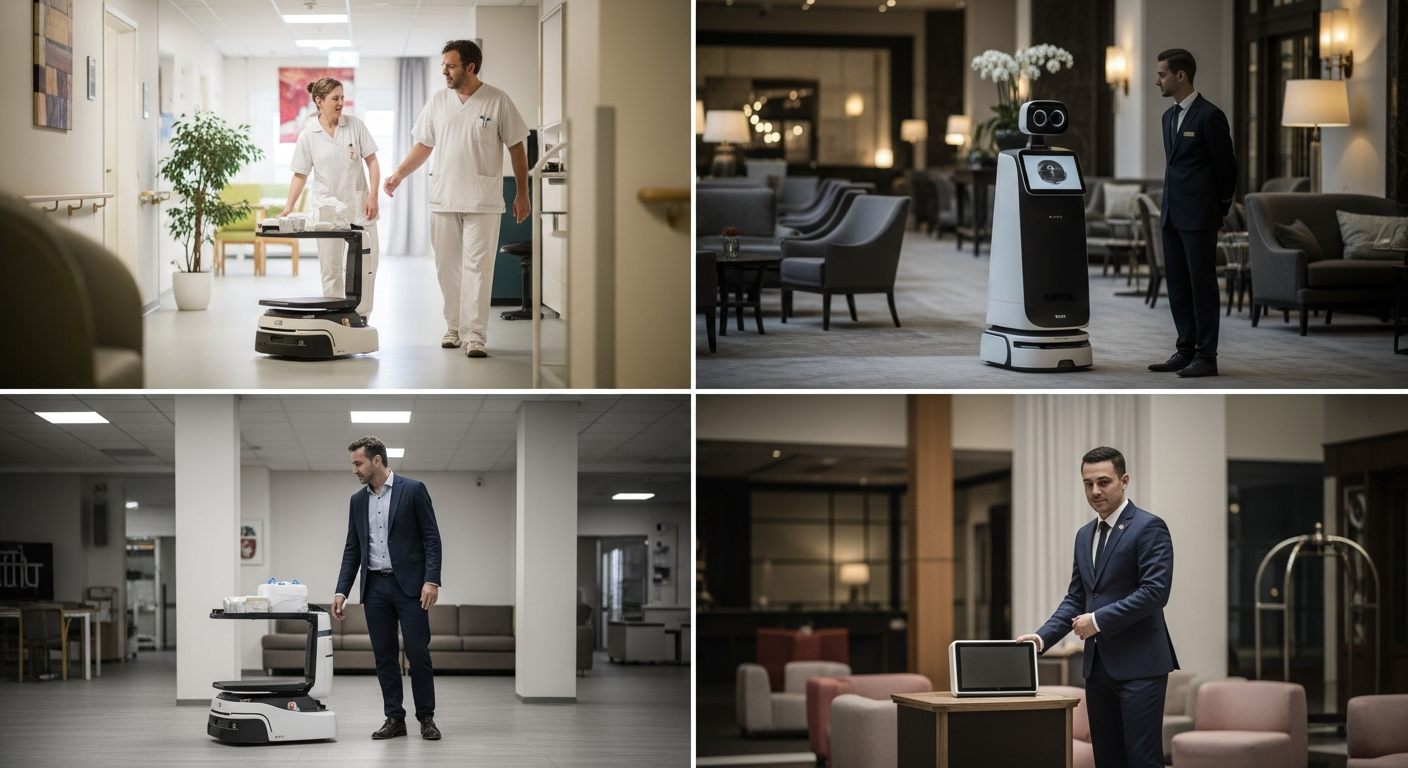
Station 2. 10:00 p.m. The medication cart starts moving silently while the nursing staff prepares the handover for the night shift. In this scene it becomes clear that modern robotics is no longer a project for the future, but rather an operational necessity to relieve the burden on specialist staff. In a nursing facility in Hamburg, such a robot is already taking on critical transport tasks in its twelfth week of operation. The operator did not buy the hardware, but rather uses a rental model that was implemented by werob as a system integrator. This approach eliminates technological risk and converts high acquisition costs into predictable operational expenses, while the annual cost relief per location is around 92,000 euros for medication rounds.
Key Takeaways
- 1Rental models convert high investment costs into calculable operational expenses and enable immediate cost relief of up to 112,000 euros per year in the hotel sector.
- 2werob's hardware-agnostic strategy prevents vendor lock-in and provides access to over 280 robot models from 44+ OEM partners.
- 3Compliance with the EU Machinery Regulation 2023/1230 will be mandatory from January 2027 and is already ensured today by werob as a system integrator.
Strategic flexibility through Robotics-as-a-Service
The classic purchase of hardware represents a significant hurdle for many companies in the hotel, care and logistics industries. The technological half-life of robot systems is short and being tied to a single manufacturer carries the risk of vendor lock-in. This is where the rented service robotics model comes into play. werob does not act as a simple reseller, but rather as the operational level that controls the entire life cycle of the fleet. Thanks to the outcome-only model, operators only pay when the system is in productive use. This shifts financial responsibility from capital expenditure (CAPEX) to operating expenditure (OPEX).
A key advantage of this model is scalability. For example, a hotel resort can start with two robots for room service and expand the fleet to eight units as needed without burdening the balance sheet with high depreciation. werob currently supports over 200 robots in live operation in eleven European countries. This experience flows directly into the rental conditions, as the reliability of the systems is continuously monitored by the werob cockpit. Operators thus receive a turnkey solution that always remains technologically up to date, as hardware updates or the replacement of components are part of the integration service.
The Spec Engine: A precise requirement in 48 hours
One of the biggest time wasters when introducing robotics is the definition phase. Traditional consulting firms often need three to six months to formulate requirements. werob shortens this process to 48 hours with the Spec Engine. Trained on over 35,000 projects, this engine translates the human description of a workflow into a technical specification. When a facility manager indicates that a floor needs to be patrolled at night, the Spec Engine immediately generates the necessary parameters for sensors, battery life and connectivity.
This speed is crucial for companies suffering from acute staff shortages. As soon as the specification is in place, the supplier match takes place. werob compares the requirements with the catalog of over 44 OEM partners and ranks more than 280 different robot models. werob remains strictly hardware-agnostic. It's not about selling a specific product, but rather finding the system that best meets the specification. Whether a robot from Keenon, Pudu or Boston Dynamics is used depends solely on its operational suitability for the customer's specific workflow. This data-driven selection process ensures that the rented hardware fits the location exactly.
Regulatory safety according to EU Machinery Regulation 2023/1230
An often underestimated aspect of renting service robotics is legal compliance. On January 20, 2027, the new EU Machinery Regulation 2023/1230 will become binding. Many manufacturers, especially from non-European countries, do not have the necessary conformity assessments for the European market. werob acts as the decisive compliance path here. As a system integrator, werob ensures that all rental robots used comply with applicable standards such as ISO 13482 for personal assistance robots.
For operators in sensitive areas such as care, this is of vital importance. Home supervision in Germany places high demands on the security of autonomous systems in public spaces. werob integrates these regulatory requirements as early as the planning phase. The live cockpit also continuously monitors the status of regulatory compliance. If the legal framework changes, werob can make adjustments via the platform level without the operator having to invest its own legal resources. This legal certainty is an integral part of the rental offer and protects companies from liability risks and operating bans.
Seamless integration into the existing software stack
A robot that works in isolation only creates a fraction of the possible added value. True efficiency comes from connecting to the existing IT infrastructure. werob offers pre-built connectors for the most important industry stacks. In nursing, these are integrations in PointClickCare and MatrixCare, in the hotel industry in Opera PMS or Mews, and in logistics in systems such as SAP EWM. These connectors allow the robot to receive orders directly from the system and return status reports in real time.
When a guest orders an additional towel in the hotel via the PMS, this order is transmitted to the robot without manual intervention. In logistics, a yard patrol robot can be integrated directly into the security center via Genetec. This deep integration reduces the error rate and increases acceptance among employees because the robot is perceived as a natural part of the team. werob takes care of the entire technical implementation of these interfaces, so that the operator does not have to provide its own software developers. This shortens the time to productive use to just eight weeks, while traditional integration projects often take over a year.
Economic efficiency: Verified cost reductions per location
The decision for rented service robotics is ultimately made based on the return on investment (ROI). werob works with hard numbers instead of vague promises. In the care industry, Korian Germany achieved double-digit cost reductions in the first year through the use of robots. Specifically, this means an annual relief of 92,000 euros per location for one round of medication. In the area of transport logistics within a facility, the savings are around 71,000 euros.
The effects are also significant in other sectors. A hotel can achieve cost savings of 112,000 euros per year by automating room service. In the catering industry, a tray bot in the dishwashing chamber saves the business by 76,000 euros annually. These numbers are based on real operational data from the over 200 robots that werob currently manages. Since werob's commercial model is results-oriented, the rental fee correlates directly with the service provided. The operator therefore bears no financial risk for downtimes or inefficient processes. The transparency of these savings is visualized daily in the werob cockpit, which enables precise budget planning.
The live cockpit: transparency across the entire rental fleet
Managing a robot fleet requires a central control unit that goes beyond pure hardware monitoring. The werob Cockpit offers a four-dimensional traffic light system that displays the status of hardware, infrastructure, regulations and specifications in real time. Operators can immediately see whether a robot is down due to a Wi-Fi failure or whether maintenance is due in accordance with the EU Machinery Regulation. This transparency is particularly crucial for companies with multiple locations in order to ensure consistent service quality.
The cockpit also serves as an auditing authority. All actions of the robots are logged in accordance with GDPR, which serves as proof of the proper execution of tasks during audits or inspections by authorities. In logistics, for example, the cockpit enables the monitoring of yard patrols, with the cost savings here being 68,000 euros per year. Thanks to central data storage, optimization potential can be quickly identified and translated into new work instructions for the robots using the Spec Engine. The operator thus retains full control over his rented fleet without having to deal with the technical complexity of the individual OEM systems.
From need to productive use in eight weeks
Speed is a core promise of werob. While the robotics market is often characterized by long pilot phases and feasibility studies, we follow a standardized eight-step process. This begins with recording the current status and, via the 48-hour specification, leads directly to the offer within five days. Delivery and commissioning of the robots usually takes place within eight weeks. This tight schedule is only possible because werob relies on pre-built connectors and an established network of 44+ OEM partners.
For an operator, this means that they will feel significant operational relief within two months. A golf club, for example, can automate ball collection within a very short time and thus save 38,000 euros per year. The process is designed in such a way that ongoing operations are minimally disrupted. Integration into the software stack takes place parallel to the hardware preparation. On the day of commissioning, the system is immediately ready for use and connected to the werob cockpit. This pace makes werob the leading systems integrator in Europe and enables companies to realize the benefits of robotics without the usual bureaucratic and technical delays.
Future-proof through hardware-agnostic integration
The decision for a rental model at werob is a decision for long-term flexibility. Since werob is not tied to a single manufacturer, the fleet can be adapted to technological advances at any time. If a new, more efficient humanoid comes onto the market, it can be integrated into the workflow using the existing connectors. This is particularly relevant as development in the field of humanoid robots is progressing rapidly, for example through partners such as Apptronik or Unitree. werob has already successfully put the first humanoid pilot project into operation in a Hamburg care facility.
This agility protects the invested capital and ensures that the company always works with the most efficient technology available. The focus is always on the result: relieving employees and reducing operational costs. With the goal of having over 2,000 robots in use by 2028, werob is continually expanding its position as an operational level for European service robotics. Companies that enter the rental model today not only secure immediate cost relief, but also access to a platform that completely abstracts the complexity of robotics and makes it manageable.
FAQ
- Why should I rent service robotics instead of buying?
- Renting via a RaaS model eliminates the technological risk of obsolescence and protects liquidity. werob also offers an outcome-only model where you only pay when the system is running productively, including maintenance and compliance updates.
- How quickly is a rented robot ready for use?
- werob guarantees a specification within 48 hours and a quote within five days. The complete implementation, including software integration, usually takes eight weeks.
- Which software systems can be connected?
- werob has ready-made connectors for PointClickCare, MatrixCare, Opera PMS, Mews, Toast, SAP EWM and other market-leading systems in the care, hotel and logistics industries.
- What happens if there are technical problems with the hardware?
- The werob cockpit monitors the fleet in real time. In the event of disruptions, the integrated fleet management intervenes. Since it is a rental model, maintenance and technical support are included in the monthly fee.
- Is renting robots GDPR compliant?
- Yes, werob ensures that all data processing by the robots complies with European data protection guidelines. The logging in the cockpit is audit-proof and anonymized.
- Can different brands of robots be mixed in a fleet?
- Yes, that is a core advantage of werob. The platform is hardware-agnostic and enables the management of a mixed fleet from different manufacturers via a central cockpit.
Related reading
Rent a robot: operational scaling without investment risk
Renting robots is evolving from a trend to an operational standard for European companies. Find out how werob, as a system integrator, combines hardware agnostics and regulatory security in an outcome-only model.
17 June 2026robot subscriptionRobot subscription: Scalable automation without investment risk
A robot subscription gives companies access to state-of-the-art robotics without high upfront investments. werob integrates these systems into existing workflows in a hardware-agnostic manner and guarantees operational success through a purely results-oriented billing model.
17 June 2026robot leasingRobot leasing for companies: models and ROI factors
Companies face the challenge of scaling automation without high CapEx hurdles. Robot leasing offers the necessary financial flexibility for this, provided that it is integrated directly into the existing operator stack.
17 June 2026robot as a service GermanyRobot as a Service Germany: Efficiency without investment risk
Robot as a Service (RaaS) is transforming the way German companies scale automation. As a hardware-agnostic system integrator, werob offers the direct path from workflow analysis to a productive fleet in eight weeks.
27 June 2026robot as a service pricing germanyRobot as a Service Pricing Germany: ROI and Models
Robot as a Service (RaaS) transforms high investment costs into predictable operating expenses. Learn how werob realizes measurable cost relief in care, hospitality, and logistics through hardware agnosticism and outcome-only models.
16 June 2026