Robot as a Service: Operational excellence without investment risk
Robot as a Service (RaaS) transforms rigid investment models into flexible, results-oriented operating solutions. As a hardware-agnostic system integrator, werob offers direct access to over 44 OEM partners and ensures integration into existing IT stacks.
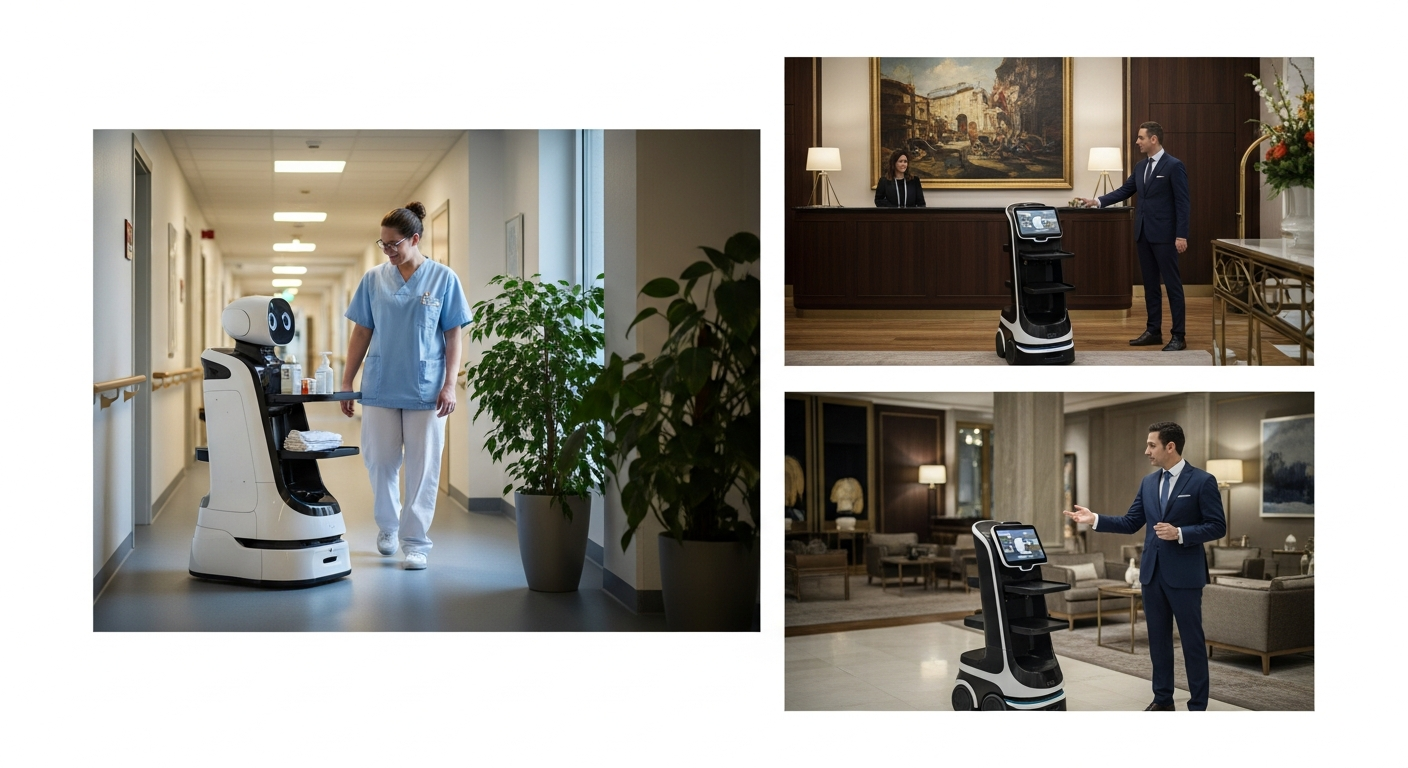
Station 2. 10:00 p.m. The handover is complete and while the nursing staff concentrates on direct patient care, the transport robot autonomously begins distributing nighttime medication. In the hotel industry, a service robot simultaneously delivers the order to room 402 without an employee having to leave the reception. At werob, these scenarios are not visions of the future, but rather everyday operations in over 200 live installations across Europe. As a system integrator, werob translates complex workflows into precise robotics specifications. The Robot as a Service model forms the financial and operational backbone that allows companies to use state-of-the-art technology without the hurdles of high acquisition costs and technological uncertainties.
Key Takeaways
- 1Robot as a Service (RaaS) eliminates high upfront investments and converts CapEx into predictable OpEx.
- 2As a hardware-agnostic integrator, werob offers access to over 44 OEMs and thus prevents vendor lock-in.
- 3Compliance with the EU Machinery Regulation 2023/1230 is already integrated as a compliance path in the werob model.
The definition of Robot as a Service in a B2B context
Robot as a Service (RaaS) describes much more than a simple rental model for hardware. At its core, it's about providing productive capacity. For an operator in care, hotels or logistics, this means that the focus is not on owning a robot, but on reliably completing a task. werob acts as the decisive operating level, which controls the entire life cycle of automation. While classic OEM resellers are often tied to a single brand, werob remains hardware agnostic. This means that the machine that best meets the site's requirements is selected from a catalog of over 44 OEM partners.
The market for RaaS is growing rapidly as companies look for ways to address the skills shortage without burdening their balance sheet with high capital expenditure (CapEx). By converting to operating expenses (OpEx), liquidity is maintained while operational efficiency immediately increases. werob secures this process with the Spec Engine, which creates a usable specification from the operator's words within 48 hours. This data-driven approach, trained on over 35,000 projects, significantly shortens the month-long discovery phases common in traditional consulting.
Economic benefits and verified cost relief
The use of robotics via a RaaS model must be measured by hard numbers. werob follows an outcome-only approach: costs only arise when the robot is in productive use. The economic leverage effect is already massive in various industries and is proven by live data. In nursing care, the automation of the medication round leads to significant annual cost reductions per location. This sum results from the reduction of unproductive walking distances and the avoidance of errors in distribution.
The effects are similarly clear in the hotel industry. An autonomous room service significantly reduces the burden on the budget, while the preparation of the bar and breakfast buffet saves further costs. In logistics and facility management, RaaS systems pay for themselves from day one, as the monthly service fee is usually significantly lower than the costs for manual processes. A yard patrol in logistics saves significant costs per year. These figures are not estimates, but operational reality for customers such as a leading European nursing home operator, where double-digit cost reductions were achieved in the first year.
Hardware agnostics: Why the choice of OEM is crucial
A common mistake when introducing robotics is the so-called vendor lock-in. Companies commit to a manufacturer and are dependent on its innovation cycle and pricing. werob breaks down this model. With over 44 OEM partners in the catalog, including leading names such as Keenon, Pudu, Boston Dynamics and Apptronik, werob offers an objective ranking. The Supplier Match algorithm compares the operator's requirements with the technical capabilities of over 280 different robot types.
This independence is particularly important when it comes to specialized tasks. Whether it's humanoid robots for complex interactions or specialized cleaning robots for F&B kitchen floors (which bring significant relief per year), Werob selects hardware based on performance, not sales quotas. If a manufacturer no longer meets the requirements or a better model comes onto the market, werob's RaaS model enables flexible adaptation of the fleet without the operator being stuck with outdated hardware.
Integration into the operator stack: The role of connectors
A robot that works in isolation is only half as valuable as an integrated system. The true value of Robot as a Service lies in the communication with the existing IT infrastructure. werob supplies prefabricated connectors that integrate the robot directly into the operator stack. In care, this means a connection to PointClickCare or MatrixCare. In the hotel industry, the robots communicate directly with Opera PMS or Mews to handle tasks such as room service fully automatically.
Integrations for Toast and Lightspeed are available for the Food & Beverage (F&B) sector, while logistics is connected via SAP EWM. This connectivity ensures that data flows in real time and the robot becomes part of the digital workflow. A tray bot in a washroom that saves significant costs annually is only efficient if it knows when and where it is needed. werob's connectors eliminate manual interfaces and make automation an integral part of operational management.
Regulatory and the EU Machinery Regulation 2023/1230
An often underestimated aspect when using robotics is legal security. From January 20, 2027, the EU Machinery Regulation 2023/1230 will be binding. This presents many operators with enormous challenges as they are responsible for the conformity of the systems used. werob supports as a compliance path. As a system integrator, werob assumes responsibility for compliance with these strict European standards as well as other standards such as ISO 13482 for service robots in personal areas.
Werob offers the necessary security, especially for Asian OEMs, who often supply excellent hardware but do not map the complex European certification processes in detail. The RaaS model includes continuous monitoring of regulatory requirements via the live cockpit. Operators in Germany also have to comply with specific requirements such as home supervision in care or the guarding regulations (BewachVO) in the security area. werob integrates these requirements in the spec phase, so that the use is legally secure and auditable.
The werob Cockpit: Live fleet management in real time
As soon as the robots are in use, the focus switches to stable operation. The werob Cockpit is the central control unit for the entire fleet, regardless of location or robot type. A four-dimensional traffic light system constantly monitors hardware health, network infrastructure, regulatory compliance and performance against the original specification. This guarantees that deviations are detected before they disrupt operational processes.
The cockpit offers transparency across all 11 European countries in which werob operates. For a director of operations, this means he can see the performance of his fleet in real time, from the utilization of the cleaning robots to the success rate of the medication rounds. This data forms the basis for continuous improvement of the processes. Since werob relies on an outcome-only model, the company is intrinsically motivated to keep the availability of the robots at a maximum. Standstill means no sales for werob, which creates an identity of interest between integrator and operator.
Comparison: RaaS vs. Traditional Purchase
The decision between purchasing robots and werob's Robot as a Service model can be made based on clear criteria. While the entire technological risk lies with the operator when purchasing, werob takes responsibility for hardware, software and compliance in the RaaS model. The following table illustrates the differences:
| Criteria | Traditional purchase (CapEx) | werob RaaS (OpEx) |
|---|---|---|
| Initial investment | Very high (hardware + integration) | Zero (Outcome-only) |
| Technology risk | Operator bears obsolescence risk | Hardware-agnostic & flexible |
| Maintenance & support | Additional service contracts required | Included in the live cockpit |
| Compliance (EU 2023/1230) | Operator must self-certify | Integrated compliance path |
| Scalability | Slow through budget cycles | Fast (8 weeks to live) |
This comparison shows that RaaS is particularly attractive for companies that want to scale quickly and attach importance to operational security. The speed of five days until the offer is made and eight weeks until the robot is in use can hardly be achieved in the traditional purchasing model.
The path to your own robot fleet in eight weeks
The process at werob is designed for high speed and minimal stress for the operator. It all starts with the Spec Engine. Within 48 hours, the workflow, be it in a nursing home, a hotel or a logistics center, is translated into a technical specification. Then follows the Supplier Match, in which the appropriate machines are selected from the catalog of 44+ OEMs. After selection, integration into the existing IT stack takes place via the werob connectors.
A binding offer is available within just five days. The commercial model is very simple: you only pay when the solution is running. Once the order has been placed, it usually only takes eight weeks for the robots to be productive on site. This structured 8-step intake process ensures that all aspects from infrastructure to regulation to commercial framework are covered. werob is not a consulting company that delivers Powerpoint slides, but a system integrator that brings results down to earth.
Future Outlook: Humanoid Robots and AI Integration
The development of robotics does not stand still. werob is already a pioneer in the use of humanoid robots, as shown by the pilot project in a Hamburg care facility, which is already in its twelfth week of operation. In the future, humanoid systems from partners such as Apptronik, Figure AI or Unitree will take on tasks that are still considered too complex for machines. Thanks to werob's RaaS model, operators can participate in this development without having to become technology experts themselves.
The integration of artificial intelligence into the robot action graphs will further increase flexibility. werob monitors these trends closely and ensures that the solutions used always comply with the current state of the art and legislation, such as the EU AI Act. The goal for 2028 is clearly defined: 2,000 robots in live operation under the management of werob. For companies, this means the security of working with a partner who can scale and translate the complexity of robotics into a simple, monthly service.
FAQ
- What exactly does Robot as a Service mean at werob?
- At werob, RaaS means that you receive an automation solution that you only pay for when it is running productively. We take care of the specification, OEM matching, IT integration and ongoing fleet management.
- How quickly can a robot be used in my company?
- werob promises a specification within 48 hours, an offer within five days and productive use of the robot within eight weeks.
- What cost savings are realistic through RaaS?
- The savings vary depending on the industry: In nursing, the significant relief lies in medication rounds and in room service for room service per year and location.
- Do I have to choose a specific robot manufacturer?
- No. werob is hardware-agnostic and ranks over 44 OEM partners against your specific requirements to find the best solution for your workflow.
- Is the solution compatible with my existing software?
- Yes, werob offers pre-built connectors for systems such as PointClickCare, MatrixCare, Opera PMS, Mews, Toast and SAP EWM.
- What happens if there are technical problems or regulatory changes?
- The werob cockpit monitors your fleet live. We take care of maintenance and ensure that all legal requirements, such as the EU Machinery Regulation 2023/1230, remain met.
Related reading
Robot as a Service Germany: Efficiency without investment risk
Robot as a Service (RaaS) is transforming the way German companies scale automation. As a hardware-agnostic system integrator, werob offers the direct path from workflow analysis to a productive fleet in eight weeks.
27 June 2026service robot hotelService robots in hotels: operational excellence through integration
The implementation of service robots in the hotel industry often fails due to isolated isolated solutions. As a system integrator, werob offers the direct path to an automated fleet through seamless PMS connection and manufacturer-independent specifications.
19 June 2026robot as a service pricing germanyRobot as a Service Pricing Germany: ROI and Models
Robot as a Service (RaaS) transforms high investment costs into predictable operating expenses. Learn how werob realizes measurable cost relief in care, hospitality, and logistics through hardware agnosticism and outcome-only models.
16 June 2026abb robot integrator service providerABB robot integrator service provider for operational excellence
Choosing an ABB robot integrator service provider determines the speed of payback. As a hardware-agnostic system integrator, werob offers the direct path from process analysis to the finished robot specification within 48 hours.
5 July 2026how many service robot manufacturers944 manufacturers, 80 percent of them SMEs: why nobody dominates the service robot market
In World Robotics 2025 the IFR counts exactly 944 producers of service robots, excluding integrators and prototype builders. Four in five have fewer than 500 employees, 93 percent count as incumbents, and the number of new entrants has been falling for years. For an operator that means the market is not consolidating into a leader but into niches.
14 September 2026