Robot leasing for companies: models and ROI factors
Companies face the challenge of scaling automation without high CapEx hurdles. Robot leasing offers the necessary financial flexibility for this, provided that it is integrated directly into the existing operator stack.
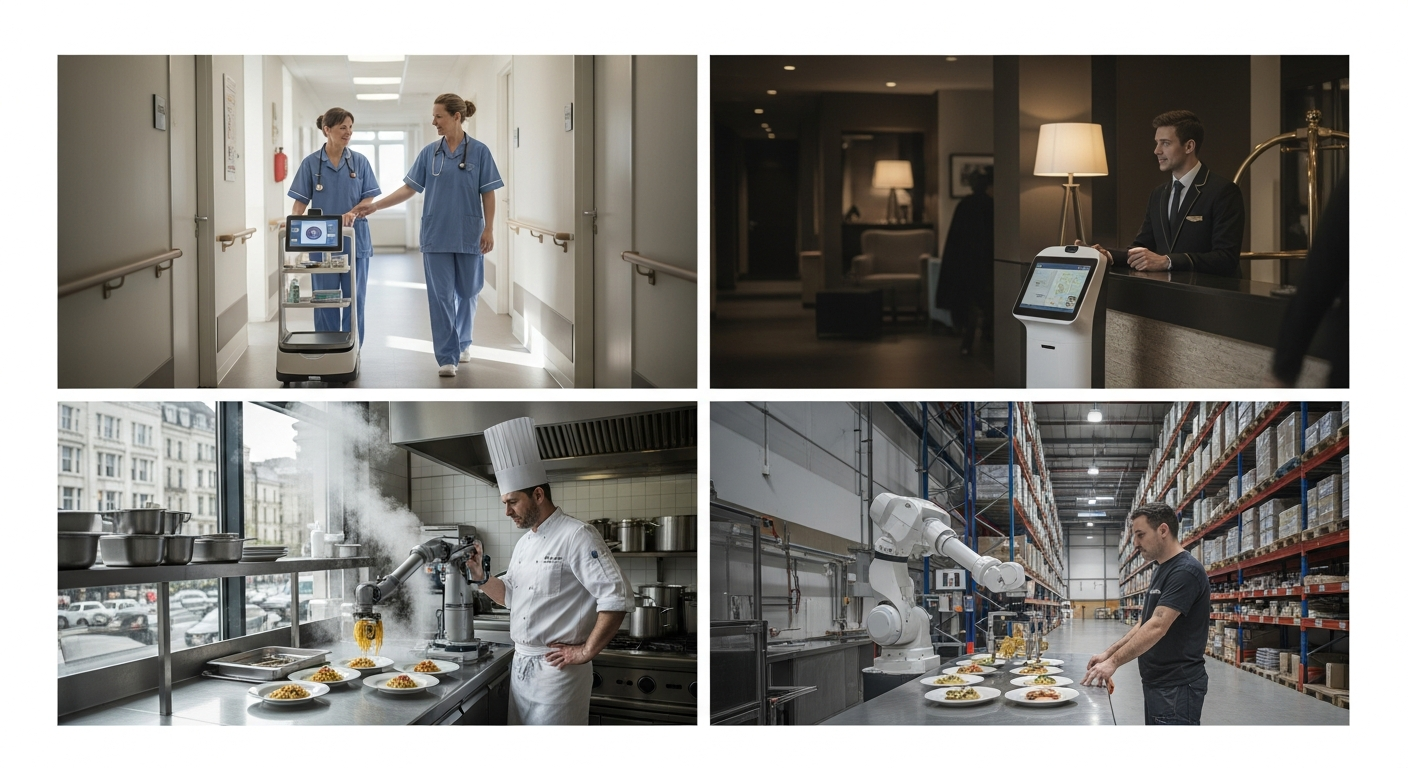
Station 3. 4:15 a.m. The night guard prepares the morning round of medication. An autonomous transport robot takes over the distribution of the heavy carts between the floors. While the staff concentrates on the residents, the hardware works in the background. Today, this operational advantage is often no longer realized through purchase but through leasing. In modern business management, the focus is changing from hardware ownership to functional availability. werob acts as the decisive authority that translates the workflow of a nursing home or hotel into a technical specification and provides the appropriate leasing solution in a hardware-agnostic manner.
Key Takeaways
- 1Robot leasing converts high CapEx investments into predictable OpEx operating costs and protects liquidity.
- 2As a hardware-agnostic system integrator, werob offers access to over 44 OEM partners without vendor lock-in.
- 3Compliance with the EU Machinery Regulation 2023/1230 is mandatory from January 2027 and is ensured by werob.
Strategic classification of robot leasing in the B2B sector
The decision to lease robots is primarily a decision for operational agility. In industries such as nursing, hotels or logistics, high upfront investments are often the biggest hurdle to modernization. Through leasing models, these investment costs (CapEx) are transformed into ongoing operating costs (OpEx). This maintains liquidity and allows for faster scaling across multiple locations. A significant advantage lies in the technological up-to-dateness. Since robotics, especially in the area of humanoids and service robots, is developing rapidly, leasing offers protection against technological obsolescence. After the contract period has expired, the fleet can be updated to the latest generation without the old devices being burdened on the balance sheet.
werob goes beyond the classic financing model as a system integrator. While conventional leasing companies only finance the hardware, werob ensures operational success. The Spec Engine ensures that only the hardware that exactly fits the workflow is leased. The Spec Engine prevents bad investments that often occur with an outright purchase or a rigid OEM leasing. With over 200 robots in live operation in eleven European countries, werob has the necessary database to build leasing models based on real performance data. The goal is not to own a machine, but to provide a service, such as medication rounds or room service.
The werob model: outcome-only instead of list price
A key differentiator in werob's approach is the commercial model. In contrast to individual OEM resellers, who often rely on list prices and maintenance contracts, werob operates according to the outcome-only principle. For the operator, this means: You pay nothing until the robot is actually running in your company. This model significantly minimizes the implementation risk. Financing through leasing is therefore directly linked to operational performance. If the specification provides relief for the medication round, success can be measured before the first lease payment is due.
Precise planning is the basis of this approach. werob's Spec Engine translates the operator's requirements into a technical specification within 48 hours. Data from over 35,000 projects is used to maximize the probability of success. In the Supplier Match, over 44 OEM partners are then tested against this specification. The operator does not receive just any robot, but rather the device most suitable for his specific application at optimal leasing conditions. This process shortens the time from the first inquiry to the robot in use to just eight weeks, while classic discovery phases in the industry often take three to six months.
Hardware agnostics as protection against vendor lock-in
When leasing robots, there is often a risk of vendor lock-in. Anyone who ties directly to a manufacturer is dependent on their software updates, spare parts prices and innovation cycles. werob breaks this model by acting hardware-agnostic. The catalog contains over 280 different types of robots, from humanoids like Apptronik Apollo to specialized service robots from Keenon or Pudu. This means maximum flexibility for the lessee. If a manufacturer no longer meets the requirements or a new model from another provider is more efficient, the werob platform enables a direct change or addition to the fleet.
The integration takes place via prefabricated connectors into the existing operator stack. Whether PointClickCare in nursing, Opera PMS in the hotel industry or SAP EWM in logistics: the robots are not viewed as isolated units, but as part of a digital ecosystem. werob's live cockpit monitors the entire fleet via a four-dimensional traffic light system with full source tracking covering hardware, infrastructure, regulatory and specification compliance. This ensures that the leased hardware permanently delivers the promised performance. A failure is immediately detected and remedied, ensuring the profitability of the leasing.
Economic efficiency and cost relief in practice
The decision for robot leasing is ultimately driven by hard numbers. In the care industry, the use of a robot for medication rounds results in a verified cost reduction of €92,000 per location per year. When transporting laundry or meals, the relief is around €71,000. These sums are compared to the monthly leasing payments and often generate a positive cash flow in the first year. An example of this is a leading European nursing home operator, where the system integration achieved double-digit cost relief in the first year.
| Use case | Cost relief per year/location | Primary benefit |
|---|---|---|
| Care medication round | 92,000 € | Skilled staff focus on residents |
| Hotel room service | €112,000 | 24/7 availability without night surcharge |
| F&B washroom tray bot | €76,000 | Reduction from Walkways |
| Logistics yard patrol | €68,000 | Complete monitoring |
In the hotel industry, the savings on room service are even more significant at €112,000 per year. Leasing enables particularly high scalability here. A hotel operator can calculate the monthly rates directly against the personnel costs saved in the night shifts. Since whoever takes over the integration into systems such as Mews or Lightspeed, expensive individual programming is no longer necessary, which further shortens the payback period of the leasing solution.
Regulatory safety: EU Machinery Regulation 2023/1230
A critical aspect of robot leasing is legal compliance. On January 20, 2027, the new EU Machinery Regulation 2023/1230 will become binding. This places significantly higher demands on conformity assessment, especially for robots that are controlled with artificial intelligence or work in close proximity to people. Many Asian OEMs currently do not have the necessary structures to independently meet these European standards. werob acts as the necessary compliance path here.
For companies that lease robots, this is critical. A leasing contract for hardware that can no longer be operated in a legally compliant manner from 2027 represents a significant financial risk. werob ensures that all robots used meet the relevant standards such as ISO 13482 for personal assistance robots or the requirements of home supervision in Germany. The cockpit continuously monitors the regulatory status of the fleet. werob thus offers SOC 2 Type II-compliant technical, financial and legal security for the entire leasing period. This regulatory protection offers an advantage over direct purchase or leasing through non-specialist financial service providers.
Integration into the operator stack as a leasing requirement
Robot leasing only makes economic sense if the hardware communicates directly with the existing software. A robot that has to be equipped and controlled manually often creates more effort than benefit. werob therefore supplies prefabricated connectors for the most common systems in the target industries. In care, this means a direct connection to MatrixCare or PointClickCare. In the hotel industry, systems such as Opera PMS or Mews are integrated to handle tasks such as room service fully automatically.
This integration is already included in the werob model. The operator does not have to provide additional IT resources to put the leased robots into operation. A binding offer is available within five days of the specification, which includes both the hardware and the necessary software connectors. This holistic approach ensures that the robots are productive from day one. The live cockpit allows management to track fleet performance in real time and provide visibility into leasing ROI. This data forms the basis for data-driven decisions about the further scaling of automation in the company.
The path to a robot fleet in eight weeks
The process at werob is designed for speed and operational excellence. It begins with a 48-hour workflow check in which the staff's tasks are analyzed. This creates a precise specification that serves as the basis for the leasing. In contrast to classic consulting firms that require months-long discovery phases, werob uses its Spec Engine to deliver immediately actionable results. After the supplier match and the selection of the optimal hardware, deployment takes place within eight weeks.
This period includes not only the delivery of the hardware, but also the configuration of the connectors and the training of on-site staff. Since we already operationally support 200 robots in eleven countries, the processes are well-established and regulatory-secure. For the operator, this means a minimal burden on day-to-day business with maximum technological profit. The leasing model supports this quick rollout, as no lengthy budget approvals are required for large investment sums. The monthly installments are financed from the current budget, which significantly shortens the decision-making process in many companies.
Future security through professional fleet management
After the leased robots are commissioned, the phase of continuous operation begins. This is where the werob cockpit shows its strengths. It offers centralized management for the entire fleet, regardless of how many different OEM partners are in use. The four-dimensional traffic light system provides immediate information about the condition of the hardware, the stability of the WLAN infrastructure, compliance with regulatory requirements and performance compared to the original specification. This monitoring ensures the long-term profitability of the leasing.
Should operational requirements change, the flexibility of the werob platform allows for quick adjustments. New tasks can be defined via the Spec Engine and transferred to the existing hardware. If additional robots are required, they can be integrated into the existing leasing network within a short period of time. With the goal of having over 2,000 robots in use by 2028, werob is continually expanding its infrastructure and partner network. For companies, working with werob not only means access to the latest technology, but also a long-term partnership in which experts retain control over the automated processes.
FAQ
- What is the advantage of robot leasing over purchasing?
- Leasing saves capital and makes it possible to claim the costs as business expenses for tax purposes. It also offers protection against technological obsolescence as the fleet can be more easily updated after the contract ends.
- How quickly is a leased robot ready for use?
- At werob, the process from specification to productive use usually takes eight weeks. A binding offer is available after just five days.
- Are the robots compatible with my existing software?
- Yes, werob offers pre-built connectors for common systems such as PointClickCare, SAP EWM, Opera PMS and Mews to ensure direct integration into your operator stack.
- What happens if there are technical problems with the hardware?
- The werob cockpit monitors the fleet live. In the event of disruptions, the support system intervenes. Since Werob works in a system-integrative manner, maintenance and repairs are coordinated as part of the outcome-only model.
- Do I have to choose a manufacturer?
- No, werob is hardware agnostic. We rank over 44 OEMs against your specific needs, so you always get the best solution for your workflow.
- How is legal compliance guaranteed?
- werob integrates all relevant regulatory requirements, such as the EU Machinery Regulation 2023/1230 and ISO 13482, directly into the provision process and monitors them via the cockpit.
Related reading
Robot Leasing Germany: Operational Efficiency Without Investment Risk
Robot leasing in Germany is evolving from a pure financing instrument to comprehensive system integration. Learn how werob as a hardware-agnostic partner paves the way for scalable automation.
17 June 2026robot subscriptionRobot subscription: Scalable automation without investment risk
A robot subscription gives companies access to state-of-the-art robotics without high upfront investments. werob integrates these systems into existing workflows in a hardware-agnostic manner and guarantees operational success through a purely results-oriented billing model.
17 June 2026rent robotsRent a robot: operational scaling without investment risk
Renting robots is evolving from a trend to an operational standard for European companies. Find out how werob, as a system integrator, combines hardware agnostics and regulatory security in an outcome-only model.
17 June 2026Rent service roboticsRent service robotics: operational efficiency without tying up capital
Renting service robot systems allows companies to scale quickly without high investment risk. As a hardware-agnostic system integrator, werob offers the direct path from workflow analysis to a productive fleet in eight weeks.
19 June 2026pms connector robotPMS Connector Robot: Integration into the Hotel Stack
The seamless connection between robotics and the property management system determines economic success in hospitality. werob delivers pre-built connectors to integrate service robots directly into daily hotel operations without manual intermediate steps.
14 June 2026