Restaurant Robots: Efficiency and Cost Relief in the F&B Sector
Process stability and personnel efficiency determine the margins in gastronomy. werob translates your workflows into a deployable robot specification within 48 hours and integrates them directly into your existing IT stack.
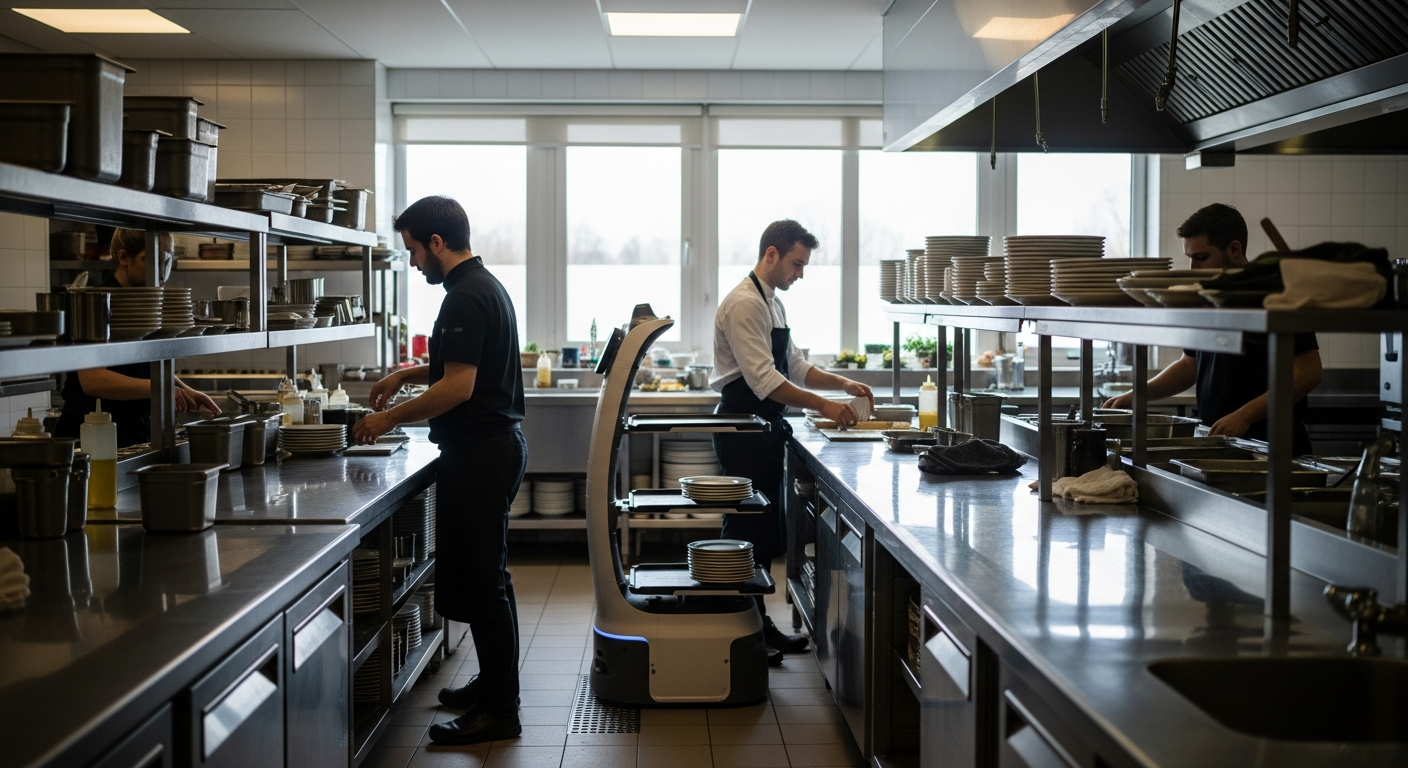
Saturday evening, 8:15 PM. In the main kitchen of a QSR branch in Berlin, there is full activity. While the service staff focuses entirely on the guests, the tray bot continuously takes over the return of used dishes to the dishwashing area. No congestion arises at the stations, as the walking distances for the staff are eliminated. This operational scene illustrates the core of modern robotics in the F&B sector: it is not about replacing skilled workers, but about stabilizing processes in times of massive staff shortages. werob forms the operational layer that connects hardware from various manufacturers with the operator's software infrastructure.
Key Takeaways
- 1Significant annual cost relief through automated tray return in the dishwashing area.
- 2Full integration into existing POS systems such as Toast and Lightspeed within eight weeks.
- 3Legal security through compliance with the EU Machinery Regulation 2023/1230 and HACCP standards.
The Systems Integrator as the Key to Scaling
In the current robotics landscape, operators are often faced with the problem of vendor lock-in. A single manufacturer usually offers only an isolated solution that is difficult to integrate into existing workflows. werob breaks open this model. As a hardware-agnostic systems integrator, werob evaluates over 44 OEM partners and ranks more than 280 different robot models against your specific requirements. This process takes place via the proprietary Spec Engine, which translates your workflows into a technical specification within 48 hours.
Instead of relying on the promises of individual hardware sellers, you receive an objective selection based on data from over 35,000 projects. This is particularly decisive for restaurant chains and QSR operators (Quick Service Restaurants) that need uniform fleet control across multiple sites. werob delivers not only the robot, but the entire operational layer, including the live cockpit for monitoring hardware, infrastructure, and regulatory compliance.
Economic Viability and Verified Cost Relief
The investment in robotics in the F&B sector must be measured against hard key figures. In practice, it is shown that the use of specialized robots releases significant sums per site and year. A tray bot in the dishwashing area leads to significant cost relief per year. This sum results from the reduction of unproductive walking distances and the associated increase in service quality at the guest.
In addition, automated kitchen floor cleaning relieves operations by considerable sums annually. For a QSR chain with multiple sites, this effect quickly adds up to millions. werob uses a performance-based billing model. For you as the operator, this means: you only pay when the robot is productively deployed. werob refrains from hidden list prices or upfront investments in hardware that ultimately does not bring the desired success. For an entire chain, the annual relief with a rollout strategy can be in the seven-digit range.
Integration into the Operator Stack
A robot that operates in isolation from the rest of the IT infrastructure causes, in the worst case, more work than it saves. werob solves this problem through pre-built connectors. These interfaces enable direct connection to market-leading point-of-sale (POS) systems such as Toast and Lightspeed. When an order is completed in the kitchen, the robot automatically receives the command to head to the corresponding table or transfer station.
This deep integration ensures that the data flows between service, kitchen, and robotics fleet are synchronized. The werob cockpit serves as the central control unit that not only monitors the status of the hardware but also ensures compliance with process specifications. Through the connection to the existing stack, the need for manual interventions by the staff is eliminated, which minimizes the error rate in the hectic daily business. The implementation of such connectors is part of the standard onboarding and is realized within the eight-week time frame until live operation.
Regulation and the EU Machinery Regulation 2023/1230
An often underestimated aspect when deploying robotics in publicly accessible spaces is legal protection. From January 20, 2027, the new EU Machinery Regulation 2023/1230 becomes mandatory. This regulation places significantly higher requirements on the safety and conformity of autonomous systems, particularly when they work in direct contact with humans. Many Asian OEMs currently do not have the necessary conformity assessments for the European market.
werob acts here as your compliance pathway. We ensure that all deployed systems not only comply with current standards such as ISO 13482 for personal assistance robots, but are also future-proof with regard to the upcoming regulation. In the F&B sector, HACCP compliance (Hazard Analysis and Critical Control Points) is also added. Robots used in food zones must meet specific requirements for hygiene and material composition. werob checks these criteria already in the Supplier Match process, so that you as the operator do not incur any legal risk.
Comparison of Deployment Scenarios in the Restaurant
Depending on the type of operation, the requirements for robotics vary. While the focus in casual dining is on supporting the service staff, in system gastronomy process speed is in the foreground. The following table gives an overview of typical deployment areas and their economic relevance.
| Deployment Area | Primary Task | Annual Relief | Connector Relevance |
|---|---|---|---|
| Dishwashing area | Tray return | Significant | High (POS/sensors) |
| Dining area | Food delivery | Significant | Very high (Toast/Lightspeed) |
| Kitchen floor | Autonomous cleaning | Medium | Medium (time control) |
| QSR chain | Fleet rollout | Very high | Critical (central management) |
These numbers are based on real operating data and show that amortization of the systems usually occurs within the first year of deployment. Through the hardware-agnostic ranking of werob, the optimal robot is selected for each of these scenarios, whether a model from Bear Robotics, Pudu, or Keenon.
From Workflow to Live Fleet in Eight Weeks
The speed of implementation is a decisive competitive advantage. While classic consulting firms often need months for discovery phases and strategy papers, werob pursues an operational approach. The process begins with an eight-stage intake procedure. Here, you describe your shift operations, the task at hand, and the infrastructural conditions on site in your own words.
Within 48 hours, the werob Spec Engine creates a deployable specification from this. After another five days, you have a concrete offer based on the Supplier Match from over 44 partners. The goal is clearly defined: within eight weeks, the robot is in live operation on your surface. This tight timeline is only possible because werob draws on pre-built integration building blocks and deep expertise in regulation. You do not have to worry about the technical details of the interfaces or the certification of the hardware. werob delivers the turnkey operational layer. A partner from a Big Four consulting firm reported that this degree of automation shortened commercial due diligence from three weeks to five days.
HACCP and Hygiene Standards in Robotics
In food processing and gastronomy, hygiene is non-negotiable. A restaurant robot must be constructed in such a way that it does not cause cross-contamination and is easy to clean. This concerns both the surface materials and the mechanical components. werob ensures that the robots selected for the F&B sector comply with HACCP guidelines.
This includes, among other things, the verification of cleaning protocols for the robot fleet, which can be documented in the werob cockpit. This way, you always have evidence for food monitoring authorities that the autonomous systems have been properly maintained and disinfected. Particularly with cleaning robots for the kitchen floor, the separation of dirty and fresh water as well as the avoidance of splash water formation is a critical selection criterion in the Supplier Match process. werob filters the market according to these specific requirements to ensure safe operation in sensitive zones.
Future Security Through the werob Cockpit
After successful commissioning, the fleet management phase begins. The werob cockpit gives you a real-time overview of all active systems with full source transparency down to the document level. A four-dimensional traffic light system immediately informs you about the status of the hardware, the local infrastructure (such as Wi-Fi coverage), regulatory compliance, and adherence to the original specification. This enables proactive action before service disruptions occur.
Should your operational requirements change - for example through an expansion of the menu or a redesign of the dining area - the specification can be adjusted via the Spec Engine. Since werob works in a hardware-agnostic manner, you can supplement your fleet with new models at any time without having to replace the entire software infrastructure. This flexibility protects your investment in the long term and allows you to benefit from technological advances at various manufacturers, while the operational layer remains stable.
Strategic Relevance for the F&B Sector
The use of robotics in restaurants is no longer a question of the distant future, but an operational necessity to secure economic viability. With significant annual cost relief in the area of tray return, the technology offers a clear return on investment. werob takes the complexity of selection, integration, and legal protection off your hands.
Through the focus on the outcome-only model and rapid implementation within eight weeks, werob minimizes entrepreneurial risk. The connection to systems such as Toast and Lightspeed ensures that the robots offer real added value for your team and your guests from day one. Start the process now and have your workflows translated into a professional robotics specification within 48 hours.
FAQ
- What does a restaurant robot cost at werob?
- werob works on an outcome-only model. This means you do not pay high upfront list prices. For detailed information on our performance-based models, please book a demo.
- How long does the installation of a robot in the restaurant take?
- From the initial specification to live operation on your surface, it usually takes eight weeks at werob. The specification itself is already available after 48 hours.
- Can the robots communicate with my POS system?
- Yes, werob offers pre-built connectors for market-leading systems such as Toast and Lightspeed. This way, work orders are transmitted directly from the POS to the robot fleet.
- Are the robots safe for use among guests?
- Absolutely. The robots selected by werob comply with ISO 13482 and are already prepared for the upcoming EU Machinery Regulation 2023/1230. They are equipped with state-of-the-art sensors for obstacle avoidance.
- Which manufacturers does werob offer?
- werob is hardware-agnostic and has over 44 OEM partners in the catalog, including leading brands such as Bear Robotics, Pudu, and Keenon. We select the model that best fits your specific specification.
- Do I have to renovate my premises for the robot?
- In most cases, no structural changes are necessary. The robots use existing Wi-Fi structures and navigate autonomously. As part of the 48-hour spec, we check the infrastructure on site.
Related reading
Renting Restaurant Robots: System Integration Instead of Hardware Leasing
Renting restaurant robots is more than a financing decision. Learn how werob as a systems integrator closes the gap between hardware rental and real operational added value.
16 June 2026buy pudu kettybotBuying the Pudu KettyBot: System Integration and ROI for F&B Operations
Anyone wishing to buy a Pudu KettyBot often faces the challenge of system integration. As a hardware-agnostic integrator, werob offers the path from specification to live operation in eight weeks.
15 June 2026service robot gastronomy costsService robot catering costs: ROI and system integration
The calculation of service robots in the catering industry goes far beyond the pure purchase price. werob shows how integration into existing POS systems such as Toast or Lightspeed increases operational efficiency and creates measurable cost savings.
18 June 2026service robot gastronomyService robots for catering: Efficiency through system integration
The catering industry is facing a turning point. A shortage of skilled workers and rising operating costs require solutions that go beyond selective hardware purchases. As a system integrator, werob offers the path to a fully integrated robot fleet in eight weeks.
18 June 2026transport robotTransport robots: efficiency and cost reduction in operation
Transport robots take over repetitive routes in care, hotels and logistics. werob integrates these systems into your existing software stack in a hardware-agnostic manner in eight weeks.
20 June 2026