Renting Restaurant Robots: System Integration Instead of Hardware Leasing
Renting restaurant robots is more than a financing decision. Learn how werob as a systems integrator closes the gap between hardware rental and real operational added value.
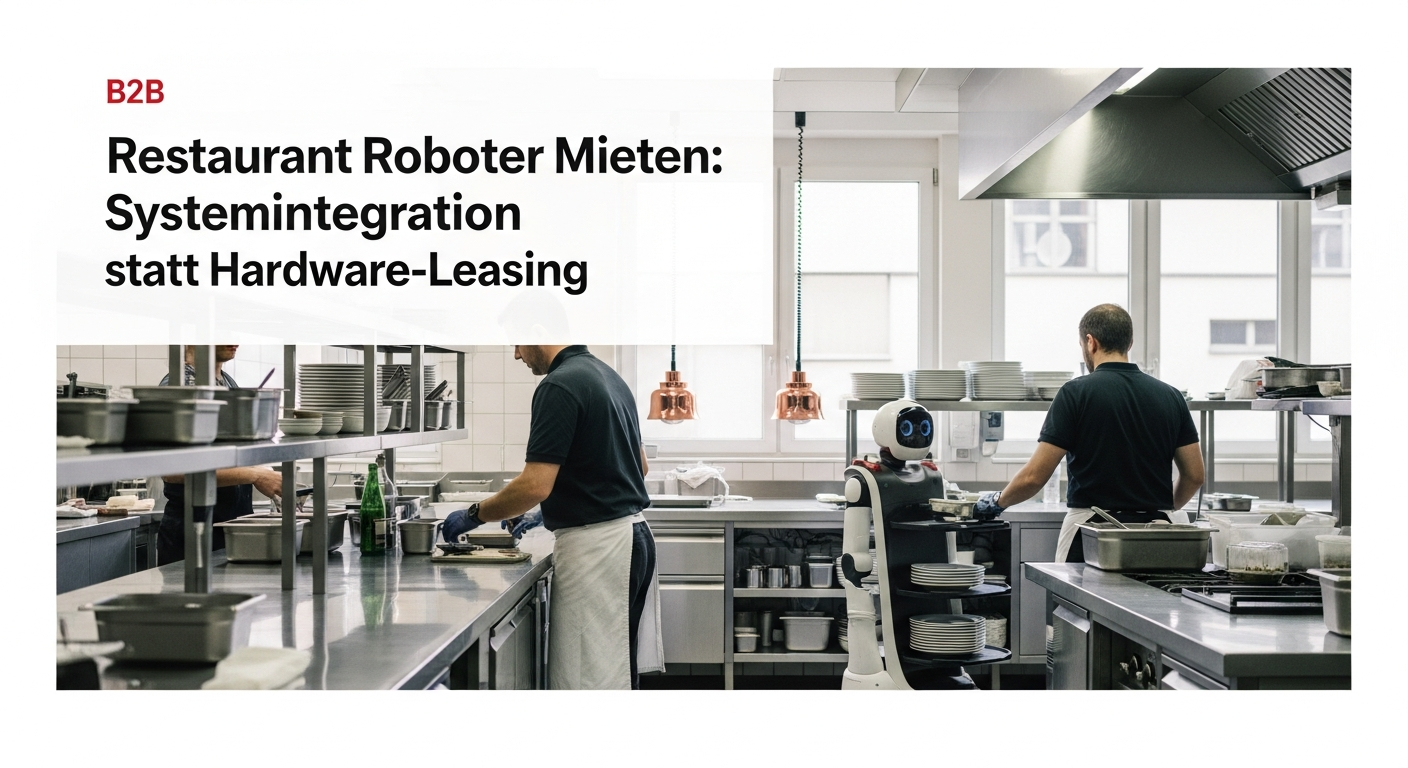
Saturday evening, 8:15 PM. In the dishwashing kitchen of a large burger chain, trays are piling up. The service staff is fully loaded and the walking paths between the dining area and the dishwashing station tie up valuable capacity. At this moment, a tray bot silently takes over the return of empty trays, while the service staff stay with the guests and increase the turnover per table. This scene is not a pilot project, but operational reality at over 200 sites that werob serves across Europe. For operators, the question is no longer whether they will deploy a robot, but how they can integrate it into their existing stack without technical risk and with immediate cost relief.
Key Takeaways
- 1Do not rent hardware without integration: success depends on the connection to Toast, Lightspeed, or SAP EWM.
- 2Realize measurable savings of up to 76,000 euros per year through tray bots in the dishwashing area.
- 3Secure yourself against the EU Machinery Regulation 2023/1230, which becomes mandatory for all autonomous systems from January 2027.
The Rental Model in Transition - Why Hardware Alone Is Not Enough
The decision to rent a restaurant robot is often made from a pure financing perspective. Conventional providers often act as pure resellers or leasing agents of individual brands. However, this approach falls short, as it ignores the operational complexity of gastronomy. A robot that does not communicate with the POS system or whose paths cannot be dynamically adjusted to peak times quickly becomes an obstacle rather than a relief.
werob breaks open this model. As a systems integrator, we view the hardware as an interchangeable component in a larger ecosystem. Our Spec Engine translates your workflows into a technical specification within 48 hours. Over 280 different robot models from more than 44 OEM partners are tested against your requirements. The goal is not to own a device, but to achieve a defined operational result. Through this hardware-agnostic approach, you avoid vendor lock-in and remain flexible if your requirements or the technological landscape change.
Verified Cost Relief - Numbers Instead of Adjectives
In system gastronomy and at QSR chains, measurable efficiency per site counts. werob delivers clear data from live operations here. The use of a tray bot in the dishwashing area leads to verified cost relief of 76,000 euros per year and site. This sum results from the reduction of unproductive walking distances and the associated increase in service quality at the guest. Another example is automated kitchen floor cleaning, which enables annual relief of 44,000 euros.
For larger organizations, these effects scale massively. A QSR chain that rolls out a fleet across multiple sites can expect annual total relief of approximately 1.44 million euros. These numbers are not estimates but are based on the werob live cockpit, which monitors the fleet's performance in real time. The commercial model of werob is consistently success-oriented: it is an outcome-only model. You only pay when the robot is operationally running and delivers the specified performance. This eliminates the investment risk that often slows innovation in classic purchase or rigid rental models.
Integration into the Operator Stack - Toast and Lightspeed
A decisive factor when renting restaurant robots is technical connectivity. A robot must know when an order is ready or which table must be served as a priority. werob delivers pre-built connectors into the common operator stack. These include direct integrations into POS systems such as Toast and Lightspeed. These interfaces allow the robot to become part of the digital workflow, without requiring manual intervention by the staff.
The integration goes beyond the POS system. Through the werob cockpit, management receives a four-dimensional traffic light system that monitors hardware, infrastructure, regulation, and adherence to the specification. If you rent a fleet of Bear Robotics or Pudu models, for example, the werob platform ensures that all data converges centrally. This is particularly essential for operators with multiple sites to ensure consistent performance and to plan maintenance cycles proactively. The connectors drastically reduce the implementation time: from the initial specification to the robot in operation, it usually takes only eight weeks at werob.
Comparison of Rental Models - Integrator vs. Single OEM
When comparing rental options, operators should carefully check what services are included in the package. A single-OEM reseller only offers you the device of one manufacturer. werob, on the other hand, acts as the operational layer above the hardware. The following table illustrates the differences in approach.
| Criterion | Single-OEM Reseller | werob Systems Integrator |
|---|---|---|
| Hardware selection | Limited to one brand | Agnostic (44+ OEMs, 280+ robots) |
| Specification phase | Often 3-6 months discovery | 48 hours via Spec Engine |
| POS connection | Mostly proprietary or missing | Native connectors (Toast, Lightspeed) |
| Compliance pathway | Buyer's responsibility | EU Machinery Regulation 2023/1230 incl. |
| Payment model | Down payment / monthly rate | Outcome-only (payment upon operation) |
This comparison shows that pure rental of hardware only solves the smallest part of the challenge. The true value creation lies in the ability to seamlessly embed the hardware in the existing infrastructure and to guarantee regulatory security.
Regulation - The EU Machinery Regulation 2023/1230
An often overlooked but critical aspect when renting robots is legal security. From January 20, 2027, the new EU Machinery Regulation 2023/1230 becomes mandatory. This regulation places significantly higher requirements on conformity assessment, particularly for autonomous mobile robots that are deployed in areas with human contact. Many Asian OEMs currently do not have the necessary structures to independently meet these requirements in the European market.
werob acts here as the necessary compliance pathway. We ensure that all rented and integrated systems comply with applicable standards, including ISO 13482 for service robots and HACCP standards for use in food zones. By using the werob platform, operators outsource the regulatory risk. The cockpit continuously monitors the compliance status and proactively warns of deviations. This not only protects against legal consequences but also secures the long-term operation of the fleet beyond 2027.
HACCP and Hygiene - Robots in the Food Zone
In gastronomy, compliance with hygiene standards is non-negotiable. If you rent robots for deployment in the kitchen or service, they must be HACCP-compliant. This concerns both the material composition of the surfaces and the cleanability of the sensors and chassis. werob selects from the catalog of 44+ partners specifically those models that are certified for contact with food or can withstand operation in sensitive zones such as the dishwashing kitchen.
Operational excellence is shown here in detail: a cleaning robot such as the Pudu CC1 must be programmed in such a way that it avoids guests during operating hours but performs a deep cleaning of the kitchen floor after closing that withstands the strict requirements of food monitoring. By integrating these tasks into the werob cockpit, every cleaning run is documented, which massively simplifies the obligation to provide evidence to authorities. This way, the rented robot goes from being a simple tool to an integral part of your quality management.
The 8-Week Path - From Idea to Live Operation
Speed is a competitive advantage in gastronomy. While traditional consulting firms often spend months on discovery decks, werob delivers results in days. The process begins with a 48-hour workflow-to-spec procedure. Your specific shift schedules, floor layouts, and tasks are analyzed. Within five days, you receive a binding offer based on the Supplier Match from 44+ OEMs.
The actual implementation takes place within eight weeks. During this time, the connectors to your POS system are configured, the robots are trained on site, and the staff is trained. Since werob already operates over 200 robots in 11 European countries, we draw on an enormous wealth of experience. We know what pitfalls lurk in Wi-Fi infrastructure or with automatic doors and resolve them before they disrupt operations. The goal is a smooth transition in which the robot delivers the promised relief from day one.
Future Security Through the werob Cockpit
After commissioning, the most important phase begins: long-term operation. The werob cockpit is the central nervous system of your robot fleet. It monitors not only the charging status or position of the devices, but also provides deep insights into operational performance. Does the tray bot reach the target times? Are there bottlenecks at certain stations? The system detects patterns and enables continuous optimization of the action graphs.
This data is the basis for the outcome-only model. Since you pay for the result, werob has a direct interest in ensuring that the robots run with maximum efficiency. Should a device fail or requirements increase, the hardware-agnostic structure enables a quick exchange or expansion of the fleet without the entire integration having to be rerolled. With werob, you do not just rent a machine, but a future-proof operational layer for your entire automation strategy.
FAQ
- What does it cost to rent a restaurant robot at werob?
- werob works on an outcome-only model. This means there are no classic list prices. You only pay when the system is operationally running and delivers the agreed performance. This minimizes your financial risk completely.
- Which POS systems can be connected to the robots?
- werob offers pre-built connectors for market-leading systems such as Toast and Lightspeed. Integrations into SAP EWM for logistical processes in gastronomy are also available.
- How long does it take from inquiry to first deployment?
- Within 48 hours, you receive a finished specification, after five days an offer, and within eight weeks the robot is ready for deployment in your operation.
- Are the robots safe for handling food?
- Yes, werob specifically selects partners whose hardware is HACCP-compliant and meets the strict hygiene requirements in food zones.
- What happens if the hardware of a manufacturer is no longer available?
- Since werob works hardware-agnostically and has over 44 OEM partners in the catalog, we can switch to alternative models at any time that meet your specification.
- Does werob also support operations in multiple countries?
- Yes, werob is currently operationally active in 11 European countries, including Germany, Austria, Switzerland, France, Italy, and Spain.
Related reading
Restaurant Robots: Efficiency and Cost Relief in the F&B Sector
Process stability and personnel efficiency determine the margins in gastronomy. werob translates your workflows into a deployable robot specification within 48 hours and integrates them directly into your existing IT stack.
16 June 2026buy pudu kettybotBuying the Pudu KettyBot: System Integration and ROI for F&B Operations
Anyone wishing to buy a Pudu KettyBot often faces the challenge of system integration. As a hardware-agnostic integrator, werob offers the path from specification to live operation in eight weeks.
15 June 2026hardware markup oem robotHardware markup OEM robots: system integration instead of vendor lock-in
The choice of robot hardware is secondary to process integration. werob explains how hardware markup for OEM robots paves the way from requirement to productive fleet in eight weeks.
23 June 2026robot leasing germanyRobot Leasing Germany: Operational Efficiency Without Investment Risk
Robot leasing in Germany is evolving from a pure financing instrument to comprehensive system integration. Learn how werob as a hardware-agnostic partner paves the way for scalable automation.
17 June 2026robotics platformRobotics platform for operations: integration instead of hardware
A modern robotics platform is much more than a control unit for individual machines. It acts as an operational layer that combines hardware agnostics, regulatory compliance and deep software integration in one system to realize measurable cost reductions.
5 July 2026