Service robots for catering: Efficiency through system integration
The catering industry is facing a turning point. A shortage of skilled workers and rising operating costs require solutions that go beyond selective hardware purchases. As a system integrator, werob offers the path to a fully integrated robot fleet in eight weeks.
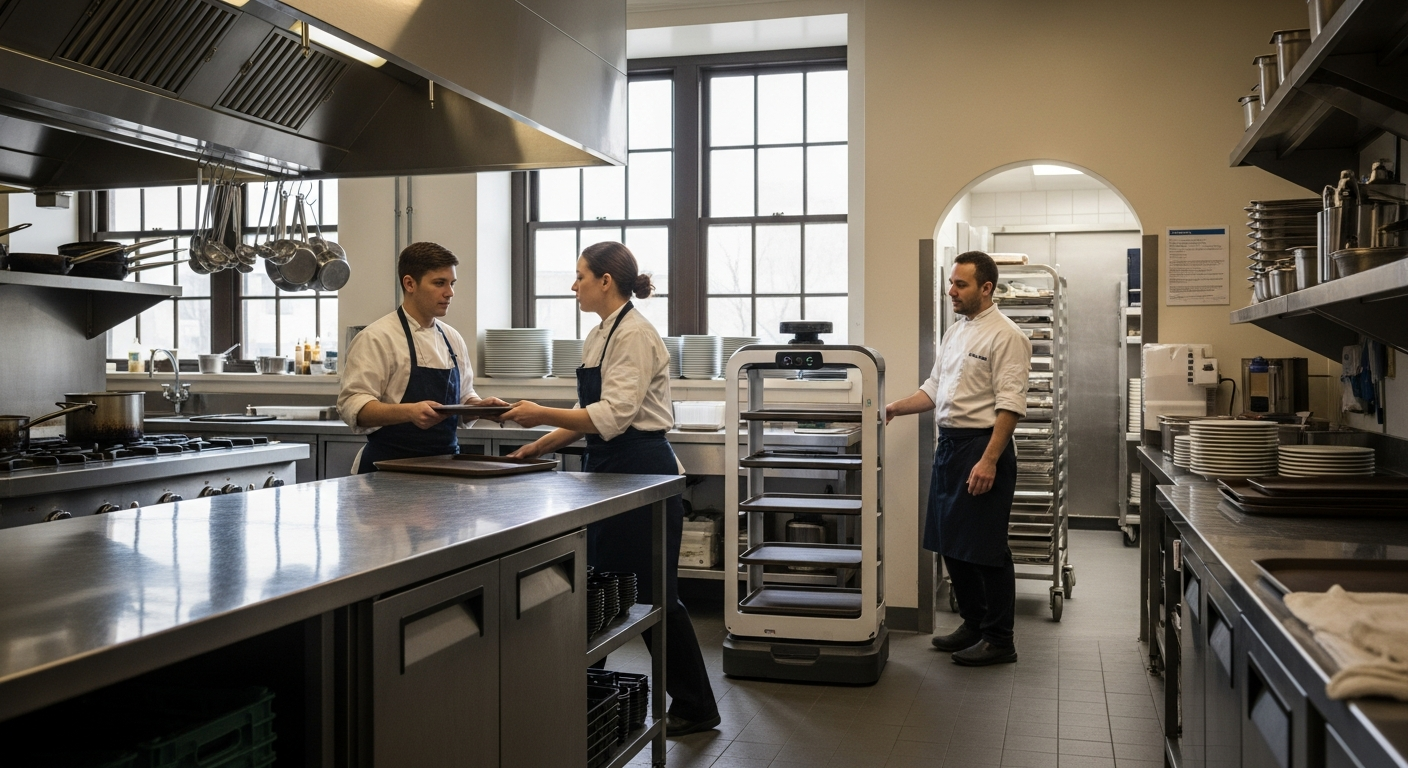
Saturday evening, 8:15 p.m. The restaurant is full to the last seat. The trays are stacked up in the scullery while the service staff shuttles between the dining area and the kitchen. At this moment the Tray-Bot takes over the return of the dishes. It navigates autonomously through the narrow corridor, avoids guests precisely and relieves the team of walking distances that would amount to several kilometers per shift. This is not a vision of the future, but rather everyday operational life in companies that see robotics not as a gimmick, but as an integrated part of their workflow. werob translates these workflows into precise specifications and brings the appropriate hardware into live operation.
Key Takeaways
- 1System integration instead of purchasing hardware: werob connects 44+ OEMs with your POS stack like Toast or Lightspeed.
- 2Measurable cost reduction: A tray bot in the washing chamber saves 76,000 euros per year and location.
- 3Speed and security: Specs in 48 hours and live operation in 8 weeks including EU compliance.
The difference between hardware purchase and system integration
Many catering businesses make the mistake of viewing service robots as isolated hardware products. A single robot without a connection to the existing IT infrastructure often remains a foreign object in the operational process. werob does not act as a reseller of individual brands, but as a system integrator. This means: We first look at the workflow. Our Spec Engine translates your requirements into a technical specification in 48 hours. We use data from over 35,000 projects.
Instead of being tied to a single manufacturer, werob provides access to over 44 OEM partners. We rank more than 280 different robot models to suit your specific requirements. Whether a model from Bear Robotics, Pudu or Keenon is the best choice depends solely on its suitability for your location. This hardware-agnostic approach prevents vendor lock-in and ensures technology grows with your needs. The integration takes place directly into your existing stack, for example via connectors to Toast or Lightspeed.
Economic efficiency: 76,000 euros in cost savings per location
The economic validation of robotics in the catering industry takes place through the measurable relief of staff from unproductive tasks. A verified use case is the use of a tray bot in the washing chamber. Here the annual cost relief is 76,000 euros per location. This sum results from the saving of working hours that the specialist staff would otherwise spend manually transporting dirty dishes. When it comes to kitchen floor cleaning, companies realize an additional relief of 44,000 euros per year.
For QSR chains (Quick Service Restaurants), this effect scales massively. When planning a rollout for a chain with 20 locations, this results in total annual savings of around 1.44 million euros. werob uses an outcome-only commercial model. What this means for you: You only pay when the robot is in productive use. There are no hidden list prices or upfront investments in feasibility studies. The focus is purely on the operating result and the amortization from the first day of live operation.
Integration into the tech stack: Toast, Lightspeed and SAP EWM
A service robot is only as efficient as its communication with the point-of-sale (POS) system. werob delivers pre-built connectors that enable seamless integration. When an order is received via Toast or Lightspeed, the robot can be automatically instructed to go to the appropriate station. This eliminates manual input errors and significantly accelerates throughput times in the kitchen and in service.
This connectivity also extends to larger logistical structures within the catering and hotel industries, such as the connection to SAP EWM for warehouse management. By linking the robot fleet with the operational stack, a closed data cycle is created. In the werob cockpit you monitor the fleet in real time using a four-dimensional traffic light system. This system controls not only the hardware status, but also the infrastructure, compliance with specifications and regulatory requirements. This means operations directors maintain full control over performance at all locations at all times.
Regulatory: EU Machinery Regulation 2023/1230 in focus
Legal security is a critical factor in the implementation of robotics. From January 20, 2027, the EU Machinery Regulation 2023/1230 will be binding. Many Asian OEMs currently do not have the necessary conformity assessments for the European market. werob acts as your compliance path here. We ensure that all systems used meet strict European standards before they are integrated into your operation.
In addition, HACCP standards must be strictly adhered to in the F&B area. Robots that operate in food zones are subject to special material and cleaning requirements. werob already takes these factors into account in the spec phase. Compliance with the GDPR when using camera sensors for navigation and cybersecurity in accordance with IEC 62443 are also integral parts of our security concept. We take responsibility for regulatory compliance so you can focus on your core business.
From workflow to live operation in eight weeks
Time is a crucial competitive factor in the catering industry. While traditional consulting firms often require months for discovery phases, werob shortens the process to a minimum. You will receive a ready-to-use specification of your workflow within 48 hours. After five days you will receive a concrete offer. The entire process, from the first analysis to the first robot working productively on your site, takes just eight weeks.
This accelerated rollout is made possible by our standardized processes. We do not use individual tinkering solutions, but rather rely on proven connectors and a validated selection of hardware partners. Our goal for 2028 is to have 2,000 robots operating across Europe. There are currently over 200 units in live use in 11 countries, which underlines the scalability of our platform. We accompany you from the first shift analysis to permanent fleet management in the cockpit.
Comparison of areas of application in the catering industry
The following table gives an overview of the typical areas of application and the associated economic potential that can be realized through system integration:
| Area of application | Primary task | Annual relief | Integration |
|---|---|---|---|
| Washing chamber | Tray return | 76,000 € | Toast / Lightspeed |
| Kitchen | Floor cleaning | €44,000 | Autonomous Schedules |
| Guest room | Food transport | Variable | POS connection |
| Warehouse/logistics | Goods replenishment | €68,000 | SAP EWM |
These numbers are based on real ones Operational data and show that automation goes far beyond just serving plates. The relief in the back-of-house areas in particular leads to an immediate increase in operational efficiency.
Hardware agnostics as a strategic advantage
The decision for specific hardware should never be the beginning of an automation project. The market for service robots is highly dynamic; New models from manufacturers such as Bear Robotics (Servi Plus) or Pudu (BellaBot) come onto the market in short cycles. werob rates this hardware neutrally. We check the mechanical reliability, sensor technology and interface capability of each model before it is included in our catalog of over 44 partners.
This approach allows you to remain flexible. If a manufacturer stops production or a technologically superior model is released, the werob platform enables a simple change or addition to the fleet without having to re-set up the entire software integration. The cockpit remains your central control unit, regardless of what hardware is operating underneath. This secures your investment in the long term and guarantees continuous optimization of your F&B processes.
Conclusion: The future of gastronomy is integrated
The implementation of service robots in the catering industry is no longer a technological experiment, but a necessary response to the economic pressure in the industry. The key to success lies not in the hardware itself, but in its seamless integration into the operational workflow and the existing tech stack. werob offers the necessary platform and expertise for this.
With a cost reduction of up to 76,000 euros per year and location as well as a quick rollout window of eight weeks, the hurdle for entry is lower than ever before. Thanks to the outcome-only model, you bear no financial risk before commissioning. Use the expertise of the largest system integrator for robotics in Europe to future-proof your business and free your staff from repetitive tasks.
FAQ
- Which POS systems does werob support in the catering industry?
- werob offers pre-built connectors for market-leading systems such as Toast and Lightspeed. Integrations into ERP systems such as SAP EWM for logistical processes are also available.
- How much do the robots cost to purchase?
- werob works with an outcome-only model. This means you only pay when the system is running productively. There are no classic list prices for hardware integration.
- Do the robots meet German hygiene regulations?
- Yes, all robots used by werob for the F&B sector are HACCP-compliant and suitable for use in food zones.
- What happens if there are technical problems during ongoing operations?
- The fleet is monitored in real time via the werob cockpit. A four-dimensional traffic light system immediately detects disruptions in hardware, infrastructure or compliance and enables a quick response.
- Is my company suitable for service robots?
- Within 48 hours werob creates a specification based on your workflow. The condition of the ground, walking routes and shift plans are analyzed.
- Does the new EU Machinery Regulation also apply to existing devices?
- Regulation 2023/1230 will become binding from January 20, 2027. werob ensures that all newly implemented systems already meet these requirements.
Related reading
Service robot catering costs: ROI and system integration
The calculation of service robots in the catering industry goes far beyond the pure purchase price. werob shows how integration into existing POS systems such as Toast or Lightspeed increases operational efficiency and creates measurable cost savings.
18 June 2026buy pudu kettybotBuying the Pudu KettyBot: System Integration and ROI for F&B Operations
Anyone wishing to buy a Pudu KettyBot often faces the challenge of system integration. As a hardware-agnostic integrator, werob offers the path from specification to live operation in eight weeks.
15 June 2026robot as a service GermanyRobot as a Service Germany: Efficiency without investment risk
Robot as a Service (RaaS) is transforming the way German companies scale automation. As a hardware-agnostic system integrator, werob offers the direct path from workflow analysis to a productive fleet in eight weeks.
27 June 2026service robot hotelService robots in hotels: operational excellence through integration
The implementation of service robots in the hotel industry often fails due to isolated isolated solutions. As a system integrator, werob offers the direct path to an automated fleet through seamless PMS connection and manufacturer-independent specifications.
19 June 2026restaurant robotsRestaurant Robots: Efficiency and Cost Relief in the F&B Sector
Process stability and personnel efficiency determine the margins in gastronomy. werob translates your workflows into a deployable robot specification within 48 hours and integrates them directly into your existing IT stack.
16 June 2026