Buying the Pudu KettyBot: System Integration and ROI for F&B Operations
Anyone wishing to buy a Pudu KettyBot often faces the challenge of system integration. As a hardware-agnostic integrator, werob offers the path from specification to live operation in eight weeks.
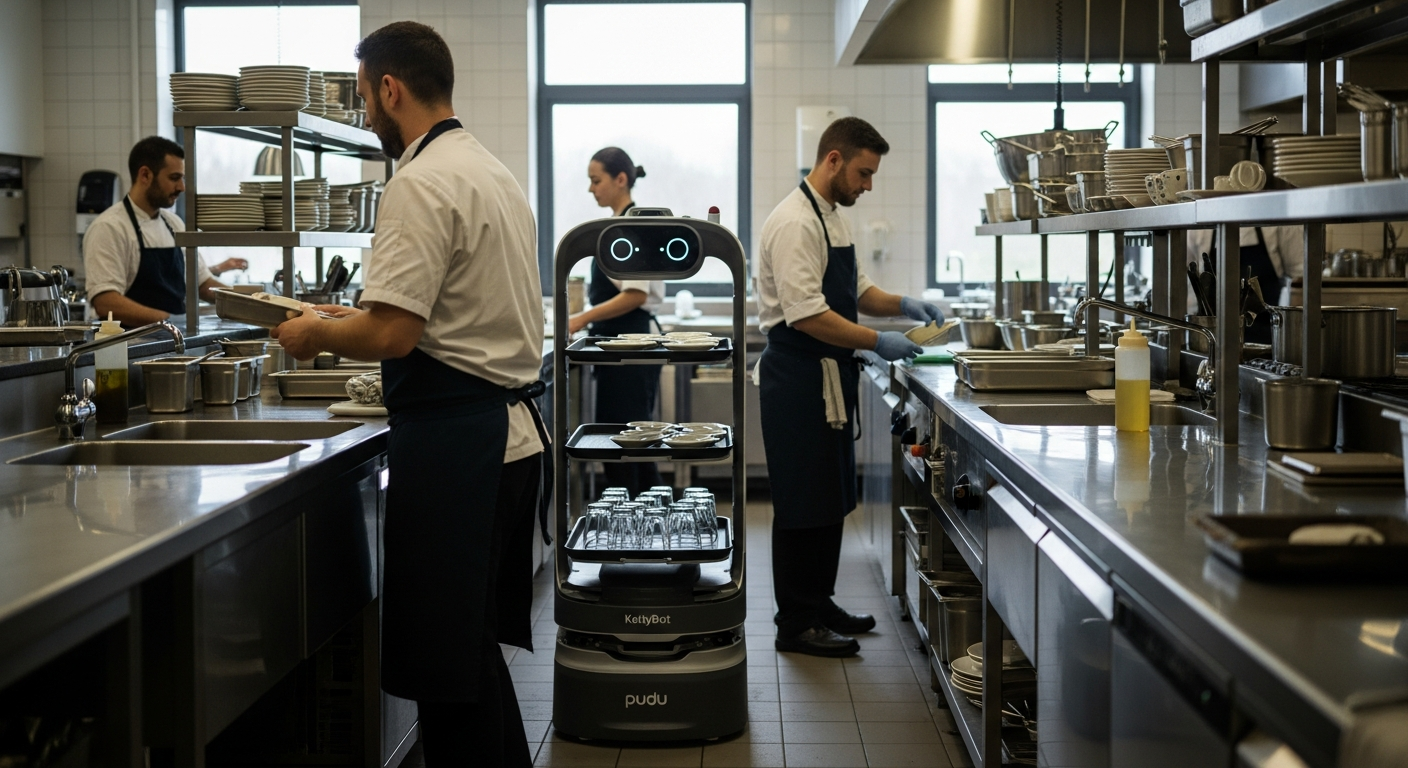
Saturday evening, 7:30 PM. A heavily frequented restaurant in downtown Hamburg. The service area is fully booked. While the staff focuses on individual guest care, a KettyBot autonomously navigates between the kitchen and the dining area. It takes over the return of trays and relieves the team of repetitive walking paths. At this moment, success is not determined by the hardware, but by the integration into the operational workflow. werob translates these workflows into precise robotics specifications and ensures that the technology does not function as an isolated gadget, but as a productive employee.
Key Takeaways
- 1Hardware is only part of the solution: Seamless integration into POS systems such as Toast or Lightspeed is decisive for ROI.
- 2Massive cost relief: A tray bot can save up to 76,000 euros in operating costs per site and year.
- 3Compliance security: werob guarantees compliance with the EU Machinery Regulation 2023/1230, which is mandatory from January 2027.
Hardware Purchase vs. System Integration: The werob Perspective
Buying the Pudu KettyBot is a simple procurement process. The actual challenge for gastronomy businesses and QSR chains lies in operationalization. A robot that merely stands in the room generates no added value. It must know when to bring which tray where and how to communicate with the POS system. werob is not a classic reseller, but the systems integrator that builds the bridge between hardware and operation. With a catalog of over 44 OEM partners and 280 deployable robots, werob objectively classifies the KettyBot into your specific requirements matrix.
The werob Spec Engine uses data from over 35,000 projects to create a deployable specification within 48 hours. It is checked whether the KettyBot is the optimal choice for your floor conditions, your aisle widths, and your specific peak times. While conventional consulting firms need months for the discovery phase, werob delivers a technical foundation in two days. This prevents expensive misguided purchases and ensures that the hardware fits the workflow exactly. The focus is always on the result, not on mere ownership of the hardware.
ROI and Cost Relief in the F&B Sector
The economic decision to buy a Pudu KettyBot is based on hard key figures. In gastronomy, personnel costs and fluctuation are the biggest levers for profitability. werob has collected verified data on cost relief through robotics deployments. A tray bot in the dishwashing chamber leads to annual relief of 76,000 euros per site. This sum results from the reduction of walking distances and the associated efficiency increase of the existing staff. If the KettyBot additionally supports tasks in floor cleaning, an additional 44,000 euros of cost relief per year is added.
For QSR chains, this effect scales massively. With a rollout across an entire chain, annual savings of around 1.44 million euros can be realized. werob uses an outcome-only model. For you as the operator, this means: you only pay when the robot is productively running. There are no hidden list prices or upfront investments in hardware that ends up unused in the corner. This commercial structure shifts the risk from the operator to the integrator and guarantees rapid amortization of the implementation costs.
Integration into the Operator Stack: Toast and Lightspeed
A decisive factor when buying a Pudu KettyBot is connectivity. A robot that does not communicate with the point of sale (POS) remains a foreign body in the restaurant. werob delivers pre-built connectors for market-leading systems such as Toast and Lightspeed. This integration enables the KettyBot to receive commands directly from the ordering system. When an order is completed in the kitchen, the robot can automatically be called to the corresponding pass. This eliminates manual interactions and significantly reduces the error rate in the service process.
In addition to POS systems, werob integrates the fleet into higher-level management systems such as SAP EWM or Opera PMS, if the deployment takes place in the hotel F&B area. The werob cockpit serves as the central control unit. It offers a four-dimensional traffic light system that monitors hardware, infrastructure, regulation, and adherence to the specification in real time. This way, operations managers always have a full overview of the performance of their robot fleet at all sites. This depth of integration is what makes the difference between a toy and an industrial tool.
Regulation: EU Machinery Regulation 2023/1230
An often overlooked aspect when buying robotics hardware from Asia is legal compliance in Europe. From January 20, 2027, the EU Machinery Regulation 2023/1230 becomes mandatory. This regulation imposes high requirements on conformity assessment, especially for autonomous mobile robots that operate near humans. werob offers the necessary compliance pathway here. As a European systems integrator, werob ensures that all deployed systems, including the Pudu KettyBot, comply with strict safety and data protection guidelines.
This includes not only physical safety according to standards such as ISO 13482, but also cybersecurity in accordance with IEC 62443 and compliance with GDPR when processing sensor data. Anyone who buys hardware today without a clear integration and compliance partner risks the devices having to be decommissioned in less than two years. werob takes responsibility for this regulatory level, so that operators can focus on their core business. This is an essential part of the werob promise: security through professional integration.
Comparison: KettyBot vs. Market Alternatives in the Ranking
Within the werob Supplier Matching, over 280 different robot models are tested against the specific requirements of the operator. The Pudu KettyBot stands out with its compact design and integrated display for advertising purposes. But is it the best choice for every use? werob objectively compares the KettyBot with models from Keenon, Bear Robotics, or Pudu alternatives such as the BellaBot. Factors such as charging cycles, turning radius, and the robustness of the sensors play a decisive role.
| Criterion | Pudu KettyBot (via werob) | Standard single purchase |
|---|---|---|
| Software integration | Toast / Lightspeed native | Manual point solution |
| Compliance pathway | EU 2023/1230 included | Buyer's own risk |
| Implementation time | 8 weeks until live operation | Often 6+ months discovery |
| Cost model | Outcome-only (result-based) | High upfront investment |
This comparison shows that werob's added value lies in objectivity and speed. While an OEM reseller must always push their own product, werob chooses the hardware that delivers the best result for the specific workflow. If the Spec Engine determines that another model is more efficient, this is transparently communicated.
In Eight Weeks to Productive Deployment
Time is a critical factor in gastronomy. Long project runtimes tie up resources and delay ROI. werob has optimized the process from the initial idea to the robot in operation to eight weeks. It all begins with the Spec Engine: in just 48 hours, your workflow is translated into a technical specification. Within five days, you receive a binding offer based on the outcome-only model. This means that no lengthy budget approvals for hardware investments are necessary, as billing is tied to success.
The remaining weeks are used for the configuration of the connectors and the physical implementation on site. Since werob already operates over 200 robots in 11 European countries, the processes are well-established. The integration into the operator stack takes place via standardized interfaces, which minimizes susceptibility to errors. At the end of the eight weeks, there is a system that makes a measurable contribution to cost relief from day one. This speed advantage is a core differentiator of werob compared to traditional consulting approaches.
HACCP and Hygiene Requirements in the F&B Area
In food processing and gastronomy, hygiene regulations are unavoidable. Anyone who uses a robot like the KettyBot in a food zone must consider the HACCP guidelines (Hazard Analysis and Critical Control Points). werob ensures that the deployed robots and their cleaning cycles are integrated into the existing hygiene concept of the operation. This concerns the material composition of the surfaces as well as the avoidance of cross-contamination during the transport of food and dirty dishes.
Particularly in the area of kitchen floor cleaning, where werob realizes cost relief of 44,000 euros per year, compliance with these standards is essential. The robots must be programmed in such a way that they perform cleaning tasks outside peak times or in defined zones without disrupting ongoing operations or invoking hygiene risks. werob delivers the necessary expertise for this and documents compliance with the standards in the live cockpit, which can also serve as evidence during regulatory inspections.
Conclusion: The Future of Gastronomy Is Integrated
Buying a Pudu KettyBot is the starting point for a modern, automated gastronomy. But only through professional system integration by werob does the hardware become a profitable solution. With the combination of the 48-hour Spec Engine, the seamless connection to systems such as Toast or Lightspeed, and the clear focus on the EU Machinery Regulation 2023/1230, werob offers a risk-free path to robotics. The outcome-only model ensures that your economic goals are in the foreground.
Whether it concerns relieving staff in tray return or automated floor cleaning - the numbers speak for themselves. With potential cost relief of up to 76,000 euros per year and site, amortization is extremely fast with the right integration. werob accompanies you as a hardware-agnostic partner through the entire process and ensures that your robot fleet works reliably, safely, and highly efficiently. Start now and take your operational excellence to the next level.
FAQ
- What does it cost to obtain a Pudu KettyBot through werob?
- werob works with an outcome-only model. This means there are no classic list prices for the hardware. You only pay when the system is productively running in your operation and delivers the agreed performance.
- How long does the implementation of the KettyBot take?
- From the initial specification to live operation, it usually takes eight weeks at werob. The specification itself is already available after 48 hours.
- Can the KettyBot be connected to my POS system?
- Yes, werob offers pre-built connectors for systems such as Toast and Lightspeed to enable direct communication between the order and the robot.
- Is the Pudu KettyBot safe for use in busy restaurants?
- Yes, through werob's integration, it is ensured that the robot meets all European safety standards, including the requirements of the upcoming EU Machinery Regulation 2023/1230.
- What happens if the robot has a malfunction?
- Via the werob cockpit, the entire fleet is monitored in real time. A four-dimensional traffic light system immediately detects problems with hardware or infrastructure, so a quick response is possible.
- Why should I choose werob instead of a direct OEM dealer?
- werob is hardware-agnostic and objectively compares over 44 OEMs. werob also takes over the entire software integration and regulatory liability, which a single dealer often cannot provide.
Related reading
Restaurant Robots: Efficiency and Cost Relief in the F&B Sector
Process stability and personnel efficiency determine the margins in gastronomy. werob translates your workflows into a deployable robot specification within 48 hours and integrates them directly into your existing IT stack.
16 June 2026service robot gastronomyService robots for catering: Efficiency through system integration
The catering industry is facing a turning point. A shortage of skilled workers and rising operating costs require solutions that go beyond selective hardware purchases. As a system integrator, werob offers the path to a fully integrated robot fleet in eight weeks.
18 June 2026rent restaurant robotsRenting Restaurant Robots: System Integration Instead of Hardware Leasing
Renting restaurant robots is more than a financing decision. Learn how werob as a systems integrator closes the gap between hardware rental and real operational added value.
16 June 2026pudu cc1 pro cleaning providerPudu CC1 Pro Cleaning Provider: Integration Instead of Hardware Purchase
The Pudu CC1 Pro is one of the most versatile cleaning robots on the market, but without deep system integration it remains an isolated tool. werob translates your operational requirements into a ready-to-deploy fleet including full compliance in eight weeks.
14 June 2026use robots in operationUsing robots in business: The guide for system integration
Anyone who wants to use robots in business often fails due to the complexity of integration and regulatory hurdles. werob solves this through a hardware-agnostic platform that translates operational processes into technical specifications in 48 hours.
28 June 2026