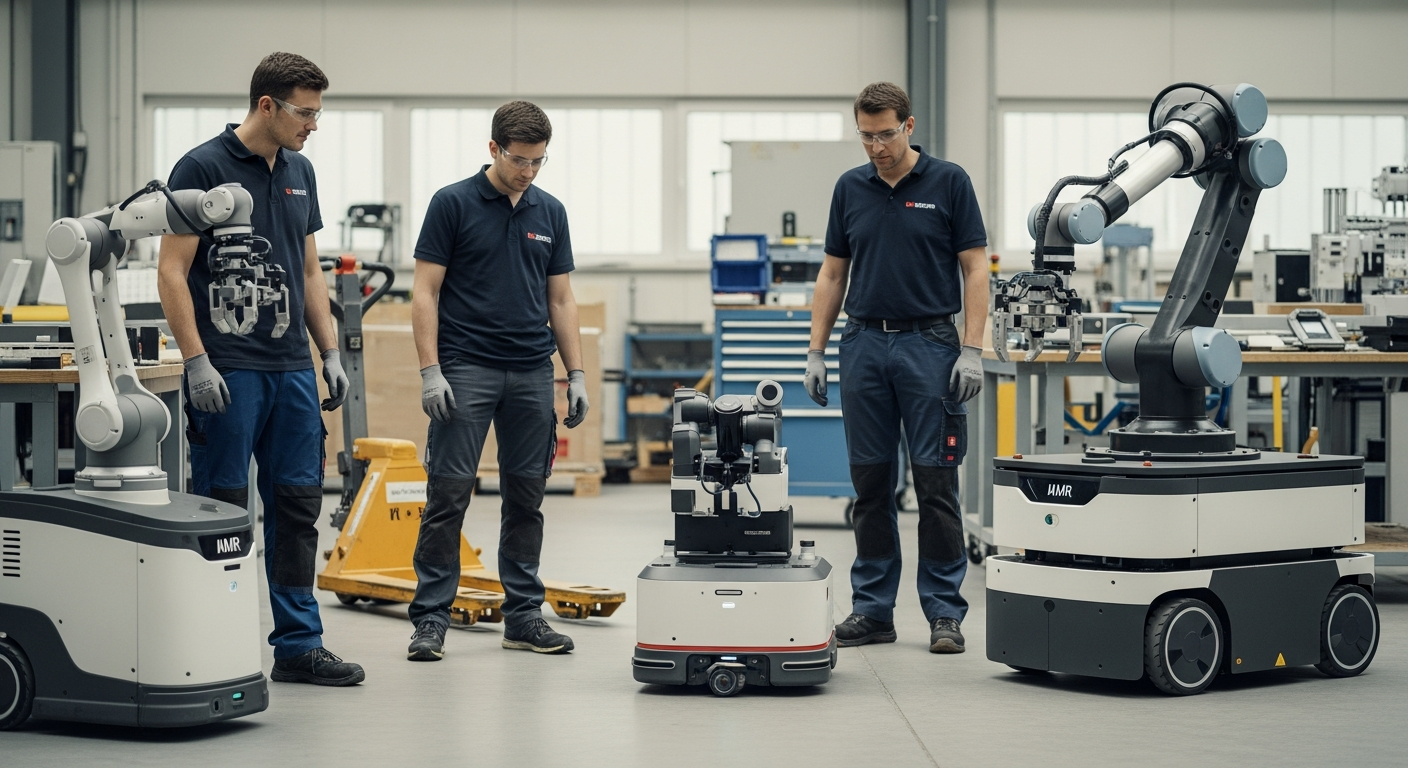
Transport robots: efficiency and cost reduction in operation
Transport robots take over repetitive routes in care, hotels and logistics. werob integrates these systems into your existing software stack in a hardware-agnostic manner in eight weeks.
Logistics center, 3:00 a.m. There is a lot of activity in Hall 4, but no forklift trucks cross the order pickers' path. An autonomous transport robot glides silently past the shelves, loaded with three mesh boxes for outgoing goods. It knows its path, avoids obstacles with centimeter precision and communicates directly with the warehouse management system. What was once tedious manual travel time is now an automated process flow. This scene is not a pilot project, but rather everyday operations in over 200 live companies that werob controls across Europe. The focus is not on the hardware, but on the seamless integration into the existing operation.
Key Takeaways
- 1Verified cost relief of up to 112,000 euros per year through automated transport processes
- 2Full compliance with the EU Machinery Regulation 2023/1230 and seamless integration into SAP EWM or MatrixCare
- 3Hardware-agnostic approach with access to over 44 OEM partners and 280 robot models without vendor lock-in
The difference between AGV and autonomous transport robots
In industrial automation, a distinction is often made between Automated Guided Vehicles (AGV) and Autonomous Mobile Robots (AMR). While classic AGVs follow rigid guidelines on the ground, modern transport robots act completely autonomously as AMRs. They use LiDAR sensors and cameras to create a digital map of their surroundings and dynamically avoid obstacles. For you as the operator, this means a drastic reduction in installation costs, as no structural measures such as magnetic strips or reflectors are necessary.
werob acts as a hardware-agnostic integrator. We evaluate over 280 different robot models from more than 44 OEM partners, including manufacturers such as Keenon, Pudu or ANYbotics. The goal is not to sell a specific model, but rather to select hardware that fits your exact specification. A transport robot in a nursing home must meet different safety standards than a system in a logistics hall. Through our ranking process, we ensure that the selected hardware represents the optimal solution for your application in both technical and regulatory terms.
Economic efficiency: 71,000 euros in cost relief per location
The introduction of transport robots is primarily a business decision. In the care industry, an automated transport robot relieves staff of unproductive walking, for example when transporting dirty laundry or food. Our data from live operations shows a verified cost reduction of 71,000 euros per location and year in the area of care transport alone. In the hotel industry, especially room service, this value increases to up to 112,000 euros.
These figures are based on the consistent transfer of routine tasks to the machine. The staff gains time for value-adding activities with guests or patients. werob uses an outcome-only commercial model. What this means for you: You only pay when the robot is in productive use. There are no hidden list prices or lengthy discovery phases. Our promise is: in 48 hours to the specification, in five days to the offer and in eight weeks to the robot in live operation. This speed is only possible because we have access to a spec engine that has been trained on over 35,000 projects.
Integration into the operator stack: SAP EWM and MatrixCare
A transport robot that operates in isolation creates new manual effort. True efficiency comes from integration into your existing software landscape. werob delivers pre-built connectors that connect the robot directly to your stack. Whether SAP EWM in logistics, MatrixCare or PointClickCare in nursing or Opera PMS and Mews in the hotel industry: the robot becomes part of the digital workflow. He receives his orders directly from the system and reports the status in real time.
Which interfaces are crucial for transport robots?
Bidirectional communication is crucial. The robot must not only know where to go, but also be able to call elevators, open automatic doors and acknowledge receipt of the goods. Our platform takes care of this orchestration. You retain full control of your fleet via the werob cockpit. A four-dimensional traffic light system monitors hardware, infrastructure, regulations and compliance with the original specification. This is how you identify bottlenecks before they disrupt operations.
Regulatory and EU Machinery Regulation 2023/1230
An often underestimated factor when introducing robotics is legal protection. From January 20, 2027, the new EU Machinery Regulation 2023/1230 will be binding. It places stricter requirements on conformity assessment, especially for systems that use AI-supported security functions. Many Asian OEMs do not have the necessary European certifications for direct operations in sensitive areas such as care or public spaces.
werob acts as your compliance path here. We ensure that all systems used comply with European standards such as ISO 13482 for personal assistance robots. We assume responsibility for regulatory compliance as part of system integration. This protects you as an operator from liability risks and ensures that your investment is safe beyond 2027. In industries such as security or logistics, we also take into account specific requirements such as the BewachVO or IEC 62443 for industrial cybersecurity.
Comparison of transport systems: AMR vs. humans
In order to objectify the decision for a transport robot, a direct comparison of the operational parameters helps. While an employee covers several kilometers of transport routes per shift, the robot works in multi-shift operation without any signs of fatigue. In the following table you can see the comparison of the performance values in a typical scenario of internal logistics.
| Parameters | Manual transport | werob transport robot (AMR) |
|---|---|---|
| Availability | 8 hours per shift | 24/7 (with Intermediate charging) |
| Error rate | Variable (human) | Minimal (system controlled) |
| Integration | None (oral/paper) | Direct (SAP EWM / API) |
| Cost per year | Labor costs + Additional wage costs | Outcome-based model |
| Compliance | Occupational safety | EU 2023/1230 + ISO 13482 |
The robot does not replace humans, but frees them from the burden of purely material transport. This is a crucial competitive advantage, especially in times of skilled labor shortages.
Areas of application: From care to the golf course
The versatility of modern transport robots allows them to be used in a wide variety of verticals. In nursing, for example with customers like Korian Germany, the systems support with the medication round and massively relieve the burden on specialist staff. In logistics, they take over yard patrol or transport between production cells. Specialized transport robots are even used on golf courses, for example in the automated collection of balls, which enables costs to be reduced by around 38,000 euros per year.
How safe are transport robots in public areas?
Safety is the top priority. Thanks to redundant sensor systems and certified safety PLCs (programmable logic controllers), the robots stop immediately when a person crosses their path. In the hotel industry, they safely navigate lobby areas and use elevators to bring room service orders directly to the guest's door. Acceptance among guests and patients is high because the robots are perceived as helpful support and not as a threat to jobs.
The werob workflow: Going live in eight weeks
The path to automation at werob is standardized and highly efficient. He starts with the Spec Engine. Within 48 hours we will translate your verbal requirements into a precise technical specification. We don't ask about robot models, but about your shifts, your routes and your loads. In the second step, the supplier match takes place: We rank over 44 OEMs against your spec and find the hardware with the best price-performance ratio and the highest compliance security.
After selection, our connectors ensure the technical connection to your software stack. Implementation on site takes place within a few days. The transport robot will be fully operational after eight weeks at the latest. Our cockpit monitors the fleet throughout the entire operation. If a robot fails due to an infrastructure change or a hardware defect, the system reports this immediately via the four-dimensional traffic light system. You receive a turnkey solution without the risk of long development times.
Future-proofing through hardware agnostics
The robotics market is extremely dynamic. New models and manufacturers are constantly coming onto the market while others disappear. Anyone who ties themselves to a single OEM today risks a vendor lock-in. werob solves this problem through hardware agnostics. Because we separate the operational layer (Spec, Match, Connectors, Cockpit) from the physical robot, you can expand your fleet or replace hardware at any time without having to rebuild your entire software integration.
This is especially important with the emerging generation of humanoid robots. werob is already running the first humanoid pilot project in a Hamburg care facility in its twelfth week. Our platform is prepared to seamlessly integrate these complex systems into existing workflows. With werob you are not investing in a device, but in a future-proof automation strategy that grows with technological advances.
Conclusion: Transport robotics as a strategic lever
The automation of internal transport is no longer a technological experiment, but an economic necessity. The combination of massive cost reductions, regulatory security through the EU Machinery Regulation and seamless system integration makes transport robots an indispensable tool for modern companies. werob offers you the fastest and safest way to increase efficiency.
Take advantage of our expertise as a leading system integrator in Europe. We accompany you from the initial specification to daily fleet management in the cockpit. Start now and transform your logistics processes into a highly profitable, automated system in just eight weeks. The first step is simple: define your workflow and let our Spec Engine do the work.
FAQ
- How much does it cost to implement a transport robot at werob?
- werob works according to an outcome-only model. This means you don't pay high upfront investments or list prices for hardware. Costs only arise when the system is running productively in your company and delivers the defined benefits.
- How long does it take until the first robot is ready for use?
- Our promise is clearly defined: You will receive a finished specification in 48 hours, a concrete offer in five days and the transport robot will be live in your company within eight weeks.
- Do I have to adapt my IT infrastructure for the robots?
- Thanks to our pre-built connectors, the werob platform can be integrated directly into existing systems such as SAP EWM, Opera PMS or MatrixCare. We use existing interfaces and minimize the adjustment effort for your IT.
- Are the robots safe for use in public areas?
- Yes, all of the systems we integrate comply with the strict European safety standards, in particular ISO 13482. We also prepare your company for the upcoming EU Machinery Regulation 2023/1230.
- Which manufacturers are supported by werob?
- We are hardware agnostic and work with over 44 OEM partners including Keenon, Pudu, ANYbotics and Unitree. We select the hardware that best suits your specific task.
- What happens if there are technical problems during ongoing operations?
- We monitor your fleet in real time via the werob cockpit. A four-dimensional traffic light system immediately detects problems with hardware, infrastructure or regulations, minimizing downtime.
Related reading
Serving robots: increasing efficiency through system integration
Serving robots reduce the operational load in the catering and hotel industries. werob delivers a ready-to-use fleet including full stack integration in eight weeks.
19 June 2026transport robot clinicTransport robot clinic: Efficiency through system integration
The use of transport robots in hospitals reduces the burden on specialist staff and optimizes internal flows of goods. werob integrates manufacturer-independent fleets into existing clinic systems and ensures compliance with regulatory standards.
20 June 2026keenon m2 provider careKeenon M2 Provider Care: Integration Instead of Pure Hardware Purchase
The Keenon M2 is considered a specialized delivery robot for the healthcare sector. As an agnostic systems integrator, werob integrates this hardware directly into your operational care stack and secures compliance with EU standards.
10 June 2026hospital transport robotHospital transport robots: how autonomous intralogistics relieves clinical staff
What autonomous transport robots do in a hospital, which platforms are genuinely available, and why lift, fire door and WLAN integration decides the project.
22 July 2026hotel cost reduction roboticsHotel Cost Reduction Robotics: Operationalizing ROI in 8 Weeks
Move from discovery decks to live operations. werob delivers a deployable robot specification in 48 hours and a live fleet in eight weeks, offsetting up to €112,000 in annual room service costs.
2 July 2026