Service robot catering costs: ROI and system integration
The calculation of service robots in the catering industry goes far beyond the pure purchase price. werob shows how integration into existing POS systems such as Toast or Lightspeed increases operational efficiency and creates measurable cost savings.
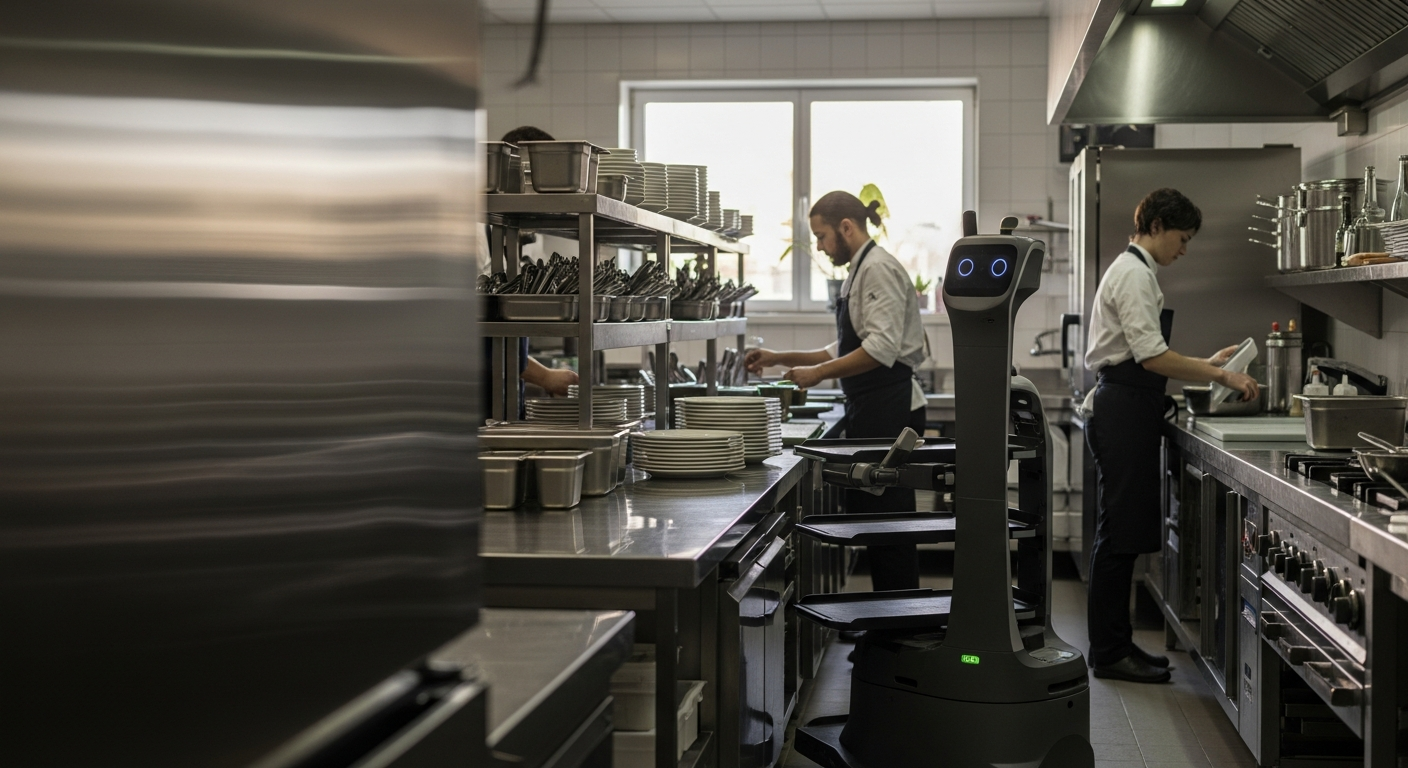
Saturday evening, 8:30 p.m. The restaurant is full to the last seat. The trays are stacked up in the scullery while the service staff shuttles at high pressure between the dining area and the kitchen. In this critical phase, the Tray-Bot takes over the return of the dishes. It relieves the team of having to walk several kilometers per shift. What counts for the operator at this moment is not the technology itself, but rather the operational availability and seamless integration into the workflow. werob translates these requirements into a usable specification within 48 hours in order to compensate for the shortage of skilled workers through measurable automation.
Key Takeaways
- 1Integrated tray bots in the dishwashing area enable annual cost savings of up to €76,000 per location.
- 2The EU Machinery Regulation 2023/1230 will become mandatory from January 2027 and requires certified compliance paths.
- 3Pre-built connectors for Toast and Lightspeed are essential for avoiding additional manual effort.
Economic viability of service robots in the catering industry
The discussion about service robots in the catering industry is often reduced to the pure purchase price. However, this falls short, as the true economic value lies in process optimization. A robot viewed in isolation without a connection to the cash register system remains a toy. Significant savings only arise through integration into the operational stack. In practice, it has been shown that a tray bot in the dishwashing area can generate annual cost savings of €76,000 per location. This sum results from the reduction of unproductive walking distances and the associated increase in the service capacity of the staff to guests.
Another important factor is the automated floor cleaning in the kitchen. The verified cost relief here is around €44,000 per year. These numbers are based on real operational data and take into account not only labor cost savings, but also the consistency of execution. werob acts as a system integrator that does not sell a single product, but rather automates the entire workflow. Thanks to the outcome-only model, operators only pay when the system is running productively, which reduces the investment risk to zero.
Hardware agnostics as protection against bad investments
The market for service robotics is fragmented. There are over 44 well-known OEM partners such as Bear Robotics, Pudu or Keenon, each of which has different strengths in areas such as load capacity, sensors or battery life. A common mistake in the catering industry is prematurely focusing on a specific model. werob breaks this vendor lock-in by having the Spec Engine analyze the restaurant's individual workflow and check it against a catalog of over 280 maneuverable robots. Within 48 hours, operators receive a manufacturer-independent recommendation that is tailored precisely to the structural conditions and the frequency of operation.
This hardware agnostic ensures that the chosen solution remains scalable in the long term. Should a manufacturer discontinue support or technological development stagnate, the werob platform allows for easy hardware changes while the process logic and integrations remain in place. This is particularly crucial for QSR chains (Quick Service Restaurants), which can aim for annual cost relief of around 1.44 million euros with a rollout across several locations.
Integration with Toast, Lightspeed and the operator stack
The technical connection to the point-of-sale (POS) system is the heart of successful automation. Without these connectors, staff would have to enter each order manually into the robot, which negates the time advantage. werob supplies pre-built connectors for market-leading systems such as Toast and Lightspeed. As soon as an order is recorded in the system, the robot automatically receives the destination coordinates and prioritization. This reduces the error rate and significantly speeds up the entire service cycle.
In addition to the POS system, integration into fleet management via the werob cockpit is crucial. The cockpit provides a four-dimensional traffic light system that monitors hardware status, infrastructure, regulatory and specification compliance in real time. For the Director of Operations, this means full transparency across all locations. You can immediately see whether a robot is not ready for use due to a blocked charging station or a network error, before operational bottlenecks arise.
Regulatory and the EU Machinery Regulation 2023/1230
An often overlooked cost factor is legal compliance. From January 20, 2027, the new EU Machinery Regulation 2023/1230 will be binding. Many robots currently imported directly from Asia do not meet these strict requirements without additional customization. werob offers the necessary compliance path here. As a system integrator, we take responsibility for conformity assessment and ensure that all systems used comply with European security standards.
This includes not only physical security when dealing with guests, but also aspects of cybersecurity in accordance with IEC 62443 and data protection in accordance with GDPR. In the catering industry, HACCP conformity is also required for use in food zones. Violation of these guidelines can result in heavy fines and the immediate ban on operating the robots. By working with werob, operators protect themselves against these regulatory risks and receive audit-ready reporting via the live cockpit.
Comparison of cost relief by area of application
In order to evaluate profitability, it is necessary to look at the specific use cases. The following table illustrates the potential savings per location and year when using the werob platform:
| Area of application | Annual cost relief | Primary benefit |
|---|---|---|
| Sink room tray bot | €76,000 | Reduction in walking distances, faster Table turning |
| Kitchen floor cleaning | €44,000 | Constant hygiene, relief for the kitchen team |
| Room service (hotel/restaurant) | €112,000 | 24/7 availability without Night surcharges |
| Bar/breakfast preparation | €54,000 | Automated replenishment of consumables |
These values show that the investment in an integrated solution often pays for itself in the first year. The werob model stipulates that no list prices are paid for hardware, but rather the focus is on the operating result. You only pay when the robot is productively integrated into your workflow.
For productive use in 8 weeks
Speed is a decisive competitive advantage in the catering industry. While classic consulting projects often require three to six months for the discovery phase, werob shortens this process radically. The Spec Engine, trained on data from over 35,000 projects, produces an accurate specification within 48 hours. Five days later, a binding offer is available, and after eight weeks the robot is live in use.
This process is divided into eight clear steps, ranging from the initial needs analysis to the location check to the final integration into the software stack. The goal is to minimize the burden on day-to-day operations during the implementation phase. Since we already operationally support over 200 robots in 11 European countries, new customers benefit from a proven infrastructure and in-depth experience in scaling robot fleets.
HACCP and hygiene standards in focus
In the catering industry, compliance with hygiene standards is non-negotiable. Service robots that operate near food must meet specific requirements. This applies to both the materials used and the cleaning ability of the hardware itself. werob ensures that the selected OEM partners have the necessary certifications and that the robots can be seamlessly integrated into the company's existing HACCP concept.
Particularly with cleaning robots in the kitchen, documentation of the service provided is essential. The werob Cockpit logs every cleaning trip and creates automated reports that can serve as evidence during food monitoring inspections. This digital documentation saves time and significantly increases legal certainty for the operator. In this way, robotics turns from a technical innovation into an integral part of quality management.
Conclusion for Operations Directors and F&B Managers
The decision for service robots in the catering industry should never be a purely hardware decision. Success depends on integration into existing processes and systems. As a system integrator, werob offers the necessary platform to go from the initial idea to live operation in eight weeks. With verified cost reductions of up to €76,000 per year per location, automation offers an answer to increasing cost pressure and the shortage of skilled workers.
Operators minimize their risks thanks to the hardware-agnostic approach and the built-in compliance path for the upcoming EU machinery regulation. The outcome-only model also ensures that the interests of the integrator and operator are perfectly aligned. The next step for interested companies is to create an individual specification in order to determine the exact savings potential for their own locations.
FAQ
- How much does a service robot for the catering industry cost per month?
- The pure hardware costs are often between €600 and €1,200, but at werob the model is outcome-only. This means that the costs are based on operational success and the relief achieved, rather than on rigid list prices.
- How quickly does a service robot pay for itself?
- With a verified cost reduction of €76,000 in the dishwashing area or €44,000 in cleaning, the systems usually pay for themselves within the first year of operation through werob integration.
- Which POS systems are supported?
- werob offers direct connectors for market-leading systems such as Toast and Lightspeed to ensure seamless communication between order and robot.
- Is the use of service robots legally safe?
- Yes, provided the EU Machinery Regulation 2023/1230 and the GDPR are observed. werob ensures this compliance path for all 44+ OEM partners.
- How long does implementation take?
- At werob, it usually only takes eight weeks from the first specification (48 hours) to productive use on the site.
- Can the robots also clean carpets?
- Yes, werob ranks over 280 different robot models, including specialized systems for different floor coverings in guest rooms and kitchens.
Related reading
Service robots for catering: Efficiency through system integration
The catering industry is facing a turning point. A shortage of skilled workers and rising operating costs require solutions that go beyond selective hardware purchases. As a system integrator, werob offers the path to a fully integrated robot fleet in eight weeks.
18 June 2026service robot retirement home costsService robots in nursing homes: costs and operational relief
The costs for service robots in care primarily depend on the integration and the selected operating model. Learn how werob eliminates financial risk through hardware-agnostic system integration and an outcomes-only model.
18 June 2026robot as a serviceRobot as a Service: Operational excellence without investment risk
Robot as a Service (RaaS) transforms rigid investment models into flexible, results-oriented operating solutions. As a hardware-agnostic system integrator, werob offers direct access to over 44 OEM partners and ensures integration into existing IT stacks.
27 June 2026service robot hotelService robots in hotels: operational excellence through integration
The implementation of service robots in the hotel industry often fails due to isolated isolated solutions. As a system integrator, werob offers the direct path to an automated fleet through seamless PMS connection and manufacturer-independent specifications.
19 June 2026lightspeed pos robot integrationLightspeed POS Robot Integration: Efficiency in F&B Operations
The seamless connection between the cash register system and service robotics determines the profitability in the catering industry. werob delivers the ready-made connectors for Lightspeed to transform manual processes into automated workflows.
24 June 2026