Replacing the Tugger Train: Specifying and Sourcing Outdoor AMRs
Intralogistics leaders are replacing manual tugger trains with outdoor AMRs to combat labor shortages and safety incidents. Discover how to specify the right navigation and payload architectures while ensuring compliance with ISO 3691-4 and EU Machinery Regulation 2023/1230.
In manufacturing and distribution facilities operating across multiple buildings, moving heavy materials between indoor production lines and outdoor yards remains a critical operational link. Historically, driver-operated tow tractors-commonly referred to as tugger trains-have served as the default workhorse for inter-building transport. However, changing economic and demographic realities are turning this traditional transportation model into a persistent bottleneck. Facility managers face severe difficulty retaining licensed drivers for monotonous, fixed-route yard runs, leading to frequent schedule disruptions and rising operating costs.
Key Takeaways
- 176% of logistics decision-makers face workforce shortages, driving the shift to autonomous transport.
- 2Outdoor AMRs use LiDAR SLAM and RTK-GPS to safely navigate changing yard environments.
- 3Autonomous operations of 2,800 missions/day can be achieved by replacing manual tow tractors with AMRs.
- 4EU deployments must comply with ISO 3691-4 and the EU Machinery Regulation 2023/1230.
The Intralogistics Labor Crisis and Tugger Inefficiency
The operational impact of these labor bottlenecks extends across entire supply chains. A study by Descartes Systems Group and SAPIO Research, which surveyed 1,000 supply chain and logistics decision-makers, found that 76% of those leaders are experiencing notable workforce shortages in their operations, with 37% describing the shortage as high to extreme. In yard transport, this labor deficit creates structural inefficiencies. Tow tractors rely on human operators who spend hours navigating fixed routes between loading bays, exposed to shifting weather conditions and repetitive physical tasks. When shift positions go unfilled, material movements stall, causing downstream buffer shortages at assembly stations.
Beyond sheer headcount shortages, driver-operated tugger trains exhibit fundamentally low asset utilization. Human-driven tow tractors are subject to mandatory rest breaks, shift handovers, and unpredictable operational pacing. Fixed-route schedules frequently result in empty returns, where a tow tractor travels back across the yard with unloaded dollies simply because a synchronized pickup was missed. As manufacturing plants expand footprint and increase production cadence, scaling a manual tugger fleet requires a linear increase in headcount-an approach that is no longer sustainable in competitive industrial regions.
| Operational Metric | Manual Tugger Trains | Autonomous Mobile Robots (AMRs) |
|---|---|---|
| Labor Dependency | Requires 1 dedicated driver per shift per tractor | Driverless operation managed via central fleet software |
| Schedule Flexibility | Constrained by shift patterns and driver availability | 24/7 continuous operation with dynamic dispatch |
| Driver Utilization | Low due to transit wait times and empty return loops | High through optimized mission queuing and route calculation |
| Route Adaptability | Rigid fixed routes dependent on driver habit | Dynamic rerouting around yard obstacles and layout changes |
| Operating Efficiency | Vulnerable to shift turnover and workforce gaps | Consistent operational throughput across all shifts |
Transitioning from driver-operated tow tractors to autonomous mobile robots (AMRs) removes human labor dependencies from repetitive transit corridors. Autonomous outdoor transport enables facilities to decouple material flow schedules from labor availability, ensuring predictable material deliveries across multi-building campuses regardless of shift constraints.
Addressing Yard Safety and Accident Reduction
Industrial yards and inter-building logistics zones represent high-risk environments within manufacturing facilities. Operating driver-operated tow tractors in shared outdoor spaces involves navigating blind spots, variable outdoor lighting, pedestrian crosswalks, and heavy truck traffic. Human drivers operating tow tractors carrying multiple trailing dollies often face restricted visibility, particularly when reversing or maneuvering tight turns around outdoor storage racks. These conditions create recurring safety hazards that lead to equipment damage, material loss, and workplace injury.
Workforce instability directly compounds these safety challenges. In an Instawork survey of warehouse and light industrial employers reported by FreightWaves, 73% of businesses said they have problems attracting employees, up from 26% a year earlier. When facilities experience high driver turnover, less experienced operators are assigned to complex yard routes, increasing the probability of collision incidents. Manual driving habits, speed variance, and distraction during long shifts contribute directly to safety risks in high-density logistics yards.
- Multi-layer safety LiDAR: 360-degree horizontal scan fields detect pedestrians, forklifts, and static yard obstacles in real time.
- Dynamic safety zone switching: Automatic adjustment of protective fields based on vehicle speed, steering angle, and payload weight.
- Audible and visual signaling: High-visibility LED light bands and localized acoustic warnings alert nearby personnel to vehicle motion.
- Hardware-certified emergency stops: Redundant physical E-stop switches accessible from all vehicle sides for immediate manual intervention.
- 3D perception sensors: Solid-state LiDAR and stereo cameras identify low-profile objects, trailer hitches, and overhead hazards.
Replacing manual tow tractors with autonomous mobile robots introduces systematic risk mitigation. Outdoor AMRs adhere strictly to programmed safety envelopes and speed limits, using redundant sensor arrays that scan for obstacles hundreds of times per second. By enforcing predictable vehicle behavior and eliminating human distraction, outdoor AMRs transform chaotic yards into controlled, standardized material corridors.
Hardware Architecture: Towing vs. Load-Carrying AMRs
When specifying an outdoor autonomous transport solution to replace driver-operated tugger trains, operations leaders must evaluate two primary hardware architectures: autonomous towing vehicles (tow tractor AMRs) and load-carrying (underride or platform) AMRs. Choosing between these architectures dictates the facility's yard infrastructure requirements, loading workflows, and total payload throughput.
Autonomous towing AMRs directly replace conventional tow tractors by hitching to existing wheeled dollies or trailer trains. This approach leverages existing rolling inventory, allowing operators to haul a high total payload across several coupled dollies in a single transit mission. Towing architectures excel on long-distance inter-building routes across expansive manufacturing yards. However, towing vehicles require wide turn radiuses, dedicated hitching procedures, and structured staging areas for manual or automated hitch engagement.
| Evaluation Criteria | Autonomous Towing AMRs | Load-Carrying / Underride AMRs |
|---|---|---|
| Primary Use Case | High-volume batch transport over long yard distances | Point-to-point pallet or container delivery between bays |
| Payload Handling | Pulls multi-trailer dolly trains for high aggregate payload | Carries loads directly on deck or lifts underride dollies |
| Yard Maneuverability | Requires wide turning circles and dedicated staging lanes | Zero-turn capability and compact footprint for tight aisles |
| Loading Automation | Requires automated hitching or manual dolly coupling | Fully automated underride lifting with zero manual coupling |
| Facility Footprint | Demands spacious turning bays and trailer drop zones | Minimal space requirements; integrates into standard dock doors |
Conversely, load-carrying underride AMRs navigate beneath customized dollies or carry heavy industrial payloads directly on their top deck. While load-carrying units typically feature lower overall payload limits per mission compared to multi-trailer tow trains, they deliver superior agility in tight loading bays and narrow outdoor transit lanes. Load-carrying AMRs can drive directly into indoor production cells, eliminate dolly coupling steps, and achieve zero-turn maneuvers, making them highly effective for frequent, low-latency material runs.
Outdoor Navigation: From LiDAR SLAM to RTK-GPS
Deploying autonomous mobile robots outdoors introduces navigation challenges that do not exist within controlled indoor warehouse environments. Outdoor yards lack uniform overhead structures, feature shifting dynamic obstacles such as parked trailers and container stacks, and experience constantly changing ambient light and atmospheric conditions. Reliable outdoor navigation requires multi-sensor fusion architectures that combine global positioning with precise local perception.
Wide-open yard transit relies on Real-Time Kinematic Global Positioning System (RTK-GPS) technology. Standard GPS provides positioning accuracy within several meters, which is insufficient for autonomous industrial vehicles. RTK-GPS utilizes local base stations or satellite correction networks to achieve centimeter-level positioning accuracy across open outdoor lanes. However, satellite signals can be degraded or blocked by metal multi-story buildings, covered staging docks, or dense overhead pipe bridges, requiring complementary navigation systems.
- RTK-GPS receivers: Delivers centimeter-level absolute positioning in open yard zones.
- 3D LiDAR SLAM: Generates volumetric spatial maps to navigate along building walls, outdoor storage racks, and covered walkways.
- Industrial Inertial Measurement Units (IMU): Measures angular velocity and acceleration to maintain dead-reckoning trajectory during temporary satellite outages.
- Wheel odometry encoders: Tracks precise wheel rotation and wheel speed to complement spatial positioning.
- Stereo vision camera arrays: Classifies dynamic obstacles, identifies lane markings, and detects ground surface anomalies.
To maintain continuous autonomy during indoor-outdoor transitions-such as moving from a brightly lit yard into a dim assembly hall-modern outdoor AMRs utilize 3D LiDAR SLAM (Simultaneous Localization and Mapping). LiDAR SLAM matches real-time laser point clouds against 3D spatial maps of the facility. By seamlessly fusing RTK-GPS data with LiDAR SLAM and IMU odometry, autonomous mobile robots maintain robust spatial orientation without requiring physical floor magnetic tape or expensive yard reflector infrastructure.
Environmental Resilience and Autonomous Charging
Outdoor autonomous mobile robots must perform reliably under harsh environmental conditions that would stop indoor automated guided vehicles. Operating in yard environments requires industrial-grade mechanical and electrical protection against heavy rain, snow, dust, ambient temperature swings, and uneven asphalt or cobblestone surfaces.
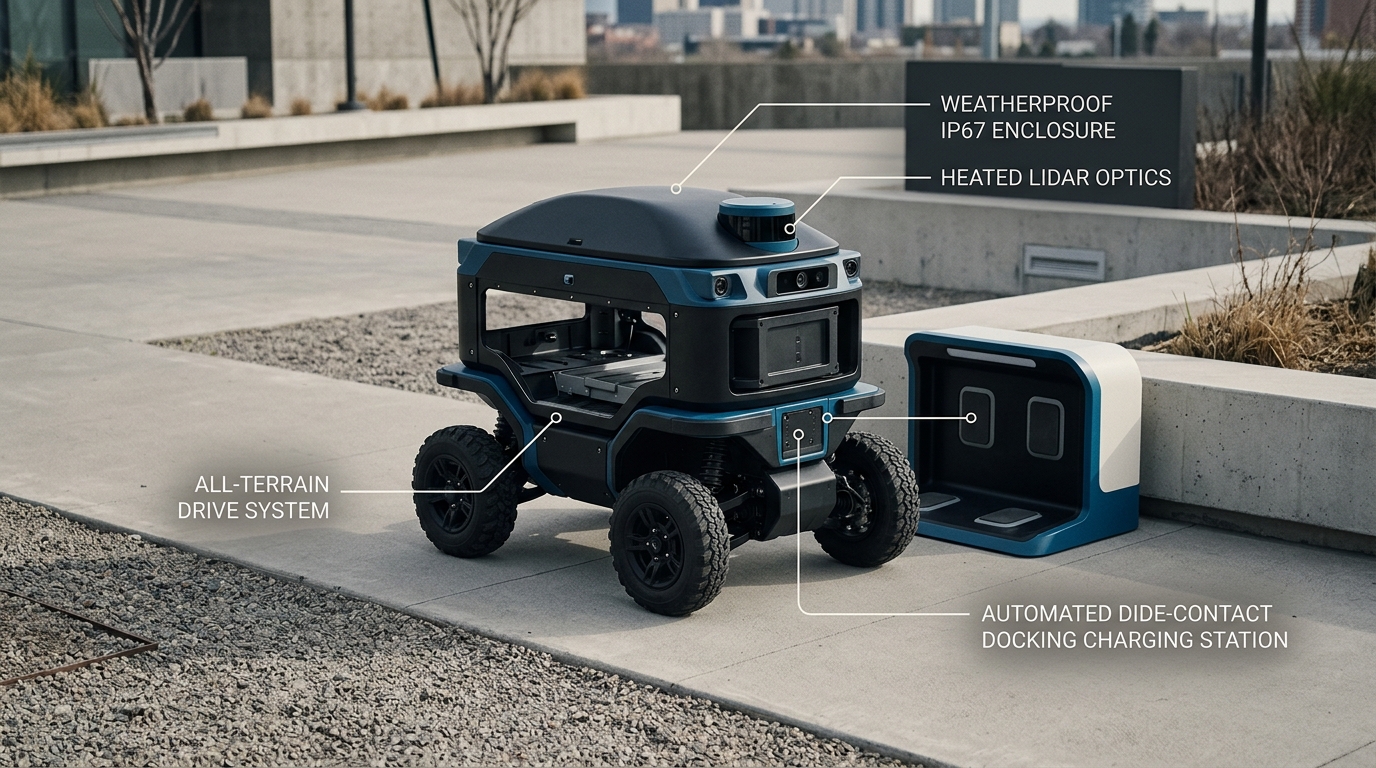
Weatherproofing for outdoor AMRs demands structural enclosure ratings of IP65 or IP67, ensuring sensitive control electronics, batteries, and drive motors remain completely sealed against water ingress and airborne particles. Furthermore, optical sensor perception algorithms must incorporate active noise filtering to differentiate between actual physical obstacles and atmospheric noise caused by heavy rainfall, dense fog, or airborne dust particles. Heated sensor optics prevent ice build-up and lens fogging during freezing winter operation.
Continuous multi-shift operation requires fully automated charging solutions that eliminate manual battery swapping or plugin procedures. Modern outdoor AMRs feature automated contact charging plates or high-efficiency inductive charging pads installed at outdoor staging docks or buffer stations. During brief operational lulls between material transit tasks, AMRs automatically dock at charging stations to execute opportunity charging, maintaining battery state-of-charge across 24/7 schedules.
The operational viability of high-cadence autonomous transport in industrial environments is demonstrated by real-world deployments. Industrial implementations, such as Idealworks AMRs deployed at the DRÄXLMAIER Group manufacturing plant in Landau, demonstrate how autonomous mobile robots complete over 2,800 automated transport missions per day across multi-shift operations, replacing conventional tugger train workflows with consistent, round-the-clock reliability.
Compliance Requirements: ISO 3691-4 and EU 2023/1230
Deploying autonomous mobile robots in shared outdoor yards and factory roadways requires strict adherence to international safety standards and European regulatory frameworks. Unlike indoor AGVs operating in closed, restricted zones, outdoor AMRs frequently interact with human pedestrians, driver-operated industrial trucks, and external delivery vehicles. Ensuring legal compliance and liability protection requires a rigorous hazard assessment and certified safety control architecture.
The foundational standard for autonomous industrial vehicles is ISO 3691-4 (Industrial trucks - Safety requirements and verification - Part 4: Driverless industrial trucks and their systems), whose current edition explicitly covers autonomous mobile robots, automated guided vehicles, and tunnel tuggers. Its operational requirements include a braking system that operates on interruption of the power supply and activates automatically on loss of control of speed or steering, brakes able to stop the truck within the manufacturer's specified personnel detection range, a stop initiated when the truck exceeds its rated speed, and an emergency stop function conforming to ISO 13850:2015. In practice, safety functions such as emergency stopping and speed monitoring are specified to Performance Level d (PLd) or Performance Level e (PLe) according to ISO 13849-1.
- Zone classification: Defining restricted, operating, and shared pedestrian zones across outdoor yard transit paths.
- Redundant safety control architecture: Implementing dual-channel safety controllers certified to ISO 13849-1 PLd/PLe.
- Personnel detection validation: Testing protective sensor fields against physical test pieces across all vehicle speeds and outdoor lighting conditions.
- Cybersecurity and AI governance: Complying with software integrity and autonomous decision-making provisions under the EU Machinery Regulation 2023/1230.
- Technical file compilation and CE marking: Documenting complete system compliance for legal operation within the European Economic Area.
In addition to ISO 3691-4, facility operators must prepare for the mandatory enforcement of the new EU Machinery Regulation 2023/1230, which becomes applicable in January 2027, replacing the older Machinery Directive 2006/42/EC. The new regulation introduces explicit binding requirements for artificial intelligence safety, software updates, and protection against malicious cyber interference. For plant operators, ensuring that outdoor AMR deployments meet these evolving regulatory requirements is essential to safeguard workforce safety and prevent costly operational shutdown orders.
Sourcing and Deploying Outdoor AMRs
Navigating the complex landscape of outdoor autonomous mobile robots requires evaluating diverse OEM hardware options, mapping custom yard workflows, integrating enterprise software, and ensuring strict regulatory compliance. As a hardware-agnostic robotics systems integrator, werob simplifies this transition for intralogistics and manufacturing leaders: rather than manufacturing proprietary hardware, it evaluates, selects, and deploys robotic hardware from an extensive OEM partner network encompassing over 44 leading robot manufacturers across Europe and global markets.
The integration process begins with Spec Engine, an AI-assisted specification software that translates plain-language shift requirements, transport volume targets, and yard layout constraints into formally verified, ROS-compatible action graphs within 48 hours. Supplier Match then scores and ranks hardware candidates across a 44+ OEM supplier graph based on regulatory readiness, towing capacity, weatherproofing specifications, and regional service coverage, ensuring operators receive an unbiased hardware architecture tailored to their specific yard environment.
- Week 1 - Workflow Specification: Rapid mapping of yard routes, payload limits, and shift requirements using Spec Engine.
- Week 2 - OEM Sourcing & Matching: Scoring supplier hardware candidates via Supplier Match across 44+ OEM partners.
- Week 3 - Simulation & Virtual Validation: Validating multi-robot yard navigation, traffic control, and sensor performance in digital twin environments.
- Week 4 - System Integration & Middleware: Connecting AMRs to existing WMS, ERP, and PMS stacks via pre-built Connectors middleware.
- Week 5 - Site Infrastructure & Charging: Installing outdoor docking stations, RTK-GPS base stations, and localized safety signage.
- Week 6 - On-Site Commissioning: Calibrating 3D LiDAR SLAM maps, sensor safety zones, and indoor-outdoor transit corridors.
- Week 7 - Safety Certification & Audit: Executing ISO 3691-4 risk assessments and verifying compliance under EU Machinery Regulation 2023/1230.
- Week 8 - Go-Live & Cockpit Monitoring: Handing over operational control backed by real-time fleet monitoring and traffic light analytics via Cockpit.
To bridge the gap between autonomous hardware and existing facility IT, Connectors provide pre-built middleware integration layers that connect robotic systems directly into enterprise platforms including SAP EWM, PointClickCare, and Opera PMS. Operational leaders gain centralized oversight through Cockpit, a unified fleet operations dashboard offering four-dimensional traffic light monitoring across hardware status, infrastructure health, regulatory compliance, and specification metrics.
werob eliminates implementation risk through a structured eight-week deployment roadmap, backed by a performance-driven outcome-only payment model. Operators pay only upon successful live operation of the autonomous fleet in their facility. Combining unbiased OEM hardware selection, rapid software integration, and full regulatory certification gives operators a reliable pathway to replace driver-operated tugger trains with high-performance outdoor AMRs.
FAQ
- Why are outdoor AMRs replacing manual tugger trains?
- Manual tugger trains are highly vulnerable to labor shortages, with 76% of logistics leaders facing workforce gaps. Outdoor AMRs eliminate the reliance on manual drivers for fixed inter-building routes, offering 24/7 autonomous transport.
- What is the difference between a towing AMR and a load-carrying AMR?
- A towing AMR operates similarly to a traditional tow tractor, pulling a series of passive trailers behind it. A load-carrying AMR integrates the payload directly onto its chassis. The choice depends on your specific yard workflows and required payload capacity.
- How do outdoor AMRs navigate between buildings?
- Outdoor AMRs rely on advanced sensor suites to move safely. They typically use a combination of RTK-GPS for precise positioning in open yard spaces and LiDAR SLAM to detect moving obstacles, handle changing environments, and smoothly transition between indoor and outdoor areas.
- What safety regulations apply to outdoor AMRs in Europe?
- Deploying AMRs in European intralogistics environments requires compliance with the EU Machinery Regulation 2023/1230 and ISO 3691-4. These frameworks define strict safety requirements for driverless industrial trucks, ensuring proper control systems and liability protection.
- Can outdoor AMRs operate in extreme weather conditions?
- Yes, commercial outdoor AMRs are built with robust weatherproofing to handle rain, snow, and extreme temperature fluctuations. They also utilize automated docking and inductive charging to ensure safe, continuous operations without exposing charging components to the elements.
- How does werob help source the right outdoor AMR?
- werob acts as a hardware-agnostic integrator, using its Supplier Match platform to evaluate over 44 OEM manufacturers. Instead of selling proprietary hardware, werob specifies the best AMR for your workflow and manages the entire integration via an 8-week deployment process.
Related reading
Outdoor AMR vs. Tugger Fleet: Total Cost of Ownership
Discover the complete total cost of ownership for outdoor AMRs versus traditional tugger fleets, including labor, maintenance, and leasing structures.
18 August 2026robot load transferLoad transfer: the thirty centimetres where transport robot projects actually fail
The route is the easy part. The robot drives, and has done reliably for years. What almost never appears in a specification is the moment the load comes onto it and off again — and that is exactly where the schedule stops.
2 September 2026physical ai for outdoor amrsPhysical AI for Outdoor AMRs: Brownfield Buyer's Guide
Deploying outdoor AMRs in brownfield sites requires more than basic navigation. This guide explores how Physical AI enables real-time terrain adaptation, and explains how werob evaluates OEM hardware for IP ratings and EU 2023/1230 compliance during our eight-week rollout.
13 August 2026outdoor agv replacementOutdoor AGV Replacement: Evaluating the Shift to AMRs
Replacing legacy fixed-path outdoor AGVs with dynamic AMRs requires a shift from hardware decisions to systems integration. werob offers an eight-week phased migration, evaluating over 44 OEMs to deploy flexible, autonomous fleets under an outcome-only payment model.
13 August 2026mining construction amrsMining & Construction AMRs: Compliance and Sourcing
Deploying wheeled and tracked AMRs in mining demands ruggedized hardware and compliance with ISO 17757 and ATEX. An eight-week, hardware-agnostic integration process ensures fleets meet the EU Machinery Regulation 2023/1230 safely.
13 August 2026