Load transfer: the thirty centimetres where transport robot projects actually fail
The route is the easy part. The robot drives, and has done reliably for years. What almost never appears in a specification is the moment the load comes onto it and off again — and that is exactly where the schedule stops.
Almost every transport robot specification describes the route in detail: origin, destination, cadence, gradient, doors. Almost none describes how the load actually gets onto the robot. That is remarkable, because driving has worked for years and the transfer is the part where projects genuinely stall. It is thirty centimetres and two seconds, and it decides more about success than the remaining two hundred metres.
Key Takeaways
- 1Tolerances add up at the transfer point: the vehicle’s, the load carrier’s and the station’s. If the sum does not stay below the capture range of the mechanism, the pick-up does not engage.
- 2The load carrier is the underestimated variable. For the Euro pallet (1200 × 800 × 144 mm) EPAL states inherent tolerances in the timber of ±2 mm per element across length, width and thickness, rising to as much as 5 mm where drying takes place in a wood-fired kiln.
- 3Pallets in circulation are worse than new ones. Damaged pallets lose their exchangeability under EPAL rules, and repairs may only be carried out by licensed operations using the repair mark.
- 4VDA 5050 standardises the message, not the mechanism: it defines pick and drop actions, a vehicle carries only one load at a time, and the loads field in the state is optional.
- 5A powered transfer station is a second machine with its own controls, its own safety case and its own interface. It belongs in the specification, not in commissioning.
The route is solved. The transfer is not
Autonomous navigation indoors and across industrial sites is no longer an open problem. A vehicle finds its way, avoids obstacles, holds a cadence and reports when something is blocking it. Anyone setting up a transport project today buys that capability rather than developing it.
What is new in every project, by contrast, is the transition between the load and the vehicle. It happens twice per order, it lasts a few seconds, and it is the only moment when the robot physically interacts with something that does not belong to it: a pallet, a roll cage, a tote, a rack, a dock.
That is exactly where the schedule stops. The driving route can be planned from a floor plan. The transfer can only be planned against the real load carrier, and the real load carrier is almost never what its manufacturer’s data sheet says it is.
Tolerances add up, and nobody adds them
Three inaccuracies meet at an automatic pick-up. First, the positioning accuracy of the vehicle — how precisely it comes to rest at the station. Second, the dimensional accuracy of the load carrier itself. Third, the position of that load carrier on or in the station: whether it sits skewed, was set down at an angle, or overhangs the edge.
Each of those three is normally discussed separately and warranted separately. They are rarely added together. Yet the arithmetic is simple and unforgiving: the sum of the three deviations has to stay smaller than the capture range of the pick-up mechanism. If it does not, the pick-up fails — not occasionally, but systematically on some proportion of movements.
The difference between a project at 99 per cent and one at 92 per cent successful pick-ups is operationally enormous, because every failed attempt calls a person to the station. That person is the one the robot was meant to relieve. How to read such success rates honestly rather than averaging them is set out in Reading robot success rates honestly.
What a Euro pallet actually measures
The Euro pallet is held up as the model case for standardisation, and in a sense it is: 1200 by 800 by 144 millimetres, identical worldwide, and virtually every automatic conveyor system is calibrated to that dimension.
The figures next to it are rarely read. For the timber, EPAL states inherent tolerances of plus/minus 2 millimetres per element across the three dimensions of length, width and thickness; where drying takes place in a wood-fired kiln, those tolerances can reach 5 millimetres. That is the figure for a new pallet built to standard.
In circulation it looks different. Pallets swell, dry out, splinter, lose blocks and develop protruding nails. Under EPAL rules damaged pallets lose their exchangeability and present a safety risk, and repairs may only be carried out by licensed operations using the repair mark. For an automation project that means the condition of your pallet pool is not a peripheral logistics matter but a technical boundary condition of the pick-up.
The load carrier was built for a human
This is the real error of reasoning in many projects. Existing load carriers — pallets, roll cages, mesh boxes, trolleys — evolved over decades for handling by people. And a person has a practically unlimited capture range.
A forklift driver corrects continuously. They see that the pallet sits three centimetres out of square, turn the wheel slightly, come at it again, lift at an angle and nudge it straight on setting down. They do this without noticing, hundreds of times a shift. The task has no tolerance for them because they are the tolerance.
A robot has exactly one attempt with exactly one capture range. It does not correct by feel but by what its sensors can reliably detect. So the same load carrier that was unremarkable through thirty years of manual operation can become the limiting factor once the operation is automated. The robot has not got worse. The silent correction has gone.
Passive or powered: when the station becomes a second machine
There are two fundamentally different designs for the transfer, and choosing between them is a cost question rather than a matter of taste.
The passive design leaves all the work to the vehicle. It drives under a trolley and lifts it, it picks up a pallet, it tows a train. The station is then a piece of floor with a marking, perhaps a stop. It has no controls, no power supply and no safety case of its own.
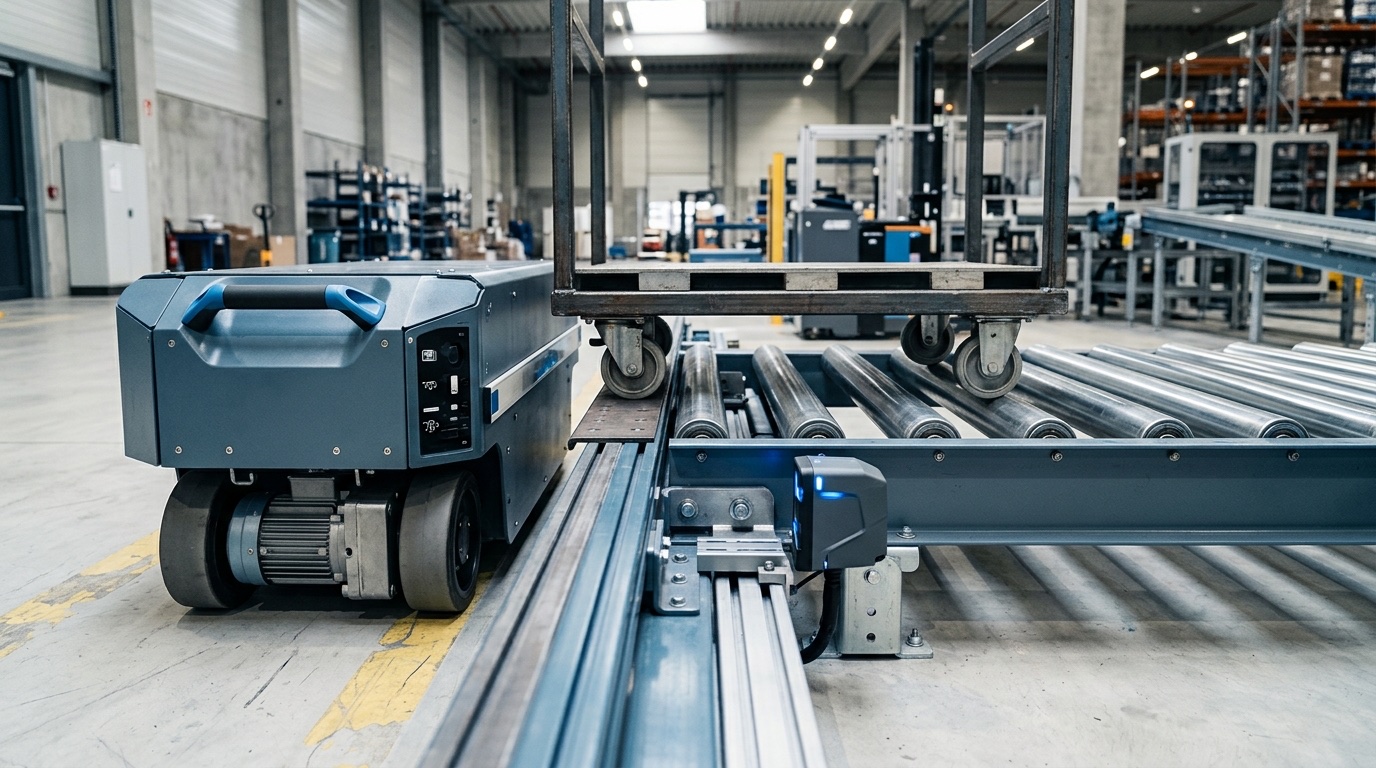
The powered design splits the work: the vehicle brings a roller or chain conveyor deck up to a fixed conveyor deck, and the two move the load across together. That is mechanically more elegant and more tolerant, because the load is transferred under guidance rather than picked up. It has just one consequence that regularly surprises people: the station is now itself a machine, with its own controls, its own power supply, its own conformity assessment, and an interface over which both sides have to agree when the transfer happens.
That second machine belongs in the specification and in the budget. If it first appears during commissioning it becomes the most expensive line in the project, because electrical design, acceptance and floor space then have to be arranged retrospectively.
What VDA 5050 governs at the transfer, and what it does not
Anyone running a mixed fleet meets the interface at this point. VDA 5050 knows load changes as actions: pick and drop, each with optional parameters such as the duration for which the action stays in the RUNNING state. The vehicle state carries a field for the loads currently held; that field is optional, and an empty field tells master control that the vehicle can reason about its own load state and is currently carrying nothing. A vehicle can pick up and carry only one load at a time and must drop it before picking up the next.
That is precise, and it is limited. What is standardised is the message: that a pick-up was requested, that it is running, that it has completed. What is not standardised is the mechanism: how high it lifts, with what capture range, against which stop, with what feedback on a failed pick-up. Two vehicles from different manufacturers can both report pick in full conformity and still fail differently at the same station.
Where else the interface stops carrying is set out in VDA 5050 and the mixed fleet. For the transfer, the short version is this: the standard tells you that something happened, not that it will fit.
What the operator settles before selection
Vehicle selection, navigation, the economics and the path from an existing tugger fleet to autonomous vehicles are covered at length elsewhere in our archive — among others in Replacing the tugger train and Building-to-building material transfer. What those deliberately leave open is this list.
Before any equipment selection, settle: which load carrier exactly, by type designation and not by category. What condition it is actually in across the estate, measured from a sample rather than estimated. Whether it is the same at both ends or whether the load is transhipped on the way. How high the transfer surface sits, at both ends. Whether the station may stay passive or has to be powered. And what should happen when a pick-up fails: retry, defer the order, call a person.
That last point matters most and is forgotten most often. A failed attempt is not an exceptional case but a recurring event with a frequency you should know before you build a shift plan on it. Settling the fallback behaviour in writing beforehand means not negotiating it later in live operation.
FAQ
- Why do transport robot projects fail at the transfer rather than on the route?
- Because the route is a solved problem and the transfer is new in every project. Three inaccuracies meet at the transfer point: the positioning accuracy of the vehicle, the dimensional accuracy of the load carrier and its position in the station. If that sum does not stay below the capture range of the mechanism, the pick-up fails systematically on some share of movements.
- How accurate is a Euro pallet really?
- Nominal dimensions are 1200 by 800 by 144 millimetres. EPAL states inherent timber tolerances of plus/minus 2 millimetres per element in length, width and thickness, rising to as much as 5 millimetres where drying takes place in a wood-fired kiln. That applies to a new pallet built to standard; pallets in circulation deviate more.
- Can we keep using our existing load carriers?
- Often yes, but it is a test and not an assumption. Existing load carriers evolved for handling by people, and a person corrects continuously without noticing. A robot has a fixed capture range and one attempt. So base the assessment on a sample drawn from live circulation, not on a new unit from the store.
- Does VDA 5050 govern load transfer?
- Only the communication about it. VDA 5050 defines pick and drop actions, a vehicle carries only one load at a time and must drop it before picking up the next, and the field for carried loads in the vehicle state is optional. The mechanics of the pick-up — lift height, capture range, stop, behaviour on a failed attempt — are not standardised.
- When do we need a powered transfer station?
- When the capture range of a purely vehicle-side pick-up does not cover the sum of your tolerances, or when the load has to be transferred under guidance. Expect in that case that the station is a machine in its own right, with controls, power supply, conformity assessment and an interface. That item belongs in the specification, not in commissioning.
Related reading
Building-to-Building Material Transfer: Outdoor Robots
On multi-building campuses and plant sites, building-to-building material transfer quickly becomes a bottleneck once weather, ramps, and gate crossings enter the picture. This guide shows how outdoor AMRs take over these routes and how the werob Platform brings hardware-agnostic deployments live in eight weeks.
14 August 2026VDA 5050 mixed fleetVDA 5050 and the mixed fleet: what the standard covers and what it does not
Running two OEMs in one building does not make their robots cooperate. What VDA 5050 actually standardises, what its own Scope section excludes, and the list you have to agree in writing.
28 August 2026drone inventory in warehousesInventory drones in the warehouse: does the hall have a door to outside?
The market sells them as drones, and with the word comes the drone regulation. For operation inside buildings its core requirements expressly do not apply — and switching them off is what pulls a different body of law in. One question decides which.
9 September 2026robot success rateReading robot success rates honestly: what 45.7 percent floor pickup means for a shift plan
Google published per-task success rates alongside its new models. They are strong research results and they are not shift ready for every task. Telling those apart is a numeracy problem, not a robotics problem.
30 July 2026replacing the tugger trainReplacing the Tugger Train: Specifying and Sourcing Outdoor AMRs
Intralogistics leaders are replacing manual tugger trains with outdoor AMRs to combat labor shortages and safety incidents. Discover how to specify the right navigation and payload architectures while ensuring compliance with ISO 3691-4 and EU Machinery Regulation 2023/1230.
13 August 2026