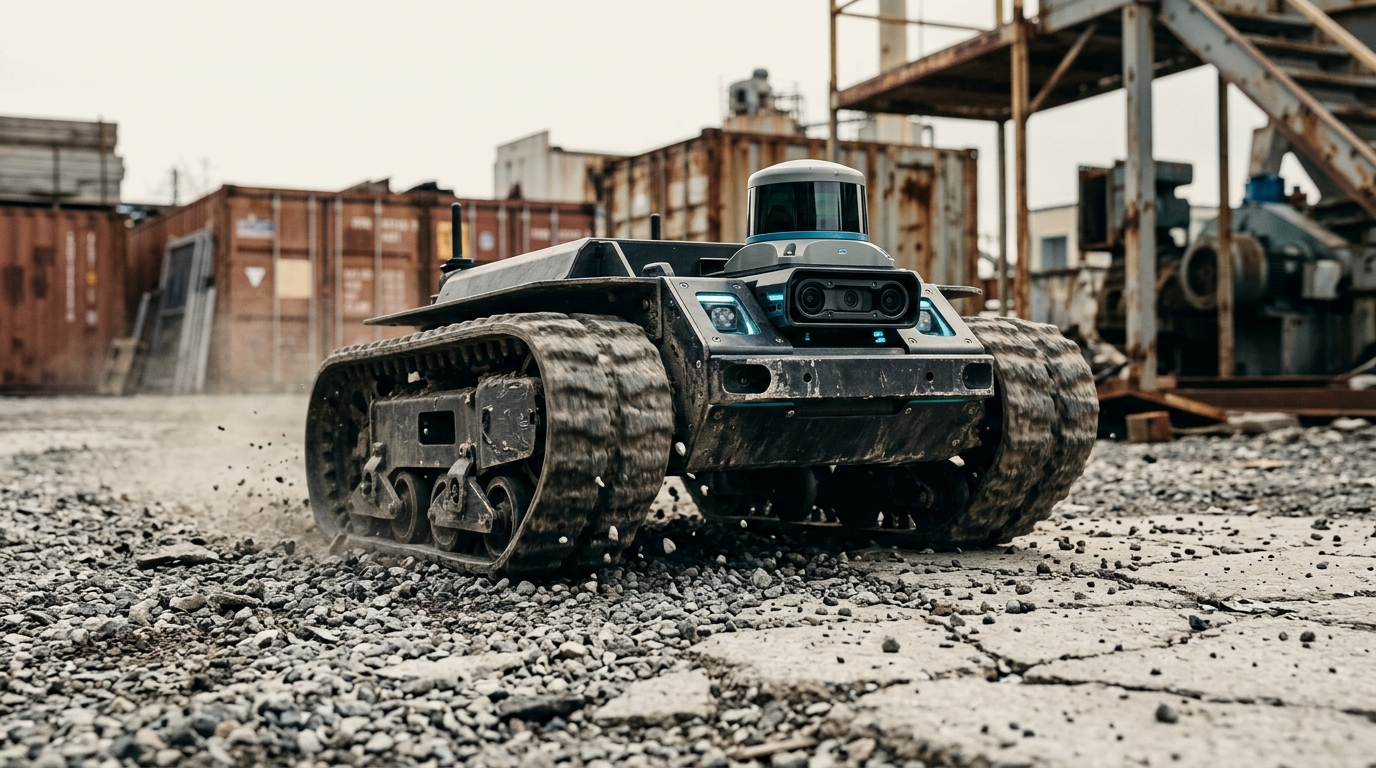
Physical AI for Outdoor AMRs: Brownfield Buyer's Guide
Deploying outdoor AMRs in brownfield sites requires more than basic navigation. This guide explores how Physical AI enables real-time terrain adaptation, and explains how werob evaluates OEM hardware for IP ratings and EU 2023/1230 compliance during our eight-week rollout.
Legacy logistics yards and outdoor manufacturing sites face acute operational pressures. As industrial operations scale, intra-site material movement between unheated warehouses, exterior staging pads, and production bays remains a critical bottleneck. Traditional automated guided vehicles (AGVs) relied on rigid magnetic tape, overhead wires, or embedded floor transponders, whereas AMRs need none of that fixed infrastructure. Modifying thousands of square meters of weathered asphalt or concrete in a brownfield yard to support magnetic guidance is costly and disrupts ongoing facility operations.
Key Takeaways
- 1Logistics sectors face 40-60% annual turnover, accelerating the push for AMRs
- 2Physical AI replaces pre-mapped paths with real-time terrain adaptation.
- 3IP65 to IP67 ratings are critical for weathering low-pressure jets and immersion.
- 4EU Machinery Regulation 2023/1230 compliance is mandatory by January 2027.
- 5werob delivers hardware-agnostic AMR deployments in just eight weeks.
The Case for Outdoor AMRs in Brownfield Sites
Compounding these infrastructure constraints is a severe labor crisis across logistics operations. Frontline logistics personnel experience high churn, with annual warehouse turnover rates averaging 40% to 60%. Replacing a single frontline associate incurs an estimated economic cost between $4,000 and $10,000 when accounting for recruitment, onboarding, and initial productivity deficits. Outdoor yard tasks, which involve long walks in harsh weather conditions, suffer the highest turnover rates.
- Infrastructure preservation: AMRs operate on existing outdoor surfaces without cutting wire slots or installing reflective markers.
- Dynamic routing: Autonomous vehicles adjust paths instantly around parked trailers, temporary pallets, or maintenance vehicles.
- Labor stabilization: Automating heavy exterior transport reduces physical strain on personnel and mitigates associate turnover.
- Scalable throughput: Fleet capacity scales modularly by adding units during peak seasons without civil engineering works.
Modern autonomous mobile robots (AMRs) provide a flexible alternative. Instead of altering existing outdoor real estate, autonomous systems adapt to the site as built. An outcome-oriented robotics systems integrator evaluates OEM options that automate outdoor logistics without demanding capital-intensive site modifications.
Physical AI: Redefining Outdoor Navigation
Transitioning mobile robots from indoor warehouses to outdoor yards requires a paradigm shift in autonomous perception. Indoor AMRs operate under predictable LED lighting on level concrete, drawing from 2D LiDAR maps and ceiling landmarks. Outdoor environments introduce dynamic obstacles, shifting sun angles, shadows, blowing debris, and rain. Physical AI combines onboard sensor fusion with real-time spatial processing, enabling autonomous machines to interpret physical geometry and surface conditions as they drive rather than replaying a stored route.
A central pillar of Physical AI is 3D Visual SLAM (Simultaneous Localization and Mapping). Unlike magnetic tape, QR codes, or 2D LiDAR-based SLAM, Visual SLAM requires no added infrastructure: off-the-shelf onboard cameras perceive natural features in the environment, construct real-time 3D maps, and keep the vehicle localized while ignoring transient objects such as people and passing vehicles. In a yard, that perception layer also has to distinguish navigable wet asphalt, loose gravel, and puddles from impassable drop-offs.
- Multi-sensor perception: Fusing 3D LiDAR, RGB-D vision, and inertial measurement units (IMUs) creates a redundant spatial model.
- Terrain feature mapping: Neural networks identify terrain boundaries, gravel patches, and curb heights on the fly.
- Predictive path synthesis: Onboard motion planners continuously update local velocity vectors to maintain traction across uneven ground.
- Infrastructure-free autonomy: Real-time spatial tracking eliminates external beacon arrays or magnetic ground guides.
Through real-time terrain adaptation and active path synthesis, outdoor AMRs re-plan trajectories in milliseconds when facing unmapped obstructions. This spatial intelligence allows fleets to navigate dynamic outdoor yards safely while maintaining operational throughput.
Overcoming Complex Retrofit Challenges
Brownfield industrial facilities present environmental hazards that were never engineered for autonomous navigation. Outdoor logistics routes frequently traverse broken pavement, railway tracks, drain grates, and steep loading ramps. Because AMRs run onboard perception and path planning rather than following a fixed route, navigation software can evaluate incline limits and chassis roll angles and adjust vehicle speed to prevent load shifting when crossing uneven aprons or gravel paths.
Satellite-based positioning presents another significant challenge in brownfield yards. Tall steel-clad warehouses, shipping container stacks, and heavy overhangs create GPS-denied zones where satellite signals suffer severe multipath reflection or total blockage. Advanced outdoor AMRs hold their position estimate through multi-sensor fusion, handing over between GNSS, camera-based SLAM, and wheel odometry when passing near metallic structures, so the fleet keeps a usable location fix without external beacons.
| Retrofit Challenge | Operational Risk | Physical AI Mitigation Strategy |
|---|---|---|
| Uneven asphalt & gravel | Vehicle tipping or pallet slippage | Active suspension monitoring & real-time speed adaptation |
| GPS-denied building shadows | Loss of location fix & drift | 3D Visual SLAM fused with wheel odometry and IMU sensors |
| Mixed pedestrian & forklift traffic | Collisions in congested corridors | 360-degree 3D perception with dynamic pedestrian trajectory tracking |
Operating safely alongside manual forklifts, delivery trucks, and site personnel requires strict safety zone management. Onboard perception classifies surrounding traffic in real time, predicting pedestrian paths and enforcing speed reductions in tight passages, ensuring safe co-existence within existing yard workflows.
Hardware Durability and Ingress Protection
Environmental exposure is a leading cause of hardware failure in outdoor AMR deployments. Fine industrial dust, heavy rainfall, mud, and extreme seasonal temperatures degrade sensitive optical sensors and electronic drive systems. Specifying the correct Ingress Protection (IP) rating, the two-digit code defined by international standard IEC 60529, is vital to prevent unscheduled operational downtime.
Under IEC 60529, the first digit signifies solid particle ingress protection on a scale from 0 to 6, while the second digit defines liquid ingress protection from 0 to 9. An IP65 rating indicates complete dust-tight enclosure protection and resistance against water jets projected from a 6.3mm nozzle at 12.5 liters per minute. This rating is suitable for general outdoor yard transport under light to moderate rain.
- IP65 Rating: Fully dust-tight enclosure protecting against low-pressure 6.3mm water jets; ideal for dry dust exposure and standard rainfall.
- IP67 Rating: Complete dust protection plus survival against temporary liquid immersion up to 1 meter depth for 30 minutes.
- Thermal Management: Internal climate control units prevent optical lens fogging and sensor overheating during extreme weather cycles.
- Corrosion Resistance: Stainless steel hardware and sealed cabling protect chassis components against road salt and moisture.
Where vehicles navigate standing water, flooded loading bays, or heavy washdown areas, IP67 protection is the safer specification. Ensuring correct IP certification across chassis, camera housings, and sensor domes preserves fleet availability and extends equipment lifecycle.
Compliance: EU Machinery Regulation 2023/1230
Deploying autonomous machinery in the European single market requires strict adherence to evolving legal frameworks. The EU Machinery Regulation 2023/1230 officially replaces the legacy Machinery Directive 2006/42/EC, establishing updated mandatory safety requirements across all EU member states. While entered into force in July 2023, full compliance becomes strictly mandatory on January 20, 2027.
Regulation 2023/1230 is the first machinery law to treat digital technologies such as artificial intelligence, the Internet of Things, and robotics as product-safety risk factors, and it extends the definition of safety components to include software. Operators must ensure that self-evolving AI algorithms remain predictable and bound within verified safety parameters. A new section on protection against corruption also sets cybersecurity requirements for machinery: cybersecurity threats must not be allowed to compromise a machine's safety functions, so countermeasures are mandatory rather than left to the manufacturer's interpretation.
- Mandatory enforcement date: From 20 January 2027 only the Machinery Regulation applies, superseding Directive 2006/42/EC with no transitional phase in which either text may be used.
- Third-party assessment: The machinery subject to a special conformity assessment procedure is now listed in Annex I, split into Part A, where involvement of a notified body is mandatory, and Part B, which follows the procedure previously set out in Annex IV of Directive 2006/42/EC.
- Cybersecurity integration: Control systems and software must be protected so that cybersecurity threats cannot compromise the machine's safety functions.
- Digital technical records: Instructions for use and the EU Declaration of Conformity may be supplied in digital form, with a paper version provided on request.
Non-compliance creates substantial liability risks for facility managers. Buyers should therefore require documented evidence from every OEM that the deployed fleet meets Regulation 2023/1230 well ahead of the enforcement deadline, and confirm who carries the conformity assessment obligation after any site-specific modification.
Software Integration for Unified Fleet Management
Physical autonomous vehicles deliver business value only when integrated with existing enterprise tools. Isolated robot silos push work back onto human dispatchers, who then re-enter tasks by hand and lose much of the efficiency the fleet was bought for. A unified software architecture connects mobile hardware directly with warehouse management systems (WMS), enterprise resource planning (ERP) platforms, and yard execution tools.
Bridging hardware fleets with corporate IT infrastructure takes a dedicated software layer. Pre-built connectors link autonomous mobile fleets directly to enterprise platforms such as SAP EWM, PointClickCare, and Opera PMS. These middleware modules translate high-level transport orders into verified robot motion tasks without requiring custom interface engineering.
- Connectors: Pre-built integration middleware establishing bi-directional data pipelines between AMRs and ERP/WMS systems.
- Cockpit: Unified fleet dashboard delivering real-time monitoring across hardware status, site infrastructure, compliance, and spec dimensions.
- Automated dispatching: Dynamically assigning transport tasks based on vehicle location, state of charge, and terrain suitability.
- Auditable activity logs: Centralized task logging and escalation tracking to support continuous operational audits.
Operations teams monitor multi-terrain fleets in real time through Cockpit. Featuring unified traffic-light indicators across hardware, infrastructure, regulatory compliance, and specification metrics, Cockpit delivers actionable visibility and instant escalation management across the entire outdoor fleet.
The Integrator Approach: Eight Weeks to Go-Live
Selecting, integrating, and deploying autonomous mobile fleets across brownfield sites means resolving terrain, safety, IT, and regulatory questions in parallel. A hardware-agnostic systems integration partner evaluates the optimal robot hardware from a supplier graph of over 44 OEM partners rather than pushing single-brand hardware solutions.
The deployment process begins with Spec Engine, an AI-assisted specification tool that translates plain-language shift descriptions into formally verified, ROS-compatible action graphs within 48 hours. Following specification, Supplier Match scores OEM candidates against regulatory readiness, terrain capabilities, regional service coverage, and target price bands to select the ideal hardware.
- Week 1-2: Workflow specification using Spec Engine to generate formal ROS-compatible deployment plans.
- Week 3-4: OEM candidate scoring via Supplier Match across 44+ robot manufacturers.
- Week 5-6: Deploying Connectors to link the robot fleet with existing SAP EWM or site WMS systems.
- Week 7-8: On-site multi-terrain commissioning, safety validation, and live operations handover live fleet in 8 weeks.
Delivered through the werob Platform, this structured deployment methodology takes fleets from initial site specification to live operation in eight weeks. Operating under an outcome-only payment model where clients pay upon successful live operational performance, werob aligns technical success directly with customer business outcomes.
FAQ
- What is Physical AI in the context of outdoor AMRs?
- Physical AI allows outdoor AMRs to perceive and adapt to unstructured environments in real-time. Instead of following magnetic tape or pre-mapped indoor layouts, robots use advanced sensors and Visual SLAM to navigate around obstacles safely.
- How do AMRs handle uneven brownfield terrain?
- AMRs designed for multi-terrain use feature specialized suspensions and active path-planning. This enables them to navigate uneven surfaces, loading docks, and transitions between indoor and outdoor zones without requiring facility modifications.
- Why are IP ratings important for outdoor robotics?
- Ingress Protection (IP) ratings define weather resistance. An IP65 rating protects against 6.3mm water jets, while IP67 ensures defense against immersion, preventing critical hardware failures when robots are exposed to heavy rain or dust.
- What is the new EU Machinery Regulation 2023/1230?
- Regulation (EU) 2023/1230 updates safety standards for modern robotics, officially replacing Directive 2006/42/EC. It introduces strict new requirements for AI, cybersecurity, and autonomous systems, becoming mandatory in January 2027.
- Does werob manufacture its own outdoor AMRs?
- No. werob is a hardware-agnostic systems integrator. We use our Spec Engine and Supplier Match to evaluate hardware from a large catalog of OEM partners, ensuring you get the exact robot required for your brownfield deployment.
- How does werob integrate AMRs with existing software?
- We utilize Connectors to link the robotic fleet directly into your existing warehouse management systems, such as SAP EWM. Our Cockpit dashboard then provides real-time monitoring and escalation management for the entire operation.
- How long does an outdoor AMR deployment take with werob?
- We utilize an eight-step deployment process that takes an AMR from initial scoping to live operation in just eight weeks. Furthermore, our outcome-only payment model means customers only pay upon successful deployment.
Related reading
Physical AI: why adaptive robots fail less often than scripted ones
A rigid, pre-scripted system stalls the moment reality deviates from the plan — a moved cart, a closed door, a skipped step. Physical AI is the difference between a robot that stops there and one that keeps working.
11 September 2026outdoor agv replacementOutdoor AGV Replacement: Evaluating the Shift to AMRs
Replacing legacy fixed-path outdoor AGVs with dynamic AMRs requires a shift from hardware decisions to systems integration. werob offers an eight-week phased migration, evaluating over 44 OEMs to deploy flexible, autonomous fleets under an outcome-only payment model.
13 August 2026learned robot policy acceptanceLearned Robot Policies: Acceptance and the Safety Case
You can accept a deterministic AMR route by route. You cannot do that with a learned policy. What therefore belongs in the specification, the acceptance protocol and the contract.
31 August 2026mining construction amrsMining & Construction AMRs: Compliance and Sourcing
Deploying wheeled and tracked AMRs in mining demands ruggedized hardware and compliance with ISO 17757 and ATEX. An eight-week, hardware-agnostic integration process ensures fleets meet the EU Machinery Regulation 2023/1230 safely.
13 August 2026outdoor AMR total cost of ownershipOutdoor AMR vs. Tugger Fleet: Total Cost of Ownership
Discover the complete total cost of ownership for outdoor AMRs versus traditional tugger fleets, including labor, maintenance, and leasing structures.
18 August 2026