Outdoor AGV Replacement: Evaluating the Shift to AMRs
Replacing legacy fixed-path outdoor AGVs with dynamic AMRs requires a shift from hardware decisions to systems integration. werob offers an eight-week phased migration, evaluating over 44 OEMs to deploy flexible, autonomous fleets under an outcome-only payment model.
Legacy automated guided vehicles (AGVs) long served as the backbone of internal logistics. However, in outdoor yard management and inter-building transport, fixed-path physical guidance systems are encountering operational limits. Magnetic tape, embedded inductive wires, and physical ground markers were engineered for stationary indoor environments with predictable layouts. Exposed to harsh outdoor weather, heavy axle loads, temperature swings, and surface wear, magnetic strips peel, wires sever, and reflective targets become obscured by mud or frost. Maintaining physical guidance lines across sprawling industrial yards requires ongoing civil works and floor repairs.
Key Takeaways
- 1Modern AMRs handle heavy outdoor logistics, natively supporting payloads up to 1350kg.
- 2Dynamic AMR navigation achieves localization accuracy under 10 mm without magnetic tape or wire guidance.
- 3Safe integration requires fulfilling ISO 3691-4 and EU Machinery Regulation 2023/1230 standards.
- 4werob's Supplier Match assesses over 44 OEMs to find the right hardware for your facility.
The Breaking Point for Legacy Outdoor AGVs
Beyond physical degradation, legacy AGVs introduce structural rigidity into expanding operations. Modern logistics facilities, manufacturing sites, and outdoor storage yards undergo frequent layout adjustments to accommodate changing throughput demands and seasonal inventory spikes. Altering an established outdoor AGV route involves cutting concrete, trenching asphalt, re-laying wires, and re-commissioning fixed magnetic paths. That civil work takes the affected lanes out of service for weeks and adds installation cost that scales with every metre of new route, before a single transport task has changed.
- Physical Infrastructure Vulnerability: Outdoor magnetic tape and buried wire paths suffer rapid wear from heavy vehicles, rain, ice, and surface contamination.
- High Route Modification Costs: Expanding or altering an outdoor path requires physical trenching and weeks of operational disruption.
- Bottlenecks and Stoppages: Fixed-path AGVs stop completely when encountering obstacles, causing yard congestion and requiring manual operator resetting.
- Escalating Maintenance Overhead: Ongoing repairs to ground infrastructure drag on long-term operational budgets.
Furthermore, legacy AGVs lack situational adaptability. When a parked forklift, pallet, or maintenance vehicle blocks an AGV's predetermined line, the vehicle stops entirely and waits for human intervention. In high-traffic outdoor yards where equipment and personnel move constantly, these path obstructions trigger frequent stoppages, dragging down overall throughput and increasing reliance on manual supervisory labor.
Fixed Infrastructure vs. Dynamic Navigation
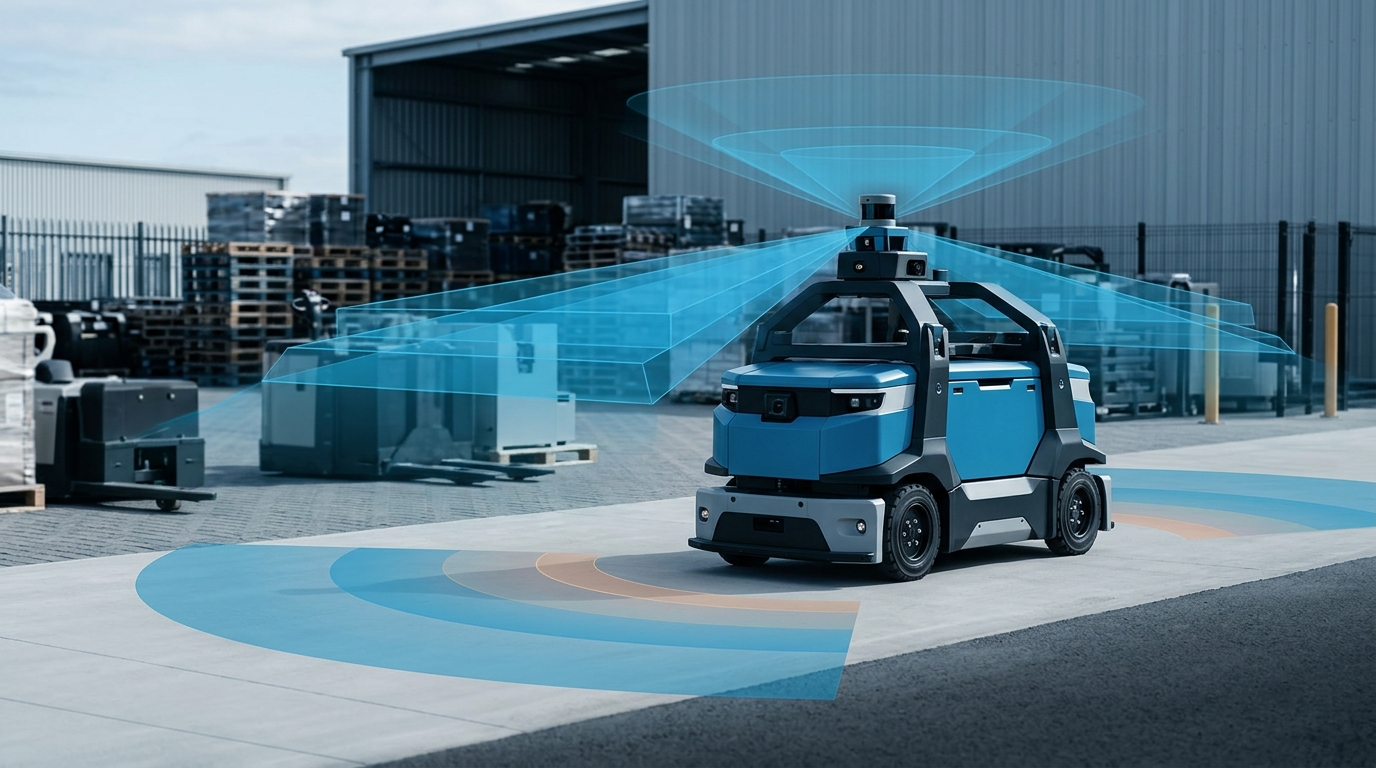
Replacing fixed-path AGVs with next-generation autonomous mobile robots (AMRs) fundamentally changes how vehicles navigate industrial spaces. While AGVs rely on physical tracks or external reflectors, modern AMRs utilize onboard intelligence and multi-sensor perception to construct real-time environmental maps and navigate dynamically. Technologies such as 3D LiDAR, stereoscopic vision cameras, real-time kinematic GNSS (RTK-GNSS), and wheel odometry allow AMRs to determine their location and plan optimal paths autonomously without physical ground modification.
A primary operational concern for plant managers transitioning from AGVs to AMRs is positioning precision. Traditional AGVs achieve high repeatability by physical constraint, following a wire directly to a loading dock. Modern AMRs close that gap with marker-assisted docking: the MiR1350, a heavy-payload platform rated for a maximum payload of 1,350 kg, specifies positioning accuracy of plus/minus 3 mm on both the X and Y axes when docking to an L-marker under controlled conditions, with SLAM, 3D vision, inertial measurement, and satellite positioning handling the approach. This level of precision allows autonomous mobile units to align with outdoor transfer stations, hydraulic dock levelers, and automated yard ramps with high reliability.
| Performance Dimension | Legacy Outdoor AGVs | Next-Generation Outdoor AMRs |
|---|---|---|
| Primary Navigation | Embedded magnetic tape, floor wires, or fixed laser reflectors | 3D LiDAR SLAM, RTK-GNSS, and stereoscopic vision |
| Facility Infrastructure Needs | High (ground trenching, wire placement, surface markers) | Minimal (digital facility mapping, no physical markers) |
| Obstacle Handling | Stops on line until obstacle is manually moved | Autonomously circumvents obstacles and recalculates route |
| Path Flexibility | Fixed routes requiring civil works to modify | Software-configurable routes updated via digital fleet tools |
| Positioning Accuracy | Repeatability set by the physical guide line | Centimetre-level repeatability via multi-sensor fusion and SLAM |
The core advantage of dynamic navigation lies in obstacle recovery. When an outdoor AMR detects an obstacle in its path, onboard perception algorithms calculate a safe bypass route on the move, allowing the vehicle to continue its delivery mission without stopping yard operations. Organizations seeking a hardware-agnostic integration path can transition to dynamic navigation while protecting existing operational workflows.
Evaluating TCO and Operational Flexibility
Evaluating the financial case for replacing outdoor AGVs requires analyzing Total Cost of Ownership (TCO) across a multi-year horizon rather than focusing solely on upfront hardware price tags. On paper, individual AGV units can appear less expensive than high-spec AMRs. However, comprehensive TCO accounting reveals that infrastructure modifications, physical installation, and route recalibration make up a substantial share of total AGV deployment expenses, a cost category that is largely absent from AMR deployments because navigation happens in software rather than in the ground.
Global adoption data highlights this structural shift toward autonomous mobility. According to market intelligence from Interact Analysis, annual shipments of mobile robots expanded from approximately 30,000 units in 2018 to more than 200,000 units by 2025. Autonomous mobile robots account for a growing majority of new deployments in modern logistics environments, driven by software scalability and lower long-term maintenance costs.
- Infrastructure Cost Offset: Eliminates trenching, floor wire installation, and physical marker maintenance across outdoor yards.
- Faster Deployment Time: AMRs commission in weeks because routes are mapped in software, while fixed-path AGVs wait on civil works.
- Shorter Payback Period: Avoided infrastructure and recommissioning work pulls the break-even point forward compared with a wire-guided fleet.
- Scalable Fleet Expansion: Adding new units or routes involves software mapping rather than civil engineering work.
For operations leaders presenting an automation ROI model to financial executives, the software-driven flexibility of AMRs protects capital expenditure against facility changes. As yards expand or operational layouts shift, software-configurable routes ensure that material handling fleets adapt without requiring additional capital investments in floor infrastructure.
Safety and EU Machinery Regulation 2023/1230
Operating autonomous heavy machinery in outdoor yards introduces distinct safety and regulatory demands. Unlike predictable indoor corridors, outdoor industrial environments feature dynamic light conditions, heavy rain, fog, uneven terrain, and mixed traffic including heavy trucks, forklifts, and pedestrian workers. Ensuring safe operation requires compliance with EN ISO 3691-4:2023, the international standard governing driverless industrial trucks and safety requirements.
Regulatory compliance is taking on greater urgency across European industrial sites with the implementation of the new EU Machinery Regulation 2023/1230, which becomes mandatory on 20 January 2027. The regulation establishes strict safety requirements for autonomous mobile machinery, artificial intelligence integration, cyber-resilience, and functional safety architecture. Operators must verify that fleet software, sensor field switching, and emergency stop systems satisfy unified risk assessments across all operational modes.
Modern outdoor AMRs fulfill safety obligations by employing multi-layered sensor arrays. Safety-rated 2D and 3D LiDARs establish adaptive protective zones that adjust dynamically based on vehicle speed, steering angle, and surface friction. If an obstacle enters the dynamic warning field, the AMR decelerates smoothly; if the inner safety zone is breached, safety controllers trigger an immediate, verified emergency stop, protecting human personnel and surrounding assets.
Hardware-Agnostic Sourcing Across OEMs
Selecting hardware for heavy outdoor logistics poses significant operational risk. Managing heavy outdoor payloads across steep inclines, gravel tracks, and exposed loading bays requires specialized chassis design, high-torque drive systems, and ruggedized weatherproofing. Relying on a single hardware manufacturer for an entire fleet exposes plant operators to vendor lock-in, supply chain disruptions, long lead times for spare parts, and limited flexibility if operational requirements evolve.
To mitigate vendor risk, enterprise operators increasingly turn to a hardware-agnostic evaluation approach. Rather than forcing a single manufacturer's platform onto diverse tasks, a modern systems integration model evaluates robot fleets across global hardware developers to select optimal chassis, payload capacities, and drive configurations for specific site conditions.
- Regulatory Readiness: Verifying CE marking, ISO 3691-4 compliance, and cybersecurity audit trails across OEM hardware.
- Regional Service Coverage: Assessing local maintenance response SLAs, spare parts availability, and technician support.
- Integration Footprint: Evaluating native software interfaces, API openness, and mechanical coupling compatibility.
- Price and Payload Matching: Balancing capital requirements against the payload classes the site actually needs, from light tow tractors to heavy haulers.
Through Supplier Match, an OEM matching engine that scores and ranks a supplier graph of over 44 robot manufacturers, operational requirements are benchmarked against verified technical criteria. Partnering with a hardware-agnostic systems integrator ensures that operators deploy hardware tailored to their specific outdoor environment while maintaining multi-vendor supply chain flexibility.
Connecting Fleets to Legacy Systems
A major bottleneck in mobile robotics projects is connecting autonomous fleets to enterprise software systems. Deploying high-performance outdoor AMRs delivers limited value if transport tasks cannot communicate seamlessly with site Enterprise Resource Planning (ERP), Warehouse Management Systems (WMS), or Facility Management (FM) databases. In many legacy installations, custom API development and brittle middleware drivers delay projects by months and create ongoing maintenance headaches.
Achieving full operational autonomy requires direct software interoperability. Autonomous mobile fleets must trigger transport orders automatically when material is staged, confirm pickups at loading docks, signal automatic gate barriers, and log completed deliveries directly into operational systems without manual human entry.
| Integration Layer | Connected Operational Systems | Operational Functionality |
|---|---|---|
| Enterprise ERP / WMS | SAP EWM, Oracle SCM, Microsoft Dynamics | Automated task dispatching, inventory location updates, and material tracking |
| Facility & Operations Stacks | PointClickCare, Opera PMS, FM Software | Scheduling material deliveries, linen transport, and facility logistics workflows |
| Yard Control & Access | Automatic gate controllers, traffic lights, RFID barriers | Automated gate actuation and inter-building transit management |
| Fleet Monitoring Dashboard | Unified traffic light status, tasks, audit logs | Real-time visibility across hardware, infrastructure, regulatory, and spec dimensions |
To bridge this software gap, Connectors provide pre-built integration layers that link robotic fleets directly with enterprise stacks, including SAP EWM, PointClickCare, and Opera PMS. Operators monitor fleet performance through Cockpit, a unified monitoring dashboard that provides real-time traffic lights across hardware, infrastructure, regulatory, and specification dimensions. This integration ensures labor cost reduction while eliminating manual dispatching overhead.
The Eight-Week Phased Migration Roadmap
Transitioning an active industrial yard from legacy outdoor AGVs to dynamic AMRs requires a structured, low-risk execution strategy. Shutting down yard operations for weeks during migration is unacceptable for active logistics facilities. A structured eight-week deployment methodology ensures a smooth, phased transition that keeps material moving while new autonomous fleets are integrated.
A hardware-agnostic robotics systems integration platform manages the complete lifecycle from initial specification to continuous live monitoring. The transition begins with Spec Engine, an AI-assisted setup tool that translates plain language shift descriptions and yard workflows into formally verified, ROS-compatible action graphs within 48 hours. This specification is then evaluated through Supplier Match to select optimal hardware across a partner catalog of 44+ OEM manufacturers.
- Weeks 1-2 (Workflow Mapping & Specification): Define yard routes, task cycles, and payload needs; generate deployable plan specs using Spec Engine within 48 hours.
- Weeks 3-4 (OEM Selection & Compliance Audit): Score and rank hardware via Supplier Match across 44+ OEM partners, verifying ISO 3691-4 and EU Machinery Regulation compliance.
- Weeks 5-6 (System Interoperability & Integration): Deploy Connectors to link fleet management directly with SAP EWM and site yard management software.
- Weeks 7-8 (Pilot Testing, Commissioning & Handover): Conduct live yard trial runs, configure real-time monitoring in Cockpit, and transition to live operation.
To remove capital barriers and financial risk for enterprise operators, the werob Platform operates on an outcome-only payment model, meaning customers pay only upon successful live operation in their yard. By bridging OEM hardware, pre-built middleware, regulatory compliance, and fleet monitoring into a unified model, engaging a dedicated systems integration platform enables operators to replace legacy AGVs with confidence and unlock next-generation industrial autonomy.
FAQ
- What is the main navigation difference between an AGV and an AMR?
- AGVs follow predefined physical paths using magnetic tape or wires, whereas AMRs navigate dynamically using SLAM, LiDAR, and 3D cameras to avoid obstacles and adapt to environment changes.
- Why replace outdoor AGVs with autonomous mobile robots?
- Outdoor operations frequently change due to yard expansions and shifting layouts. AMRs eliminate the costly, rigid infrastructure required by AGVs, enabling rapid deployment and continuous material flow.
- How does an AMR ensure precise localization outdoors?
- Advanced AMRs utilize high-resolution sensors and digital mapping to maintain localization accuracy under 10 mm, ensuring reliable transport without ground infrastructure.
- Who manages the safety compliance of an AMR fleet?
- The systems integrator carries the system-level risk assessment. Integrating fleets requires strict adherence to ISO 3691-4 and the EU Machinery Regulation 2023/1230 to guarantee site safety.
- Can AMRs handle heavy outdoor payloads?
- Yes. Industrial AMRs are designed for robust material handling, with leading OEM models seamlessly transporting payloads up to 1350kg across unstructured logistics yards.
- How long does a typical AGV to AMR migration take?
- Through a dedicated integrator using a phased approach, an end-to-end AMR deployment can be completed in just eight weeks, ensuring minimal disruption to live operations.
Related reading
Physical AI for Outdoor AMRs: Brownfield Buyer's Guide
Deploying outdoor AMRs in brownfield sites requires more than basic navigation. This guide explores how Physical AI enables real-time terrain adaptation, and explains how werob evaluates OEM hardware for IP ratings and EU 2023/1230 compliance during our eight-week rollout.
13 August 2026outdoor AMR total cost of ownershipOutdoor AMR vs. Tugger Fleet: Total Cost of Ownership
Discover the complete total cost of ownership for outdoor AMRs versus traditional tugger fleets, including labor, maintenance, and leasing structures.
18 August 2026replacing the tugger trainReplacing the Tugger Train: Specifying and Sourcing Outdoor AMRs
Intralogistics leaders are replacing manual tugger trains with outdoor AMRs to combat labor shortages and safety incidents. Discover how to specify the right navigation and payload architectures while ensuring compliance with ISO 3691-4 and EU Machinery Regulation 2023/1230.
13 August 2026mining construction amrsMining & Construction AMRs: Compliance and Sourcing
Deploying wheeled and tracked AMRs in mining demands ruggedized hardware and compliance with ISO 17757 and ATEX. An eight-week, hardware-agnostic integration process ensures fleets meet the EU Machinery Regulation 2023/1230 safely.
13 August 2026building-to-building material transferBuilding-to-Building Material Transfer: Outdoor Robots
On multi-building campuses and plant sites, building-to-building material transfer quickly becomes a bottleneck once weather, ramps, and gate crossings enter the picture. This guide shows how outdoor AMRs take over these routes and how the werob Platform brings hardware-agnostic deployments live in eight weeks.
14 August 2026