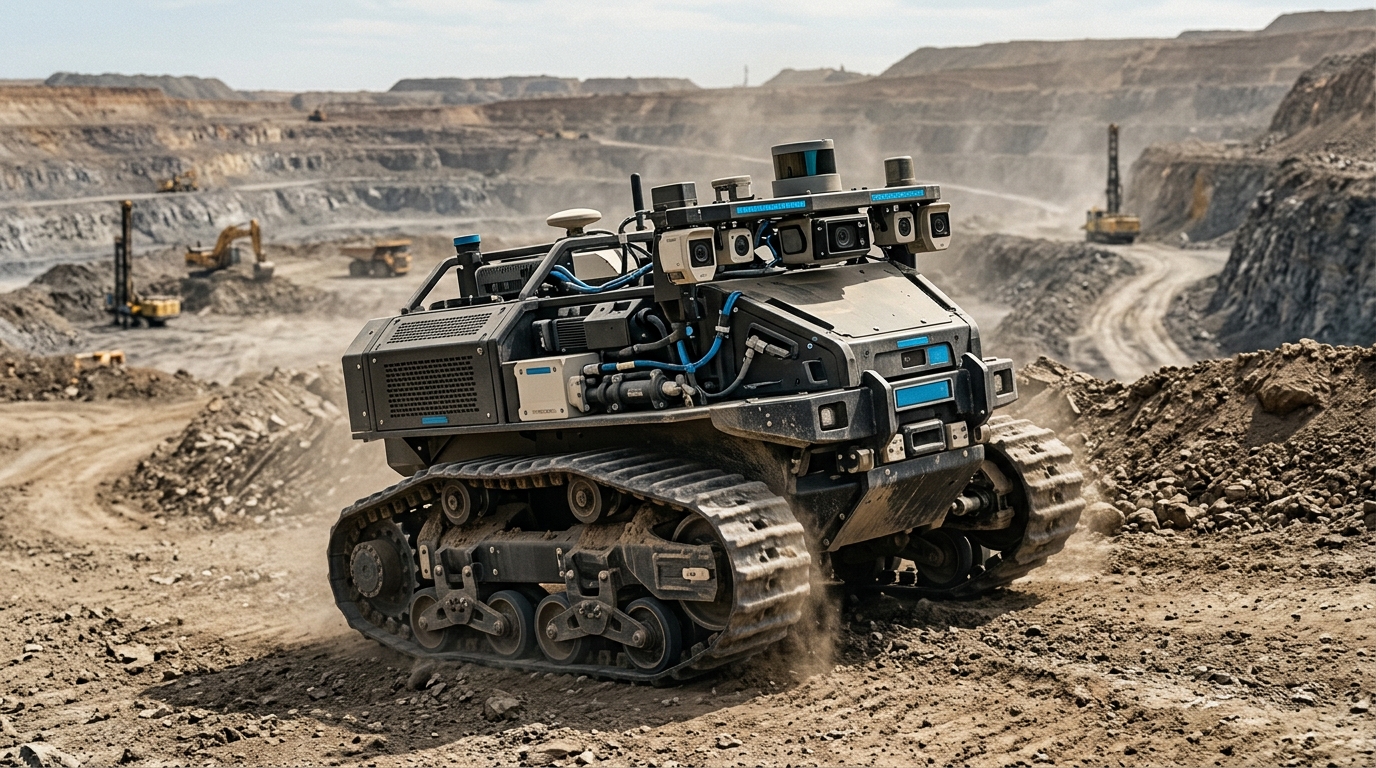
Mining & Construction AMRs: Compliance and Sourcing
Deploying wheeled and tracked AMRs in mining demands ruggedized hardware and compliance with ISO 17757 and ATEX. An eight-week, hardware-agnostic integration process ensures fleets meet the EU Machinery Regulation 2023/1230 safely.
Autonomous mobile robots (AMRs) are rapidly redefining operational efficiency across heavy industries. In rugged surface mines, subterranean shafts, and high-density construction jobsites, wheeled and tracked AMRs now handle hazardous material transport, site hauling, continuous slope monitoring, and automated material distribution. Transitioning from human-driven heavy machinery to autonomous ground fleets reduces worker exposure to high-risk zones, mitigates operational downtime, and creates predictable shift schedules.
Key Takeaways
- 1The EU Machinery Regulation 2023/1230 becomes mandatory on 20 January 2027, requiring updated conformity for all new AMR deployments.
- 2ISO 17757 dictates strict safety criteria for autonomous earth-moving and mining machinery to support zero-injury goals.
- 3Wheeled AMRs operating in explosive atmospheres must hold ATEX certifications under Directive 2014/34/EU.
- 4Integrating AMRs in remote sites requires deep connectivity with existing fleet management via robust API middleware.
- 5A hardware-agnostic integrator allows operators to deploy ruggedized fleets in eight weeks using an outcome-only payment model.
The New Standard for Heavy-Duty Robotics
Deploying mobile automation into harsh industrial environments presents immense engineering and legal challenges. Surface and underground extraction sites expose ground vehicles to abrasive dust, intense structural vibration, standing water, extreme ambient temperatures, and volatile atmospheric gases. Furthermore, operating heavy autonomous machinery alongside human personnel requires strict compliance with international safety protocols and local equipment directives. Selecting an off-the-shelf mobile robot based solely on payload capacity or nominal battery life frequently leads to unexpected hardware failures, integration bottlenecks, or regulatory non-compliance.
To bridge the gap between raw original equipment manufacturer (OEM) hardware and live site operation, industrial buyers are turning to structured systems integration methodologies. Operating as a hardware-agnostic systems integrator, an enterprise partner coordinates specification, OEM sourcing, software integration, and regulatory verification. Through an eight-week deployment framework backed by an outcome-only payment structure where operators only pay upon successful live operation, mining and construction enterprises can deploy robust AMR fleets without carrying the burden of hardware selection mismatch or compliance risk.
Navigating Autonomous Safety Guidelines
The primary regulatory benchmark for mobile machinery in extraction and heavy earth-moving environments is ISO 17757. Titled Earth-moving machinery and mining: Autonomous and semi-autonomous machine system safety, the standard provides safety requirements for autonomous and semi-autonomous machines (ASAM) and their machine systems (ASAMS), covering the machines themselves plus associated systems and infrastructure, including hardware and software. It applies to autonomous and semi-autonomous versions of earth-moving machinery defined in ISO 6165 and to mobile mining machines used in either surface or underground mining robotics applications, and it addresses the additional hazards specific to autonomous operation.
Achieving compliance with ISO 17757 demands that autonomous software architectures translate high-level operational commands into deterministic, safety-verified motion plans. Mobile robots must continuously monitor their functional environment, maintain active perception corridors, and automatically initiate safe stop routines if a human worker or obstacle breaches a protective zone. Evaluating these dynamic interaction patterns requires rigorous validation before physical vehicles enter live production zones.
To ensure absolute alignment between operator workflows and mandatory safety parameters, technical teams utilize Spec Engine. This AI-assisted setup engine translates natural language shift descriptions and jobsite rules into formally verified, ROS-compatible action graphs within 48 hours. By converting operational requirements into mathematically validated execution specs prior to field deployment, project leaders guarantee that basic safety functions, braking behaviors, and speed limits conform directly to ISO 17757 directives.
- Verification of functional safety functions including dual-channel emergency stop systems and speed restriction zones.
- Implementation of standardized electromagnetic compatibility (EMC) protection under ISO 13766 directives.
- Integration of fail-safe braking and steering test procedures tailored for autonomous rubber-tired and crawler machinery under ISO 3450 and ISO 10265.
- Formal translation of shift requirements into verified, ROS-compatible action graphs via Spec Engine within 48 hours.
The Upcoming Machinery Regulation Mandate
Industrial fleet operators in Europe face a major regulatory pivot with the upcoming EU Machinery Regulation 2023/1230. Replacing the long-standing Machinery Directive 2006/42/EC, Regulation 2023/1230 was published in mid-2023 and becomes strictly mandatory across all EU member states on 20 January 2027. Unlike its predecessor directive, the new regulation applies directly as binding law without requiring national transposition, introducing stringent requirements for digital technologies, artificial intelligence, and cybersecurity.
A pivotal aspect of Regulation (EU) 2023/1230 is the explicit integration of industrial cybersecurity into safety conformity: safety-related control systems and software must be protected against corruption, covering both accidental failures and deliberate cyber-attacks, and networked or remote-access functions must not create hazardous situations. Autonomous ground fleets utilizing wireless control links, cloud analytics, or remote teleoperation must be fully safeguarded against malicious digital corruption. Under the new rules, cyber threats must not be capable of compromising a machine's physical safety functions or causing erratic vehicle movement. Furthermore, software modules that execute safety-critical decisions are now formally classified as safety components, requiring third-party testing by accredited notified bodies for high-risk machine categories.
The regulation also introduces precise legal criteria regarding substantial modifications: it adds a definition of a substantial modification of machinery and the legal consequences that follow, and where a substantial modification has taken place the operator becomes the manufacturer, with all the obligations that entails. If an operational team retrofits a standard commercial vehicle with third-party autonomy kits, custom sensor payloads, or modified control software that alters the machine's original risk profile, that team legally becomes the manufacturer. This status transfers full liability and requires a fresh CE conformity assessment. Proactive compliance planning is therefore essential to prevent operational disruptions or invalidating site insurance when expanding AMR fleets.
- Mandatory compliance enforcement beginning 20 January 2027 across all European operational jurisdictions.
- Integration of compulsory cybersecurity measures to prevent digital intervention from altering machine safety functions.
- Classification of safety-critical software modules as physical safety components requiring conformity audit.
- Legal reclassification of fleet operators as manufacturers whenever substantial vehicle modifications occur.
ATEX Compliance in Explosive Atmospheres
Deploying wheeled or tracked AMRs into underground extraction sites or enclosed material processing facilities introduces severe ignition risks. Underground coal mines and subterranean shafts frequently contain firedamp (methane gas) and combustible coal dust, while surface processing buildings generate fine dust concentrations. In these environments, electronic devices on mobile robots, such as traction motors, battery enclosures, LIDAR lasers, and power relays, present potential ignition sources if not properly isolated.
Within the European Union, mobile equipment operated in explosive atmospheres must comply with Directive 2014/34/EU, the ATEX product directive covering equipment and protective systems intended for use in potentially explosive atmospheres, including mines. The directive categorizes equipment into two primary divisions: Equipment-group I for underground mining operations and Equipment-group II for non-mining surface installations. Underground mining equipment is further divided into Category M1, which must employ two independent means of protection (or remain safe when two faults occur independently) and may stay energised and operational while an explosive atmosphere is present, and Category M2, which offers a high protection level for normal and severe operating conditions and de-energises in the event of an explosive atmosphere. Surface processing zones with combustible dust fall under Category 2 (Zone 21) or Category 3 (Zone 22).
Navigating the complex matrix of ATEX certification requirements requires evaluating hardware manufacturers across global supply chains. To simplify this task, enterprise procurement teams leverage Supplier Match. This specialized OEM matching engine evaluates and ranks a supplier graph of over 44 robot manufacturers based on ATEX regulatory readiness, regional service coverage, integration footprint, and total cost band. By filtering potential hardware vendors against site-specific explosive zone classifications, operations leaders eliminate non-compliant options early in the procurement lifecycle.
| ATEX Group & Category | Target Site Environment | Hazard Condition | Required Safety Engineering Level |
|---|---|---|---|
| Group I, Category M1 | Underground Mining Shafts | Continuous explosive methane or dust presence | 2 independent means of protection, or protection assured with 2 independent faults; equipment stays energised in an explosive atmosphere. |
| Group I, Category M2 | Subterranean Extraction Corridors | Potential explosive gas concentration | 1 level of protection for normal and severe operating conditions; equipment de-energises when an explosive atmosphere occurs. |
| Group II, Category 2 (Zone 21) | Surface Processing & Grain Mills | Combustible dust likely in normal operation | 1 fault tolerance: protection with frequently occurring disturbances or 1 equipment fault; stays operational in Zones 21 and 22. |
| Group II, Category 3 (Zone 22) | Enclosed Material Storage Yards | Infrequent combustible dust concentration | 0 fault tolerance: protection in normal operation only; stays operational in Zone 22. |
Evaluating Hardware Ruggedization
While regulatory certificates ensure baseline legal compliance, physical durability dictates daily operational uptime on active jobsites. Heavy construction zones and surface mining pits subject mobile ground robots to extreme mechanical stresses. Unpaved terrain, mud, sharp gravel, and steep grades demand robust tracked or heavy-duty wheeled drive chassis. Drive systems must feature sealed gearboxes, high-torque brushless motors, and reinforced track assemblies capable of resisting abrasive wear from silica sand and crushed rock.
Ingress protection against dust and liquid is governed by international standard IEC 60529. Heavy-duty AMRs deployed outdoors or underground require an IP67 rating as a minimum standard, guaranteeing total protection against airborne dust ingress and protection against temporary water immersion. For vehicles subjected to high-pressure washdowns during daily maintenance cycles, an IP69K rating is highly recommended to prevent water breaching electronic seal perimeters.
In addition to ingress sealing, mobile robots must withstand continuous mechanical vibration and shock loads generated by heavy earth-moving activities. ISO 16750-3 covers the mechanical loads acting on vehicle electronics, defining test methods and severity levels for sinusoidal vibration, random vibration, mechanical shock, free fall, and gravel bombardment, with severity set by the component's installation location. That location-based structure is how buyers judge whether electronic control units, LIDAR mounts, and wiring harnesses will survive severe multi-axis vibration without solder joint fatigue or connector displacement. Thermal resilience is equally vital, requiring vehicles to operate reliably across ambient temperature windows from -20°C in winter construction sites to +50°C in deep open-pit operations.
- Ingress protection rating of IP67 or IP69K under IEC 60529 for total dust sealing and washdown resistance.
- Multi-axis mechanical vibration and shock testing under ISO 16750-3, whose severity levels are set by the component's mounting location on the vehicle.
- Extended operating thermal range spanning -20°C to +50°C for reliable performance in extreme climates.
- Vendor-neutral selection across hardware catalogs to avoid single-brand lock-in and optimize vehicle chassis fit.
Overcoming Connectivity and Integration Hurdles
Operating autonomous ground fleets in remote mines or subterranean sites presents difficult connectivity obstacles. Deep open pits, active tunnel headings, and concrete structural frameworks block conventional GPS signals and public cellular networks. To maintain continuous command transmission and real-time telemetry, sites rely on private LTE networks, local 5G SA bubbles, or industrial wireless mesh networks installed along haulage corridors.
Autonomous ground fleets must maintain intelligent local edge processing to continue safe operation when network connectivity drops temporarily. Rather than relying on constant cloud round-trips for path planning, the AMR's onboard compute stack executes localized obstacle avoidance and trajectory execution. Telemetry data, payload counts, and health diagnostics are buffered locally at the edge and automatically synchronized with central management platforms upon re-establishing connection.
Connecting autonomous robotics to existing enterprise software stacks requires seamless middleware integration. Heavy industry facilities rely on established Enterprise Resource Planning (ERP), Warehouse Management Systems (WMS), and telematics engines such as SAP EWM or site management tools. This software bridge is provided by Connectors. These pre-built, multi-tenant integration layers connect autonomous mobile systems directly into existing operational databases, enabling automated task dispatch, asset tracking, and material delivery logs without custom code development.
An Outcome-Only Path to Fleet Deployment
Transitioning a heavy industrial site from manual routines to autonomous robot operations requires a structured deployment roadmap. A hardware-agnostic systems integrator manages end-to-end implementation through an eight-step deployment framework executed over an eight-week timeline. This systematic process takes operators from initial workflow auditing to live autonomous fleet execution:
- Operational Workflow Audit: On-site mapping of physical routes, payload demands, and ambient hazards.
- Formal Specification: Translating operational parameters into verified ROS action graphs using Spec Engine within 48 hours.
- OEM Hardware Sourcing: Evaluating candidates across a 44+ manufacturer catalog using Supplier Match for regulatory and physical fit.
- Middleware Integration: Linking robot control interfaces to site ERP, WMS, and telematics systems using Connectors.
- Pre-Deployment Verification: Executing safety testing and CE marking compliance audits.
- Site Infrastructure Alignment: Setting up local wireless network anchors, charging stations, and safety perimeters.
- On-Site Commissioning: Field testing wheeled and tracked AMRs under live operational conditions.
- Handover to Operations: Staff training, operational sign-off, and continuous remote fleet monitoring.
To remove financial risk for procurement leaders, werob operates under an outcome-only payment model. Enterprise customers incur financial obligation only upon successful live site operation, ensuring that project execution milestones are fully met before capital is committed. Once deployed, site managers maintain complete operational oversight using Cockpit. This central dashboard features a 4-dimensional traffic light system that monitors fleet health across hardware status, site infrastructure, regulatory compliance, and specification adherence alongside real-time task management, escalations, and immutable audit logs.
By uniting hardware-agnostic vendor selection, formal specification, pre-built integration layers, and continuous compliance monitoring, the werob Platform delivers an end-to-end framework for autonomous mobile robot deployment. Mining and construction enterprises can modernize field operations, satisfy strict safety standards like ISO 17757 and Regulation (EU) 2023/1230, and achieve sustained productivity gains without accepting hardware lock-in or integration exposure.
FAQ
- What is the primary safety standard for autonomous mining machinery?
- ISO 17757 is the leading international standard for autonomous and semi-autonomous earth-moving and mining machinery. It specifies the necessary safety requirements and risk controls to support the industry's goal of zero injuries on remote sites.
- When does the EU Machinery Regulation 2023/1230 take effect?
- The EU Machinery Regulation 2023/1230 becomes mandatory on 20 January 2027. On this date, it completely replaces the older Machinery Directive 2006/42/EC, introducing new requirements for cybersecurity and autonomous systems.
- How does ATEX apply to autonomous mobile robots?
- Under Directive 2014/34/EU, any equipment operating in potentially explosive atmospheres, such as underground coal mines, must meet ATEX safety standards. Tracked and wheeled AMRs require specific Zone 1 or Zone 2 certifications to operate legally in these environments.
- How can operators evaluate AMR ruggedization for construction sites?
- Operations leaders should assess OEM hardware for high ingress protection against dust, extreme temperature tolerance, and vibration resistance. A comprehensive supplier graph can filter candidates based on these ruggedization metrics before deployment.
- Why is a hardware-agnostic approach beneficial for AMR deployment?
- A hardware-agnostic systems integrator does not manufacture robots, ensuring unbiased supplier selection. Operators benefit from accessing a broad catalog of over 44 robot manufacturers, matching exact regulatory and environmental specifications without vendor lock-in.
- How are AMRs integrated into existing mining telematics?
- Deploying AMRs on remote sites requires continuous IT connectivity. Pre-built, multi-tenant integration layers connect the robotic systems directly to the operator's existing fleet management, telematics, and operational databases to ensure seamless communication.
Related reading
Physical AI for Outdoor AMRs: Brownfield Buyer's Guide
Deploying outdoor AMRs in brownfield sites requires more than basic navigation. This guide explores how Physical AI enables real-time terrain adaptation, and explains how werob evaluates OEM hardware for IP ratings and EU 2023/1230 compliance during our eight-week rollout.
13 August 2026underground mining robotics automationUnderground mining robotics: what autonomous vehicles and inspection robots do today
Where autonomous haulage is actually installed in Europe, why ATEX equipment group I decides the hardware list, what the documented German cases are, and what stays with the mine surveyor.
23 July 2026construction robots skilled labour shortageConstruction Robots Against the Skilled-Labour Shortage: Which Tasks Pay Off in 2026
Discover which construction robots pay off in 2026 as general contractors in the DACH region deploy automated layout, rebar, and drilling systems.
17 July 2026replacing the tugger trainReplacing the Tugger Train: Specifying and Sourcing Outdoor AMRs
Intralogistics leaders are replacing manual tugger trains with outdoor AMRs to combat labor shortages and safety incidents. Discover how to specify the right navigation and payload architectures while ensuring compliance with ISO 3691-4 and EU Machinery Regulation 2023/1230.
13 August 2026outdoor agv replacementOutdoor AGV Replacement: Evaluating the Shift to AMRs
Replacing legacy fixed-path outdoor AGVs with dynamic AMRs requires a shift from hardware decisions to systems integration. werob offers an eight-week phased migration, evaluating over 44 OEMs to deploy flexible, autonomous fleets under an outcome-only payment model.
13 August 2026