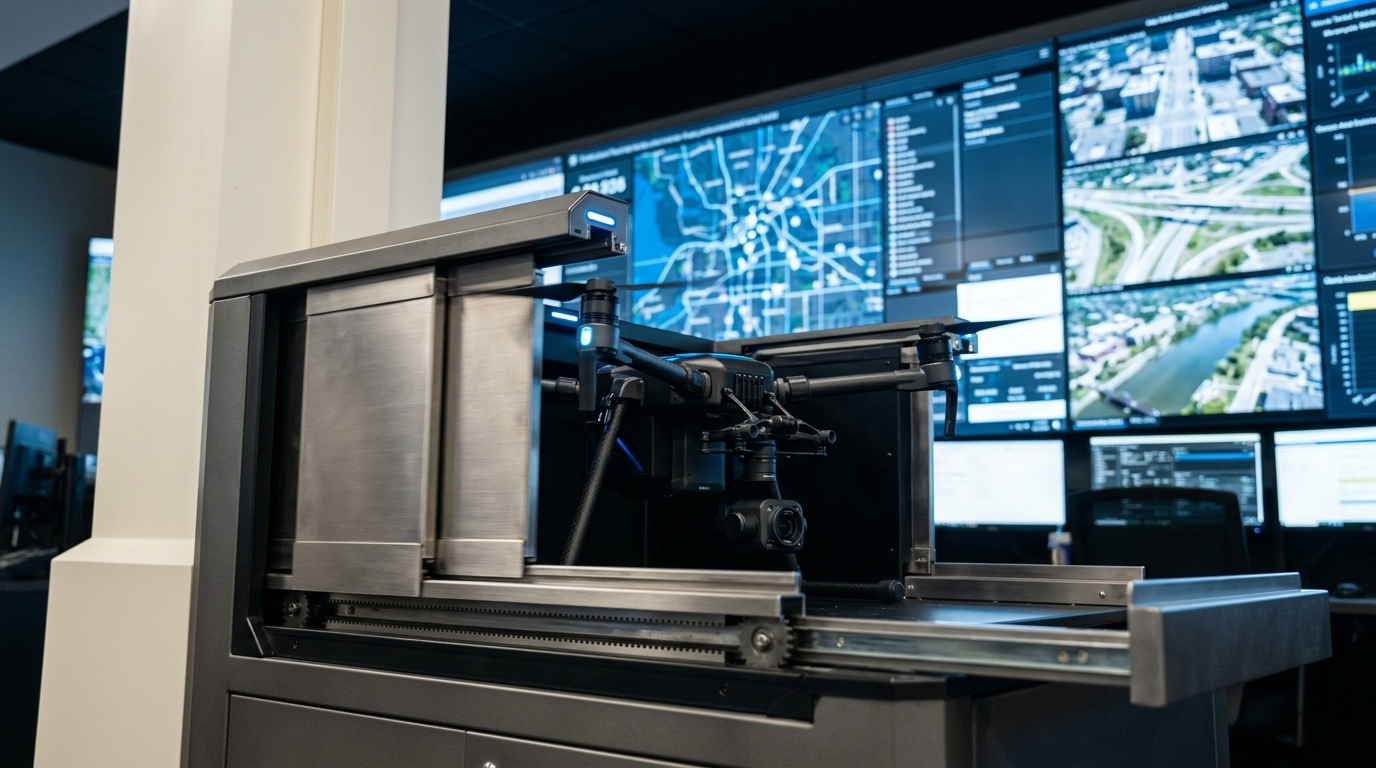
Police drone networks: A live picture within minutes
Drone networks for police control centers provide immediate aerial situational pictures. Learn about BOS rights, SORA exemptions, and system integration.
Automated drone networks are revolutionizing police work: in the Drone as First Responder (DFR) concept, drones launch autonomously upon an emergency call to provide an immediate aerial situational picture. As a BOS actor, the police benefit from legal exemptions.
Key Takeaways
- 1Automated drone networks in the DFR concept provide police with an aerial situational picture before patrol cars arrive.
- 2Under EU law (Article 2(3)), sovereign police operations are exempt from SORA approval requirements.
- 3BOS drones fly with high endurance and transmit live data securely to the control center.
- 4Control centers must independently ensure a level of safety comparable to DVO (EU) 2019/947.
- 5The wedrone Defense & Authorities division integrates hardware independent of manufacturers via the werob Platform.
Drone as First Responder: The automated aerial situational picture
When an emergency call reaches a police control center, the initial minutes dictate the outcome of the entire operation. Historically, valuable time is lost between call intake, dispatch assignment, and the physical arrival of the first patrol vehicles at the scene. The Drone as First Responder (DFR) concept closes this tactical void: permanently installed drone docking stations launch automatically upon emergency dispatch and fly directly to the incident coordinates, providing incident command and responding units with a high-resolution, real-time aerial situational picture before ground forces arrive.
The physical mechanics of weatherproof docking stations, autonomous battery replenishment, and geocoordinate-based triggering have been widely documented across industrial and private security applications. However, in the sovereign context of public safety organizations (Behörden und Organisationen mit Sicherheitsaufgaben, BOS), the primary operational leverage lies in tactical command support: dispatchers and commanders identify hazards, escape routes, physical barricades, or involved individuals before the first patrol cruiser pulls up to the perimeter.
Operational advantages before emergency forces arrive
Having an immediate tactical aerial view fundamentally transforms frontline tactics. Rather than approaching an ambiguous situation with uncertainty, patrol crews navigate and position themselves based on verified real-time reconnaissance. In a multi-month pilot project, the North Rhine-Westphalia Police (Polizei NRW) conducted around 500 operational flights and reported that drones help most with reconnaissance, forensic evidence collection, and traffic accident documentation: highways could be reopened noticeably faster after accidents, in some cases up to three hours earlier than in comparable cases handled without a drone. The state police office (LZPD NRW) put it more concretely: accident documentation that previously closed a motorway for up to four hours is now often completed within an hour.
- Early situational assessment: Rapid visual verification of incoming incident reports to optimize initial unit dispatch and perimeter containment.
- Officer safety: Tactical reconnaissance of danger zones, hostile actors, and potential ambush positions before officers enter a structure or property.
- Live suspect tracking: Continuous monitoring of fleeing perpetrators and direct transmission of telemetry and visual tracking data to approaching intercept units.
- Efficient resource allocation: Elimination of unnecessary blue-light dispatches for false alarms and faster escalation when specialized tactical units are required.
EU Drone Regulation: The exception for BOS forces
European aviation law imposes a rigorous regulatory framework on commercial and civil drone operations. For federal and state police agencies as well as other public safety organizations, however, a fundamental statutory exemption applies: according to Article 2(3)(a) of Regulation (EU) 2018/1139, harmonized EU civil aviation rules do not apply to aircraft carrying out military, customs, police, search and rescue, firefighting, border control, coastguard, or similar activities conducted under the control and responsibility of a Member State in the public interest.
The German Federal Aviation Authority (Luftfahrt-Bundesamt, LBA) confirms that public safety operations conducted within the scope of danger prevention (Gefahrenabwehr) are fundamentally exempt from the scope of Implementing Regulation (EU) 2019/947, meaning that a formal operational authorization is not required for sovereign BOS missions. For control center directors and procurement officers, this statutory exemption removes administrative friction from day-to-day operations: urgent police deployments are not stalled by the lengthy bureaucratic lead times of civilian flight authorization workflows, as public safety mandates take legal precedence.
Legal leeway for everyday control center operations
At the national level in Germany, this privilege is complemented by statutory provisions such as Section 30(1a) of the German Air Traffic Act (Luftverkehrsgesetz, LuftVG) for federal and state police forces. The LBA notes that such exemptions may only be used with due regard to public safety and order, and that special rights may only be claimed to the extent strictly necessary to carry out the task. Within that framework, police control centers can launch drone networks for an active incident without applying for a single-flight authorization.
- No single-flight operational permits: Immediate automated launch upon confirmation of a sovereign emergency incident.
- Routine beyond visual line of sight (BVLOS): Standard deployment of automated UAS missions beyond the visual line of sight of remote operators across the dispatch sector.
- Dynamic trajectory routing: Direct point-to-point transit across populated urban areas to achieve the shortest possible flight time to the target site.
Police deployment vs. SORA approval path
The core difference between police drone operations and private security or industrial site surveillance lies in the regulatory approval pathway. Commercial operators seeking to run automated beyond visual line of sight (BVLOS) flights over populated urban centers must complete the complex SORA approval path (Specific Operations Risk Assessment). That civilian methodology requires exhaustive quantitative risk assessments, technical redundancy validations, containment demonstrations, and multi-agency regulatory reviews that often span many months.
Police control centers, by contrast, act under a direct sovereign public-safety mandate. External commercial operators are not exempt from the authorization requirement and must stay within the scope of the operational authorization granted to them, whereas the LBA states that a formal operational authorization under Implementing Regulation (EU) 2019/947 is not required for public safety organizations acting in a sovereign capacity. This legal distinction ensures instantaneous operational readiness across the entire territorial jurisdiction of the police department.
| Criterion | Sovereign Police Deployment (BOS) | Commercial Security / Plant Protection |
|---|---|---|
| Legal basis | Art. 2(3) Regulation (EU) 2018/1139 in conjunction with § 30(1a) LuftVG | Implementing Regulation (EU) 2019/947 (Specific Category) |
| Authorization requirement | No formal operational authorization under Regulation (EU) 2019/947 required | Mandatory comprehensive SORA validation and formal civil aviation authorization |
| Safety level management | Duty to independently ensure a level of safety comparable to Implementing Regulation (EU) 2019/947 | Standardized compliance via SORA, SAIL mitigation tiers, hardware redundancies, and permit stipulations |
| Deployment readiness lead time | Immediate operational readiness following technical network integration | Multi-month administrative lead time for risk modeling and regulatory approval |
Duty to ensure a comparable level of safety
Although public safety agencies are legally exempt from civilian operational authorizations under Article 2(3) of Regulation (EU) 2018/1139, the statute explicitly obligates Member States to ensure that the core safety objectives of the regulation are upheld and that safe separation from all other airspace traffic is maintained. Public safety organizations carry self-administered responsibility for operating at a safety standard comparable to Implementing Regulation (EU) 2019/947.
Deviations from standard safety rules are only possible after a deliberate assessment by the incident commander. The LBA draws an explicit parallel to the "special rights" granted under the German Road Traffic Act (Straßenverkehrs-Ordnung, StVO): deviating from the rules in order to carry out a danger-prevention task may be unavoidable, but it must not create a loss of safety elsewhere that outweighs the operational objective being pursued. Police drone networks therefore have to be safeguarded organizationally and technically so that system failures, collisions, and loss of control are systematically minimized.
Practical framework for self-administered safety
To establish robust organizational and legal compliance across routine automated operations, police departments establish standard operating procedures (SOPs) and comprehensive operational manuals based on the safety benchmarks of Regulation (EU) 2019/947. These manuals define clear command hierarchies, abort criteria, and airspace deconfliction protocols.
- Manned traffic avoidance (TMPR): DFR networks must give right-of-way to manned aviation at all times, supported by live ADS-B In receiver telemetry and optical detect-and-avoid sensors, especially near low-altitude helicopter corridors.
- Defined command authority: Clear internal guidelines specifying under which tactical conditions flight paths may deviate from baseline safety envelopes and who holds decision-making authority.
- Comprehensive flight and audit logging: End-to-end recording of flight paths, telemetry logs, link stability metrics, and command inputs to satisfy statutory accountability requirements.
Technical specifications for integration
Deploying a city-wide or district-level DFR drone network requires robust, mission-critical hardware engineered for uninterrupted operational readiness. Automated docking stations deployed on police precincts, municipal rooftops, or elevated infrastructure serve as autonomous hangars that shelter the aircraft from adverse weather conditions, perform fast battery swapping or rapid inductive charging, and maintain continuous broadband connectivity with dispatch centers.
When a CAD (Computer-Aided Dispatch) emergency call is logged, the docking station automatically opens its protective canopy, initiates internal pre-flight system diagnostics, and launches the drone along an optimized 3D trajectory calculated to avoid high-risk obstacles. Dual-sensor electro-optical and thermal imaging payloads deliver stabilized video streams with high optical zoom capabilities, allowing control room staff to identify vehicle license plates, assess building access points, and track thermal signatures in darkness or smoke.
Core architectural requirements for tactical UAS
- High-availability autonomous docking: Weather-sealed IP-rated enclosures with integrated climate control, automated pad heating, and fast-charging mechanisms ensuring sub-3-minute relaunch readiness.
- Resilient multi-carrier connectivity: Redundant LTE/5G cellular uplinks paired with encrypted satellite backup links to prevent command latency and maintain continuous video transmission in degraded networks.
- Fail-safe flight control systems: Dual IMUs, GNSS with RTK positioning accuracy, emergency return-to-home algorithms, and autonomous ballistic parachute recovery systems to mitigate ground risk.
Data protection and data security during flight operations
Deploying autonomous camera-equipped aerial systems in urban environments requires strict adherence to data protection standards and sovereign cybersecurity regulations. Because police surveillance flights capture personal and situational data in public spaces, the processing of video feeds must comply with statutory police laws, the German Federal Data Protection Act (BDSG), and the General Data Protection Regulation (GDPR).
Operational drone networks implement strict architectural safeguards, including privacy-by-design mechanisms that dynamically blur non-relevant residential areas or uninvolved bystanders unless a specific criminal offense is under direct investigation. End-to-end encryption protocols protect video streams during transmission from the aircraft to the control room, preventing unauthorized interception, signal spoofing, or data manipulation.
Data protection compliance protocols
- End-to-end encrypted telemetry and video: AES-256 encrypted live streaming protocols directly into on-premises control center servers without unvetted third-party cloud routing.
- Automated retention and deletion routines: Incident-linked archiving for evidentiary court proceedings combined with automated deletion of unneeded reconnaissance recordings after statutory retention windows.
- Granular role-based access management: Strict permission tiers ensuring only authenticated dispatchers, forensic investigators, and tactical commanders access live camera controls and recorded mission data.
Procurement and manufacturer-independent integration
When modernizing control center infrastructure, police agencies and public procurement bodies face the risk of proprietary vendor lock-in. Selecting a closed ecosystem limits operational flexibility, ties future expansion to a single hardware OEM, and creates integration barriers with existing dispatch software, GIS mapping layers, and command-and-control software stacks.
The wedrone Defense & Authorities division addresses this challenge by delivering vendor-neutral system integration. Rather than locking agencies into proprietary hardware, operational integration is orchestrated through the werob Platform, enabling control centers to connect heterogeneous drone docking stations, diverse aircraft models, and specialized sensor payloads into a unified command dashboard. This hardware-agnostic architecture ensures compliance with public procurement standards while delivering seamless interoperability across diverse tactical fleets.
- Universal CAD and GIS middleware: Standardized API connectors integrating automated drone fleets directly into existing police command and control systems.
- Hardware-neutral scalability: Freedom to deploy best-in-class multirotor, fixed-wing, or hybrid VTOL drones from multiple verified OEMs without changing operator software.
- Future-proof operational resilience: Modular software architecture that accommodates future regulatory updates, sensor upgrades, and evolving tactical requirements across municipal and regional forces.
Read more: wedrone Defense & public agencies · Drone as First Responder for security teams · Drone networks for fire department control centers.
FAQ
- What does Drone as First Responder (DFR) mean for police?
- DFR refers to the automated deployment of drones that launch directly from a docking station when an emergency call comes in. They give the control center an immediate real-time aerial picture before the first responding units arrive at the scene.
- Does police need a SORA approval for drones?
- No, police fly in sovereign operations as an authority with security tasks (BOS). According to the Federal Aviation Office, no formal operating permit under Implementing Regulation (EU) 2019/947 is required for BOS in sovereign operations, while commercial operators must go through the SORA approval process.
- What requirements apply to police flight operations?
- Despite the exemption from approval, police control centers must ensure a safety level comparable to the EU Drone Regulation. This requires an operations manual that would in principle be approvable, clear deviation rules, and defined safety distances from uninvolved persons.
- How long can a modern BOS drone stay airborne?
- Flight time depends on aircraft weight, sensor payload, and weather, and for multicopters is typically in the range of a few tens of minutes per battery charge. The docking station is therefore key to continuous operation: automatic charging or a battery swap quickly restores readiness.
- How is drone data securely integrated into the control center?
- Manufacturer-independent integrators such as wedrone use specialized middleware and platforms to transmit encrypted live video streams in a GDPR-compliant way directly into the dispatch systems and the control center's central Cockpit.
Related reading
Fire department drone networks: Automatic launch on alarm
Discover how automated drone networks for fire departments provide real-time aerial intelligence before units arrive, leveraging BOS SORA exemptions.
17 August 2026drone as first responder how security teams verifyDrone as First Responder: how security teams verify alarms in minutes
See how Drone as First Responder systems verify alarms in under 5 minutes using automated landing pads, compliant BVLOS flight, and unified mission dashboards.
3 July 2026police drone deploymentDrones for police: aerial reconnaissance in active operations
Learn how police drones support manhunts, traffic accident recording, and major events, and how they are operationally controlled during active deployments.
17 August 2026drone in a boxDrone-in-a-box: what one dock actually covers in a day
The box launches in 45 seconds. That number is real and it is also the least useful one in the brochure, because a dock flies one aircraft at a time and then has to charge it. What decides whether the installation earns its place is the cycle, not the launch.
2 September 2026drone no-fly zone airport section 21h LuftVODrone No-Fly Zones at German Airports: What Section 21h LuftVO Means
An airport is not an ordinary fenced site. Section 21h LuftVO sets its own, considerably larger exclusion zones — regardless of who owns the ground underneath.
18 September 2026