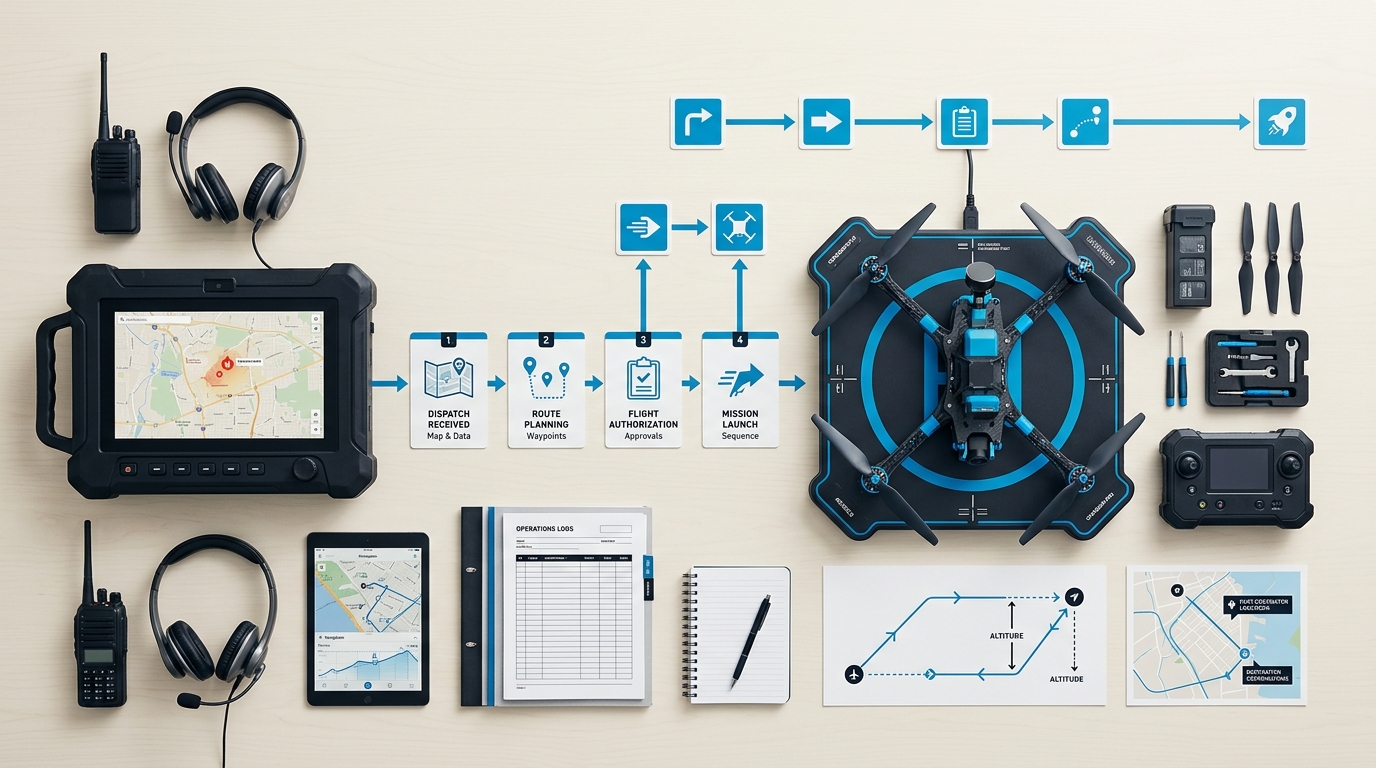
Fire department drone networks: Automatic launch on alarm
Discover how automated drone networks for fire departments provide real-time aerial intelligence before units arrive, leveraging BOS SORA exemptions.
A drone network linked to the fire department's control center automatically provides an aerial situational picture upon alarm. As BOS in sovereign deployment, fire departments are exempt from the complex SORA approval requirements.
Key Takeaways
- 1A drone network connected directly to the dispatch system delivers a live image while units are still en route.
- 2The system can launch in 25 seconds after an alarm, long before emergency services arrive at the scene.
- 3Fire departments, as BOS in sovereign operations, benefit from exemptions in the EU Drone Regulation 2019/947.
- 4Unlike commercial use, BOS operations do not require a complex SORA approval process for automated flights.
- 5Highly scalable networks are essential to support the 23,760 volunteer fire departments across Germany.
The critical time advantage: Aerial situation picture before the first vehicle
In the initial minutes of a structural fire or rescue operation, situational clarity directly determines the tactical outcome. Control centers and incident commanders face the recurring operational challenge of making critical tactical decisions based on incomplete caller information, static map data, and fragmented radio updates. Before the first fire engine or command vehicle arrives on scene, eight to ten minutes often elapse in urban districts, while transit times across rural jurisdictions frequently take significantly longer. An automated drone network connected directly to the fire department dispatch center resolves this tactical information vacuum by launching an unmanned reconnaissance unit simultaneously with the initial alarm dispatch.
Real-time tactical reconnaissance ahead of arriving crews
Triggered automatically through the Computer-Aided Dispatch (CAD) system, the unmanned aircraft reaches the incident scene several minutes before the first ground units arrive. While emergency crews remain in transit, the drone streams high-resolution optical and thermal video directly to the control center operators and mobile command terminals. This precise operational concept was evaluated by the German Aerospace Center (DLR) in the ADELE research project (Automated Drone Deployment from Control Centers, running from 2024 to 2025) in collaboration with Frequentis, Vodafone, and the Rostock Professional Fire Department: the system tasks the drone directly through dispatch infrastructure, transmitting real-time optical and thermal video streams to incident commanders before first responders reach the location.
Autonomous aerial reconnaissance fundamentally reshapes the initial size-up. Key tactical hazards such as impending flashovers, hidden fire spread across roof trusses, blocked access lanes, or hazardous materials leaks are clearly visualized before emergency personnel enter dangerous operational perimeters.
- Real-time identification of seat of fire and hidden ember pockets using calibrated thermal imaging sensors
- Verification of unobstructed access and staging routes for incoming heavy apparatus and turntable ladders
- Precise localization of casualties within structural danger zones, traffic incidents, or water rescue scenarios
- Rapid pre-arrival requests for specialized extinguishing media, hazmat resources, or additional units without on-scene delay
This immediate aerial data transforms the traditional size-up phase from a sequential, time-consuming on-site ground inspection into a parallel, data-driven operational decision process.
Drone-in-a-box: A brief look at the technology
Automated drone networks rely structurally on weatherproof docking stations (Drone-in-a-Box systems). These installations shelter the unmanned aircraft against extreme weather, autonomously cycle and recharge battery systems, and execute precision automated take-offs within seconds of receiving an encrypted dispatch trigger. The broader hangar mechanics and turnkey docking-station operations are already covered in detail in the articles on Drone-in-a-Box for industrial sites and Drone as First Responder.
For public safety control centers and municipal procurement authorities, evaluation focuses less on mechanical hangar casing and primarily on operational resilience under adverse meteorological conditions, automated sensor diagnostic routines, and robust API integration into existing dispatch systems.
| System component | Requirement for public safety control center operations | Tactical operational benefit |
|---|---|---|
| Weatherproof hangar | IP55/IP66 ingress protection rating with integrated climate control | Constant operational readiness in heavy rain, snowfall, and temperature extremes |
| Fast-charging system | Autonomous battery replenishment ensuring full readiness in under 30 minutes | Rapid turnaround capability for consecutive dispatches across the response district |
| Automated pre-flight check | Sensor-based autonomous verification of rotor integrity, payloads, and battery health | Guarantees failure-free automated launch sequences without local ground personnel |
| Redundant data link | Primary 5G cellular communication with encrypted LTE failover routing | Zero-latency HD visual and radiometric thermal streaming to dispatch consoles |
The physical hardware serves strictly as an operational instrument, delivering its core value through reliable, tamper-proof integration into municipal emergency dispatch chains.
Area coverage: Scaling for the whole of Germany
Providing comprehensive support for statutory emergency response times across an entire jurisdiction cannot be achieved by stationing individual drones at isolated flagship fire stations. Germany maintains a dense emergency response infrastructure: as of December 31, 2023, the German Firefighters Association (DFV) documented 23,760 volunteer fire departments, 114 professional municipal fire services, and 728 industrial fire departments nationwide.
From isolated systems to a resilient networked alliance
Safeguarding metropolitan agglomerations, industrial corridors, and extensive rural districts requires a cohesive network of stationary docking hubs. Standalone implementations fail due to line-of-sight constraints, flight endurance limits, and jurisdictional borders. Strategic positioning of docking stations along key geographic nodes establishes overlapping operational radii, guaranteeing immediate response by dispatching the nearest ready unit upon alarm.
- Needs assessment: Georeferenced spatial analysis of historical dispatch frequencies to pinpoint high-risk coverage clusters
- Inter-district grid layout: Positioning automated hangars across fire stations, telecommunication towers, and municipal real estate
- Redundant cell coverage: Overlapping flight radii compensate for local weather degradation or concurrent emergency calls
- Centralized fleet orchestration: Dynamic cross-jurisdictional fleet routing during mass-casualty incidents and catastrophic weather events
An integrated multi-station grid enables dispatchers to assign drone assets dynamically, executing automated cross-sector mission transfers whenever prolonged incidents demand sustained aerial observation.
BOS and sovereign deployment: The legal advantage
Operating automated unmanned aircraft beyond visual line of sight (BVLOS) represents a demanding regulatory undertaking within civil and commercial sectors. Commercial operators conducting industrial perimeter surveillance or infrastructure inspection must undergo rigorous authorization procedures under EU Drone Regulation (EU) 2019/947 within the 'Specific' category. This process mandates complex Specific Operations Risk Assessments (SORA), extensive Concept of Operations (ConOps) documentation, and operational authorizations typically detailed in BVLOS approval frameworks.
In contrast, public safety organizations (Behörden und Organisationen mit Sicherheitsaufgaben, BOS) benefit from fundamental legal exemptions when executing sovereign emergency missions. Under European aviation law, activities undertaken by military, customs, police, search and rescue, firefighting, and disaster management services are exempted from standard civil UAS operating restrictions pursuant to Article 2(3)(a) of Regulation (EU) 2018/1139. In Germany, this sovereign privilege is codified within national aviation law (§ 30 LuftVG).
Consequently, fire departments acting within their statutory public safety mandates are exempt from individual civil SORA approval procedures for emergency dispatches. This legal framework permits immediate automated launch on alert without months of site-specific administrative approvals, creating the foundation for automated drone networks in life safety operations.
Comparable safety level and documentation obligation
The statutory exemption from civil SORA procedures does not grant authority for unregulated flight operations. Public safety agencies remain legally bound to guarantee a comparable level of operational safety to protect uninvolved third parties and critical ground infrastructure during autonomous emergency deployments.
To uphold this safety standard, automated BOS drone systems incorporate redundant failsafe architectures, including dynamic geofencing around restricted airspace, autonomous Return-to-Home (RTH) routines upon telemetry interruption, automated motor anomaly detection, and designated emergency landing waypoints along every flight corridor.
Simultaneously, municipal fire services must fulfill rigorous documentation standards. Every automated mission requires complete, tamper-proof logging of flight telemetry, system health metrics, pilot-in-command oversight timestamps, and data protection compliance protocols. Implementing automated compliance management workflows generates audit-ready reports that ensure full legal accountability and operational transparency during post-incident reviews.
Organizational integration into the computer-aided dispatch system
The practical success of an automated aerial reconnaissance network hinges on seamless operational integration into existing control center environments. Deploying an autonomous drone must not introduce administrative friction or manual workload for dispatch operators handling emergency calls.
Integration occurs directly at the software interface between the CAD system (Einsatzleitsystem) and the drone fleet management server. When an operator inputs standardized dispatch keywords into the CAD console (such as residential structure fire, major transport accident, or water rescue), the system matches the incident geocoordinates against available docking stations and automatically schedules an aerial mission.
- Automated tasking: Immediate generation of flight trajectories based on incident coordinates, local terrain models, and static geofences
- Rapid launch cycle: Automated hangar opening, rotor spin-up, and launch completion within 25 seconds of dispatch confirmation
- Encrypted data routing: Ultra-low-latency video streaming delivered simultaneously into the control center video wall and responding vehicle terminals
- Human-in-the-loop governance: Dispatchers and tactical commanders retain override capabilities to abort flights, hold orbital patterns, or control camera gimbals at all times
This bi-directional data exchange ensures that the aerial stream integrates naturally into the common operating picture without altering established tactical command routines.
wedrone: Your system integrator for BOS drone networks
Establishing an automated, CAD-integrated drone network across municipal districts requires specialized systems engineering bridging emergency dispatch workflows, aviation safety standards, and robust telecommunications infrastructure. Municipalities and public safety authorities require experienced implementation partners rather than isolated hardware suppliers.
As an end-to-end systems integrator, wedrone guides fire departments, public safety organizations, and municipal authorities through the full deployment lifecycle. The integration scope spans geospatial risk analysis, site selection across municipal real estate, 5G and redundant radio link planning, direct API integration into leading CAD platforms, and procurement of proven, weatherproof Drone-in-a-Box hardware.
Through the werob platform infrastructure, agencies benefit from pre-built CAD connectors and comprehensive operations cockpit monitoring that track hardware status, automated flight logs, and regulatory compliance records. By combining robust systems architecture with dedicated public safety expertise, wedrone delivers turnkey automated aerial reconnaissance that equips command teams with immediate operational clarity when every second counts.
Read more: Drone as First Responder for security teams · Drone networks for police control centers · What's legally deployable for first responders today.
FAQ
- Does the fire department need a SORA approval for a drone network?
- No. Unlike commercial operators, fire departments act as authorities and organizations with security tasks (BOS). In sovereign operations, they fall under the exemptions of EU Regulation 2018/1139, so the demanding SORA process does not apply.
- How is the drone network integrated into the fire control center?
- The system is coupled directly to the existing computer-aided dispatch (CAD) system via dedicated interfaces. When an emergency call comes in, the control center automatically transmits the coordinates to the docking station, which then launches the drone fully automatically.
- How quickly is the drone airborne after the alarm?
- Modern drone networks connected directly to the dispatch platform can be ready to launch within 25 seconds, saving valuable time in the early reconnaissance phase.
- Who receives the drone's aerial picture?
- The high-resolution live feed is transmitted simultaneously to the control center and, via mobile devices, to the incident commander and the responding crew in the vehicle.
- What requirements does the Federal Aviation Office set for BOS drones?
- Although BOS are exempt from the standard operating-permit requirement, the Federal Aviation Office (LBA) requires that a safety level comparable to EU Implementing Regulation 2019/947 is maintained at all times.
Related reading
Police drone networks: A live picture within minutes
Drone networks for police control centers provide immediate aerial situational pictures. Learn about BOS rights, SORA exemptions, and system integration.
17 August 2026fire department dronesFire drones: situational awareness for the first crew
Fire department drones provide the first crew with life-saving situational overviews. Learn how automated reconnaissance secures real time advantages.
17 August 2026aerial reconnaissance droneDrone Reconnaissance: Legal Rules for First Responders
Learn the legal rules for BOS drone aerial reconnaissance, including sovereign operation exemptions, geozone flights, SORA 2.5, and strict GDPR requirements.
17 August 2026drone as first responder how security teams verifyDrone as First Responder: how security teams verify alarms in minutes
See how Drone as First Responder systems verify alarms in under 5 minutes using automated landing pads, compliant BVLOS flight, and unified mission dashboards.
3 July 2026tethered drone operation authorisationTethered Drones: The Permanent Aerial Standpoint Over One Fixed Site
The tether removes the endurance limit and the battery-swap cycle, and it changes the risk argument. It does not remove the authorisation. What an operator gains, what they must additionally justify, and where the limits sit.
1 September 2026