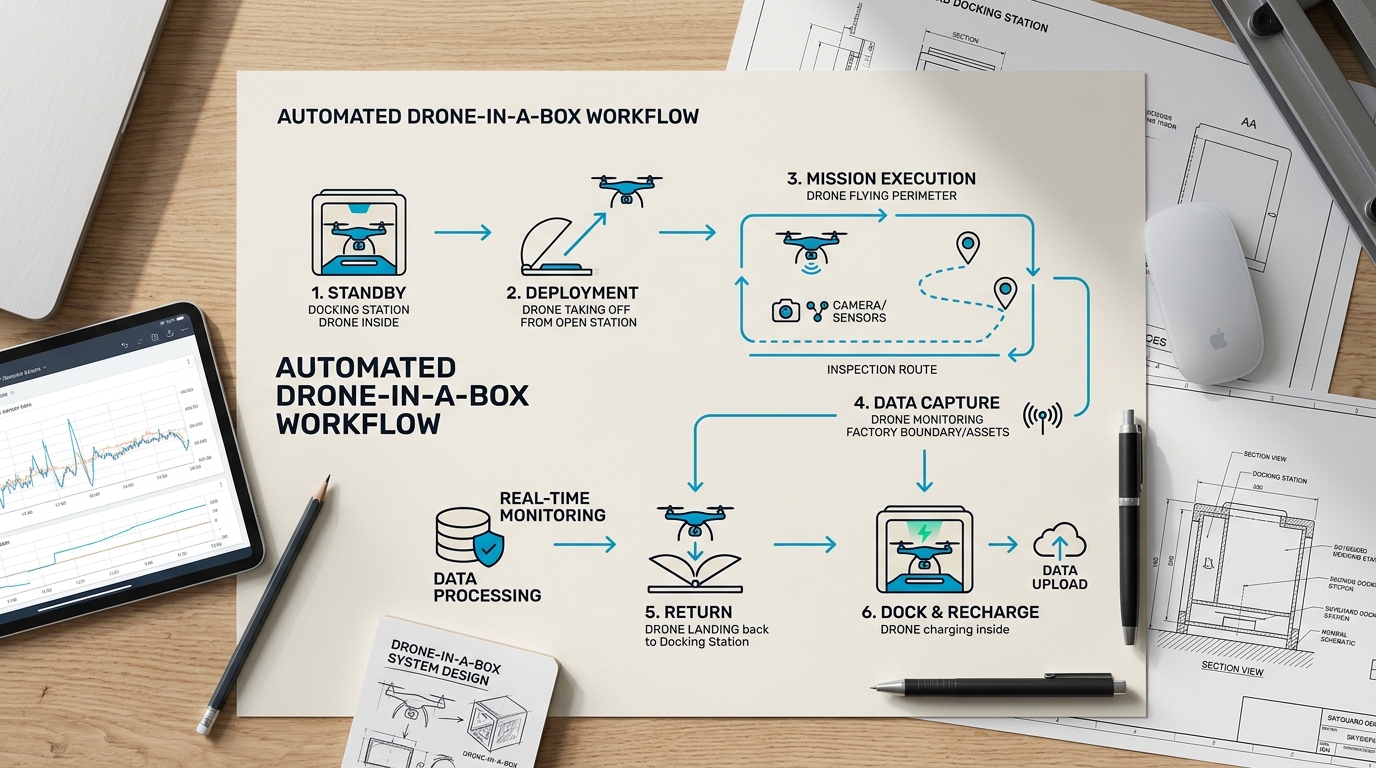
Drone-in-a-box: what one dock actually covers in a day
The box launches in 45 seconds. That number is real and it is also the least useful one in the brochure, because a dock flies one aircraft at a time and then has to charge it. What decides whether the installation earns its place is the cycle, not the launch.
Every drone-in-a-box brochure leads with the launch time, and the launch time is genuinely impressive. It is also the number that tells you least about whether the installation will do what you need. A dock holds one aircraft. That aircraft flies one sortie, comes back, and then occupies the dock while it charges. Everything that matters operationally — how many inspection rounds you get, what happens when a second alarm comes in, whether the thing works in February — follows from that cycle rather than from the launch.
Key Takeaways
- 1A dock is a single-aircraft resource. It launches one flight at a time, and the aircraft occupies the dock while charging, so sorties are serial rather than parallel.
- 2DJI publishes two figures for the Dock 2: blade detection, safety checks and take-off in 45 seconds given a robust network signal, and charging from 20 to 90 per cent in 32 minutes at 25 °C.
- 3The useful planning number is the cycle, not the launch: flight time plus roughly half an hour of charge. That is what sets how many rounds a day one dock supports.
- 4The 32-minute figure carries a temperature qualifier. The enclosure is a thermal envelope as much as a weather cover, and a dock sited outdoors in a German winter is not operating at 25 °C.
- 5Siting is the decision that cannot be revisited cheaply. Where the dock stands determines every route it will ever fly, and a fixed installation only pays where the same ground is covered repeatedly.
One box, one aircraft, one flight at a time
A drone-in-a-box installation is a weatherproof enclosure holding a drone, a charging system and enough connectivity to take a command and return a video stream. On a trigger — a schedule, a sensor, a person in a control room — the roof opens, the aircraft launches, flies a stored route and lands back on the pad.
The part that gets left out of that description is that the resource is singular. One dock holds one aircraft. While that aircraft is airborne, the dock is empty and cannot receive anything else. While it is charging, the dock is occupied and cannot launch. There is no queue and no overlap. Sorties from a single dock are strictly serial.
That sounds obvious written down, and it is routinely missed in planning, because the demonstration everyone sees is a single flight. A single flight always looks like abundant capacity. The question that decides the business case is what the tenth flight of the day looks like, and whether it can happen at the moment you need it.
The two numbers the manufacturer publishes
Take the most widely deployed reference point. For the Dock 2, DJI states that real-time blade detection, safety checks and take-off complete in 45 seconds, given a robust network signal. DJI also states a charging time of 32 minutes to bring the aircraft from 20 to 90 per cent in a 25 °C environment.
Both figures are useful and both carry a qualifier that belongs in the planning rather than in the brochure. The 45 seconds assumes the network is good; a dock at the far corner of a site on marginal coverage is not a 45-second dock, and the checks that make up those 45 seconds are the ones you would not want skipped. The 32 minutes assumes 25 °C and a partial charge band — from 20 per cent, not from empty, and to 90 per cent, not to full.
Neither qualifier is a criticism of the product. They are the ordinary conditions under which a specification is measured, and quoting the figures without them is what produces disappointed operators. The right use of these two numbers is as inputs to an arithmetic, which is what the next section does.
What that makes of a working day
The planning unit is the cycle: launch, fly, land, charge, ready. Launch is negligible at three quarters of a minute. Charge, on the published figure, is a little over half an hour under favourable conditions. So the cycle is roughly the flight time plus half an hour.
Put your own flight time in and the arithmetic does itself. A ten-minute perimeter lap on a cycle of about forty minutes gives something on the order of one lap every forty minutes, and rather fewer than that across a real day once weather holds, maintenance windows and scheduled inspection routes are taken out. A longer inspection sortie stretches the flight side and shortens the number of cycles further.
This is why the honest comparison is never "drone versus guard" but "how many covered laps do I get, at what interval". If the requirement is a lap every twenty minutes, one dock does not meet it at any flight duration, because the charge alone exceeds the interval. The answer then is a second dock, a different cadence, or a different technology — and that is a decision far better made before procurement than after.
The second alarm is the real constraint
Scheduled rounds are the easy case, because you control the timing. The hard case is event-driven use, where the dock exists to put eyes on an alarm quickly.
Here the serial constraint bites in a way that scheduling cannot smooth. An alarm comes in, the aircraft launches, verifies, returns and starts charging. For the next half hour or so, that dock cannot answer anything. If a second alarm arrives in that window — and on a site where alarms cluster, which is most sites, that is not a remote possibility — the response is whatever it was before you installed the dock.
So the specification question is not "how fast does it respond" but "what is the availability across the alarm pattern we actually have". That requires looking at your own alarm log for a year: how often two alarms fall within thirty minutes, and what the consequence of the second one going unverified would be. Operators who do that arrive at a number of docks. Operators who do not arrive at one dock and a disappointment. The wider set of things that break once a perimeter programme grows past its first site is covered in what breaks after the pilot.
The enclosure is a thermal envelope, not just a roof
It is easy to read the box as weather protection: something that keeps rain off an expensive aircraft. It does that, and it does something less obvious that matters more to the cycle.
Recall that the 32-minute charge figure is quoted at 25 °C. Charging chemistry is temperature-dependent, and the published figure is a warm-conditions figure. A dock standing on a yard in northern Europe in February is not working in a 25 °C environment unless the enclosure is actively bringing it there — which is one of the things a conditioned enclosure is for, and one of the reasons a dock draws mains power rather than running off the aircraft battery.
The practical consequence is that the cycle you planned in a summer trial is not the cycle you get in winter, and the gap is not a fault. It is the difference between a specification condition and a site condition. Ask for the charge figure at the temperature range your site actually sees, and ask what the enclosure does to close that gap. If the answer is that the enclosure is passive, plan a longer winter cycle and say so in the shift plan rather than discovering it in January.
Siting decides every route the dock will ever fly
A dock is a fixed installation. It needs a footing, mains power, network, and a piece of ground whose owner has agreed to it. Once it is there, its position sets the geometry of everything it can do: what is within range, what is within the return-to-home envelope, what the aircraft would overfly on any given route, and what lies beneath the volume it needs in a failure case.
Those are the same questions any authorisation asks, and they get asked once for a fixed installation rather than repeatedly. That is the genuine advantage of the box and the reason it suits a site that is covered over and over: the assessment is done once and stays done.
It is also the reason siting is not a facilities decision to be settled after the aircraft is chosen. Moving a dock fifty metres can change which routes are assessable. Choosing the aircraft first and the position afterwards inverts the dependency, and the cost of that inversion appears late, when the position is already poured.
Fixed box or mobile crew: which problem you actually have
The box answers one shape of problem very well: the same ground, covered repeatedly, on a cadence no one wants to staff. Where a single point is visited often enough, a fixed installation amortises its siting, its power, its network and its one-time assessment across hundreds of sorties.
Where that is not true — where the requirement is a different location every day and no point is visited often enough — the installation never amortises, and the answer is a crew that arrives with the aircraft in a vehicle. That is a different operating model with different regulatory questions, and we have set it out separately in launching drones from a vehicle. The third case, continuous presence over one fixed point rather than repeated sorties, is the tether, covered in tethered drones.
Three models, three shapes of requirement. The mistake worth avoiding is buying the one with the best demonstration rather than the one matching your cadence. Describe the cadence first — how often, over what ground, at what interval, with what response time on an event — and the model chooses itself. The German companion to this article, which covers the same technology from the site-security side, is Drone-in-a-Box: Automatisierte Drohnen für Werksgelände.
FAQ
- How many flights a day does one drone-in-a-box support?
- It follows from the cycle rather than the launch time. Take your flight duration and add the charge time; DJI publishes 32 minutes from 20 to 90 per cent at 25 °C for the Dock 2. A short perimeter lap therefore sits on a cycle of roughly forty minutes under favourable conditions, and fewer cycles fit a real day once weather holds and maintenance are taken out. A dock flies one aircraft at a time, so sorties are serial.
- Is the 45-second launch figure realistic?
- It is DJI’s published figure for the Dock 2, covering real-time blade detection, safety checks and take-off, and it carries the qualifier that the network signal is robust. On a site with marginal coverage at the dock position, it is not the figure to plan with. It is also the least decisive number in the specification, because the constraint is the cycle rather than the launch.
- What happens if a second alarm comes in while the drone is charging?
- Nothing, from that dock. The aircraft occupies the dock while charging and cannot launch again until the cycle completes. For event-driven use this is the decisive question, so it is worth checking a year of your own alarm log for how often two alarms fall within half an hour, and deciding what the consequence of the second one going unverified would be.
- Does a dock work through a northern European winter?
- It is built to, but the published cycle figure is not a winter figure. The 32-minute charge time is quoted at 25 °C, and charging is temperature-dependent. Ask for the figure across the temperature range your site actually sees, and ask whether the enclosure conditions the aircraft actively or only shelters it. Then plan the winter cadence accordingly rather than discovering it in January.
- When is a fixed dock the wrong answer?
- When no single point is visited often enough to amortise the siting, the power connection, the network and the one-time assessment. If the requirement is a different location most days, a crew arriving with the aircraft in a vehicle fits better. If the requirement is continuous presence over one point rather than repeated sorties, a tethered system fits better.
- Why does siting have to be settled before choosing the aircraft?
- Because the dock position sets the geometry of every route it can fly: range, return-to-home envelope, what is overflown, and what lies beneath the volume needed in a failure case. Moving a dock fifty metres can change which routes are assessable. Choosing hardware first inverts the dependency, and the cost of that appears late, once the position is fixed.
Related reading
Launching drones from a vehicle: line of sight, the operating site, and the containment that travels
The fixed box on the fence is well understood. The other case is the crew that arrives in a van, stays two hours and drives on. For them there is no hangar, no fixed operating site, and no containment that stays put.
2 September 2026tethered drone operation authorisationTethered Drones: The Permanent Aerial Standpoint Over One Fixed Site
The tether removes the endurance limit and the battery-swap cycle, and it changes the risk argument. It does not remove the authorisation. What an operator gains, what they must additionally justify, and where the limits sit.
1 September 2026drone landing pad businessDrone Landing Pads for Business and Home: The Last Metre of Drone Delivery
Drone delivery rarely fails because of the drone. It fails at the landing point. What a drone landing pad is, which variants exist and how wedrone plans, builds and operates pads.
3 July 2026cemetery watering robot grave care200 graves a night: the unglamorous case for robotics in grounds care
On the Waldfriedhof in Schwabach a robot waters the graves of a cemetery nursery — at night, from a 215-litre tank, at refill points the nursery had to install first. No mowing robot, no lawn, no brochure shot. That is exactly why it works.
11 September 2026cargo drone payloadCargo drones: which payload class is actually approvable in Europe today
The cargo drone conversation is about aircraft. It is settled by a number that sits in the regulation rather than the spec sheet: 25 kilograms of take-off mass. That is exactly where the whole class-mark system ends, and both standard scenarios end with it.
2 September 2026