Building-to-Building Material Transfer: Outdoor Robots
On multi-building campuses and plant sites, building-to-building material transfer quickly becomes a bottleneck once weather, ramps, and gate crossings enter the picture. This guide shows how outdoor AMRs take over these routes and how the werob Platform brings hardware-agnostic deployments live in eight weeks.
In manufacturing facilities, distribution hubs, and sprawling multi-building campuses, transporting materials between different buildings is frequently the most critical bottleneck in the internal value stream. While intralogistics processes within closed production halls and warehouses are already largely automated and precisely synchronized, the continuous flow of goods routinely breaks down at factory gates and loading docks. Conventional transport between separate building complexes still largely depends on manned forklifts, manual tugger trains, or flatbed utility vehicles, tying up valuable skilled labor on repetitive shuttle routes.
Key Takeaways
- 1Outdoor AMRs navigate autonomously via GPS, dock with 3 cm accuracy, and handle up to 300 kg payload.
- 2Modern sensor technology allows mobile robots to avoid obstacles and master gradients of up to 10 percent.
- 3The EU Machinery Regulation 2023/1230 puts cybersecurity and AI robotics in focus from January 20, 2027.
- 4The werob Spec Engine translates operator requirements into ROS-compatible action graphs within 48 hours.
- 5werob Connectors seamlessly integrate AMR fleets into existing infrastructures like SAP EWM.
The Challenge of Building-to-Building Material Transfer
This manual transfer approach is inherently vulnerable to operational disruptions. Inclement weather conditions such as heavy rain, snow, ice, or reduced visibility cause delivery delays, while unpredictable wait times at roll-up gates and airlocks compromise the cycle times of downstream assembly lines. Furthermore, mixing pedestrian traffic with delivery trucks and heavy industrial vehicles on outdoor factory roads creates severe accident risks. Intralogistics providers report that many AMR projects reach a payback period of one to three years where the process was previously manual, since unproductive empty runs disappear and material flows stay synchronized with demand, which is exactly the case for shuttle traffic handled today by manned outdoor AMRs.
- Disruption of production cycle times due to manual staging and weather-induced transit delays on campus roads
- High labor costs and tied-up personnel resulting from recurring transport runs across multiple shifts
- Increased collision risks in unorganized mixed traffic involving pedestrians, trucks, and heavy material handling equipment
- Thermal energy losses and high utility costs caused by prolonged gate opening times during manual truck passage
- Lack of end-to-end visibility and tracking gaps during goods transfer between disparate ERP or warehouse zones
Overcoming these bottlenecks requires autonomous transport systems capable of seamlessly transitioning between climate-controlled hall floors and rough outdoor surfaces without manual intervention.
Outdoor AMR vs. AGV: Technological Differences
When automating outdoor transport routes, plant managers must evaluate the technological trade-offs between traditional Automated Guided Vehicles (AGVs) and modern Autonomous Mobile Robots (Outdoor AMRs). Conventional AGVs rely on fixed infrastructure such as magnetic floor tracks, embedded induction wires, or optical reflectors mounted along building facades. On outdoor surfaces, these rigid guidance mechanisms quickly encounter physical limits: road resurfacing, frost heaves, snow accumulation, and surface dirt interrupt tracking lines and trigger costly system stoppages.
Sensor Fusion and Off-Road Capability for Outdoor Areas
Outdoor AMRs overcome these constraints through map-based Simultaneous Localization and Mapping (SLAM) algorithms coupled with redundant sensor fusion. In open campus environments, 3D-LiDAR and wheel odometry are augmented by real-time satellite positioning using Real-Time Kinematic GNSS (RTK-GNSS). This setup enhances positioning accuracy down to approximately 2 cm compared to standard satellite navigation signals, providing consistent positional repeatability even across expansive open spaces lacking vertical geometric landmarks. Ruggedized outdoor platforms feature IP65 ingress protection to withstand rain, snow, and extreme temperatures, negotiate ground thresholds, gravel, and uneven cobblestones, handle moderate ramp gradients, and tow wheeled trolleys or pallet dollies whose rated load depends on the chassis configuration.
| Feature | Classic AGV / Automated Guided Vehicle | Autonomous Mobile Robot (Outdoor AMR) |
|---|---|---|
| Navigation baseline | Fixed guide lines, magnetic tracks, reflectors | Hybrid SLAM (3D-LiDAR, RTK-GNSS, IMU) |
| Outdoor positioning accuracy | Track-dependent, prone to errors from dirt | Approx. 2 cm via RTK-GNSS |
| Path planning and obstacles | Stops before obstacles, waits for manual clearance | Dynamic obstacle avoidance and real-time rerouting |
| Terrain capability | Even indoor floors, typically IP54 protection | Gravel, uneven paving, moderate ramp gradients, IP65 rating |
| Towing capacity / Payload | Typically optimized for flat indoor floors | Rated for wheeled trolleys and pallet dollies depending on model |
Thanks to dynamic trajectory generation, outdoor AMRs steer autonomously around parked transport vehicles or temporary staging areas, ensuring uninterrupted throughput across campus roads without requiring structural ground modifications.
Outdoor Regulations: EU Machinery Regulation 2023/1230
Operating autonomous mobile robots in outdoor campus environments with mixed traffic requires compliance with rigorous safety frameworks. When transport robots exit indoor facilities and enter thoroughfares shared with trucks, service vans, and pedestrians, safety fields and emergency braking curves must adapt reliably to variable ambient conditions. This mandates comprehensive 360-degree environmental perception using safety-certified LiDAR scanners, radar units, and ultrasonic sensors that distinguish reliably between static structures and human beings under heavy rain, fog, low-angle sunlight, or ground spray.
Mandatory Requirements for Operators and Manufacturers From 2027
At the European level, the regulatory foundation for autonomous industrial machinery is undergoing a major overhaul. The EU Machinery Regulation (Regulation EU 2023/1230) supersedes the previous Machinery Directive 2006/42/EC and becomes strictly mandatory for all economic operators and plant owners on January 20, 2027. The regulation explicitly classifies self-learning autonomous software architectures and safety components containing digital logic as high-risk elements, requiring comprehensive and auditable risk assessments.
- Mandatory application of Regulation (EU) 2023/1230 starting January 20, 2027, with no transition period for placing machinery on the market under the old directive
- Classification of safety components now explicitly includes autonomous navigation software and machine learning algorithms
- Mandatory cybersecurity and corruption protection requirements (such as IEC 62443 standards) treated as integral aspects of functional safety
- Legally binding guidelines for evaluating 'substantial modifications' when retrofitting or expanding existing AMR fleets
- Adherence to safety standards for driverless industrial trucks and personal care robots, notably ISO 3691-4 and ISO 13482
Facility operators running autonomous transport systems across outdoor campus grounds must verify that the complete system architecture, including interfaces to automated gates and peripheral infrastructure, is documented for compliance and hardened against functional and digital security vulnerabilities.
From Requirement to ROS-Compatible Specification
The success of an inter-building automation initiative is largely determined during the initial specification phase. Traditional engineering requirement specifications frequently span hundreds of pages of unstructured text. These static documents are neither machine-readable nor capable of accurately modeling the complex interplay between pathway geometry, delivery cycle times, automated gate controls, and variable environmental factors, resulting in costly retrofits and project delays during commissioning.
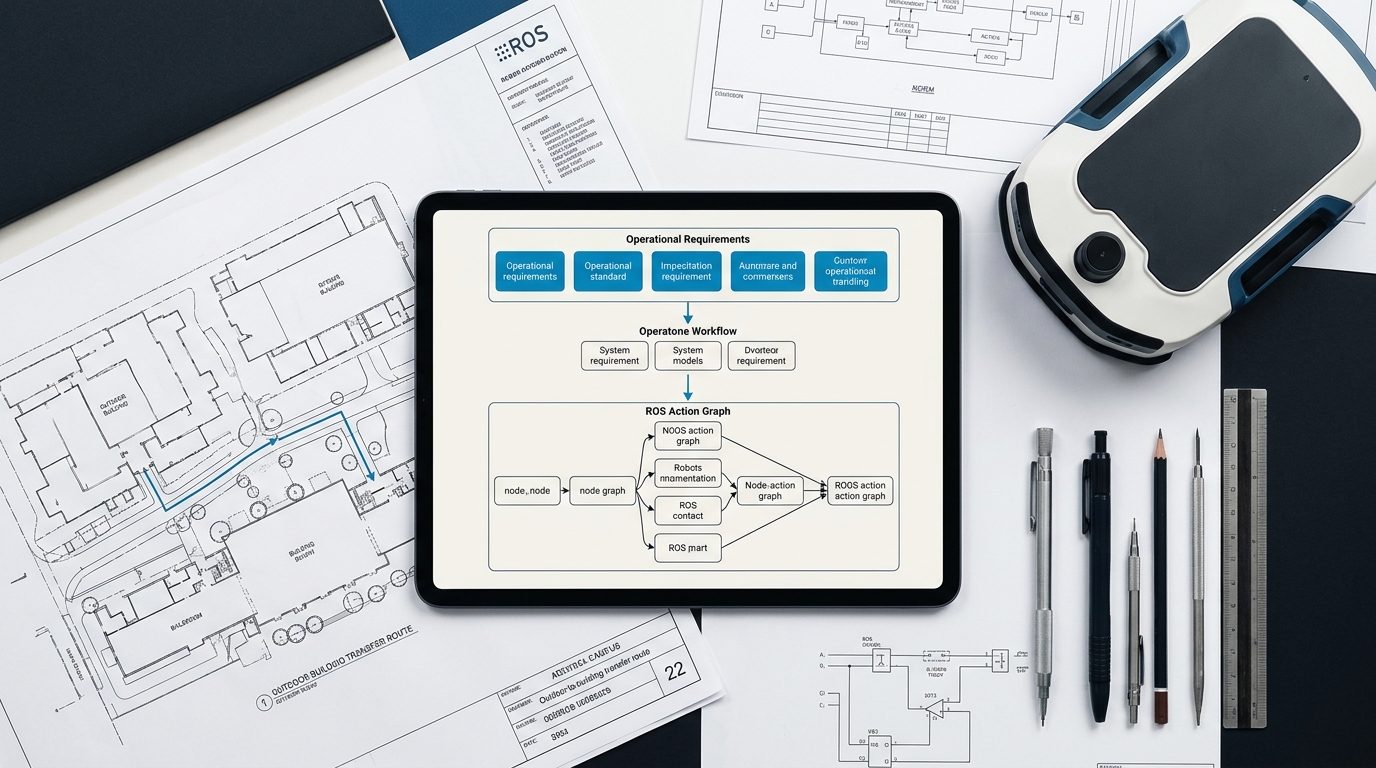
Bridging this gap requires an automated transition from operational requirements to executable robotic control code. The Spec Engine addresses this challenge by converting plain-language shift models, dispatch schedules, and campus pathway layouts into formally verified, ROS-compatible action graphs and deployment blueprints within 48 hours.
- Automated extraction of transport cycles, payload profiles, and environmental constraints directly from operational descriptions
- Generation of deterministic ROS/ROS2 state machines and navigation graphs tailored to campus topography
- Algorithmic verification of safety clearances, docking tolerances, and battery charging cycles prior to hardware procurement
- Elimination of ambiguous specifications through standardized, machine-interpretable engineering models
By establishing a mathematically validated specification before committing to hardware, robotics teams reduce integration risk and establish a clear baseline for procurement and physical testing.
Hardware Sourcing Without Vendor Lock-In
Choosing the right mobile robotic hardware for outdoor operations is a complex architectural decision. Different deployment scenarios demand diverse hardware attributes: some routes require heavy-duty towing hooks for pallet dollies, others need enclosed, weather-sealed cargo compartments, high ground clearance for unpaved terrain, or specific sensor configurations for hazardous areas. Committing to a single hardware vendor can lead to suboptimal performance across heterogeneous transport routes and creates costly vendor lock-in.
To match operational specifications with the most suitable hardware platforms, Supplier Match evaluates and ranks an extensive supplier graph of over 44 robot manufacturers. Rather than relying on static vendor marketing claims, the matching algorithm ranks available platforms across multidimensional operational criteria.
- Regulatory maturity and availability of CE documentation covering the relevant industrial safety standards for outdoor operation
- Regional service network coverage, spare parts availability, and guaranteed maintenance response times
- Physical chassis footprint, suspension design, IP ingress protection ratings, and maximum towing/carrying payloads
- Openness of software APIs, ROS2 driver maturity, and fleet management interoperability (such as VDA 5050 compatibility)
- Total cost of ownership, including initial acquisition capital and recurring service contracts
This vendor-neutral sourcing approach ensures that multi-building facilities deploy the most capable chassis for each transport segment without sacrificing architectural compatibility.
Integration Into Infrastructure and Software Stacks
Autonomous outdoor transport involves more than moving from point A to point B across open asphalt; it requires constant synchronization with building infrastructure and enterprise software. When a robot navigates between separate facilities, it must interact directly with physical access control systems, roll-up high-speed gates, interlocking airlocks, and site traffic management systems without requiring human intervention.
Software connectivity is established through pre-built Connectors, which integrate mobile robot fleets into higher-level enterprise resource planning (ERP), warehouse management (WMS), and building automation systems.
- Bidirectional integration with enterprise software stacks such as SAP EWM for real-time transport order generation and material tracking
- Automated wireless interaction with industrial fast-acting doors and security gates via industrial I/O protocols and MQTT/OPC UA bridges
- Integration with facility elevator controls and automated ramp locking mechanisms for seamless multi-level campus logistics
- Deterministic error handling and fail-safe protocols during intermittent campus Wi-Fi or private 5G cellular handovers
Direct integration eliminates manual dispatching and tracking gaps, providing supply chain managers with real-time visibility as goods transition between discrete enterprise inventory zones.
Fleet Control and Real-Time Campus Monitoring
Operating a multi-building robot fleet reliably over years requires continuous operational visibility. Outdoor deployments encounter dynamic edge cases daily: sudden severe weather, delivery vehicles blocking designated transport corridors, or transient communication interruptions. Operations teams need unified tooling to oversee fleet health, dispatch missions, and manage exceptions without navigating disparate OEM software portals.
Centralized fleet supervision is delivered through Cockpit, a unified operations dashboard that provides use-case-level monitoring across four core dimensions: hardware status, infrastructure communication, regulatory compliance, and mission specification adherence. By visualizing operational status through an integrated traffic light system, maintenance personnel and plant operators can pinpoint bottlenecks before they impact plant throughput.
- Real-time telemetry tracking battery degradation, sensor health, and drive-train metrics across all deployed units
- Continuous audit logging and export-ready compliance reporting aligned with EU safety documentation standards
- Automated escalation pathways and remote recovery routines for handling blocked path scenarios or gate communication timeouts
- Unified KPI tracking measuring transport cycle times, fleet utilization, and on-time delivery rates across the campus
By connecting automated specification, vendor-independent sourcing, pre-built infrastructure connectors, and unified operations monitoring, the werob Platform provides the complete framework needed to transition multi-building campus intralogistics from concept to live autonomous operation in eight weeks.
FAQ
- What is the difference between an AGV and an outdoor AMR?
- An AGV typically runs on predefined routes (e.g. magnetic tape), while an outdoor AMR navigates dynamically via GPS. This lets AMRs safely and autonomously route around obstacles thanks to 360-degree sensor coverage.
- What gradients can transport robots handle on a plant site?
- Rugged outdoor AMRs are built for uneven terrain and ramps. High-performance models handle gradients of up to 10 percent while carrying heavy payloads of up to 300 kg without issue.
- When does the new EU Machinery Regulation 2023/1230 become mandatory for industrial robots?
- The EU Machinery Regulation 2023/1230 becomes mandatory from 20 January 2027. It classifies software as a safety component and places greater focus on industrial cybersecurity.
- How accurate is outdoor robot positioning?
- By combining GPS with RTK (Real-Time Kinematic) correction data, modern outdoor robots achieve extremely high positioning accuracy of up to 3 cm, which makes precise docking at gates and doorways easier.
- How quickly does purchasing an autonomous mobile robot pay off?
- In multi-shift operations, an AMR often pays for itself quickly. Economic analyses of intralogistics deployments show that ROI for these systems is frequently reached within 24 months.
Related reading
Load transfer: the thirty centimetres where transport robot projects actually fail
The route is the easy part. The robot drives, and has done reliably for years. What almost never appears in a specification is the moment the load comes onto it and off again — and that is exactly where the schedule stops.
2 September 2026robot commissioning on siteHow a robot learns your building: off-site vs on-site
Understand how robots learn to navigate your building, what vendors can train off-site, and why on-site integration dictates the commissioning schedule.
27 August 2026multi-robot orchestrationGemini Robotics ER 2: what multi-robot orchestration really means for a mixed fleet
Google demonstrated a humanoid and a wheeled robot dividing a task between them. For an operator already running two vendors in one building, the interesting part is not the demo but the architecture behind it.
30 July 2026robot fiducial marker site configurationThe 146 millimetre square your inspection round depends on
Boston Dynamics specifies the printed marker Spot localises against down to the millimetre, and documents what happens when one moves. It is building infrastructure with a tolerance, and it is on nobody's maintenance schedule.
9 September 2026