Construction Robots Against the Skilled-Labour Shortage: Which Tasks Pay Off in 2026
Discover which construction robots pay off in 2026 as general contractors in the DACH region deploy automated layout, rebar, and drilling systems.
As DACH region construction firms face a forecast shortage of over 100,000 skilled workers by 2030, manufacturer-independent robotic systems like layout printers and rebar tying bots are proving their financial payoff in 2026
Key Takeaways
- 1The HDB forecast from 2022 projects a shortage exceeding 100,000 skilled workers by 2030 across 81,890 German construction companies.
- 2Automated layout printers like HP SitePrint and Dusty FieldPrinter accelerate BIM floor markings with up to 10x manual speed.
- 3The ACR TyBot ties over 1,200 rebar connections per hour, accelerating work on Germany's 40,264 federal trunk road bridges.
- 4The semi-autonomous Hilti Jaibot can drill up to 300 overhead holes per shift, drastically reducing ergonomic hazards.
The Structural Labour Crisis Facing DACH Construction Firms
The German construction sector relies on 81,890 companies as of June 2025, according to data from the Hauptverband der Deutschen Bauindustrie (HDB). For general contractors and construction firms across the DACH region, this massive ecosystem is now navigating an unprecedented structural crisis. The HDB 2022 forecast projects a shortage of over 100,000 skilled workers by the year 2030, meaning that what once seemed like a distant problem is now an imminent threat to project timelines and overall operational viability. Because of these macroeconomic labor gaps, utilizing automation to combat the skilled labor shortage has rapidly transitioned from a technological luxury to an urgent operational necessity.
- Heavy civil work and layout: Traditional surveying and layout marking are highly labor-intensive, taking up valuable hours of skilled specialists.
- Repetitive masonry and structural tasks: Boring, ceiling drilling, and rebar tying require physically demanding posture, driving high injury and retirement rates.
- Data collection and monitoring: Progress tracking often pulls experienced supervisors away from active task management, reducing overall site efficiency.
To address these mounting pressures, DACH contractors must shift from traditional, human-only crews to robotic augmentation. Rather than replacing the workforce, automated systems act as force multipliers, taking over repetitive, strenuous, or hazardous tasks so existing teams can focus on high-value execution. Managing this transition requires coordinating diverse hardware platforms across active sites. This is where a manufacturer-independent integrator like werob helps. By matching operational needs to the right robotic tools and handling software middleware, systems integrators help craftsmen and construction supervisors deploy automation seamlessly on the ground.
Manufacturer-Independent Integration: The Strategic Path Forward
Among the 81,890 construction companies operating in the German main construction industry as of June 2025, manual labor is no longer a guaranteed resource. General contractors across the DACH region must adapt to a stark reality: an official HDB forecast from 2022 projects a skilled-worker shortage exceeding 100,000 workers by the year 2030. To counter this deficit, contractors are turning to automation, yet adopting single-vendor proprietary systems often leads to expensive operational lock-ins. This is why partnering with a manufacturer-independent systems integrator like werob provides a crucial strategic advantage. Rather than manufacturing proprietary hardware, werob acts as a neutral orchestrator that connects best-in-class robotics into existing workflows.
- Sourcing without lock-in: Evaluating robotic systems across an extensive database of OEM hardware to find the perfect operational match.
- Actionable specifications: Mapping physical construction tasks into standardized, ROS-compatible technical parameters.
- Seamless middleware connectivity: Bridging the gap between physical machines and the enterprise software stacks used by general contractors.
- Fleet-wide visibility: Monitoring diverse robot brands from a single interface to track uptime, safety, and productivity.
This modular framework is powered by specialized tools designed to streamline deployment on complex project sites. Using Supplier Match, an OEM evaluation engine, general contractors can instantly screen over 44 robot manufacturers based on regional service footprint, DACH-region regulatory compliance, and specific performance specs. Once the ideal hardware is selected, Spec Engine translates plain-language site requirements into formally verified, ROS-compatible action graphs and deployable plans within 48 hours. This software-driven planning allows construction firms to implement target-oriented automation workflows without committing to a single hardware brand, ensuring that their capital investments directly alleviate the mounting labor crisis.
Laying the Groundwork: High-Speed Layout Automation
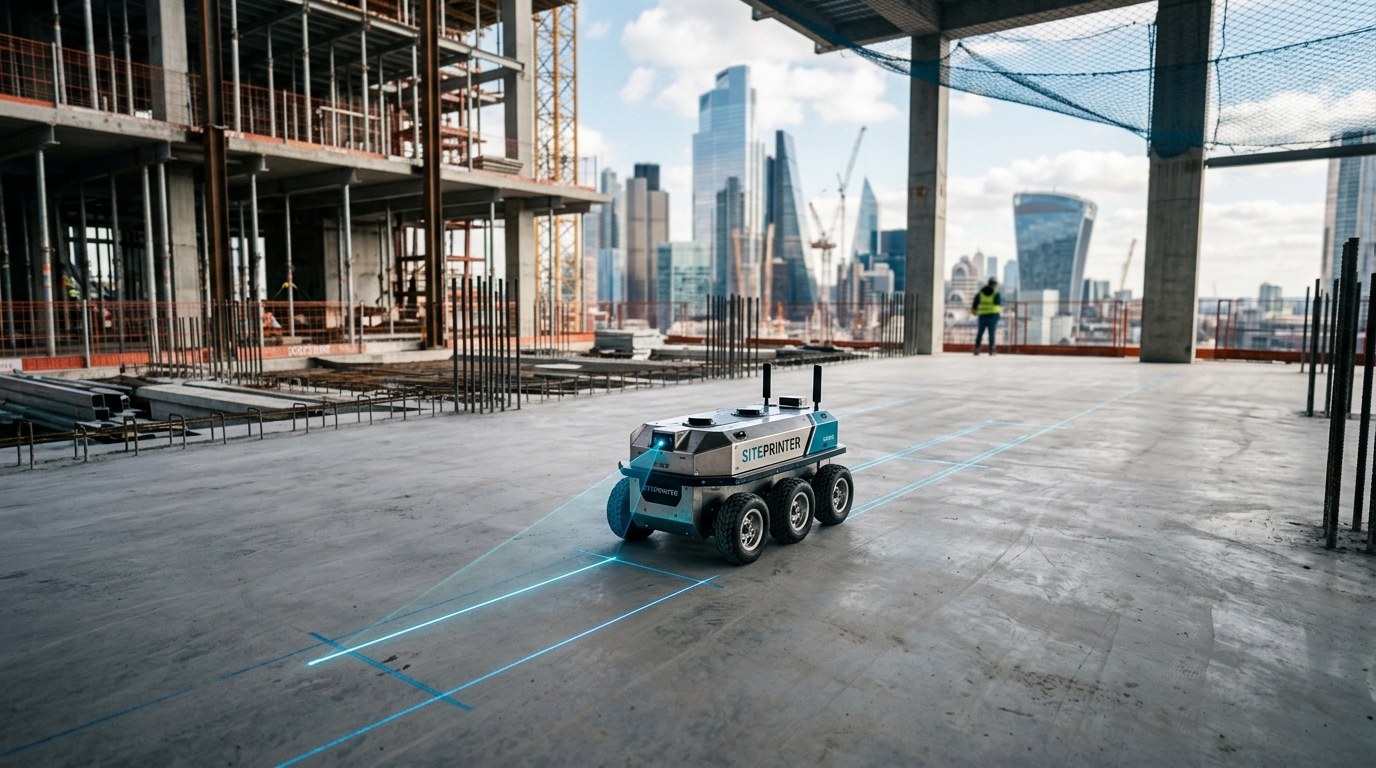
Manual construction layout is traditionally slow, physically demanding, and prone to human error. For the 81,890 construction companies navigating today's DACH market, layout deviations during the early phases of structural setup propagate downstream, causing expensive rework. This vulnerability is compounded by the forecast shortage of over 100,000 skilled workers by 2030. Rather than struggling to staff these precise roles, general contractors are deploying autonomous layout robots to translate Building Information Modeling (BIM) data directly onto site slabs up to 10x faster than traditional methods. Through software tools like Supplier Match, werob assists general contractors in evaluating and sourcing these layout systems without vendor lock-in.
| Robotic System | Accuracy Tolerance | Deployment Speed | Primary Advantage |
|---|---|---|---|
| Dusty FieldPrinter | 1/16 inch (approx. 1.6 mm) | Up to 10x faster than manual layouts | High-resolution multi-color printing on dry slabs |
| HP SitePrint | ±3 mm (up to ±2 mm in high-accuracy mode) | Up to 10x faster than manual processes | Compact three-wheel design and multi-surface capability |
Both systems represent highly effective layout solutions, yet successful deployment depends heavily on operational integration rather than raw hardware. Incorporating robotic layout into active site workflows requires translating native CAD and BIM models into execution paths. This is where the Spec Engine comes in, converting operator specifications into verified, ROS-compatible action graphs within 48 hours. By acting as a manufacturer-independent system integrator, werob ensures these high-speed systems link seamlessly to real-time site total stations, helping contractors navigate the ongoing skilled labor shortage with minimal friction. To see our latest field integrations, visit our official LinkedIn page.
Reinforcing Infrastructure: Automating Rebar Installations
Infrastructure modernization projects across Germany face unprecedented backlogs. General contractors and civil engineering firms must manage monumental workloads, including repairing 40,264 bridges on federal trunk roads (BASt, March 2026 data), expanding 37,900 km of extra-high-voltage grid (BNetzA, end 2024), and maintaining 30,906 wind turbines (end 2025). With a shrinking pool of skilled workers, manual steel reinforcement has become a primary bottleneck on these sites, directly delaying critical path operations.
Automating rebar placement is one of the most immediate ways to relieve pressure on site schedules. The ACR TyBot, a specialized autonomous rebar-tying robot, can execute over 1,200 ties per hour. By shifting repetitive, physically demanding tying tasks to autonomous systems, firms can dramatically reduce the total labor hours required for deck reinforcement. This allows existing crews to pivot to highly critical alignment and preparation work, shortening schedules without relying on additional staffing.
- High-speed performance: Achieves a tie rate exceeding 1,200 intersections per hour.
- Continuous operations: Runs for up to 10 hours without refueling to keep pace with aggressive concrete pouring schedules.
- All-weather reliability: Ties steel day or night, rain or shine, eliminating weather-related scheduling risks.
- Zero pre-mapping: Ready to operate within two hours of arrival with no manual BIM pre-mapping needed.
Deploying these heavy-duty systems on active infrastructure sites requires robust operational coordination. Rather than building proprietary hardware, werob operates as a manufacturer-independent robotics integrator. Contractors can work with werob as an automation partner to evaluate suitable systems using Supplier Match, translate task requirements via Spec Engine, and manage deployments on the werob Platform. This vendor-agnostic approach ensures that advanced robotics like the ACR TyBot deliver maximum financial return on complex civil engineering projects.
Overhead Drilling Safely and at Scale: Hilti Jaibot
Ceiling drilling for MEP installations is historically one of the most physically exhausting and hazardous tasks for manual workers on construction sites. The ergonomic strain of continuous overhead work leads to chronic rotator cuff injuries, fatigue, and heavy exposure to concrete dust. As general contractors across Germany, Austria, and Switzerland combat an acute skilled labor shortage, which the Main Association of the German Construction Industry (HDB) forecasted in 2022 to exceed 100,000+ workers by 2030, safeguarding health while maintaining momentum is critical. The Hilti Jaibot addresses this directly by removing workers from the immediate physical hazard zone, transforming their role from manual labor to machine supervision.
The semi-autonomous Hilti Jaibot operates directly from digital Building Information Modeling (BIM) data uploaded to the cloud. Using a rugged field tablet and the PLT 300 total station for spatial reference, the tracked robotic platform navigates indoor spaces to locate, mark, and drill up to 300 holes per shift with millimeter precision. This automated execution ensures absolute alignment for complex piping and cable trays, completely bypassing the manual measurements that frequently introduce human error and downstream installation delays.
- BIM-driven precision: Automatically aligns with digital design files, ensuring every anchor point matches the engineered schematics exactly.
- Dust-free operation: Employs a built-in vacuum extraction system that captures concrete dust at the point of drilling, protecting site air quality.
- Cordless endurance: Runs on a completely cordless system designed to operate continuously for up to eight hours on a single charge.
While the Hilti Jaibot provides exceptional task-specific hardware, realizing its full financial return requires seamless integration into the broader jobsite ecosystem. As a manufacturer-independent systems integrator, werob does not build proprietary robots. Instead, the werob Platform coordinates diverse technologies, ensuring that data pipelines flow smoothly between BIM engines, total stations, and scheduling tools. By managing the implementation without vendor lock-in, werob enables general contractors to deploy specialized robots exactly where they deliver the highest operational payoff.
Continuous Site Auditing: Leica and Boston Dynamics Spot
Addressing the severe labor deficit, highlighted by a forecast of over 100,000+ skilled-worker shortage by 2030 (HDB forecast 2022), requires general contractors in the DACH region to automate repetitive on-site processes. Traditional manual site auditing is slow, expensive, and introduces human error that delays project timelines. Instead of walking sites with handheld tools, teams are adopting autonomous reality capture. As a manufacturer-independent systems integrator, werob utilizes the werob Platform to design and deploy these hardware-agnostic workflows to fit the precise operational needs of construction companies.
Autonomous Reality Capture on Rugged Terrain
The most reliable workflow for continuous auditing combines the Boston Dynamics Spot quadruped with the certified Leica BLK ARC reality capture payload. Spot's four-legged agility enables autonomous data acquisition on rugged terrain, including muddy surfaces, stairs, and debris-filled spaces. By incorporating this sensor suite, the robot can execute pre-planned laser scanning paths as an automated routine without human intervention. The captured 3D point clouds are uploaded automatically to cloud platforms to generate precise, real-time digital twins of the construction site.
- Continuous Progress Verification: Automatically comparing high-density 3D scan data against building information modeling (BIM) specifications to track exact project completion rates.
- Early Clash Detection: Identifying structural deviations, such as mismatched pipe runs or displaced walls, before subsequent build phases make correcting them extremely expensive.
- Targeted Resource Deployment: Freeing scarce, highly skilled engineers from repetitive data-gathering tasks so they can focus on high-impact quality assurance and site supervision.
From Sourcing to Live Monitoring: Operating the Robotic Fleet
For general contractors in the DACH region, deploying heterogeneous robots is not merely a hardware challenge, but an integration task. As an independent automation partner rather than a hardware manufacturer, werob focuses on standardizing the software stack across diverse OEMs. For instance, executing layout scripts from HP SitePrint alongside ceiling drilling tasks from a Hilti Jaibot requires connecting these on-site units directly to enterprise software. Using pre-built software systems integration layers, specifically our Connectors middleware, general contractors can bridge active field robots directly to their core systems like SAP EWM. This mirroring of physical telemetry with enterprise resource planning mimics the latest industrial standards, where physical AI and ERP logic converge in a single loop.
- Sourcing Verification: Evaluating candidate hardware neutral-to-manufacturer through Supplier Match to ensure regional service coverage and compliance.
- Task Compilation: Converting operational specifications into ROS-compatible action graphs via the Spec Engine within 48 hours.
- API Middleware Connection: Integrating on-site fieldbus and ERP layers to centralize operational telemetry without human intervention.
- Enterprise Reporting: Dispatching completed layout, drilling, or survey data directly into corporate audit trails.
Once active on site, real-time control is consolidated within the Cockpit dashboard. This unified interface tracks progress across four core dimensions: hardware, infrastructure, regulatory, and specification. Instead of swapping between disconnected OEM apps for layout or autonomous survey, site managers monitor the entire fleet from one screen. By logging auditable training progress and real-time alerts, the dashboard helps firms mitigate the forecast shortage of over 100,000 skilled workers by 2030, transforming raw robot telemetry into clear, auditable operational success.
FAQ
- Which robotic systems are already paying off for DACH construction companies in 2026?
- In 2026, the clear financial winners are task-specific robots that handle layout, rebar tying, and overhead drilling. Layout systems like Dusty FieldPrinter and HP SitePrint reduce drawing translation times with up to 10x greater productivity. For structural and infrastructure sites, the ACR TyBot ties over 1,200 rebar intersections per hour, while the semi-autonomous Hilti Jaibot handles tedious ceiling drilling by completing up to 300 holes per shift. These systems resolve high-cost bottlenecks without requiring a full site redesign.
- How does a manufacturer-independent integrator differ from a robotics OEM?
- A manufacturer-independent integrator like werob does not manufacture its own robotic hardware. Instead, we act as a neutral integration partner. Through the werob Platform, we help construction firms plan, source, and monitor optimal setups. By utilizing tools like our Supplier Match engine, which catalogs over 44 robot OEMs, we ensure that contractors receive the best-performing equipment for their specific trade requirements without the risk of proprietary vendor lock-in.
- What role do demolition robots play in autonomous site operations?
- It is important to note that demolition robots are remote-controlled rather than autonomous. While machines like those from Brokk are highly effective at keeping human workers out of hazardous structural zones, they still require a dedicated, skilled human operator to direct every movement. This differs from fully or semi-autonomous systems like the ACR TyBot or Dusty FieldPrinter, which execute pre-planned digital blueprints autonomously with minimal direct oversight.
- How acute is the skilled-worker shortage in the German construction sector?
- The labor deficit is severe and structural. According to data from the Hauptverband der Deutschen Bauindustrie (HDB) in June 2025, there are 81,890 construction companies active in Germany. A prior HDB forecast from 2022 predicts that the German construction industry will face a shortage of more than 100,000 skilled workers by the year 2030. This structural gap is a primary driver behind the rapid adoption of site automation, as firms can no longer find enough manual workers to meet demand.
- Can layout robots handle complex concrete slabs with millimeter precision?
- Yes, modern layout robots are designed specifically for high-precision site printing. Systems like the Dusty FieldPrinter deliver a printed floor layout with an accuracy of 1/16th of an inch. By integrating Leica laser tracking with digital BIM models, these robots print precise markings, wall lines, and mechanical penetrations directly onto concrete slabs. This level of detail virtually eliminates manual chalk-line measuring errors.
- How do robotic systems help repair Germany's aging federal infrastructure?
- Germany faces massive infrastructure updates, including 40,264 bridges on federal trunk roads monitored by BASt as of March 2026, 37,900 km of extra-high-voltage grid, and 30,906 wind turbines as of end 2025. Deploying the ACR TyBot on bridge decks allows contractors to tie over 1,200 rebar junctions per hour autonomously. This high throughput ensures that heavy infrastructure projects are completed on schedule, mitigating traffic delays and labor shortages.
Related reading
Bricklaying Robots 2026: Fastbrick Systems on Site
Evaluate masonry robotics for construction in 2026. Discover what truck-mounted systems like Fastbrick's Hadrian X actually deliver on real job sites.
21 August 2026Automation against a shortage of skilled workersAutomation against a shortage of skilled workers: Operational strategies 2026
The shortage of skilled workers endangers the operational viability of entire industries. werob shows how robot fleets create operational relief within eight weeks and free skilled workers from repetitive tasks.
21 June 2026service robots against the labour shortage how facilityService robots against the labour shortage: how facility operators automate cleaning
Discover how facility operators use independent service robotics and flexible rentals to beat the cleaning labor shortage and stabilize workflows.
6 July 2026retrofit autonomy kits investment trendRetrofit Autonomy: Why Capital Backs Kits Over New Machines
Discover why capital is flowing to retrofit autonomy kits over new machines, with a deep dive into the recent Gravis Robotics and Mariana Minerals deals.
18 August 2026construction robots crane time site logisticsCrane Time Is the Scarcest Resource: Which Construction Robots Need No Pick
The crane sets the tempo of the site, and it is not going autonomous in this planning cycle. So the useful question is not which robot lifts, but which one works without booking crane time — and which one competes for the hook or the airspace anyway.
2 September 2026