Underground mining robotics: what autonomous vehicles and inspection robots do today
Where autonomous haulage is actually installed in Europe, why ATEX equipment group I decides the hardware list, what the documented German cases are, and what stays with the mine surveyor.
Underground mining is one of the few industrial settings where robotics has a genuinely old track record and, at the same time, a thin installed base in Germany. Autonomous loading and haulage are productised and running, but concentrated in a handful of countries. Inspection robots are technically available, but the explosion protection class that a firedamp-prone mine requires does not exist for most of them. This article sorts what is installed from what is announced, and names the German cases that are actually documented.
Key Takeaways
- 1German hard coal mining ended in 2018. RAG states that it raises around 110 million cubic metres of mine water per year at 12 pumping locations along the Ruhr, the Saar and at Ibbenbüren.
- 2ATEX Directive 2014/34/EU has a separate equipment group I with categories M1 and M2 for mines susceptible to firedamp. Group II covers the rest of industry. That distinction decides hardware availability almost completely.
- 3The ANYbotics ANYmal X is ATEX certified for zone 1 IIB, which is equipment group II and therefore surface industry. There is no commercially available legged robot certified for group I. The Boston Dynamics Spot has IP54 and no explosion protection.
- 4The documented German underground case is four INSPECTOS platforms from Innok Robotics in Regensburg at the K+S Werra salt mine, Unterbreizbach site.
- 5Autonomous haulage underground is installed through Sandvik AutoMine and Epiroc but concentrated in Scandinavia, Finland, Portugal, Ireland, Greece and Bosnia. Germany hardly appears. In surface mining Komatsu has exactly one European site, Boliden Aitik in Sweden with 11 trucks, and Caterpillar none that can be evidenced.
- 6Section 64 BBergG is a documentation reservation covering the mine survey record, not a monopoly on measurement. Drone flights change the frequency; the record and the responsibility for it stay with the mine surveyor.
Where underground mining robotics actually stands in Europe
Two facts frame the German situation. Hard coal mining ended in 2018, which removed the single largest deep-mining operation in the country. What remains underground is a permanent aftercare task rather than an extraction business: RAG states that it raises around 110 million cubic metres of mine water per year at 12 pumping locations along the Ruhr, the Saar and at Ibbenbüren, and that 130 kilometres of receiving watercourses have been relieved so far. That is a company figure and should be read as such, but it describes a monitoring and pumping duty with no end date, which is a very different procurement logic from a mine with a reserve life.
The active German extraction industry is largely surface and largely mineral rather than coal. According to the Bundesverband Baustoffe, Steine und Erden, the sector comprises around 4,000 companies with about 136,000 employees, 38 billion euros in turnover and roughly 570 million tonnes of raw material extracted per year. MIRO, the aggregates association, states around 2,700 plants in about 1,600 companies with roughly 23,000 direct employees and just under 500 million tonnes of aggregates per year. Both are association figures rather than official statistics and are cited here as such.
The practical reading for anyone evaluating robotics: the German demand is concentrated in aftercare, in salt and potash, and in aggregates, not in deep coal. That shifts the emphasis from autonomous production fleets towards inspection, surveying and monitoring duties, and it explains why the reference installations you can actually visit look different from the ones in vendor brochures. The wider picture across surface and underground assets is set out under mining and quarrying.
Autonomous haulage and loading: the installed base, honestly
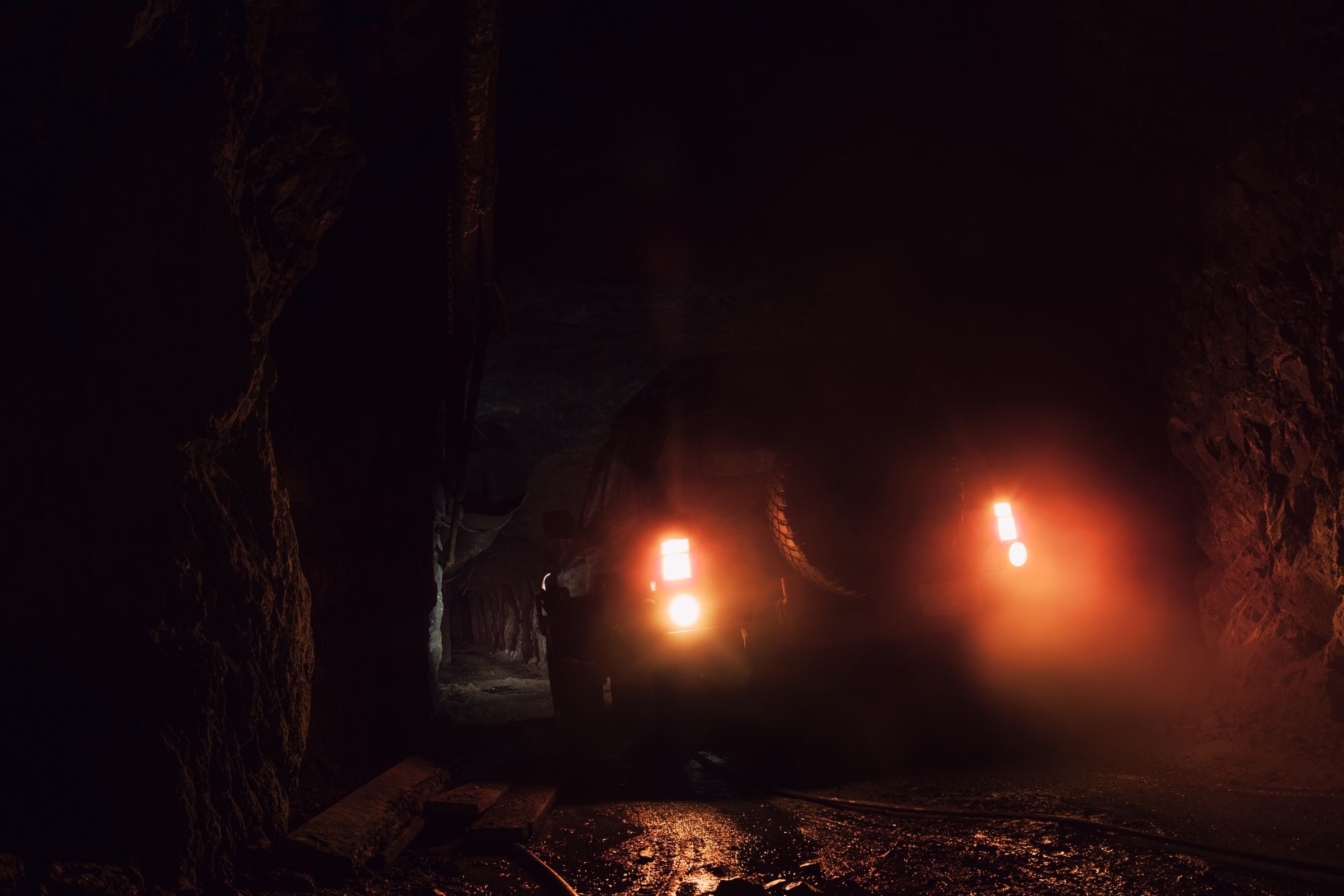
Autonomous loading and haulage underground is not experimental. Sandvik markets it as AutoMine and Epiroc has a comparable programme, both covering tele-remote and autonomous load-haul-dump machines, trucks and drill rigs, typically with a control room on surface and a defined production area fenced off from personnel. The systems are productised, supported and bought.
The geography is the part that vendor material tends to leave out. The installed base is concentrated in Scandinavia, Finland, Portugal, Ireland, Greece and Bosnia, which reflects where deep metal mining still happens in Europe. Germany barely features. Anyone benchmarking a German site against European autonomy references will find that the comparable operations are mostly abroad and mostly in ore bodies with a different geometry.
In surface mining the European picture is thinner still. Autonomous haul truck fleets, the technology most associated with mining automation in public perception, are near absent in Europe: Komatsu has exactly one European site, Boliden Aitik in Sweden with 11 trucks, and no equivalent Caterpillar installation in Europe can be evidenced. Against that background, two recent European moves are worth noting as market signals rather than as proven references. Steer, a Norwegian supplier, holds contracts for around 15 German quarries including Hermann Wegener and Hülskens/Ebel, with a first commissioning near Göttingen in the first quarter of 2026. Epiroc received a LinkOA order from Heidelberg Materials on 4 June 2026 with a stated target of more than 100 autonomous vehicles by the end of 2028. Both concern surface operations, and both are commitments rather than completed installations. The related aerial workflows are covered separately for surface mining and stockpile surveying.
One thing this article will not do is quote a productivity figure. Percentages for output gain, cost reduction or utilisation improvement through mining automation circulate widely, but the traceable ones all originate in supplier marketing. A site-specific business case built on cycle times, availability and the actual bottleneck is worth more than any of them.
Navigation without GNSS
There is no satellite navigation underground. Everything else about autonomy follows from that constraint. Vehicles and inspection robots localise themselves against the geometry of the workings using LiDAR and simultaneous localisation and mapping, supported by wheel odometry and inertial measurement, and in production environments frequently supplemented by infrastructure-based positioning such as tags or reflectors along a route.
- SLAM against the drift profile: a rotating LiDAR builds a point cloud of the surrounding rock and the algorithm matches successive scans to estimate motion. It works well in structured, unchanging drifts and degrades in long featureless sections where consecutive scans look identical.
- Inertial and odometric support: IMU data and wheel encoders bridge the gaps, which matters because wheel slip on wet floors makes odometry alone unreliable.
- Environmental interference: dust, water vapour and exhaust particulates degrade optical sensing. This is a design constraint for sensor selection, not a detail.
Communication is the second constraint and is often underestimated. Underground connectivity runs over leaky feeder cable, underground WLAN or private 5G, all with limited bandwidth and coverage that stops where the infrastructure stops. The consequence for system design is direct: a robot that streams high-resolution video continuously needs infrastructure that a robot storing data onboard and synchronising at a docking point does not. In practice this single question, how much of the network already exists, decides more procurement outcomes than the choice of chassis.
For GNSS-free mapping specifically, Exyn and Emesent with the Hovermap payload are the established market examples. They are used to produce as-built point clouds of stopes, voids and drifts that would otherwise require personnel in areas that are not entered.
ATEX group I: the constraint that decides the hardware list
The most consequential regulatory fact in this field is also the most frequently misstated. ATEX Directive 2014/34/EU distinguishes two equipment groups. Equipment group I applies specifically to mines susceptible to firedamp, with categories M1 and M2. M1 equipment must remain functional even in an explosive atmosphere; M2 equipment must be de-energised when such an atmosphere occurs. Equipment group II is everything else, the surface and general industrial explosion protection field with its zone classification.
Confusing the two makes a certificate look applicable when it is not. The clearest example is a market leader: the ANYbotics ANYmal X is genuinely ATEX certified, for zone 1 IIB. That is equipment group II, meaning surface industry such as refineries and chemical plants. It is not a group I certification and does not qualify the machine for a firedamp-prone mine. The Boston Dynamics Spot has IP54 protection and no explosion protection at all. As of today there is no commercially available legged robot certified for group I, and the same gap applies to most standard inspection robots and, in particular, to their battery packs.
This explains where robots are actually working underground in Germany. Salt and potash mines are not firedamp-prone, which removes the group I barrier. The documented German case sits exactly there: four INSPECTOS platforms from Innok Robotics in Regensburg at the K+S Werra salt mine, Unterbreizbach site. It is worth citing precisely because it is verifiable, unlike most of what circulates as underground robotics references.
Two further legal reference points belong in the same file. Operations are governed by the Bundesberggesetz with supervision by the mining authorities of the federal states and the operating plan procedure, which is where a robotic deployment has to be accommodated. And the Machinery Regulation (EU) 2023/1230 applies from 20 January 2027, which matters for any machine placed on the market from that date. Selecting hardware against these constraints is a filtering exercise before it is a technical comparison, and it is the reason the usable robot classes for industrial inspection narrow so quickly underground.
Flooded workings: the UX-1 Neo case
A substantial part of European post-mining infrastructure is under water. Shafts, galleries and pump installations in abandoned workings are inaccessible to personnel because of depth, pressure and structural uncertainty, and they still have to be characterised, because mine water management depends on knowing what the void geometry looks like.
The relevant market example here is UNEXMIN GeoRobotics in Budapest with the UX-1 Neo, a spherical autonomous submersible built specifically for flooded mines rather than adapted from an offshore ROV. Two German deployments are documented. At Käfersteige near Pforzheim the vehicle operated in November and December 2022 with 22 hours of dive time covering roughly 8.5 kilometres. At Gehren near Ilmenau a further deployment followed in March 2023.
What makes these cases technically interesting is the constraint set, which differs from open-water work. There is no GNSS and, in a flooded shaft, no acoustic surface reference either. Turbidity limits optical range far more than depth does. A tether that solves the communication problem creates a snagging problem in a collapsed drift, which is why untethered operation with onboard autonomy and later data recovery is the design choice. The same physics governs open-water inspection, which is discussed in more depth for ROV and AUV work below the surface.
Conveyor lines: the mature market is fixed sensing, not robots
Conveyor systems are the standard example when robotic inspection underground is pitched, and the honest market picture points in a different direction. For belt monitoring, the mature and purchasable technology is fixed instrumentation embedded in or mounted along the belt, not a mobile robot.
Continental and ContiTech in Hanover hold the most complete portfolio: CONTI CordProtect uses magnetic induction to monitor steel cords and has been in the field since 2008 according to the manufacturer, CONTI SpliceProtect uses magnetic markers to track splice elongation, CONTI RipProtect embeds sensor loops to detect longitudinal rips, CONTI SurfaceProtect uses laser profiling with a stated height resolution of 0.1 millimetres, and CONTI MultiProtect combines these. Inspection is also offered as a service through CordInspect, SurfaceInspect and WearInspect, and CONTI ConveyorInspect uses drones with infrared and RGB cameras to check idlers. The Hamburg brand Phoenix no longer exists independently; PHOENOGUARD and PHOENOCARE have been absorbed into the CONTI brand and should not be quoted as separate products.
On the robotics side, the reference project is instructive precisely because it did not become a product. ABB's rail-guided conveyor inspection robot CRIS, developed in Ladenburg, has explicitly remained a prototype since 2018 and no commercial successor is traceable. Further purchasable specialists in fixed sensing include Vayeron with the Smart-Idler in Australia, Beltscan and BeltSpy, whose published references are almost entirely anonymised or reduced to logo panels and should not be presented as named customer references. Voith BeltGenius ERIC from Heidenheim is sometimes listed as an inspection system, which is incorrect: it addresses energy and load optimisation and explicitly does not detect belt damage.
The conclusion is uncomfortable for a robotics narrative but useful for a buyer. If the problem is belt condition, the answer today is instrumentation. If the problem is the surrounding infrastructure, the drive station, the transfer points, the housing and the gallery itself, then a mobile platform earns its place.
Surveying, documentation and who carries the responsibility
Point clouds from drones or SLAM platforms are frequently presented as a replacement for conventional mine surveying. That is not what German mining law says, and the correct formulation matters because the incorrect one leads to a rejected operating plan.
Section 64 BBergG establishes a documentation reservation for the mine survey record, the Risswerk. It is not a monopoly on measurement. A drone flight or a SLAM point cloud is entirely permissible as a working method and can change how often a void is captured, from an annual survey to a monthly or per-blast one. What it does not change is that the record and the professional responsibility for it remain with the mine surveyor. The correct framing for an automation case is therefore frequency and personnel exposure, not substitution.
That distinction extends to the wider compliance picture. Robotic capture generates evidence: point clouds, gas readings, thermal images, timestamps. The value of that evidence depends on whether it was recorded in a form that the mining authority, the operating plan and the internal safety organisation can use. In practice this is where deployments succeed or quietly fail, more often than on the capability of the machine.
werob is a manufacturer-independent systems integrator for service robotics and a brand of CITO GmbH in Hamburg. werob does not manufacture hardware and does not operate robots itself. In this segment the useful contribution is the filtering work described above: sorting candidate systems by the explosion protection class the site actually requires, by what the existing underground communication infrastructure can carry, by service coverage within reach of the site, and by whether the resulting data can be handed to a mine surveyor, an authority or an asset management system without manual rework.
FAQ
- Which ATEX class do underground inspection robots need?
- Mines susceptible to firedamp fall under equipment group I of ATEX Directive 2014/34/EU, with categories M1 and M2. M1 equipment stays functional in an explosive atmosphere, M2 equipment must be de-energised when one occurs. Group II, the familiar zone classification, covers surface industry and does not qualify a machine for such a mine. Most standard inspection robots and their battery packs do not exist in group I.
- Is the ANYbotics ANYmal X approved for underground mining?
- Not for firedamp-prone workings. The ANYmal X is ATEX certified for zone 1 IIB, which is equipment group II and therefore surface industry such as refineries and chemical plants. There is currently no commercially available legged robot certified for equipment group I. The Boston Dynamics Spot has IP54 protection and no explosion protection at all.
- Are there documented robot deployments in German mines?
- Yes. Four INSPECTOS platforms from Innok Robotics in Regensburg are in use at the K+S Werra salt mine, Unterbreizbach site. Salt and potash mines are not firedamp-prone, which removes the ATEX group I barrier that blocks most inspection robots in coal mining. For flooded workings, UNEXMIN GeoRobotics deployed the UX-1 Neo at Käfersteige near Pforzheim in November and December 2022 with 22 hours of dive time over roughly 8.5 kilometres, and at Gehren near Ilmenau in March 2023.
- How do underground vehicles navigate without GNSS?
- There is no satellite reception underground. Vehicles localise using LiDAR-based simultaneous localisation and mapping against the geometry of the workings, supported by inertial measurement and wheel odometry, and often by infrastructure-based positioning along a route. Dust, water vapour and exhaust particulates degrade optical sensing, and communication runs over leaky feeder, underground WLAN or private 5G with limited bandwidth.
- How widespread is autonomous haulage in Europe?
- Underground it is established through Sandvik AutoMine and Epiroc, but concentrated in Scandinavia, Finland, Portugal, Ireland, Greece and Bosnia. Germany hardly appears. In surface mining, autonomous haul truck fleets are near absent in Europe: Komatsu has exactly one European site, Boliden Aitik in Sweden with 11 trucks, and no equivalent Caterpillar installation in Europe can be evidenced.
- Can drone surveying replace the mine surveyor?
- No. Section 64 BBergG creates a documentation reservation for the mine survey record, not a monopoly on measurement. Drone flights and SLAM point clouds are permissible working methods and can raise the frequency of capture considerably, but the record and the professional responsibility for it stay with the mine surveyor.
Related reading
Drones in surface mining: stockpile survey, blast monitoring and settling basins
What drone surveying actually delivers in quarries and open pits: stockpile volumes, highwall mapping, blast monitoring and settling basins, and where the responsibility of the mine surveyor begins.
24 July 2026autonomous trucks mining investment$310M Bet: Autonomous Trucks Make Stranded Mines Viable
Mariana Minerals raised $310 million to advance autonomous trucks in copper mining. Discover how autonomous haulage makes stranded mines economically viable.
18 August 2026subsea robotics rov auv inspectionSubsea robotics: what ROV and AUV inspection delivers today
German offshore wind sits in 31 m of water on average. That single figure decides which underwater vehicle, which vessel and which approval an inspection campaign really needs.
22 July 2026sewer inspection robotSewers, treatment plants and the places nobody should enter
Inspection robotics in waste water is an occupational-safety measure before it is anything else. Why coded condition data beats video, and what has to be specified so findings land in the asset register.
28 August 2026construction excavator retrofit autonomyRetrofit vs Replace: SoftBank's Signal for Excavators
SoftBank's $200 million investment in Gravis Robotics signals a shift toward retrofitting existing heavy excavators with autonomous AI kits.
18 August 2026