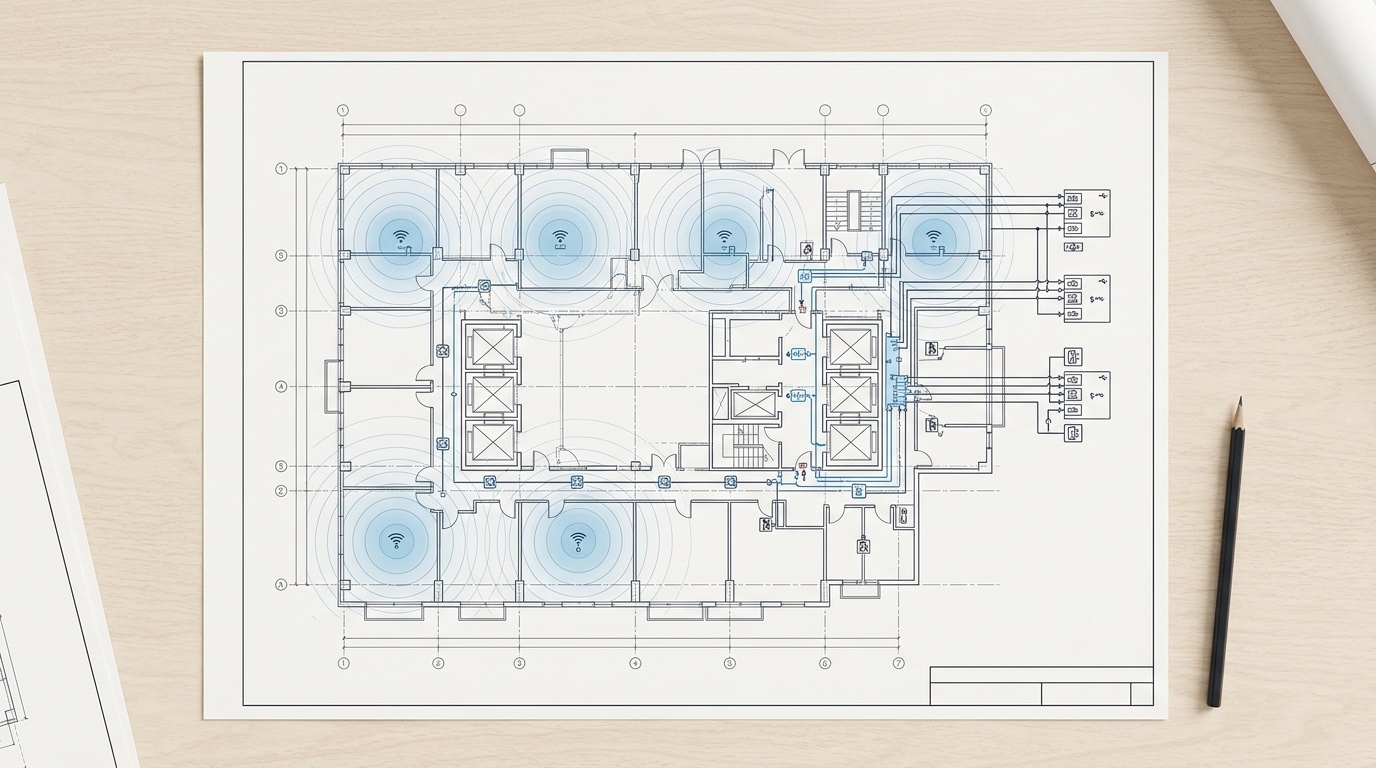
How a robot learns your building: off-site vs on-site
Understand how robots learn to navigate your building, what vendors can train off-site, and why on-site integration dictates the commissioning schedule.
The arrival of a robot is not the start of value; it is the beginning of the site-learning phase. While vendors can pre-train generic capabilities, a realistic commissioning schedule relies entirely on resolving on-site access for lifts, fire doors, and WLAN.
Key Takeaways
- 1Vendors can pre-train generic capabilities like manipulation and speech off-site, but not your specific floorplan.
- 2Funding of up to 1.4 billion US dollars highlights the push for dedicated robotics training centres to pre-train typical scenarios.
- 3Fire doors are critical integration points: deficiencies account for 45% of citations in US critical access hospital surveys.
- 4True schedule risks arise from on-site access constraints, such as opening a network VLAN or booking a lift technician.
- 5Site learning is an infrastructure and governance exercise, so staff and works council briefings belong before delivery, not after.
The limits of off-site training: why arrival is just the start
Off-site robotics training centres validate fundamental motor skills and conversational routines before hardware ships, but physical delivery marks the beginning of site learning rather than the immediate start of autonomous operations. Simulating tasks in a controlled mock facility allows manufacturers to refine kinematics, but it cannot account for the real-time friction, variable layouts, and shifting access protocols of an active commercial property.
Industry announcements have placed this staging model in the public spotlight. In June 2026, NEURA Robotics announced a Series C funding round of up to 1.4 billion US dollars to expand its production and accelerate the global rollout of dedicated training facilities known as NEURA Gyms[1]. At ITB Berlin 2026, hotel operator PLAZA Hotelgroup and NEURA presented their collaboration on the 4NE1 humanoid robot, and said the system is intended to support reception, service and housekeeping, with training taking place in the NEURA Gyms alongside hospitality practitioners[2][3].
For facility executives, hotel operations managers, and care home directors, distinguishing between announced testing and proven live-building deployment is essential. Controlled gyms prove that a robotic platform can execute a task under idealised conditions. They do not prove how that same platform handles an unmapped laundry trolley at 06:00 or a fire door interface during an unannounced drill.
| Training Dimension | Off-Site Testing Facility | Live Operating Building |
|---|---|---|
| Object Geometry | Standardised items with uniform weights and textures | Worn, non-uniform items and unlisted floor debris |
| Spatial Environment | Static walls, fixed lighting, and predictable clearances | Shifting furniture, visiting crowds, and temporary blockages |
| Network & Signals | Dedicated low-latency wireless coverage | Dead zones in lift shafts, fire corridors, and sub-levels |
| Human Interaction | Trained engineers following scripted interaction rules | Residents, guests, and hurried staff moving unpredictably |
Understanding this boundary allows operators to budget time accurately. The work done in a training centre ensures that hardware arrives functional, but the site-learning phase determines whether the deployment delivers actual labour relief on the floor.
What vendors can genuinely pre-train off-site
Robotics vendors can reliably pre-train universal physical mechanics, baseline sensory perception, and general conversational dialogue off-site because these capabilities do not depend on the specific geometry or rules of an individual building. When a machine learns how to balance its chassis, calculate arm trajectories, or parse spoken sentences, that training transfers directly to any physical installation.
Universal motor skills and standardised handling
Foundational physical interactions remain consistent regardless of the facility. Grasping a standard room-service tray, picking up a folded towel, or carrying a tote box relies on deterministic physics and computer vision models trained across thousands of object variations. Vendors can establish reliable gripping forces, acceleration profiles, and basic obstacle clearance routines long before the machine arrives on site.
- Manipulation and grasping mechanics for standardised objects such as trays, linen bundles, and storage bins.
- Generic sequential workflows, including picking up an item, traversing an open corridor, executing a handover, and returning to base.
- Speech recognition and natural language processing for multi-language guest greetings and basic voice commands.
- Visual object classification against common categories, distinguishing between humans, static walls, and rolling carts.
- Fundamental safety reflexes, including sensor-based speed reduction, emergency stop activation, and certified braking distances.
These five domains represent pure machine competence. When evaluated in a testing laboratory or training centre, they demonstrate that the robotic hardware can execute basic motions safely without damaging itself or its surroundings. However, executing a trajectory in an open test bay is fundamentally different from executing that trajectory within the daily operating rhythm of an occupied building.
What can only be learned in your specific building
A service robot can only learn dynamic environmental state, mechanical access rules, and institutional habits once it is deployed inside your specific property. While a vendor can supply a map-making algorithm, the machine cannot know how your building behaves until it experiences live operational traffic.
Building infrastructure and environmental boundaries
Every building possesses unique physical and digital interfaces that cannot be replicated in an off-site laboratory. Integrating navigation systems with lifts and fire doors requires testing the exact relays, hold-open magnets, and call priority logic installed on your site. If a service lift prioritises emergency calls or staff keys over automated dispatch requests, the robot must learn how to handle hold times without blocking lobby traffic.
| Building Variable | Off-Site Assumption | Live Facility Reality |
|---|---|---|
| Lift Dispatch | Instant API acknowledgement and immediate car arrival | Controller delays, full car bypasses, and priority overrides |
| Fire Barrier Doors | Standardised electromagnetic hold-open releases | Varied release tensions, mechanical latch friction, and strict closure rules |
| WLAN Coverage | Seamless roaming across enterprise access points | Handover packet loss at reinforced stairwells and lift lobbies |
| Corridor Access | Clean pathways matching digital architectural plans | Laundry cages parked at 06:00 and visitor crowds at 15:00 |
Operational friction and informal site habits
Beyond structural mechanics, a live building functions through informal operational rhythms. The morning change of shift creates concentrated foot traffic that alters corridor transit times. In care facilities, residents may position walking aids along hallway handrails, while hotel housekeeping teams stage linen hampers outside guest rooms during morning turnover.
These patterns constitute site state rather than machine capability. A robot cannot be pre-trained to anticipate that the Tuesday morning food delivery temporarily blocks the ground-floor freight corridor. That exception logic must be established directly against the actual operational schedule of the facility.
Why the site-learning phase is the true schedule risk
Commissioning schedules slip during site deployment not because robot algorithms fail, but because administrative access, contractor coordination, and local infrastructure constraints create cumulative delays. When an operator signs a lease or purchase agreement, delivery is often perceived as the milestone of automated productivity, but in practice it is simply the starting line of on-site system integration.
What consumes weeks during commissioning is rarely robotics engineering. Instead, project timelines stall on practical friction points: waiting three weeks for a certified lift technician to install an interface board, coordinating with central IT to open a dedicated local VLAN, or securing approval from a building surveyor for automated door closures. When deploying care robotics or hospitality transport units, these delays compound quickly if tasks are tackled sequentially rather than prepared in advance.
- Hardware delivery arrives on site, but the machine remains in its transport crate while network credentials are processed.
- Initial mapping begins, immediately revealing wireless dead zones in reinforced concrete corridors that prevent dispatch signals.
- Lift integration testing is delayed because the third-party maintenance contractor requires four weeks advance notice for on-site wiring.
- Staff on the morning shift encounter an unannounced robot in the service corridor, prompting operational complaints and works council queries.
- The project schedule slips from eight weeks to four months while administrative dependencies are resolved one by one.
Recognising that site learning is primarily an infrastructure and governance exercise changes how an organisation prepares. When managers treat commissioning as an operational integration rather than a hardware unboxing, they can address technical bottlenecks before the equipment ever reaches the loading dock.
Preparing your building before delivery: IT, lifts and doors
Preparing physical infrastructure and network access prior to delivery eliminates the primary technical bottlenecks that stall on-site robotic commissioning. By resolving electrical, wireless, and mechanical dependencies early, operators ensure that the on-site phase focuses entirely on route validation and staff orientation.
Elevator interfaces and fire safety compliance
Vertical transport and compartmentation require early technical coordination. Automated elevator calling requires an interface between the robotics dispatch server and the elevator controller, which frequently demands involvement from the lift maintenance provider. Engaging that contractor weeks before delivery avoids holding the entire deployment in a single floor zone.
Fire barrier compliance must be coordinated directly with the designated fire safety officer. Fire-rated doors operating on magnetic hold-open systems require verified release triggers to ensure life-safety protocols remain uncompromised. Ensuring strict adherence to fire safety regulations is critical across healthcare and commercial buildings: data from the Accreditation Commission for Health Care indicates that deficiencies with fire-rated door assemblies account for 45% of total citations in critical access facility surveys[4]. Any automated system passing through these openings must integrate seamlessly with existing building protection concepts.
On the digital side, enterprise IT teams require written technical specifications detailing required bandwidth, subnets, and roaming protocols. Walking the planned transit path with a Wi-Fi signal analyser identifies signal drop-offs inside lift lobbies and service basements before navigation testing begins.
Preparing your team before delivery: baselines and ownership
Operational readiness depends on establishing single-point accountability, clear escalation paths, and transparent communication with frontline staff and employee representatives before hardware arrives on site. A machine that functions mechanically will still fail operationally if shift workers view it as an obstacle or an unmanaged burden.
Route auditing and operational ownership
Site surveys must take place at the exact time of day the robot will operate, using the machine's actual turning radius and physical dimensions. A corridor that appears wide and clear during a 10:00 walk-through with an architect may be impassable at 06:00 when laundry cages and cleaning carts are staged for morning service. A five-year case study of 34 staff working with ten social and service robots, including meal and laundry transport units, in an Australian aged care facility found only conditional acceptance, scepticism about reliability, and differing views between management and frontline staff, and concluded that a supportive environment, robust infrastructure and adequate training decide whether adoption holds[5]. The same coordination logic applies to commercial cleaning robots running a fixed nightly route.
- Conduct route surveys with the robot's physical dimensions at the specific hours of scheduled transit to identify recurring physical blockages.
- Designate a single internal project owner with operational authority and dedicated weekly hours, rather than delegating oversight to a committee.
- Establish written fault-resolution procedures defining response times and responsibilities when an exception occurs after vendor technicians depart.
- Measure a clean baseline of the target manual task before arrival to evaluate labor reallocation and cycle times accurately.
- Initiate consultation with frontline staff and the works council before delivery, explaining operating parameters, safety systems, and shift roles.
Early communication ensures that employees understand the machine's operational boundaries. When nursing staff, housekeepers, and facility crews understand what the robot is programmed to do and who resolves routing stops, daily adoption proceeds without disruption.
What an eight-week commissioning schedule realistically requires
An eight-week commissioning timeline is a realistic target for a single-site commercial deployment when infrastructure access, physical route validation, and administrative sign-offs are secured before delivery. When technical prerequisites are addressed during the pre-delivery phase, the eight-week window provides adequate time for on-site mapping, edge-case tuning, and shift integration.
Roadmap and schedule risks
Timelines extend when unforeseen technical or organisational dependencies emerge during on-site testing. Identifying these risk factors in advance allows project managers to protect the deployment milestone.
| Phase | Core Deliverables | Key Dependency for Success |
|---|---|---|
| Weeks 1 to 2 | Site survey, IT network provisioning, lift contractor engagement | Single designated project owner and written IT clearance |
| Weeks 3 to 4 | Physical mapping, door interface testing, baseline task measurement | Building access permissions and fire safety sign-off |
| Weeks 5 to 6 | Live shadow runs, staff workflow training, exception logging | Frontline team briefing and active shift participation |
| Weeks 7 to 8 | Autonomous operation, performance audit, handover to local team | Agreed maintenance escalation paths and SLA protocols |
The factors that push schedules beyond eight weeks are predictable: elevator controllers that require hardware upgrades, unresolved fire-door control interfaces, discovering Wi-Fi dead spots only after unboxing, or beginning works council discussions after delivery. Addressing these items upfront keeps the deployment on schedule.
To streamline this process, the werob Platform coordinates end-to-end integration by auditing physical routes, configuring system interfaces, and assigning clear operational ownership before hardware arrives on site. By securing building readiness in advance, operators eliminate unnecessary delays and transition service robots into productive daily workflows.
FAQ
- What tasks can a service robot learn before arriving on site?
- Vendors can pre-train pure capabilities that do not rely on a specific floorplan. This includes grasping standard objects, executing basic sequences like handing over a tray, speech processing, and adhering to standard safety stopping distances.
- Why do robots struggle with fire doors in hospitals and care homes?
- Fire doors are complex because they are tied to life safety systems, and deficiencies account for 45% of citations in US critical access hospital surveys. A robot must interface securely with the building's fire safety concept to pass through hold-open magnets without compromising the release logic.
- How does WLAN coverage affect mobile robot commissioning?
- Robots depend on continuous network access for navigation updates and task instructions. Dead spots in WLAN coverage, particularly in lift shafts and long corridors, cause the system to stall. Operators must test coverage along the actual route prior to delivery.
- What causes the longest delays during robot deployment?
- The longest delays are rarely caused by the robotics hardware itself. Schedules slip due to access constraints, such as waiting for a lift contractor to modify a controller, opening a network VLAN, or finding a single internal owner with the authority to make integration decisions.
- How do residents and guests typically react to a newly deployed robot?
- Reactions vary, and a five-year Australian aged-care case study found only conditional acceptance among staff, with scepticism about reliability. Briefing staff and residents before delivery, and naming who resolves a stoppage, matters more than the machine's interface.
- Is an eight-week commissioning timeline realistic for service robots?
- Eight weeks is achievable for a well-prepared single-site deployment, provided that the route is surveyed, lift access is arranged, the network is tested, and an internal owner is named beforehand. Delays in any of these IT or facility integrations will push the schedule out.
Related reading
The 146 millimetre square your inspection round depends on
Boston Dynamics specifies the printed marker Spot localises against down to the millimetre, and documents what happens when one moves. It is building infrastructure with a tolerance, and it is on nobody's maintenance schedule.
9 September 2026layout robot construction siteLayout robots on site: printing BIM onto the slab to the millimetre
Discover how layout robots print BIM models directly onto concrete slabs with millimetre precision to eliminate manual errors and coordinate all trades.
17 July 2026hoeing robot sugar beet mechanical weed control20 hectares per robot per season: what changes when the machine hoes instead of sprays
On the Kirschgartshausen trial farm the hoeing robot left 26,000 weeds per hectare standing; broadcast spraying controlled 97 to 99 percent. The arithmetic is still not as simple as those two numbers sound — and the Bavarian state institute measured the part the brochure leaves out.
11 September 2026sorting robot quality control packaging wasteThe last picking station: what a sorting robot changes at the end of the line — and what it does not
In 2022 a waste company in Swisttal put a picking robot not at the start of its packaging-waste plant but at the end, where the PET stream is almost pure and every missed pick is expensive. The operator itself says what the robot replaces and what still happens by hand.
11 September 2026commercial cleaning robots autonomyCommercial Cleaning Robots: Beyond the Pilot Phase
Discover why commercial cleaning robots have moved from pilot projects to standard equipment, and how operators are integrating autonomous fleets at scale.
24 August 2026