Cleaning Robot Clinic Provider: System Integration for Daily Clinical Operations
The selection of the right cleaning robot for clinics often fails due to hardware fixation. werob solves this problem as a systems integrator through a 48-hour specification and manufacturer-independent ranking of over 44 OEM partners.
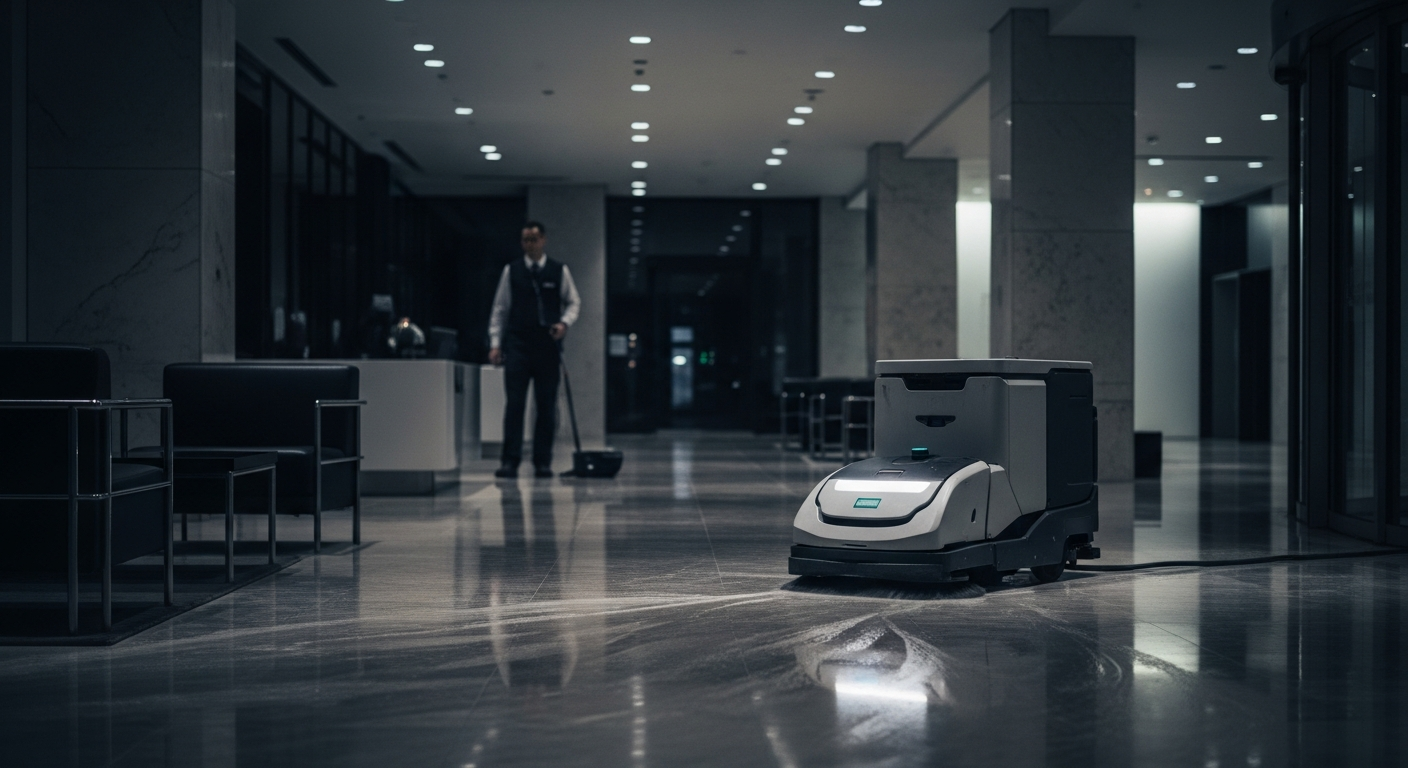
Tuesday, 3:15 AM. The corridor of the surgical ward in the west wing is deserted. While the night staff prepares the medication round, an autonomous cleaning robot silently runs its paths. It cleans 1,200 square meters of floor space according to precisely defined hygiene standards. In the morning, the housekeeping management will find the seamless digital cleaning record for the next inspection in the central cockpit. This process is not an isolated technical project, but the result of precise system integration that has translated the clinical workflow into an automated specification.
Key Takeaways
- 1Manufacturer independence protects from vendor lock-in and enables the selection of the best hardware for clinical hygiene requirements.
- 2The EU Machinery Regulation 2023/1230 mandatorily requires a qualified integration partner for legally compliant operation from 2027.
- 3Measurable cost relief of up to 44,000 euros per year in cleaning makes automation highly economically attractive.
The Provider Market: Why Hardware Alone Fails in Clinics
Clinics and hospitals face the challenge that the market for cleaning robotics is confusing and fragmented. Many providers focus exclusively on the sale of their own hardware. For a director of operations or a head of facility management in a clinic, this often means a vendor lock-in that restricts flexibility. A single robot does not solve a staffing problem if it is not seamlessly integrated into the existing infrastructure and the strict hygiene plans.
werob acts here not as a classic reseller, but as a hardware-agnostic systems integrator. With a catalog of over 44 OEM partners and 280 deployable robot models, werob evaluates the hardware objectively against the specific requirements of the clinical environment. Factors such as disinfection compatibility, navigation safety in busy corridors, and compliance with ISO 13482 for human-robot interaction are taken into account. The goal is not to own a robot, but to ensure a clean surface at predictable costs.
An essential aspect when choosing a provider is future viability. Since the requirements in clinics are constantly changing, an integrated approach offers the necessary scalability. If a new area is to be automated or a more powerful model comes onto the market, the werob platform allows a quick change or expansion of the fleet, without the entire software infrastructure having to be rebuilt.
The Spec Engine: From Requirement to Specification in 48 Hours
In traditional consulting, discovery phases for automation projects often take three to six months. In a clinical environment that suffers from constant cost pressure and staff shortages, this time frame is not acceptable. werob uses the specially developed Spec Engine to shorten this process to 48 hours. This engine was trained based on over 35,000 projects and directly translates the human description of a workflow into a technical robot specification.
The process begins with recording the operational reality: What floor coverings are present? How many elevators must be used autonomously? What cleaning cycles does the hygiene plan prescribe? The Spec Engine creates a digital action graph from this. This graph serves as the basis for the subsequent Supplier Matching. Instead of relying on marketing promises from individual manufacturers, the performance data of the 44+ OEMs is objectively compared with the requirements of the clinic.
This data-driven approach ensures that the chosen hardware is actually capable of handling the required square meters per shift. In addition, regulatory hurdles are already identified and addressed in the spec phase. The result is a precise roadmap that leads to a binding offer within five days and paves the way for live operation within eight weeks.
Economic Viability: Cost Relief and Outcome-only Model
The introduction of robotics in clinics must be economically justified. werob relies here on clear numbers instead of vague adjectives. In clinical environments, especially in large kitchens or cafeterias, automated floor cleaning achieves verified cost relief of 44,000 euros per site and year. These savings result not only from the reduction of manual working hours, but also from the consistency of cleaning and the lower consumption of cleaning agents through precise dosing.
A decisive differentiator of werob is the commercial model: outcome-only. Clinics pay nothing before the robot is actually running on the surface and delivers the specified performance. This eliminates the financial risk often associated with the acquisition of expensive specialty hardware. There are no hidden list prices or lengthy investment approvals for hardware that ends up gathering dust in the basement.
| Area | Verified Cost Relief (per year/site) | Primary Benefit |
|---|---|---|
| Kitchen floor cleaning | 44,000 € | HACCP compliance, relief for dishwashing area |
| Transport services | 71,000 € | Path time optimization for nursing staff |
| Medication round | 92,000 € | Error reduction, night shift support |
These numbers make clear that amortization often occurs in the first year. By integrating into the existing staff, skilled workers can be freed from repetitive cleaning tasks and used in direct patient care, which significantly increases the attractiveness of the workplace in times of skilled labor shortage.
Regulation and Compliance: The EU Machinery Regulation 2023/1230
For clinics, compliance with legal regulations is not optional, but vital. A critical factor that many pure hardware providers neglect is the new EU Machinery Regulation 2023/1230. This becomes mandatory from January 20, 2027, and places significantly higher requirements on the safety and conformity assessment of autonomous systems. werob offers the necessary compliance pathway here already today.
Particularly with robots that come from outside Europe, legally compliant commissioning is often complex. As a systems integrator, werob takes responsibility for compliance with relevant standards, including ISO 13482 for personal care robots and GDPR-compliant processing of sensor data. In a clinical environment where patient data and privacy have the highest priority, clean documentation of data flows is indispensable.
In addition, local requirements such as those of the care home supervisory authority or specific occupational safety regulations are included in the integration process. The werob cockpit continuously monitors the regulatory status of the fleet during live operation. Should legal frameworks change or software updates for safety become necessary, this is centrally controlled. This gives the clinical management the assurance that their automation solution is audit-secure at all times.
Integration into the Clinic Stack: SAP EWM and Connectors
A cleaning robot that operates as an isolated solution loses a large part of its potential. The true efficiency arises through the connection to the existing IT landscape of the clinic. werob delivers pre-built connectors into the operator stack, including integrations for SAP EWM (Extended Warehouse Management) for the logistics areas as well as interfaces to facility management software.
Through these connectors, the robot can, for example, be automatically requested when a cleaning sensor reports soiling or a predefined schedule in the ERP system provides for cleaning. The data flows bidirectionally: the robot reports its status, the fill level of the cleaning tanks, and the surfaces completed in real time. This enables seamless reporting, which is indispensable for quality management systems in clinics.
The technical architecture of werob is designed to reduce complexity. Instead of having to program an individual interface for each clinic, werob draws on a library of proven integrations. This drastically shortens the implementation time and ensures that the IT department of the clinic is relieved. The robots become part of a networked ecosystem that increases the overall operational efficiency of the site.
The werob Cockpit: Live Fleet Management with Traffic Light System
Once multiple robots are deployed at different sites or on different floors, monitoring becomes a challenge. The werob cockpit offers a central control level for this purpose. It uses a four-dimensional traffic light system to make the status of the fleet visible at a glance: hardware, infrastructure, regulation, and specification.
Green means that the robot is running technically perfectly, the Wi-Fi coverage is stable, all certificates are current, and the cleaning performance corresponds to the original specification. If a traffic light jumps to yellow or red, the facility management can immediately intervene, often before a standstill occurs. This proactive monitoring is decisive to guarantee the high availability rates required in a clinic.
In addition, the cockpit delivers valuable data for continuous optimization. If, for example, a robot is regularly blocked at a certain point, the specification can be adjusted or the physical environment optimized. This transparency creates trust among the staff and management, since the success of automation always remains measurable and traceable.
The Path to Success: In 8 Weeks to Productive Deployment
The implementation process at werob follows a strict 8-week plan. After the initial 48-hour specification and the offer within five days, the preparation phase begins. Here, the connectors are configured and the regulatory documents finalized. Since werob relies on pre-built processes, lengthy development cycles are eliminated.
In the sixth week, physical installation and mapping of the premises usually takes place. The staff on site is not only trained in operation but actively integrated into the new workflow. In the eighth week, the system goes into live operation. From this moment on, the outcome-only model takes effect: the clinic benefits from automation, while werob ensures stable operation via the cockpit.
This structured approach minimizes the disruptions in daily clinical operations. Since werob takes over the entire coordination between OEM, IT, and operational operation, the internal effort for the clinic remains minimal. It is a turnkey process aimed at converting technology into operational benefit as quickly as possible.
FAQ
- Why should a clinic buy from a systems integrator instead of directly from the manufacturer?
- A manufacturer only sells its own hardware. werob as a systems integrator objectively ranks over 44 OEMs against your clinical specification, delivers the necessary software connectors, and guarantees compliance with European safety standards such as the Machinery Regulation 2023/1230.
- What costs arise before commissioning?
- Through werob's outcome-only model, clinics pay nothing before the robot is productively running on the surface. There are no high upfront investments in hardware without a functional guarantee.
- How is the hygiene quality of the robots ensured?
- The cleaning performance is precisely defined in the Spec Engine and monitored in live operation via the cockpit. Digital cleaning reports serve as seamless evidence for hygiene audits and inspections.
- Can the robots use elevators and automatic doors?
- Yes, through integration into the building infrastructure and the use of standardized interfaces, the robots integrated by werob can autonomously change floors and access secured areas.
- What happens in case of technical malfunctions?
- The werob cockpit monitors the fleet in real time. Many problems are solved by remote maintenance before they disrupt operations. In case of hardware defects, the defined service level agreement of the respective OEM partner takes effect.
- Is IT security in the clinic guaranteed?
- werob relies on industry standards such as IEC 62443 and ensures that all data flows are GDPR-compliant. The integration into systems such as SAP EWM takes place via secured connectors.
Related reading
Cleaning Robots in Hospitals: Efficiency in Clinical Facility Management
Hospitals are under massive cost pressure while hygiene requirements simultaneously rise. Autonomous cleaning robots relieve specialist staff from repetitive floor cleaning tasks and ensure seamless documentation of cleaning cycles.
16 June 2026cleaning robotsCleaning Robots in B2B Use: Efficiency and Compliance
Manual floor cleaning ties up valuable skilled workers in repetitive tasks. werob integrates hardware-agnostic cleaning robots into existing workflows and ensures measurable cost relief.
15 June 2026pudu cc1 pro cleaning providerPudu CC1 Pro Cleaning Provider: Integration Instead of Hardware Purchase
The Pudu CC1 Pro is one of the most versatile cleaning robots on the market, but without deep system integration it remains an isolated tool. werob translates your operational requirements into a ready-to-deploy fleet including full compliance in eight weeks.
14 June 2026robotics provider ViennaRobotics provider Vienna: system integration for operations
The search for a robotics provider in Vienna often leads to hardware sellers without integration expertise. werob closes this gap as a manufacturer-independent system integrator for care, hotels and logistics.
3 July 2026robot lift integrationLifts, Fire Doors and WiFi: What Decides Hospital and Hotel Robot Projects
Discover how to integrate service robots in hospitals and hotels by mastering elevator APIs, fire door hold-open systems, and seamless WiFi roaming.
25 August 2026