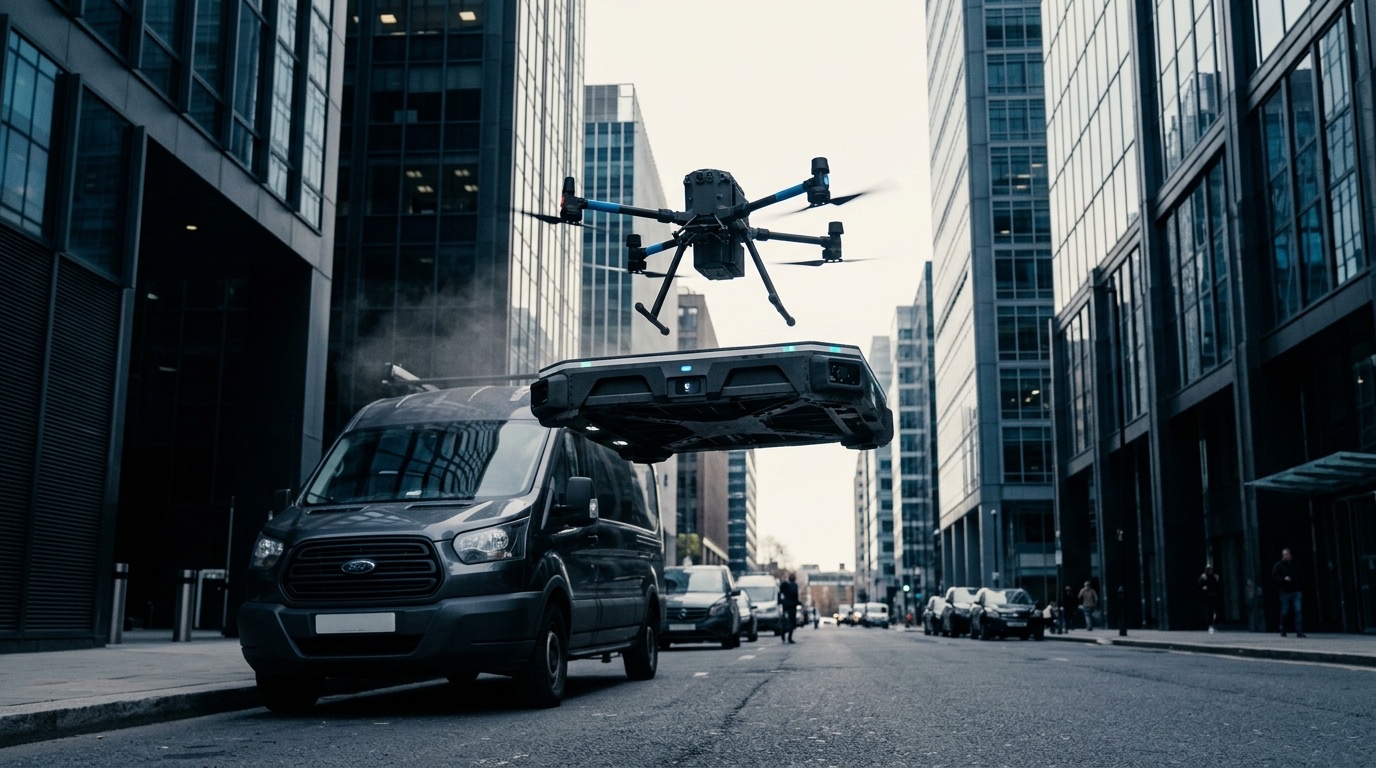
Launching drones from a vehicle: line of sight, the operating site, and the containment that travels
The fixed box on the fence is well understood. The other case is the crew that arrives in a van, stays two hours and drives on. For them there is no hangar, no fixed operating site, and no containment that stays put.
A great deal has been written about the fixed drone box, including by us. The more common case in commercial operation is a different one and barely described: a crew drives to a point, works for two hours and moves on. No hangar, no mains power, no ground belonging to anyone in particular. And therefore no fixed operating site for an authorisation to refer to. This is not a smaller version of box operation. It is a different problem.
Key Takeaways
- 1The launch point is not the issue; where the remote pilot stands is. Line-of-sight geometry is calculated from the eye, not from the vehicle roof.
- 2On flying from a moving vehicle, EASA’s AMC and GM to Part-UAS is clear: under AMC1 UAS.OPEN.060(2)(d) the remote pilot should not operate a UA from a moving vehicle; where they do, the vehicle’s speed should be slow enough to maintain visual line of sight, control, situational awareness and orientation throughout.
- 3That is open-category material. The specific category has no equivalent blanket rule — there the question is answered in the concept of operations and fixed by the authorisation under Article 12 of Implementing Regulation (EU) 2019/947.
- 4The operational volume is dimensioned in advance. The Luftfahrt-Bundesamt publishes guidance for dimensioning flight geography, contingency volume and ground risk buffer, together with a calculation tool. If the ground station moves, that dimensioning moves with it.
- 5The workable answer is rarely one enormous area but a site check turned into an approved procedure: a fixed list of what has to be established at every new point before launch.
Two modes that only look alike from outside
A permanently installed drone system in an enclosure solves a clearly bounded problem: the same site, over and over, with no one present. Location, approach paths, landing area and surroundings are assessed once and stay as they are. What that looks like we set out in Drone-in-a-Box, and continuous operation over one fixed point is the subject of Tethered drones.
Vehicle-based operation is the opposite case. It is not defined by the drone being carried in a vehicle — it almost always is — but by the vehicle being the ground station. The remote pilot works from or beside the vehicle, power comes from the vehicle, and today’s operating point is not tomorrow’s.
That changes almost everything that was stable in the assessment of a fixed installation. The ground surface is unknown. The surroundings are unknown. Who is nearby is unknown. And the point flown from is no longer a property of the installation but a decision somebody makes on site.
It is not the launch pad that counts, but where the remote pilot stands
The most common confusion in vehicle-based operation concerns line of sight. It is calculated neither from the launch pad nor from the vehicle roof, but from the remote pilot’s eye. Launching from a roof mount is therefore regulatorily irrelevant; what matters is where the person stands who has to see and control the aircraft.
That sounds obvious and has hard consequences for planning. A van parked beside a corridor blocks its own pilot’s view if that pilot is sitting inside it. An embankment, a treeline, a noise barrier or a bend takes the view in exactly the direction of flight. At a fixed installation this can be surveyed once. For a mobile crew it becomes a decision per site, and that decision is made by a person under time pressure.
So a vehicle-based concept of operations needs a rule about where the remote pilot positions themselves, not only about where the aircraft lifts off. Anything else moves a regulatory requirement onto the crew’s judgement.
Driving and flying: what the AMC material actually says
Whether you may fly while the vehicle is moving is asked more often than it is answered. For the open category, EASA’s AMC and GM to Part-UAS is clear: under AMC1 UAS.OPEN.060(2)(d) the remote pilot should not operate an unmanned aircraft from a moving vehicle. Where it does happen from a moving ground vehicle or a boat, the vehicle’s speed should be slow enough for the remote pilot to maintain visual line of sight with the aircraft, to retain control at all times, and not to lose situational awareness and orientation.
Two things about that matter. First, it is a statement about the remote pilot, not about the equipment. The problem is divided attention, not the mount. Second, it is open-category material. The specific category has no equivalent blanket rule, and it does not follow that anything goes there. It follows that the question is answered in the concept of operations and made binding through the operational authorisation under Article 12 of Implementing Regulation (EU) 2019/947.
In practice, for most commercial projects that means flying from a stationary vehicle, with the vehicle as ground station rather than platform. Anyone planning otherwise has to ask for it explicitly and justify it.
The operating site when there is no fixed one
An operational authorisation in the specific category has a geographic scope. It is not a licence valid everywhere but refers to a described operation at described locations. In Germany, section 21h(3) of the Luftverkehrs-Ordnung governs the conditions for operating unmanned aircraft systems in geographical zones.
On top of that comes the dimensioning of the operational volume. The Luftfahrt-Bundesamt publishes guidance for dimensioning flight geography, contingency volume and ground risk buffer, along with a calculation tool. That dimensioning is done in advance and at a desk. It is the core of the evidence that the aircraft cannot, in a failure case, reach a place where it does harm.
And this is precisely where mobile operation gets hard. The volume hangs off the launch point. Move the launch point and the whole construction of flight geography, contingency volume and ground risk buffer moves with it — including the question of what lies underneath the buffer. A buffer that is uncritical over a farm track sits two hundred metres further on above a trunk road.
The containment that travels
There are two answers to this, and the obvious one is usually the worse. It consists of applying for an area large enough to contain every conceivable location. That is convenient and dearly bought: the larger and more heterogeneous the area, the more unfavourable the assumptions that must hold for its worst point — and those assumptions set the effort for the entire operation.
The second answer carries better. Instead of inflating the area, the site check itself becomes the approved procedure. The concept of operations then describes not a place but a check: a fixed, short list of what has to be established at every new point before launch, and who signs it off.
What goes on that list is project-specific, but the core repeats: the sight line in the direction of flight, what lies under the contingency and buffer volume, the distance to uninvolved people and to traffic routes, clearance of the surface from whoever controls it, the airspace status at that point, and the fallback action if any of those cannot be established. The decisive line on such a list is always the last one: what to do when the answer is no.
The commercial case that needs no special status
Vehicle-based drone operation is discussed almost exclusively through the example of public authorities. That obscures the larger group of users who hold no special status at all and move entirely within the ordinary procedure.
These are the crews already out in a vehicle. Network operators driving a corridor section and inspecting a pylon every few kilometres. Survey teams visiting three sites in a morning. Engineering practices checking bridges, hall roofs and facades on a cycle. Agricultural contractors moving field to field. Maintenance crews responding to a defect rather than a calendar.
The same thing holds for all of them: a fixed installation does not pay, because no single point is visited often enough. The effort does not sit in the aircraft but in the fact that every job happens somewhere else. And for that, the site check as an approved procedure is the fitting answer — not a bigger area and not a bigger aircraft.
What the operator settles
Five decisions come before procurement, and none of them is about the aircraft.
First: will flying only ever happen from a stationary vehicle? If so, that belongs in the concept of operations as an exclusion, because it simplifies the assessment. If not, it has to be applied for explicitly and justified. Second: where does the remote pilot stand, and who decides that on site? Third: what does the site check look like, who signs it off, and how is it recorded? Fourth: what is the fallback action when a point on the check cannot be established? Fifth: who owns the surface the vehicle stands on, and how is clearance evidenced in case of doubt?
Anyone who answers those five before talking to a supplier has a different conversation. It stops being about cameras and flight times and becomes about the concept of operations — which is the part that decides whether the operation can be approved at all. What operating without holding your own authorisation means, and how the arrangement with an operator works, is described on our page on aerial site security.
FAQ
- Are you allowed to fly a drone from a moving vehicle?
- For the open category, EASA’s AMC and GM to Part-UAS is clear: under AMC1 UAS.OPEN.060(2)(d) the remote pilot should not operate from a moving vehicle. Where it does happen from a moving ground vehicle or boat, the vehicle’s speed should be slow enough that visual line of sight, control, situational awareness and orientation are maintained throughout. The specific category has no blanket rule; the question is answered in the concept of operations and made binding by the operational authorisation.
- Is line of sight measured from the vehicle or from the remote pilot?
- From the remote pilot. The launch point — ground, trailer or vehicle roof — is irrelevant to it. What counts is whether the person controlling the aircraft can see it continuously from where they stand. A vehicle can block its own pilot’s view in the direction of flight.
- What does the operating site mean if we are somewhere different every day?
- An operational authorisation in the specific category has a geographic scope, and the operational volume is dimensioned in advance. The Luftfahrt-Bundesamt publishes guidance for dimensioning flight geography, contingency volume and ground risk buffer, with a calculation tool. Move the launch point and that dimensioning moves with it, including the question of what lies under the buffer.
- Is it better to apply for one large area?
- Usually not. The larger and less uniform the area, the more unfavourable the assumptions that must hold for its worst point, and those assumptions set the effort for the whole operation. It generally carries better to make the site check itself the approved procedure: a fixed list established at every new point before launch.
- Who is vehicle-based operation worth it for, rather than a fixed installation?
- Anyone for whom no single point is visited often enough to carry an installation: network operators on corridor sections, survey teams with several sites a day, engineering practices on an inspection cycle, agricultural contractors, maintenance crews responding to defects. The effort there is not in the aircraft but in the fact that every job happens somewhere else.
Related reading
Drone-in-a-box: what one dock actually covers in a day
The box launches in 45 seconds. That number is real and it is also the least useful one in the brochure, because a dock flies one aircraft at a time and then has to charge it. What decides whether the installation earns its place is the cycle, not the launch.
2 September 2026tethered drone operation authorisationTethered Drones: The Permanent Aerial Standpoint Over One Fixed Site
The tether removes the endurance limit and the battery-swap cycle, and it changes the risk argument. It does not remove the authorisation. What an operator gains, what they must additionally justify, and where the limits sit.
1 September 2026robot commissioning on siteHow a robot learns your building: off-site vs on-site
Understand how robots learn to navigate your building, what vendors can train off-site, and why on-site integration dictates the commissioning schedule.
27 August 2026robot fleet operating metricsProgress detection as an operating metric: from robot availability to completed jobs
The quietest capability in the ER 2 release is the ability to tell whether a task actually finished. That changes which number belongs on the operations dashboard, and it is not uptime.
30 July 2026cloud seeding with drones enhancing precipitation to counterCloud Seeding with Drones: Sourcing and Managing Precision Weather Modification Operations
Discover how drone-enabled cloud seeding is integrated for drought response. Learn about EU drone regulation compliance and multi-partner operations.
7 July 2026