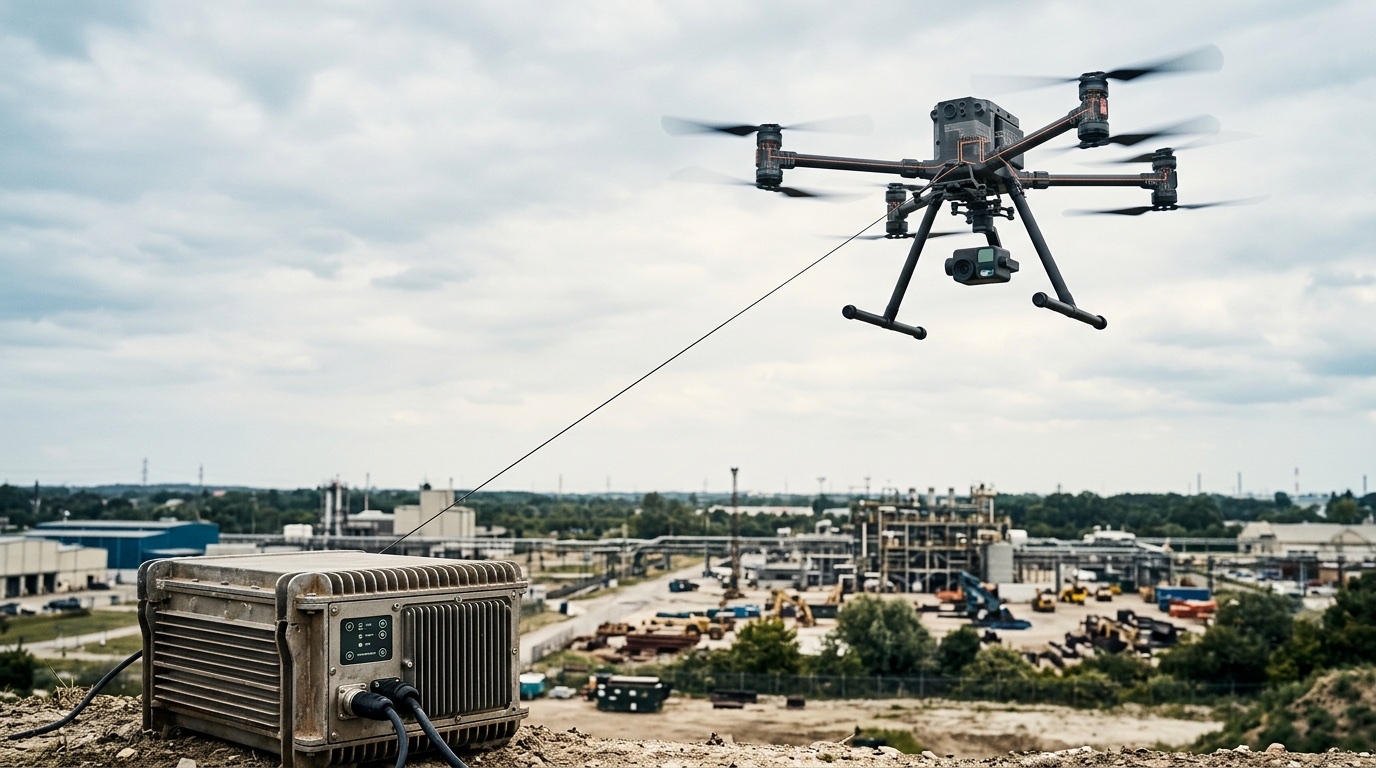
Tethered Drones: The Permanent Aerial Standpoint Over One Fixed Site
The tether removes the endurance limit and the battery-swap cycle, and it changes the risk argument. It does not remove the authorisation. What an operator gains, what they must additionally justify, and where the limits sit.
A tethered drone holds station over one point and stays there as long as power flows. Two limits that shape free-flight operation disappear with it: endurance and the battery-swap cycle. What does not disappear is the operating authorisation — and the entire operator decision sits between those two statements.
Key Takeaways
- 1Regulation (EU) 2019/945 expressly exempts tethered class C2 aircraft from three requirements: a data link loss recovery method, a protected data link and direct remote identification (“unless tethered”, Part 3 points 7, 8 and 14).
- 2The same standard sets limits on the tether: Part 3 point 5 requires a tensile length of less than 50 metres and a mechanical strength of no less than ten times the weight of the aircraft at maximum mass.
- 3The tether bounds the operational volume physically rather than procedurally — that is an argument in ground risk and containment, not a substitute for the authorisation.
- 4What is added is hardware on the ground: cable, anchor point, ground station and its footprint — together with the question of who owns that footprint and who maintains it.
- 5A tethered drone cannot reposition. It covers a fixed radius around a fixed point; everything outside it remains the job of a free-flying architecture.
What the tether changes — and what it does not
A tethered drone is an unmanned aircraft kept permanently connected to a ground station by a cable. The cable carries power upwards and, as a rule, the data link as well. The operational effect is easily stated: the aircraft holds station over one point for as long as the ground station supplies power. Endurance windows, battery swaps and the gap between two flights drop out as planning variables.
That is where the list of certainties ends. The common expectation that a tether makes the aircraft into something legally different does not hold: a tethered drone remains an unmanned aircraft and falls under Implementing Regulation (EU) 2019/947 like any other. What changes is the evidentiary case — in some places in the operator's favour, in others against it.
For the operator that is the actual basis for a decision. The question is not whether a tethered system technically stays up longer; it plainly does. It is which arguments the tether carries in the authorisation file, which additional evidence it generates, and whether the radius it covers matches the real requirement. Anyone who does not answer those three points before procurement buys endurance and then discovers it is standing in the wrong place.
Continuous operation against a docking network: what you are actually buying
A tethered drone does not compete with hand launch but with the opposite architecture: a network of automated docking stations from which an aircraft launches on demand, flies a route and lands again. Both approaches solve the same underlying problem — an aerial picture with nobody on site — by opposite means.
The docking network buys range and response. It covers area, can fly to different points, shifts its focus and launches on a trigger. What that looks like on an industrial site is described in the article on deploying autonomous perimeter monitoring; the alarm-triggered variant is covered in the piece on fire department drone networks. The price of that flexibility is the gap: between two flights the aircraft is on the ground, and every launch starts with a transit time.
The tethered drone buys the opposite: no range, but no gap. Over the point where it stands there is no transit time and no window without a picture. That is the actual object of the purchase — not “longer flight time” but uninterrupted presence over exactly one site. The sensible use case is correspondingly narrow: a situation that develops over hours in one place and is to be watched throughout, or a fixed asset with a permanent observation requirement.
The trade-off is therefore not a product question but a question of the geometry of the requirement. If the need is spread across an area, the docking network is the right architecture — the arguments for it are set out in the piece on what breaks after the perimeter monitoring pilot. If it concentrates on one point you are not going to leave anyway, the tether wins.
What the tether takes out of the risk argument
The strongest part of the argument is not in a manufacturer's brochure but in the product regulation. Delegated Regulation (EU) 2019/945 states several requirements for class C2 aircraft with the express qualifier “unless tethered” — they do not apply to tethered aircraft.
Three points in Part 3 of the regulation are affected. Point 7 requires that, in case of a loss of data link, the aircraft have a reliable and predictable method to recover — “unless tethered”. Point 8 requires a data link protected against unauthorised access to the command and control functions — “unless tethered”. Point 14 requires direct remote identification — “unless tethered”.
The logic is the same in all three cases: these requirements address an aircraft that can depart uncontrolled. An aircraft hanging on a cable cannot. That is precisely the core of the argument a tethered drone brings into a risk assessment. The operational volume is bounded physically, not procedurally: it ends where the cable ends, independently of software, geofence or return behaviour.
For the ground risk argument this shifts the centre of gravity. In free flight an operator has to justify how the number of uninvolved people is limited across an area reachable in the failure case, and has to size the ground risk buffer around the flight geography accordingly. In tethered operation the effort moves from controlling an area to the design and maintenance of the tether itself. The same holds for containment: the question of how reliably the aircraft does not leave its assigned operational volume is answered, for a tethered drone, largely by mechanics. How that evidentiary question looks in the free-flying case is set out in the article on onboard drone autonomy.
What the tether adds: cable, anchor point, wind loading
What the regulation strikes in one place it demands in another. The same Delegated Regulation (EU) 2019/945 ties the tethered class C2 design, in Part 3 point 5, to two concrete values: the tether must have a tensile length of less than 50 metres, and its mechanical strength must be no less than ten times the weight of the aircraft at maximum mass.
Both figures have immediate operational consequences. The length limit is also an altitude limit: a class-marked tethered C2 aircraft within this requirement does not stand at 100 metres above ground. Anyone who needs the observation height that makes an aerial standpoint useful in the first place leaves this frame and lands in the authorisation route of the specific category — which partly cancels the supposed simplification. The strength requirement in turn makes the tether a load-bearing component with design, inspection and replacement needs. A cable that carries power and holds structurally at the same time is a wear part and belongs in a maintenance plan.
Then there is the anchor point. The cable transmits forces downwards and sideways; the ground station or its anchoring has to absorb those forces, gusts included. This makes the system's wind limit a property of the whole installation rather than of the aircraft alone: it follows from aircraft, cable tension and anchoring together. An operator who knows only the multirotor's datasheet figure does not know their operating limit.
Finally, the tensioned cable is itself an object in space. It stands where it stands for the entire duration of the deployment — visible to other airspace users only if it is marked, and relevant to everything moving beneath it on the ground. That marking is part of deployment preparation, not of the delivered package.
Where the ground station goes and who owns the footprint
A tethered drone moves part of the system that free-flying architectures barely have onto the ground — and permanently onto one spot. The ground station needs standing space, a mains feed or a generator, and an area beneath the aircraft in which nobody is unintentionally present. For as long as the system stands, that area is occupied.
From this follows a question of responsibility that is technically unremarkable and contractually the regular bottleneck: who owns the standing space, who grants permission to occupy it, who secures it and who maintains the supply? On an industrial site this can be settled internally. On public ground, a leased plot or an event site it is a negotiation with its own lead time — and it decides whether the system may be set up at all when it is needed.
In practice, therefore, the procurement document should carry a site profile: standing area and access, available connected load and behaviour on mains failure, the area to be kept clear beneath the aircraft, the anchoring method for the given ground, and the set-up time from arrival to a stable picture. These variables determine actual usefulness far more than camera resolution does, and they can be established before the first order.
What stays unchanged in the authorisation
The tether changes arguments inside the procedure. It does not replace the procedure. A tethered aircraft remains an unmanned aircraft within the meaning of Implementing Regulation (EU) 2019/947, and classification into the open or specific category follows the same criteria as ever: mass, class marking, distance to uninvolved persons, operating height and surroundings.
The most common case in practice is therefore not the exception but the rule. As soon as the operation leaves the frame of the open category — because it works above the permitted height, because uninvolved people are closer than permitted, or because the aircraft carries no matching class marking — an operating authorisation under Article 12 of Implementing Regulation (EU) 2019/947 is required, with the risk assessment under SORA 2.5, which EASA brought into the AMC and GM to that regulation with ED Decision 2025/018/R of 29 September 2025. The route to it is described in the article on the drone service operating model and is not repeated here.
Also unchanged are the operator duties that do not hang on the aircraft: registration as an operator, the qualification of the remote pilots deployed, compliance with geographical UAS zones, and documentation of the operation. The fact that a device hangs on a cable and is not moved for hours changes none of that — on the contrary, it lengthens the period over which those duties have to be met continuously.
The honest summary for procurement is therefore: the tether is a good argument inside the risk assessment and a bad argument against filing an application. Anyone buying it as a shortcut around the procedure has not read the procedure.
The honest limits — and what the operator settles
Three limits are inherent to the principle and cannot be fixed by product selection.
No repositioning. A tethered drone does not leave its point. It cannot follow an event, fly to a second location or sweep an area. If the situation moves, the system has to be struck, relocated and set up again — which interrupts observation entirely for the duration. For applications with a shifting centre of gravity this is the wrong architecture.
Fixed radius. What the system sees follows from the ground station's location, the permitted height and the optics — and is therefore determined in advance. Occlusion by buildings, vegetation or terrain edges is not a malfunction but a property of the chosen site. It belongs to the checks made before set-up, not to the discoveries made after.
Weather. The operating limit is a property of the whole installation of aircraft, cable tension and anchoring. Continuous operation also means the system does not wait out a change in the weather but either rides it out or aborts — and the abort falls in exactly the period for which the uninterrupted presence was bought.
For procurement this yields a manageable list that should exist in writing before hardware is selected: the operating limits of the whole installation including wind limit and anchoring method; the behaviour on mains failure, cable damage and abort, each with a defined target state; the site profile with standing area, supply, area to be kept clear and set-up time; the maintenance and replacement plan for the tether as a load-bearing component; and the classification of the intended operation into the open or specific category, before a unit is ordered.
wedrone is a manufacturer-independent systems integrator and neither manufacturer nor operator: the operating authorisation, the site and the deployment remain with the organisation running the system. The integrator's contribution is to force these decisions before procurement — and to ask the honest prior question of whether the requirement really sits at one point or is in truth spread across an area.
FAQ
- Is a tethered drone legally different from a free-flying drone?
- No. A tethered aircraft remains an unmanned aircraft and falls under Implementing Regulation (EU) 2019/947. Classification into the open or specific category follows the same criteria. What changes are individual product requirements and the evidentiary case in the risk assessment.
- Which requirements fall away for a tethered aircraft?
- Delegated Regulation (EU) 2019/945 states several class C2 requirements in Part 3 with the qualifier “unless tethered”: the method to recover from a loss of data link (point 7), the data link protected against unauthorised access (point 8) and direct remote identification (point 14). These do not apply to tethered aircraft.
- How long may the tether be?
- For a tethered class C2 aircraft, Part 3 point 5 of Delegated Regulation (EU) 2019/945 requires a tensile length of less than 50 metres and a mechanical strength of no less than ten times the weight of the aircraft at maximum mass. Anyone who has to stand higher leaves this frame and needs the route through the specific category.
- Does a tethered drone replace a network of docking stations?
- Only if the requirement sits at one point. The docking network buys range and can fly to different locations, but has a gap between two flights and a transit time per launch. The tethered drone buys uninterrupted presence over exactly one site and cannot reposition in exchange. If the need is spread across an area, the docking network is the right architecture.
- What wind limit applies to a tethered drone?
- That of the whole system, not of the multirotor. The cable transmits tension to the aircraft and the anchoring, so the operating limit follows from aircraft, cable tension and anchoring method together. An operator who knows only the aircraft's datasheet figure does not know their actual operating limit.
Related reading
Launching drones from a vehicle: line of sight, the operating site, and the containment that travels
The fixed box on the fence is well understood. The other case is the crew that arrives in a van, stays two hours and drives on. For them there is no hangar, no fixed operating site, and no containment that stays put.
2 September 2026drone in a boxDrone-in-a-box: what one dock actually covers in a day
The box launches in 45 seconds. That number is real and it is also the least useful one in the brochure, because a dock flies one aircraft at a time and then has to charge it. What decides whether the installation earns its place is the cycle, not the launch.
2 September 2026onboard drone autonomyOnboard Drone Autonomy: What Changes for Operators
The question is not whether the aircraft can fly itself. It is what you have to be able to show once it does — indoors, on containment, on link loss, and in procurement.
31 August 2026fire control center drone networkFire department drone networks: Automatic launch on alarm
Discover how automated drone networks for fire departments provide real-time aerial intelligence before units arrive, leveraging BOS SORA exemptions.
17 August 2026drone as a service the operating model thatDrone-as-a-Service: the operating model that turns drone pilots into routine programs
Discover how Drone-as-a-Service converts manual pilots into routine programs. Scale your operations legally under EU regulation 2019/947 with wedrone.
7 July 2026