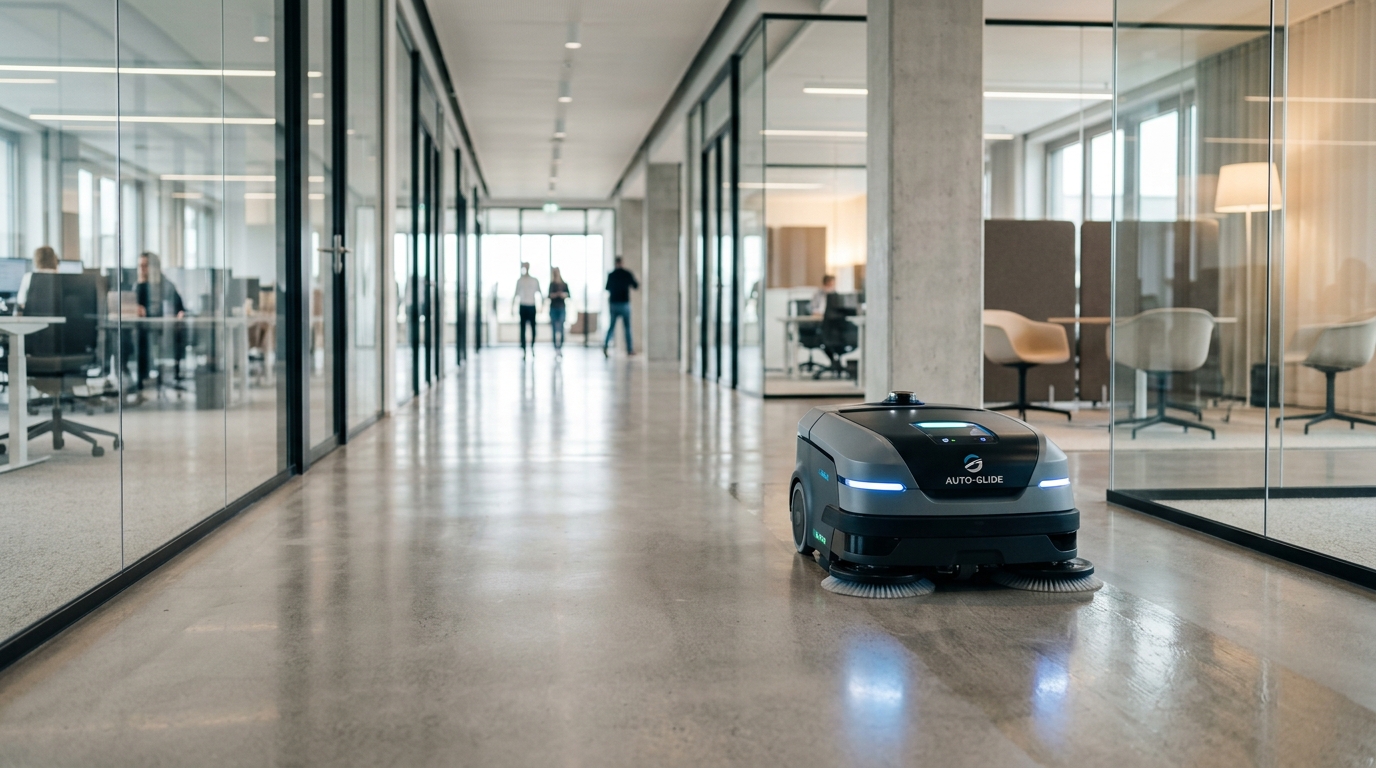
Service robots against the labour shortage: how facility operators automate cleaning
Discover how facility operators use independent service robotics and flexible rentals to beat the cleaning labor shortage and stabilize workflows.
A severe labor shortage in facility management is driving the adoption of cleaning robots. Facility operators can maintain high sanitation standards and mitigate staffing gaps by utilizing manufacturer-independent service robotics and flexible rental structures.
Key Takeaways
- 1Germany's cleaning sector struggles with severe staff gaps, with 53.9 percent of companies missing up to 10 percent of their workforce.
- 2Manufacturer-independent systems integrators evaluate multiple OEMs to deploy the exact robot model suited for each facility type.
- 3Flexible financial options, including rental and lease-to-own models, remove high upfront capital barriers for facility managers.
- 4Central monitoring through tools like Cockpit allows managers to orchestrate mixed fleets of robots from a single interface.
The Facility Management Crisis: Navigating the German Cleaning Labor Shortage
The German commercial cleaning sector faces severe operational limits due to an acute lack of personnel. According to the spring economic survey conducted by the Bundesinnungsverband des Gebäudereiniger-Handwerks, the situation has reached a critical bottleneck. More than half of surveyed service providers (53.9 percent) report lacking up to 10 percent of needed staff, while over a fifth are missing more than 20 percent of their workforce. For facility managers and operators, these vacancies are no longer just an HR issue, they directly threaten contract stability and daily operations.
Operational Risks of Unfilled Roles
When cleaning staff is unavailable, operators are forced to prioritize urgent tasks while neglecting routine floor care and maintenance. This compromise rapidly leads to service degradation and can trigger severe contract penalties from property owners. The physical strain on the remaining staff increases, leading to higher sick-leave rates and creating a vicious cycle of operational disruptions. To break this cycle, facility operators are turning to automated systems to handle repetitive floor care, allowing human personnel to focus on detail-oriented sanitization and high-touch areas.
- Risk of contract penalties due to missed cleaning cycles and unmet service level agreements
- Increased physical strain on remaining workers, which often drives up absenteeism and turnover
- Reduced ability to bid on new commercial contracts or expand operations due to capacity limits
- Visible decline in floor maintenance quality in high-traffic hallways, lobbies, and clinical environments
To secure service quality and protect operational margins, facility service providers must automate basic tasks. Deploying cleaning robots has shifted from an innovative experiment to a logistical necessity. By utilizing the manufacturer-independent werob Platform, operators can source the optimal hardware without being locked into a single supplier. As an expert systems integrator, supports companies with custom planning, flexible rental options, and centralized fleet management via Cockpit. Instead of relying on generic savings estimates, operators can assess their potential returns using an ROI calculator to evaluate setup costs and rental models. Regular updates on the integration of these solutions are shared on the official LinkedIn channel.
The Strategic Shift: Automating Floor Care to Support Human Crews
Floor cleaning is highly repetitive and labor-intensive, making it a primary candidate for automation. Amidst persistent labor shortages, facility service providers and operators are deploying robots to maintain strict hygiene standards across commercial spaces. Instead of replacing human staff, autonomous floor scrubbers and vacuum units handle the massive, monotonous corridors and open spaces. This tactical shift allows human crews to focus on complex, high-touch sanitization, detail work, and specialized cleaning tasks. The rapid growth of this technology is reflected in the market, with the European cleaning robot market projected to expand from 1.95 billion USD in 2025 to 11.73 billion USD by 2034.
Addressing the Cleanliness-Labor Gap Parametrically
For facility managers, the decision to automate is driven by operational necessity rather than novelty. When evaluating the economics of service robotics, operators should focus on parametric variables such as square footage cleaned per hour, labor redeployment rates, and shift coverage. Rather than relying on static case studies, a dynamic ROI calculator allows operators to input their specific local labor rates, machine utilization parameters, and floor layouts to determine the actual amortization period of a deployment. Deploying autonomous cleaning robots allows facility service providers to stabilize their daily operations even during periods of high staff turnover.
- Purchase options: Capital expenditure models designed for long-term ownership and maximum asset utilization.
- Standard rental agreements: Consistent monthly operational expenditures that cover hardware access and basic software.
- Flexible rental models: Scalable operational contracts that allow operators to adjust fleet size based on seasonal demand or changing contract requirements.
- Full-service package: Technical security, maintenance by qualified technicians, and remote maintenance support to minimize downtime.
- Centralized monitoring: Unified oversight of multiple machines through the central Cockpit monitoring dashboard.
To implement these systems without vendor lock-in, operators are turning to manufacturer-independent systems integrators. This hardware-agnostic approach ensures that the selected robot is matched precisely to the facility's specific floor type and architectural constraints. As a Hamburg-based integrator, werob assists facility managers in planning, deploying, and maintaining these autonomous systems. By leveraging the manufacturer-independent werob Platform, operators can easily scale their operations from a single pilot to a multi-site fleet, managing all units through a unified operating layer.
Why Manufacturer Independence is Essential for Facility Operators
In the hospitality and commercial service sectors, labor shortages remain a defining bottleneck, with industry reports indicating that up to 77% of hotel properties face staffing deficits. Many operations managers attempt to resolve these gaps by acquiring individual cleaning robots from a single manufacturer. However, a single brand rarely offers a comprehensive catalog suitable for every floor type, layout, and hygiene standard inside a large facility. This reality is forcing operators to seek automation from an independent systems integrator instead of buying direct hardware. By working with an end-to-end robotics provider, facility managers can choose the exact machinery needed for their specific building portfolio without being limited to a single supplier's catalog.
The Pitfalls of Single-Brand Vendor Lock-In
Large facility portfolios typically feature a challenging mix of surfaces, such as narrow carpeted corridors, heavy-duty concrete loading docks, and high-traffic tiled lobbies. A manufacturer that excels at producing compact retail vacuum bots is unlikely to offer an industrial scrubber-dryer designed for large logistics halls. When operators rely on a single brand, they are either left with poorly cleaned areas or forced to manage several disconnected software systems. This limitation is particularly critical when deploying cleaning robots in clinics or senior living facilities, where sterile environments and complex, busy layouts require specialized machinery. An independent approach avoids these compromises by ensuring each zone receives a machine engineered specifically for that environment.
To solve this mismatch, the Supplier Match engine screens and ranks a supplier graph of over 44 robot manufacturers based on real-world capabilities. This scoring system evaluates multiple operational criteria to find the optimal robotic OEM and hardware for each layout, helping operators avoid restrictive vendor lock-in. The engine grades each hardware candidate based on critical deployment factors that dictate daily success in commercial settings.
- Surface and Environment Compatibility: Matching the specific floor types, narrow hallways, and obstacle density with specialized machinery.
- Regional Service Coverage: Ensuring certified technicians and local replacement parts are available near the facility to minimize downtime.
- Regulatory Readiness: Verifying that the hardware complies with safety standards, which is highly relevant for public-facing deployments.
- Existing IT Integration: Scoring the robot's ability to communicate with building management systems via standard middleware Connectors.
As a manufacturer-independent partner and robot integrator based in Hamburg, werob coordinates this entire lifecycle through the werob Platform. Using the AI-assisted Spec Engine, operator requirements and daily shift descriptions are translated into formally verified, ROS-compatible action plans within 48 hours. This streamlined process is backed by flexible financial options, including direct purchase, rental, or flexible rental plans, allowing operators to deploy automation without massive capital expenditure. Rather than calculating complex capital investments upfront, facility operators can utilize the interactive ROI calculator on the website to frame their economics parametrically based on local labor costs and actual cleaning square meters.
Once the optimal multi-brand fleet is deployed, the entire operation is monitored through the Cockpit. This unified monitoring dashboard provides use-case-level traffic lights on four dimensions, including hardware, infrastructure, regulatory compliance, and specifications. Instead of forcing staff to navigate multiple proprietary apps from different manufacturers, the Cockpit centralizes tasks, training progress, and audit logs. Supported by remote maintenance and on-site technicians, this central fleet control ensures that facility operators can scale cleaning automation reliably to combat the persistent labor shortage.
Parametric Economics: Structuring Low-Risk Robot Procurement
High capital expenditure is no longer a structural barrier preventing facility operators from deploying automated cleaning solutions. Traditional procurement often demanded significant upfront budgets, restricting service robots to major pilot projects. Today, building service contractors and facility managers can bypass these restrictions. By choosing a manufacturer-independent systems integrator like werob, operators can access a broader spectrum of commercial cleaning technologies tailored directly to their portfolio. This approach separates hardware selection from strict financial constraints, enabling providers to structure procurement in direct alignment with their existing client cleaning contracts.
A Choice of Three Procurement Models
To accommodate the varying durations and budgets of facility management agreements, operators can choose between direct purchase, traditional rental, and flexible operational rental models. Direct purchase allows operators to own the assets outright, which can optimize long-term costs for stable, multi-year contracts. Traditional rental structures provide predictable operating expenses without capital lock-up. For dynamic environments with fluctuating cleaning requirements, flexible operational rental models offer the lowest financial risk. By combining these hardware acquisition models with full-service technical support, remote maintenance, and certified local technicians, werob ensures that machine uptime remains consistently high across geographically distributed locations. This operational backing protects the operator's service level agreements without requiring in-house robotics expertise.
| Procurement Model | Financial Classification | Asset Ownership | Operational Risk Level |
|---|---|---|---|
| Direct Purchase | Capital Expenditure (CAPEX) | Operator owned | High (mitigated by separate service agreements) |
| Traditional Rental | Operating Expense (OPEX) | Integrator owned | Medium (standard maintenance packages included) |
| Flexible Operational Rental | Operating Expense (OPEX) | Integrator owned | Low (full-service technicians and remote maintenance included) |
Parametric Cost Modeling and ROI Calculation
Evaluating the economic viability of autonomous floor care requires a shift from generalized industry averages to a precise, parametric cost analysis. Instead of relying on static savings estimates, professional facility operators must calculate return on investment based on real site variables. These include local hourly labor rates, actual floor areas, specific cleaning frequencies, and shift patterns. A dynamic ROI calculator allows operators to input these parameters to model exact financial outcomes prior to any hardware deployment. When using the Supplier Match tool on the werob Platform, operators are matched with the most suitable machines for their site-specific parameters. Once deployed, the performance is continuously tracked via the central Cockpit dashboard, validating that the real-world runtime data matches the initial economic projection.
Seamless Implementation: From Virtual Specification to On-Site Deployment
Deploying autonomous cleaning units is a structured transition that goes far beyond simply acquiring hardware. For facility service providers and facility managers facing acute labor shortages, the path to reliable automation requires precise site mapping, seamless software integration, and thorough employee training. Without these foundational steps, even the most advanced systems fail to deliver consistent results on the ground. This is why a manufacturer-independent systems integrator like werob, based in Hamburg, focuses on an end-to-end deployment process. By bridging the gap between virtual planning and physical operations, operators can systematically integrate cleaning robots into daily workflows without disrupting existing service levels.
Translating Operational Needs into Actionable Software Specs
A core challenge for facility operators is translating a standard cleaning plan (for instance, scrubbing a lobby every morning at a specific hour) into instructions a robot can execute. Within the comprehensive werob Platform, this transition is managed digitally. Using the proprietary Spec Engine, operators do not need to write complex code. Instead, the Spec Engine translates natural language shift descriptions into formally verified, ROS-compatible action graphs and deployable plans within 48 hours. This virtual specification ensures that the robot is programmed to navigate specific layout constraints, elevators, and doors safely before the physical unit ever arrives on site.
- Virtual Requirement Mapping: Operators describe cleaning tasks and spatial constraints in plain language.
- Automated Translation: The Spec Engine converts these requirements into verified, deployable action graphs.
- Infrastructure and Integration: The platform utilizes Connectors to link the robotic fleet to existing software databases.
- Physical Mapping and Setup: Technicians execute on-site mapping and test runs to calibrate safety sensors.
- Staff Training: On-site cleaning teams are trained to co-work with the robots, managing starting routines and basic maintenance.
- Continuous Monitoring: Operations go live, monitored in real time via the central Cockpit.
Reliable Support from Remote Maintenance to Local Technicians
To sustain high operational uptime, facility managers cannot rely on hardware alone. They need guaranteed performance. According to facility management studies, operational pressures are rising as 55.7% of managers expect work order volumes to increase while labor shortages continue to limit available staff. To alleviate this pressure, werob provides comprehensive support contracts that combine remote maintenance with on-site support from local technicians. Through the unified Cockpit dashboard, operators can track real-time traffic lights on hardware, infrastructure, regulatory compliance, and spec status. Any system deviation triggers immediate alerts, allowing remote engineers to resolve software issues or dispatch a technician to prevent downtime.
Because facility budgets differ, acquisition options must remain flexible. Rather than forcing operators into capital-intensive investments, werob provides various acquisition models including direct purchase, standard rental, and flexible renting. The financial viability of these systems depends on local labor costs, shift frequency, and the total area cleaned. Instead of relying on static savings estimates, operators are encouraged to utilize a parametric return on investment calculator to model their specific operational variables and determine exact amortization periods.
Unified Fleet Monitoring: Running Mixed Fleets in the Cockpit
Managing service robots from multiple manufacturers presents a significant administrative challenge for facility service providers and facility managers. When an organization deploys autonomous floor scrubbers from one brand and vacuum units from another, operational teams typically have to monitor performance across several isolated manufacturer portals. Juggling these proprietary software applications is inefficient, as each system uses its own unique data structures, alert levels, and reporting templates. This fragmentation creates operational blind spots, forcing managers to spend valuable administrative hours manually exporting and compiling data to get a basic overview of fleet performance. Working with a hardware-agnostic systems integrator like werob helps consolidate these workflows into a single operational view.
Eliminating the Multi-Dashboard Blind Spot
To solve the multi-brand management problem, the werob Platform offers a centralized dashboard called Cockpit. This software acts as a unified monitoring layer that pulls operational data from all deployed hardware into a single interface. Instead of logging into separate accounts to check if a machine is active, charging, or stalled, operators can monitor the entire fleet through use-case-level traffic lights. The interface standardizes error messages and status updates, allowing site supervisors to quickly identify which assets require immediate attention without needing technical expertise in every specific robotic platform.
- Hardware metrics: Real-time tracking of battery levels, charging status, and mechanical health across all robot brands.
- Infrastructure checks: Tracking connectivity status and docking station availability to prevent deployment delays.
- Regulatory compliance: Automated logging of operational boundaries and safety limits to meet local safety standards.
- Spec adherence: Ensuring robots are executing pre-planned paths and shift specifications correctly.
- Task logs and escalations: Automated routing of error notifications to local staff for rapid resolution.
Connecting Fleets to Existing Databases
A unified dashboard is highly effective for daily supervisor tasks, but large-scale facility operations also require automated, multi-brand reporting. This is achieved by linking the robotics fleet directly to existing operator databases and enterprise resource planning software. Through pre-built, multi-tenant integration layers known as Connectors, operators can integrate their robots with existing technical stacks, such as facility management databases or operational tools. This connection enables automatic data synchronization, ensuring that cleaning performance, completed square footage, and maintenance logs are recorded directly in the company's central reporting system.
By combining the hardware-independent monitoring of Cockpit with the automated integration of Connectors, facility operators can scale their automation efforts without getting locked into a single hardware brand. Operators can choose to purchase, rent, or use flexible rental models for their machines, while the underlying software layer remains perfectly consistent. This centralized approach reduces administrative overhead and ensures that cleaning operations run reliably, helping businesses counter persistent labor shortages through structured, data-driven automation.
Read more: the robots werob integrates · the ROI calculator · werob cleaning solutions.
FAQ
- How severe is the labor shortage in the building cleaning industry?
- The labor shortage is a major operational challenge. According to the BIV survey, 53.9 percent of German building service providers lack up to 10 percent of their necessary workforce, and more than a fifth are missing over 20 percent of staff.
- Why should facility operators choose an independent robotics integrator over a single manufacturer?
- No single manufacturer builds a robot that fits every environment. An independent integrator like werob evaluates dozens of brands to find the exact hardware matches for your specific floors, doors, and corridors, then integrates them into a single workflow.
- What financial procurement models are available for service robots?
- Operators do not have to purchase hardware upfront. Options include direct purchase, long-term leasing, and flexible rental contracts that allow service providers to match their robotics investment to the duration of their client contracts.
- How do cleaning robots integrate with existing facility management systems?
- Modern robotic fleets use specialized middleware like Connectors to sync with existing databases. This allows operational data, task logs, and maintenance alerts to feed directly into your current management software.
- What happens when a cleaning robot experiences a technical issue?
- Integrators like werob offer full-service support, combining digital remote maintenance with a network of on-site technicians. Technicians can diagnose and resolve software bugs remotely or dispatch a local specialist to minimize downtime.
- How do facility managers monitor multiple robots from different manufacturers?
- Instead of juggling separate proprietary applications, managers use a centralized platform like Cockpit. This dashboard provides real-time status updates, task tracking, and error escalations across your entire multi-brand robot fleet.
Related reading
Commercial Cleaning Robots: Beyond the Pilot Phase
Discover why commercial cleaning robots have moved from pilot projects to standard equipment, and how operators are integrating autonomous fleets at scale.
24 August 2026construction robots skilled labour shortageConstruction Robots Against the Skilled-Labour Shortage: Which Tasks Pay Off in 2026
Discover which construction robots pay off in 2026 as general contractors in the DACH region deploy automated layout, rebar, and drilling systems.
17 July 2026drone defense and c uas what it isDrone defense and C-UAS: What it is and how it works
Learn how Counter-Unmanned Aircraft Systems (C-UAS) work. Discover the detection, tracking, and mitigation technologies powering modern drone defense.
6 August 2026Automation against a shortage of skilled workersAutomation against a shortage of skilled workers: Operational strategies 2026
The shortage of skilled workers endangers the operational viability of entire industries. werob shows how robot fleets create operational relief within eight weeks and free skilled workers from repetitive tasks.
21 June 2026agriculture robot labor shortage Germany255,010 German farms, one labour problem
For 255,010 agricultural holdings in Germany, the open shift isn't abstract — it's the milking parlour at five in the morning with nobody there to run it. A robot costs what an unfilled position costs, just more reliably.
11 September 2026